

Writing essays can be a demanding process. You're trying to balance deadlines, dig through research, and somehow come up with something original and coherent. Many AI essay writers are now available, each claiming to simplify the process. But how can you determine which tools are effective and which produce generic content?
I decided to find out. I put a bunch of these tools to the test to see what's what. Here's my breakdown of the 7 best AI essay writers I found that can genuinely help you write better, not just churn out words faster.
What is an AI essay writer?
What exactly is an AI essay writer? It's a tool that uses smart technology (like natural language processing) to help you draft, edit, and structure your school papers. The point isn't to have a robot do your homework for you, it's more like a tool to give your own brain a leg up.
These things can be great for getting over writer's block. They can spitball ideas, create an outline from a simple prompt, or help you rephrase a sentence that just isn't working. The really good ones can even help you find sources, format citations, and scan for plagiarism. To give you a better idea, here are the main functions of a top-tier AI essay writer. It's like having a research assistant and editor rolled into one, letting you focus on the important stuff, like your actual arguments.
Our criteria for choosing AI essay writers
To pick the tools for this list, I focused on what actually helps a student or researcher get their work done. Here’s what I looked for.
First off, originality and quality. The tool had to generate text that sounded like a person wrote it and wouldn't get you in trouble for plagiarism. Next, I checked for research and citation features. Good academic writing relies on good sources, so tools with built-in plagiarism checkers and citation support got a big thumbs-up. Ease of use was also key; a simple interface means you're not wasting time learning a complicated new program. Finally, I looked at the overall features. Was it just a one-trick pony for paraphrasing, or was it a complete toolkit with options for brainstorming, editing, and grammar?
A quick comparison of AI essay writer tools
| Feature | eesel AI | Paperguide | Grammarly | QuillBot | Yomu.ai | Scribbr | Paperpal |
|---|---|---|---|---|---|---|---|
| Primary Use | High-quality first drafts | All-in-one academic suite | Grammar & style polishing | Paraphrasing & refining | Guided essay writing | Final checks & formatting | Academic text refinement |
| Citation Support | ❌ | ✅ | ✅ | ✅ | ✅ | ✅ | ✅ |
| Plagiarism Check | ❌ | ✅ (Paid plans) | ✅ (Premium) | ✅ (Premium) | ✅ | ✅ (Paid) | ✅ |
| Free Plan | ✅ (Free to try) | ✅ (Limited) | ✅ (Basic grammar) | ✅ (Limited) | ✅ (Free to try) | ✅ (Limited tools) | ✅ (Limited) |
| Best For | Generating researched drafts | Comprehensive academic work | Polishing final drafts | Rewriting & improving text | Guided essay construction | Final checks & formatting | Subject-specific editing |
The 7 best AI essay writer tools
Here's a detailed look at the tools that really stood out during my testing.
1. eesel AI
While it's marketed as an AI blog generator, the eesel AI blog writer is also effective at creating deeply researched, long-form content. It can serve as a strong starting point for a complex essay or research paper. You give it a topic, and it spits out a complete, structured document with headings, sourced info, and even relevant media like charts and tables. It’s perfect for when you need a comprehensive first draft to work from.
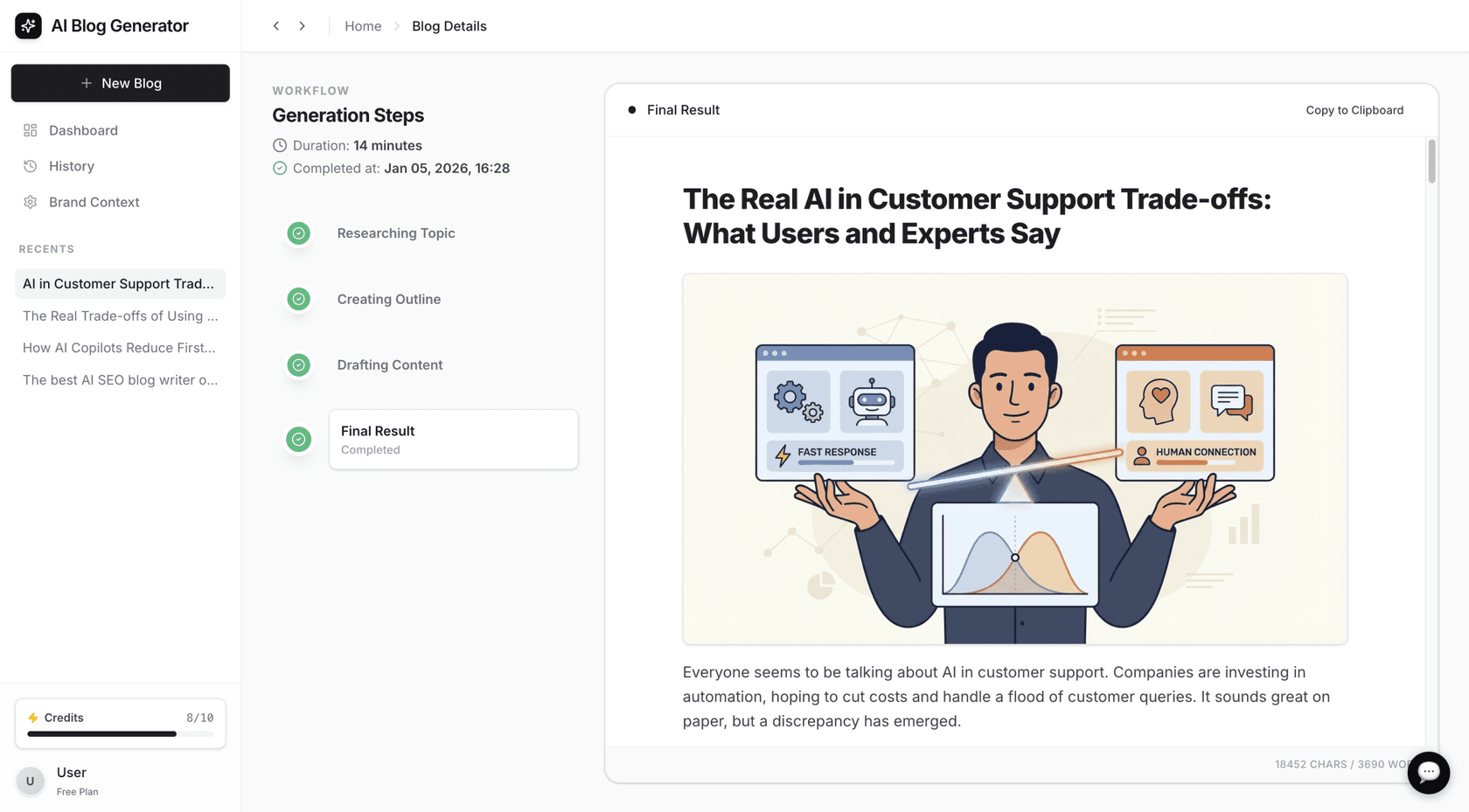
The content it creates sounds human-like and is great at context-aware research. The output is tailored to your topic, and it even pulls in real Reddit quotes and YouTube videos, which can be a unique way to find primary sources or public opinions. A key benefit is that it's completely free to try. The main drawback for school work is its lack of built-in academic features like a citation manager or plagiarism checker, so you'll need another tool for those final steps.
-
Pricing:
- Free to try.
- Paid credits start at $99 for 50 blogs.
-
Best for: Generating comprehensive, well-researched first drafts for complex topics.
2. Paperguide
Paperguide is presented as an all-in-one solution for academic work. It mixes an AI writer with a research assistant that draws from a database of over 200 million research papers. You can use it to generate intros, conclusions, and key points, or even ask it to find counterarguments to strengthen your essay.
It combines writing and research. The platform lets you find and pop in relevant, properly formatted citations right into your text, which can save time. It also includes a plagiarism checker in its paid plans. Its free plan is limited, offering only 500 MB of storage, which probably isn't enough if you're working on a big project with a lot of source documents.
-
Pricing:
- Free plan with limited features.
- Plus plan at $12/month (billed annually).
- Pro plan at $24/month (billed annually).
-
Best for: Students and researchers who want one platform for writing, research, and citations.
3. Grammarly
Grammarly is a powerful tool for polishing your final draft. Its AI-powered suggestions go far beyond basic spell-checking and help you fix your grammar, punctuation, and clarity. You can even set writing style goals (like academic or formal) to get tailored advice. The plagiarism checker in the premium version is also a feature.
i rely on these two tools to proofread my drafts and catch grammar mistakes, awkward phrasing, or unclear sentences. they’re especially useful for academic writing since they help you keep a formal tone and avoid careless errors.

Key features include its ease of use and powerful editing capabilities. However, its generative AI features have some drawbacks. As some users have noted, it can refuse to generate content on topics it deems "sensitive", like violence, politics, or religion. This limitation can be a factor for users working on certain academic subjects. Some users have noted that its generated text can sound robotic and be flagged by AI detectors.
-
Pricing:
- Free plan with basic grammar and spelling checks.
- Premium plans start at $12 per month (billed annually).
-
Best for: Proofreading and improving the quality of a draft you've already written.
4. QuillBot
Most people know QuillBot as a paraphrasing tool, but its whole suite of features makes it a useful assistant for essay writing. Its main function lets you rewrite sentences or entire paragraphs in different tones (like Formal, Academic, or Simple). It also includes a free grammar checker, summarizer, and a citation generator that supports over 1,000 styles, including APA, MLA, and Chicago.
Still one of the best for paraphrasing. Doesn’t write full essays from scratch, but amazing for smoothing rough sections or rephrasing flagged parts.
It is particularly effective at helping you refine your own writing. The paraphraser is great for making complex ideas easier to understand. However, it does not generate content from scratch and is designed to work with existing text. The free version also has its limits, and the plagiarism checker is only available on the premium plan.
-
Pricing:
- Free plan with limited paraphrasing and modes.
- Premium plan starts at $9.95/month.
-
Best for: Refining and rephrasing existing text to improve clarity and style.
5. Yomu.ai
Yomu was specifically designed to be an academic writing assistant. It gives you a clean writing space with an AI copilot that offers autocomplete suggestions for sentences and paragraphs. It also has tools to paraphrase, expand, shorten, or summarize text, plus an AI-powered citation tool and a plagiarism checker.
It offers a full set of features designed for students. The intelligent document assistant can help write entire sections, and the ability to save sources to a personal library is a helpful feature. Users often note its clean interface and efficiency. As with any AI tool, you still need to check its work to make sure everything is original and cited correctly, a point Yomu itself makes in its ethics statement.
try Yomu AI! it is pretty much complete academic writing tool that has so many features necessary for academic writing from autocompleting sentence, editing paragraphs, finding and formatting citations properly, checking for plagiarism, and downloading in DocX and LateX formats for submission.
-
Pricing:
- Free to try.
- Pro plan starts at $11/month (billed annually).
- Ultra plan starts at $18/month (billed annually).
-
Best for: Students who want a dedicated AI copilot to help them through the entire writing process.
6. Scribbr
Scribbr is laser-focused on academic writing, with a heavy emphasis on proofreading and citation. It offers a suite of tools, including a paraphraser, grammar checker, and a plagiarism checker. What sets it apart is that you can hire human editors for professional proofreading if you need that extra layer of polish.
More of a proofreading/editor platform. If you already have a draft, Scribbr is great for polishing grammar and formatting (especially for APA/MLA), but it won’t write content for you.
The quality of its checking tools is a key feature. Its AI content detector gives you a detailed report on what parts might be AI-generated versus human-written, which is useful for ensuring your work sounds authentic. A consideration is the cost. Many of its best features are behind a paywall and are priced per document, which can get expensive for students with multiple assignments.
-
Pricing:
- Free tools are available with limitations.
- Plagiarism checks are priced per document, starting at $19.95 for up to 7,499 words.
-
Best for: Final checks for plagiarism, grammar, and citation accuracy before you submit.
7. Paperpal
If you're deep in academic or scientific writing, Paperpal is for you. It's an AI writing assistant that offers real-time, subject-specific suggestions to improve your manuscripts, making it popular among researchers. A 2022 University of Cambridge study even called it a leading AI tool for research papers because of its high number of useful edits.
Paperpal is best for manuscript edits and language and grammar checks. I don't think any other tool offers the same depth and coverage for academic & research writing. It's word trimming capabilities is also by far, the best of all I've seen till now.
Its main strength is its deep understanding of academic conventions, helping you keep things like spelling, statistics, and tables consistent. It also has a plagiarism checker. It is designed primarily for refining text you've already written, so it's not the best choice for generating initial drafts from scratch.
-
Pricing:
- Free plan available with limited features.
- Premium plan starts at $19 per month.
-
Best for: Researchers and students in scientific fields who need to polish their manuscripts for publication.
How to ethically use an AI essay writer
Using an AI essay writer isn't about cheating; it's about working smarter. The key is to treat these tools like an assistant, not a replacement for your own thinking.
Never, ever copy and paste generated text directly into your assignment. Use these tools for brainstorming and outlining instead. If you're stuck, ask an AI to suggest a few thesis statements or a basic structure. Use paraphrasing tools to simplify complex sentences you've already written, not to hide content you copied from another source.
Most importantly, always double-check the information and sources the AI provides. AI models can sometimes "hallucinate" and make up facts or citations. It's your job to fact-check everything, integrate the ideas into your own argument, and write the final essay in your own voice.
For a visual guide on how some of these tools work in practice, check out this video that walks through some of the best free AI essay writers and how to use them to get top-grade results.
What is the best AI essay writer for you?
The best AI essay writer for you really comes down to what part of the process you need help with. If you're looking for an all-in-one academic tool with strong research features, Paperguide is a great choice. For final proofreading and grammar polishing, Grammarly and Scribbr are strong options.
For users whose main challenge is getting started and creating a well-researched first draft for a tough topic, other tools can be beneficial.
The eesel AI blog writer is effective at turning a single topic into a comprehensive piece of content full of useful information. It can serve as a useful starting point for a demanding essay, saving you hours of initial research and structuring. It's free to try, so you can see the quality for yourself and start your next essay with a solid foundation.
Frequently asked questions
What is the best AI essay writer for generating a first draft?
For a comprehensive first draft, a tool like the eesel AI blog writer can be effective. It creates well-researched, structured content that gives you a solid foundation to build upon, saving you hours of initial research.
Can an AI essay writer help with citations and research?
Tools like Paperguide and Yomu.ai are designed for academic work. They integrate research databases and citation managers directly into the writing process, helping you find credible sources and format citations correctly in styles like APA or MLA.
Is using an AI essay writer considered cheating?
It's not cheating if you use it ethically. Think of it as a smart assistant, not a ghostwriter. Use it for brainstorming, outlining, and refining your own ideas. Never copy and paste generated text directly. The goal is to enhance your own work, not replace it.
Do AI essay writers include a plagiarism checker?
Many top tools do, but often as part of their premium plans. Grammarly, Paperguide, and Scribbr all offer plagiarism checkers to ensure your work is original before you submit it.