
The principle of "garbage in, garbage out" is especially true for AI-generated content. AI writers can churn out text at an incredible speed, but what they produce is only as good as the instructions you feed them. A solid content brief is your secret weapon. It is how you tell an AI exactly what you need, so you end up with articles that are accurate, match your brand's voice, and actually show up on Google.
We are going to walk through how to build a great brief from the ground up. We will also look at how newer tools, like the eesel AI blog writer, are changing the game by automating the entire briefing and writing process. The goal is to generate high-quality content that avoids the generic feel sometimes associated with AI writing.
What is a content brief for an AI writer?
If you are briefing a human writer, you might talk about capturing a certain vibe or finding a creative angle. Briefing an AI is a little different. It is less about inspiration and more about giving it a super-structured set of instructions. Think of it as a detailed blueprint for the article, or a more advanced version of prompt engineering.
You're essentially giving the AI a clear framework with data, rules, and guardrails to keep it focused. This could be a simple one-line command (what some call a "zero-shot" prompt) or a complex outline with examples of the writing style you want (a "few-shot" prompt).
The whole point is to stop the AI from making things up, preventing factual inaccuracies known as "hallucinations," keep it aligned with your brand voice, and build in SEO best practices from the very beginning. It is what turns a basic request into an instruction that gets you content that works.
Core components of an AI content brief
A brief that actually gets results needs to cover four main areas: the persona, the task, the context, and the format. Get these right, and you are giving the AI a full picture of what you expect, which means you get a much better article back.
Defining the objective, audience, and persona
First things first, you have to be clear on why you're even creating this piece of content.
- Business goal: What's the purpose of this article? Are you trying to pull in leads, rank for a keyword, or show users a new feature? Be specific. For example: "The goal is to rank in the top three for 'best AI chatbots' and get more sign-ups for our free trial."
- Target audience: Who is this for? Don't just say "marketers." Are they beginners who need simple explanations, or experts looking for technical deep dives? What problems are they facing? The more detail you give, the better the AI can tailor its writing.
- Persona and tone: This is where you give the AI its personality. Tell it who to be. For instance, "You are an experienced content strategist writing for marketing managers." Then, give it clear instructions on the tone. Should it be conversational and friendly? Formal and academic? This is crucial for keeping your brand voice consistent.
Structuring content and SEO parameters
Next up, you need to give the AI a roadmap for the article itself, including all the important SEO details.
- Primary and secondary keywords: List the main keyword you are targeting, plus a few related LSI (Latent Semantic Indexing) keywords. This helps the AI understand the topic's broader context and use relevant terms naturally.
- Proposed structure: Don't just throw a topic at the AI; give it an outline. As one user on Reddit advises, a detailed brief is essential:
I first run deep research bots and create an extensive content brief. It has all the headings, talking points, background etc. I then train 4 different ai's on the background, tone, writing style etc and then feed them each section and related talking points.
 Reddit
 - Internal and external linking: Provide a list of specific pages on your site that the article should link to, maybe even suggesting the anchor text. Also, instruct the AI to cite credible external sources. This helps build the article's authority and provides valuable citations.
- Call to action (CTA): Be direct about what you want the reader to do next. Should they sign up for a newsletter, book a demo, or check out another post? Tell the AI exactly what the CTA should say.
Providing context and sources
To avoid that bland, generic AI feel, you need to feed the model some unique information and context.
- Brand and product information: Give the AI some background on your company and its products. This allows it to make natural, relevant mentions of what you offer without being overly promotional.
- Unique angle or perspective: What's your take on the topic? To make your content stand out, you need a unique angle. You can even tell the AI to "defend a certain position" to help it craft a more compelling argument instead of a boring list of pros and cons.
- Factual sources: If you want an accurate article, give the AI links to studies, data, or internal documents to use as its source of truth. This is a highly effective way to prevent it from inventing facts and figures.
From manual briefs to automation
Creating a detailed brief like the one we just outlined is a solid way to get quality content from an AI. However, this manual process can be time-intensive. Content creation is shifting away from this manual process and toward integrated tools that handle these tasks for you.
The manual approach to content briefing
Building a content brief for a single article can easily take hours. You have to conduct SERP analysis to see what's already ranking, sift through competitor outlines to find gaps, and browse forums like Reddit and Quora to figure out what people are actually asking.
Even with tools that generate a basic outline, the real work of strategic research, finding sources, and putting it all into a coherent brief still falls on you. This can become a bottleneck when trying to scale up your content production.
Many tools already generate SEO briefs. But most of them only focus on keywords and not on the complete content strategy. My goal was to create something that was faster, more customizable and useful for content creators, not just for SEO.
How the eesel AI blog writer automates the entire process
The eesel AI blog writer is designed to automate the research-and-write workflow. Instead of you building a detailed brief, it effectively automates the briefing process.
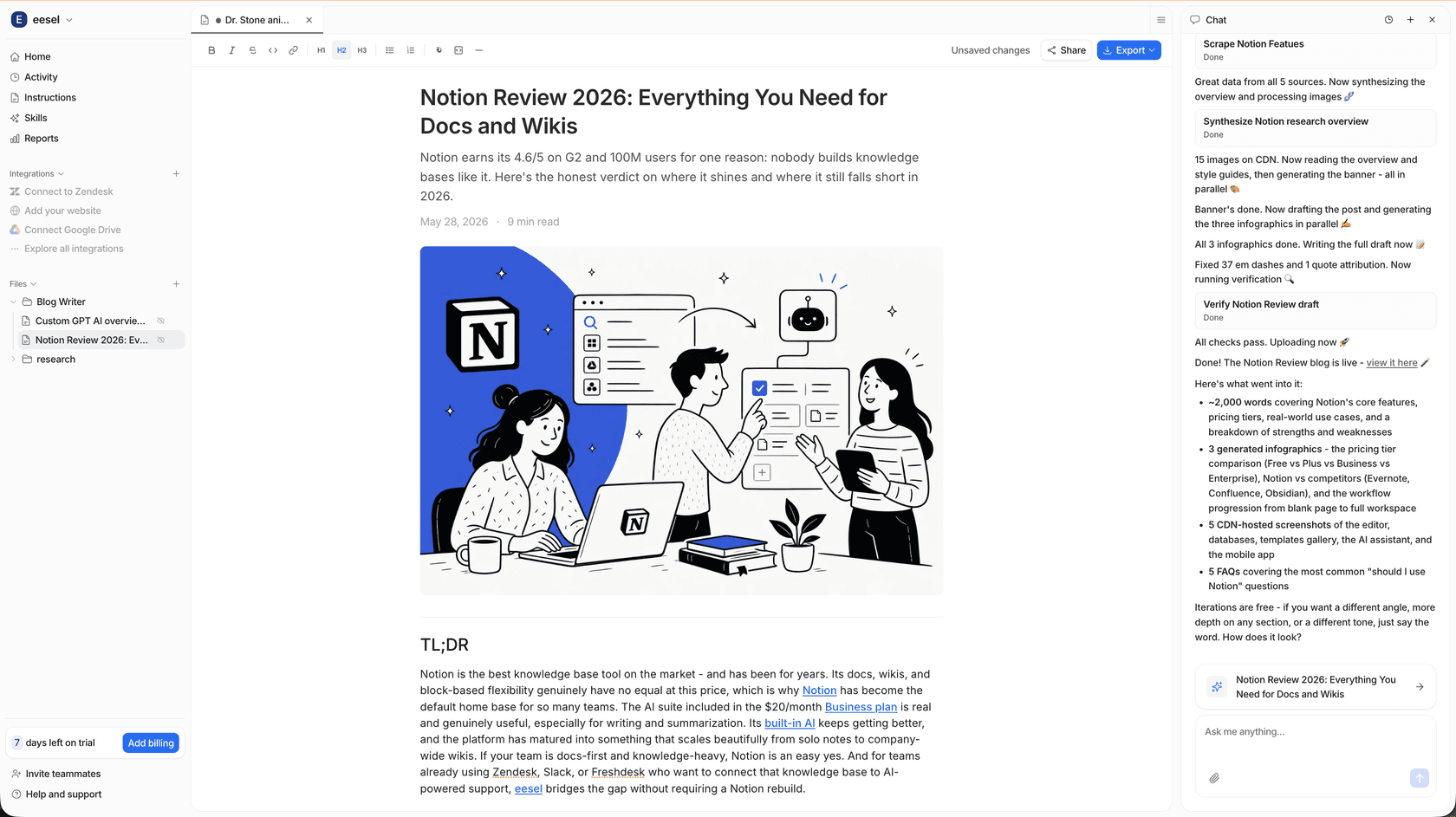
You give it a target keyword and your website URL. From there, the tool takes over:
- It performs deep, context-aware research by analyzing the top-ranking articles for your keyword to understand exactly what searchers want to know.
- It generates a complete, SEO-optimized structure with all the right headings and sections to cover the topic from every angle.
- It produces a publish-ready draft that's much more than a wall of text. It automatically adds assets like AI-generated images and infographics, embeds relevant YouTube videos, and even pulls in real quotes from Reddit to add some authentic social proof.
This is the exact process we used at eesel AI to grow our blog from 700 to 750,000 daily impressions in just three months. The tool is free to try, allowing users to see the results for themselves.
Best practices for briefing AI writers
Whether you are writing a brief by hand or using an automated tool, a few best practices can help you get even better results from any AI writer.
- Provide a framework, not just a topic: AI performs best with structure. Instead of a vague request like "Write about customer service," give it a template. As one AI power user on Reddit advises:
I have seen long form work with AI, but only when it is treated like a junior researcher, not a writer. The mistake I see is asking it to produce a full guide in one go. That almost always turns into generic fluff. What has held up better for us is using it to outline, pull gaps from SERPs, and expand very specific sections one at a time, then rewriting heavily so the voice and claims are actually accountable.
Reddit - Use negative constraints: Sometimes, telling the AI what not to do is just as important. For example: "Do not use overly technical jargon," or "Avoid mentioning our direct competitors by name."
- Use examples to show what you want: If you're after a very specific style, provide the AI with a few examples to emulate. According to research from MIT, showing the model what you want is one of the most effective ways to get a high-quality result.
- Iterate on the output: Treat the AI’s first draft as a starting point. Ask it to expand on certain sections, rephrase a confusing sentence, or offer a different perspective. A little back-and-forth can make a huge difference.
For those who prefer a visual guide, watching an expert create a content brief from scratch can be incredibly helpful. The following video breaks down the step-by-step process, offering practical tips you can apply to your own workflow.
Streamlining content creation with effective briefs
A detailed, well-structured brief is a key factor in producing strategic content that ranks well, as opposed to generic AI-generated text. It is the critical first step for anyone who is serious about using AI to scale their content.
However, building these briefs manually can be time-consuming, potentially slowing down content production for even the most efficient teams.
The future of content marketing lies in integrated tools that automate both the strategic work of briefing and the creative work of writing. By using a solution that handles the deep research, structuring, and asset creation for you, you can free yourself up to focus on the bigger picture and final polish. It's how you scale content production without sacrificing the quality that your audience and search engines demand.
Generate your first complete, SEO-optimized blog post for free with the eesel AI blog writer and see the difference for yourself.