
The pressure is always on. Publish more, rank higher, drive more traffic. Marketing teams are stretched pretty thin, and everyone is looking at AI as the easy button to keep up. But there’s a huge catch: if you’re not careful, you end up with a blog full of generic, robotic "AI slop" that bores your readers, tanks your SEO, and damages your brand.
The main problem is that scaling content often feels like a choice between quantity and quality. You’re asked to sacrifice the very things that make your content good in the first place: your unique brand voice, deep expertise, and human creativity.
But it doesn't have to be a trade-off. This guide isn't about firing your writers and replacing them with AI. It's about building a smarter system where AI acts as a powerful assistant. It handles the grunt work, so you can focus on strategy and quality.
We'll walk you through a practical workflow and show you how specialized tools can make a real difference. We used this exact approach with the eesel AI blog writer to grow our own blog from 700 to over 750,000 daily impressions in just three months by publishing over 1,000 optimized posts.
What is AI-powered content scaling?
Let's get one thing straight: AI-powered content scaling isn't just about "writing more stuff." It's about creating a system for your content production that lets you increase your output without a proportional increase in your budget or team size, and most importantly, without letting quality slide.
So, what’s AI’s role in this? Think of it as your new, incredibly fast intern. It automates the tedious, repetitive tasks that eat up your team's time, like initial research, structuring an outline, writing a first draft, or even turning a blog post into social media content.
The "without losing quality" part is what separates a smart strategy from a complete disaster. It means the final article that goes live on your blog must still be accurate, sound like your brand, and actually answer the question the user typed into Google. This is the opposite of "content farming," where the only goal is to pump out as many articles as possible, helpful or not. That stuff just just doesn't rank anymore.
Common pitfalls of scaling blog content with AI
Just feeding a topic into a generic AI chatbot and hitting "publish" is a recipe for failure. It seems easy, but you'll quickly run into some serious problems that can do more harm than good. Here are the most common issues teams face.
Your content starts sounding robotic and off-brand
Generic AI tools like ChatGPT are trained on a massive, general dataset from all over the internet. This makes them default to a bland, neutral, and slightly academic tone. You know the one I'm talking about. It’s full of phrases like "in conclusion," "let's delve into," and other dead giveaways that a human didn't have the final say.
Without deep context about your company, your products, and your point of view, the AI can't naturally weave in your brand's unique personality. The result is content that feels completely soulless and could have been written by any of your competitors.
tbh all those are solid picks, but lately i’ve been running stuff thru Walter Writes AI just to humanize it a bit more and sneak past detectors like gptzero, feels way less robotic

Factual inaccuracies and outdated information
Large Language Models (LLMs) are notorious for "hallucinating." That's a polite way of saying they sometimes make things up and state them with absolute confidence. They might invent statistics, misinterpret facts, or cite sources that don't even exist.
I'm finding AI to be a great tool - but not so great of a writer, especially for my blog posts. It generates ideas, builds outlines, and things like that - but it's still not quite trustworthy and does stupid things like making up links when it needs external links - it thinks something 'should' be there.. so it creates 'it.' Lol.
On top of that, their knowledge is usually based on a dataset with a specific cutoff date. This means they often can't provide up-to-date information on recent trends or industry news unless they have live web access, which isn't always a given. For any business writing about technical topics, industry news, or product reviews, publishing inaccurate information is a fast way to lose your audience's trust.
Poor SEO performance and failure to rank
Sure, an AI can stuff your target keyword into a post a dozen times, but it often misses the nuance of search intent. It might write a 2,000-word "what is" article when people are really searching for a direct comparison between two products.
The tools are fine but will the content generated by these tools manage to rank on search engines? That's a different story.
Generic AI output also lacks the things that both users and search engines value most: original insights, helpful visuals like custom images or infographics, and social proof from real people. As search becomes more conversational, this is even more important. In fact, Gartner predicts that search engine volume will drop by 25% by 2026 because of AI answer engines. This means that high-quality, genuinely helpful content will be the only thing that breaks through the noise.
A balanced workflow for scaling content with AI
1. Define your strategy and create detailed briefs
AI is only as good as the instructions you give it. Never start the process with a blank prompt. The quality of your output depends entirely on the quality of your input.
Start with solid keyword research to understand what your audience is looking for and what the search intent is. Then, create a detailed content brief for every single article. This brief should include:
- The target audience (e.g., marketing managers at B2B SaaS companies).
- The primary keyword and a few secondary keywords.
- The desired tone of voice (e.g., casual, expert, witty).
- The key points and arguments you want to cover.
- A proposed structure or outline.
This brief becomes the set of instructions for your AI, making sure it starts off on the right track.
2. Use AI for acceleration, not final creation
Once you have a brief, it's time to let the AI do the heavy lifting. Use it to handle the most time-consuming parts of the writing process:
- Brainstorming: Ask it to generate different angles, catchy headlines, or sub-topics related to your main keyword.
- Outlining: Feed it your brief and have it generate a logical structure with H2s and H3s.
- First Drafts: Let it write the initial draft. This is one of the biggest time-savers, as it helps you get past that dreaded "blank page" paralysis.
The key here is to treat the AI's output as what it is: a rough draft. It’s a starting point to be molded and improved, not a finished product.
3. Layer in human expertise and review
This is the most important step for maintaining quality, and it's non-negotiable. The human writer or editor is the quality gate. Their job is to take the AI's draft and transform it into something truly great. This involves:
- Fact-checking: Verifying every single statistic, claim, and piece of data in the article.
- Injecting brand voice: Rewriting clunky, robotic sentences to sound like your brand. This is where you add personal anecdotes, customer stories, or your company's unique perspective.
- Improving flow and readability: Breaking up long paragraphs, improving transitions, and making sure the story is engaging from start to finish.
- Adding rich media: Incorporating custom images, screenshots, infographics, and charts that add real value beyond the text.
4. Repurpose and update content intelligently
AI can also help you get more mileage out of the amazing content you've already created. Once an article is published, don't just let it sit there.
Feed the URL of a published blog post into an AI tool and ask it to summarize it into a Twitter thread, a LinkedIn post, or even a script for a short video. For older posts, you can use AI to help with content refreshes by asking it to identify outdated statistics or suggest new sections to add to keep the information current.
Choosing the right tools for scaling content
A solid workflow is key, but the tools you use can either supercharge your efforts or hold you back. Generic tools produce generic content. Specialized tools, on the other hand, are designed to solve specific problems and help you maintain quality as you scale.
eesel AI blog writer
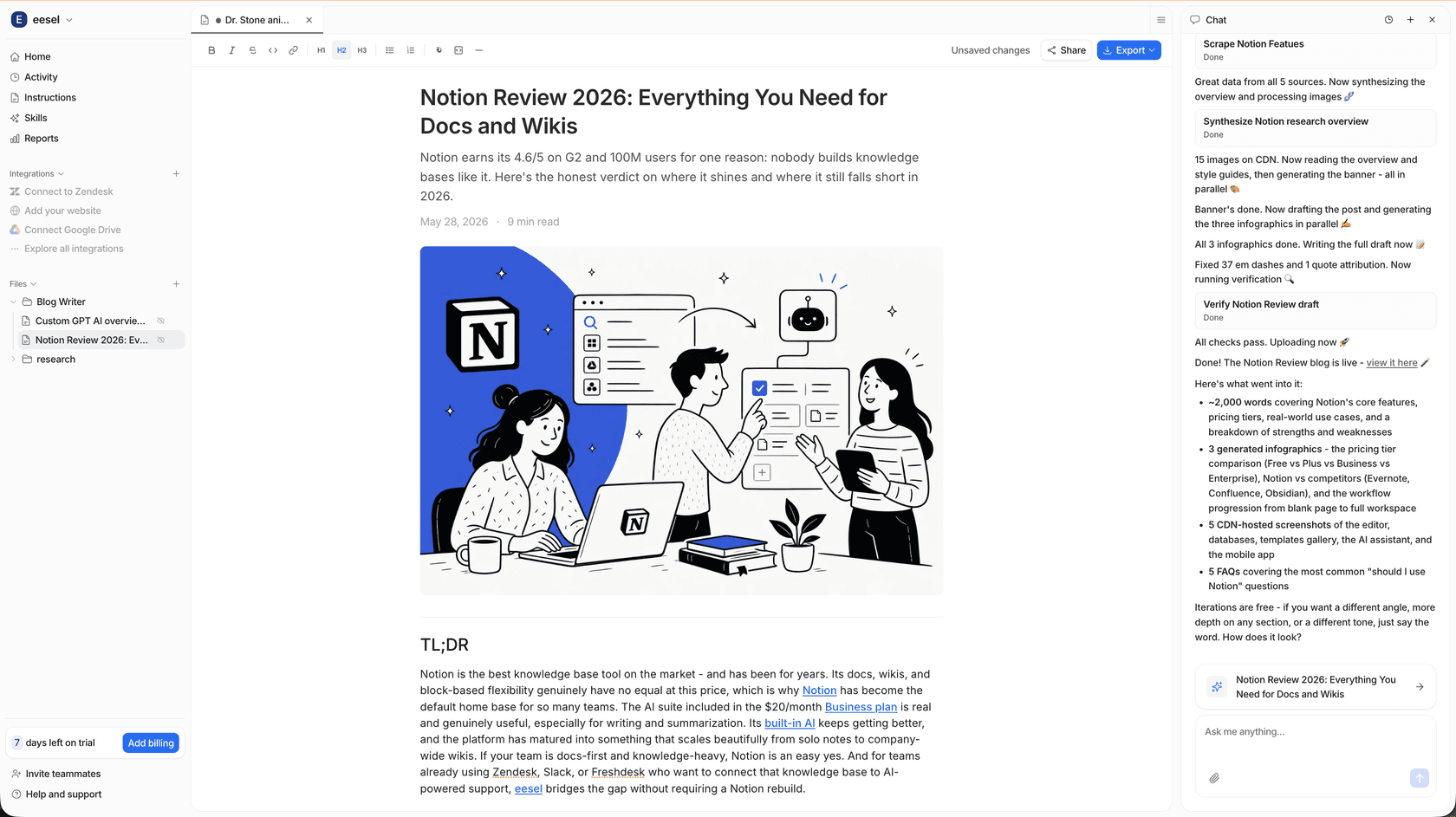
Here’s how it’s different:
- Deep, context-aware research: It goes beyond surface-level information. It understands search intent, so if you ask for a comparison post, it actively looks for pricing data and feature lists. If you ask for a product review, it finds technical specs. This ensures the content is genuinely useful from the start.
- Generates complete posts with automatic assets: It doesn't just spit out a wall of text. It produces a fully structured post that includes AI-generated images, infographics, and tables. It even embeds relevant YouTube videos and finds real, insightful quotes from Reddit threads to add authentic social proof.
- Optimized for SEO and AEO: The output is structured for traditional SEO, but it's also optimized for Answer Engine Optimization (AEO). This means the content is formatted to be easily understood and featured by AI answer engines like Google AI Overviews and Perplexity.
- Learns your brand automatically: You don't have to spend hours writing brand guidelines. Just provide your website URL, and the AI learns your tone, style, and products. It then weaves in natural, contextual mentions of your company without ever sounding like a pushy salesperson.
It’s completely free to try, so you can generate your first blog for free and see the quality for yourself.
How other tools like Jasper AI and Surfer SEO compare
Other popular tools in the space are powerful but solve different parts of the puzzle.
I have tested most of these too, and found real differences once you get past the surface features. Based on Sprout Score comparisons, Jasper scored higher (8.2) for brand voice and long-form consistency, especially in team use. Surfer SEO scored strong (8.0) in post-publish optimization and SERP alignment, but depends heavily on pairing with another tool like Jasper. Copy.ai lagged a bit (7.4) for structured content workflows, it is fast, but less controllable. Writesonic sat in the middle (7.8), solid for ecommerce and quick drafts but needed a lot of manual editing in B2B use.
- Jasper AI: Jasper is a fantastic AI content automation platform for marketing teams. It excels at creating on-brand first drafts for all kinds of content, from ads and emails to social posts and blogs. Its "Brand Voice" and "Campaigns" features are great for consistency. However, it's primarily a drafter. It does not automatically generate visual assets like images or charts, and getting its full SEO power requires a separate, paid integration with Surfer SEO.
- Surfer SEO: Surfer is a best-in-class SEO optimization platform. Its core feature, the "Content Editor," is brilliant. It analyzes the top-ranking pages for your keyword and gives you a data-driven "Content Score" with suggestions on what terms to include and how to structure your article. While its AI can generate an SEO-optimized draft, it's not designed to create a complete, finished asset. It lacks the automatic rich media and social proof integrations that make content engaging for humans. It helps you optimize a draft, not create one from scratch.
Here's a quick breakdown:
| Feature | eesel AI blog writer | Jasper AI | Surfer SEO |
|---|---|---|---|
| Primary Function | Complete Blog Post Generation | AI Content Automation & Drafting | SEO Content Optimization |
| Automatic Assets | Yes (Images, Videos, Reddit Quotes) | No | No |
| Brand Context | Automatic from URL | Manual Input via Brand Voice | Manual Input via Custom Voice |
| Output | Publish-ready post | On-brand rough draft | SEO-optimized draft |
| Best For | Scaling high-quality, complete blog posts | Enterprise teams automating the content lifecycle | SEO professionals needing deep on-page analysis |
The future is hybrid: Scaling content with AI and human expertise
Scaling your blog content with AI without sacrificing quality isn't just a fantasy. It's the most effective and sustainable strategy for modern marketing teams. The trick is to completely avoid the "copy, paste, and pray" approach that comes with using generic AI tools.
This human-in-the-loop philosophy is at the heart of everything we're building. If you're ready to scale your content production without turning your blog into a content farm, generate your first blog post with the eesel AI blog writer for free.