How to use an AI blog SEO tool to scale your traffic

Stevia Putri
Last edited January 15, 2026
The traditional content marketing playbook, which relies on a manual process for creating blog posts, can be challenging to scale. As a result, many businesses are turning to smart automation to increase their content output efficiently.
This is where an AI blog SEO tool can be beneficial. These tools are designed for businesses that want to produce more high-quality content without significantly increasing their headcount. In this guide, we’ll get into what these tools do, which features are important, and how the top platforms compare.

What is an AI blog SEO tool?
An AI blog SEO tool is a platform that combines an AI writer with a built-in SEO toolkit. It is designed not just to write words, but to write content optimized for search engines like Google.
It has two main parts that distinguish it from a simple text generator like ChatGPT:
- The AI Writer: This is the engine that creates human-like text from a keyword or prompt you provide. It can draft paragraphs, structure ideas, and adopt different tones of voice.
- The SEO Toolkit: This is the strategic layer. It analyzes what is already ranking on Google (the SERPs), suggests relevant keywords, helps structure the post, and ensures the content is built to answer user search queries.
Key features of an effective AI blog SEO tool
End-to-end content generation
Effective tools do more than provide a simple first draft. They manage the whole process, turning a single keyword into a post that’s ready to publish. This means you get a complete article with a solid introduction, a logical structure of headings, a proper conclusion, and even an FAQ section. The goal is to get you 95% of the way there, not just 25%.
Data-driven SERP analysis
An effective tool should analyze top-ranking articles for your target keyword. This helps it understand what search engines are already rewarding for that specific query. The AI can then build a content outline that aligns with what’s already working, giving your article a much better chance of ranking.
Automatic asset and media creation
To keep readers engaged, visuals are key for breaking up text and illustrating points. A top-tier tool should automatically generate or embed relevant assets right into the article. This can include AI-generated images, custom infographics, data tables, relevant YouTube videos, and even social proof like real Reddit quotes to add a layer of real-world credibility.
Generative Engine Optimization (AEO)
This is a significant factor for 2026 and beyond. AEO is about optimizing your content so it gets picked up and cited by AI answer engines like Google AI Overviews and Perplexity. The tool should structure content with clear definitions, Q&A sections, and data-rich paragraphs that are easy for large language models to pull from. It's about making sure your content is ready for the next phase of search.
Brand context and internal linking
Finally, a great tool needs to understand your brand. It should be able to learn your company’s voice to make natural product mentions that don't sound clunky or forced. It should also be smart enough to suggest relevant internal links to your other content, which is a huge help for building topical authority and improving your site’s overall SEO.
Top AI blog SEO tool platforms
Now that you know what to look for, let's check out some of the top platforms out there. We’ll start with our own tool, which we designed to be a complete content engine, and then look at a few other popular options that handle different parts of the content workflow.
eesel AI blog writer
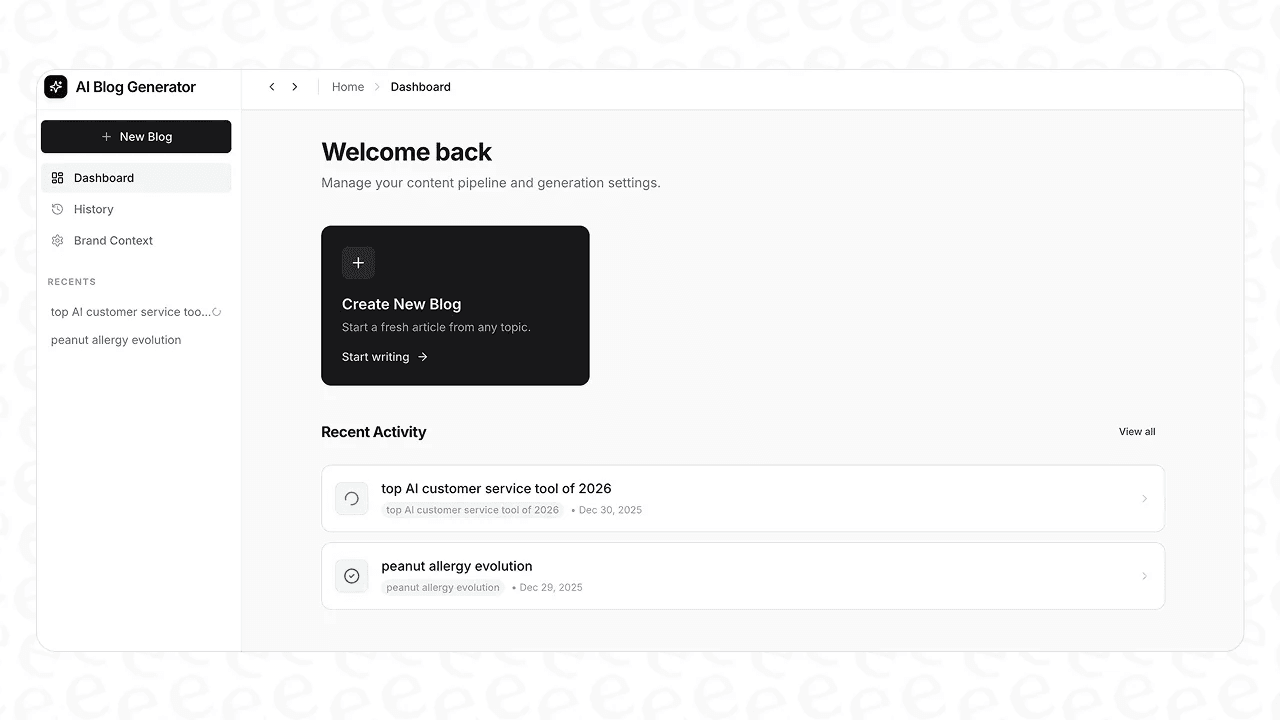
The eesel AI blog writer is built to be a one-stop shop for your entire SEO content process. The goal is to take you from a single keyword to a fully-formed, publish-ready blog post in just a few minutes.
The workflow is simple: you enter a keyword, add your website so the AI can learn your brand context, and it starts generating a complete article that’s ready to publish.
Here are a few things that make it stand out:
- Automatic Rich Assets: This isn't just about text. The platform automatically creates and embeds AI-generated images, infographics, and data tables directly into the post.
- Social and Media Integration: It embeds relevant YouTube videos and pulls real Reddit quotes to add genuine perspective and authority to your content.
- Context-Aware Research: The AI changes its research approach based on the type of blog you're creating. For a comparison post, it pulls pricing data. For a product review, it finds technical specs.
- Optimized for AEO: Every article is structured to get cited by AI answer engines like Perplexity and Google AI Overviews, putting your content a step ahead.
Pricing is straightforward. It’s $99 for 50 blog posts a month, and you can try it out completely free to see the quality for yourself.
Other popular AI blog SEO tools
While the eesel AI blog writer offers a complete, one-click solution, it’s good to know about other tools that focus on different parts of the content creation process.
The 'all-in-one' pitch is always tempting. Be careful though, a lot of these tools do 10 things just 'ok' instead of doing one thing really well. The real test is the editing time. If you're spending an hour rewriting a '1-click' 2000-word article, you're not really saving time. It's worth comparing the output quality against a solid prompt in something like Claude or GPT-4 to see if the subscription is actually worth it.

Jasper AI
- Overview: Jasper is a well-known AI platform for marketing teams that need to create a wide variety of on-brand content. Its main strength is its deep customization and tools for keeping your brand voice consistent.
- Features: It offers a Brand IQ feature to define your tone and style, Jasper Studio for building custom AI apps, and AI Agents to automate specific marketing tasks. It also has great language support, working in over 30 languages.
- Limitations: Jasper is great for generating high-quality, on-brand copy and even visuals. However, it's more of a content creation toolkit than an automated blog post generator. You still have to manually piece together the final article by finding and embedding your own assets like videos, social proof, or infographics.
- Pricing:
- Pro: Starts at $59 per month per seat when billed annually.
- Business: Custom pricing for larger teams needing advanced features and API access.
Surfer SEO
- Overview: Surfer is a popular content optimization platform built to help your content get seen on Google and in AI chats. Its primary focus is providing deep, data-driven analysis for on-page SEO.
- Features: Its core feature is the Content Editor, which gives you a real-time Content Score based on an analysis of the top-ranking pages. It also has features like Auto-Optimize for keyword insertion, automatic internal linking, and an AI Tracker to see your visibility in AI answers.
- Limitations: Surfer excels at analysis and optimization. The AI writing is more of a supporting feature for that workflow rather than the main attraction. It’s excellent at telling you what to write about, but it doesn't automatically generate a complete post with rich media from a single prompt. It takes more manual work to build the final article.
- Pricing:
- Essential: Starts at $79 per month for 30 articles when billed annually.
- Scale: Starts at $175 per month for 100 articles when billed annually.
Writesonic
- Overview: Writesonic positions itself as an all-in-one platform for boosting your brand’s visibility across both traditional search (SEO) and AI search, which it calls Generative Engine Optimization (GEO).
- Features: It includes an AI Article Writer 6.0 that uses real-time data to create factual content and Chatsonic for AI-powered conversations. Its standout feature is AI Visibility Tracking, which lets you know when your brand gets mentioned on platforms like ChatGPT and Perplexity.
- Limitations: Writesonic offers a large suite of tools, which can be more complex than platforms focused solely on blog generation. While its article writer is solid, it's just one part of a much larger platform dedicated to tracking and analysis. This might mean more setup and management compared to the direct keyword-to-post approach of the eesel AI blog writer.
- Pricing:
- Lite: $39 per month for 15 articles when billed annually.
- Standard: $79 per month for 30 articles when billed annually.
- Professional: $199 per month for 100 articles when billed annually, which is the plan that includes AI search tracking.
The future of SEO: Integrating AI into your content strategy
The role of an AI blog SEO tool is changing fast. It's no longer just a fancy text generator; it's becoming a strategic partner in building out a full content machine.
A modern content strategy is about more than just publishing random articles and hoping they stick. It requires a more systematic plan:
- Identifying and building out topic clusters to establish authority in your niche.
- Automating the creation of comprehensive first drafts to save a ton of time.
- Optimizing every piece for both traditional search engines (SEO) and the new AI answer engines (AEO/GEO).
- Systematically finding and refreshing older content to keep it from going stale.
For a deeper dive into how you can use free AI tools to build an SEO-optimized article from scratch, check out this step-by-step guide.
AI is an incredibly powerful assistant, but it’s not going to replace human strategy entirely. A common approach is to combine the speed and data-processing power of AI with a human's creativity, unique insights, and final strategic touch. Platforms that deliver the whole package, including text, assets, SEO, and AEO, streamline the entire creation workflow, freeing you up to focus on the bigger picture.
Choosing the right AI blog SEO tool
An AI blog SEO tool can be a valuable asset for scaling content and traffic in 2026. But picking the right one depends on your main goal and how you like to work.
The biggest difference comes down to choosing between a text-focused platform that helps you write faster and a complete content engine that handles the research, writing, asset creation, and optimization from start to finish. If your goal is to streamline the process from keyword to a publish-ready post, an all-in-one solution may be the most efficient option.
Ready to see what a complete AI content engine can do for you?

Frequently Asked Questions
Share this article

Article by
Stevia Putri
Stevia Putri is a marketing generalist at eesel AI, where she helps turn powerful AI tools into stories that resonate. She’s driven by curiosity, clarity, and the human side of technology.
