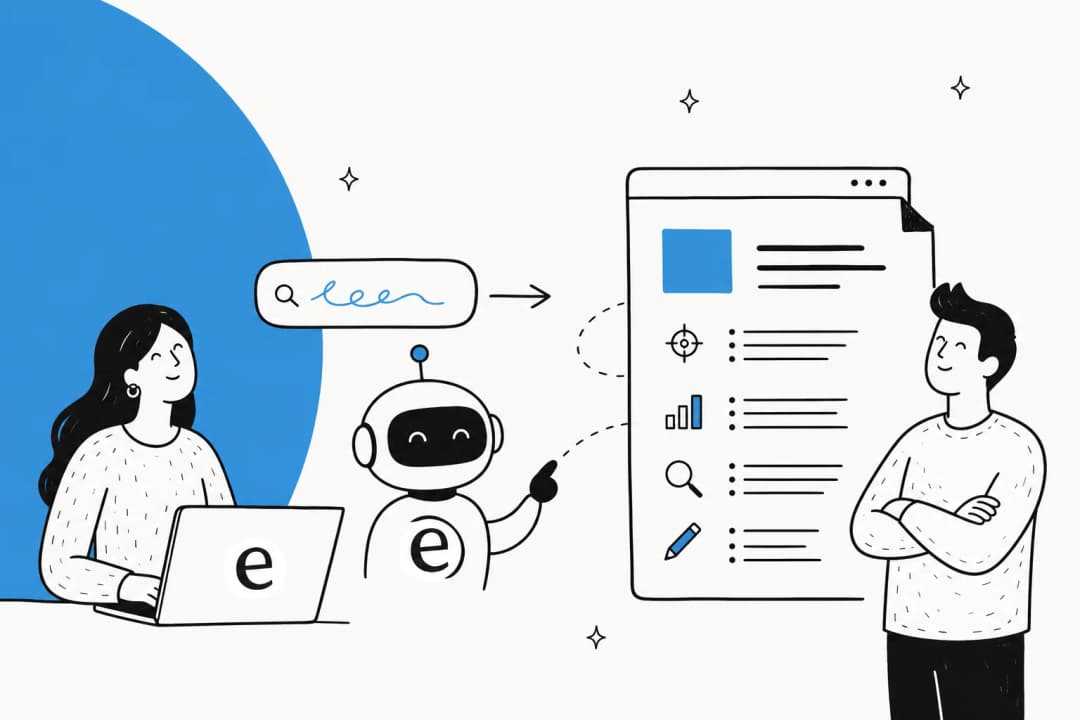
The agency content squeeze
Here's the bind every content agency I talk to is in. Clients want more posts, on more keywords, more often. Retainers are flat or shrinking, so you can't just bill more hours. And the one lever that used to fix volume, hiring another writer, makes the margin worse, not better, because a good B2B writer is expensive and slow to onboard onto a new client's voice.
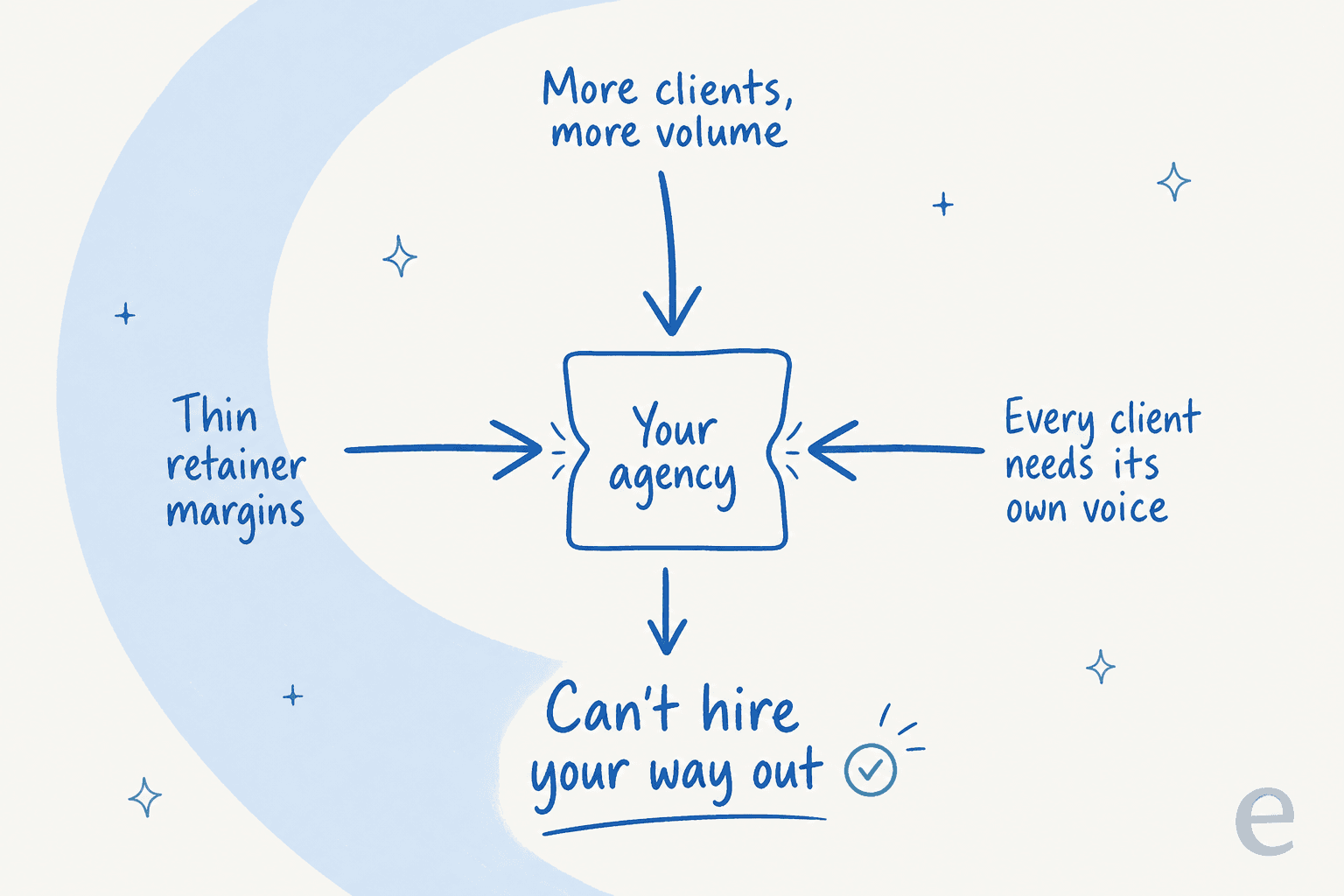
So agencies reach for AI, and the throughput is real. One content team I've watched run our blog writer scaled to 360+ posts a month, around twelve a day, off a keyword-to-publish pipeline with batch review, on a single small team. No human-only shop writes at that production speed. If your bottleneck is "we have 400 long-tail keywords across eight clients and three writers," that's an AI problem, and an AI content scaling tool is how you clear it.
The trap is thinking the volume is the whole job. It isn't. The agency version of this has a second constraint a solo blogger never faces: every post has to sound like a different company. Solve volume without solving voice and you've just industrialised the thing that gets clients to leave.
Why generic AI content is specifically an agency problem
A solo creator using AI can get away with a house voice, it's their house. An agency can't. The moment two of your clients' blogs read like they came from the same template, both of them notice, and both of them start wondering what they're paying you for. Worse, Google has spent the last two years getting better at spotting thin, unoriginal content regardless of who, or what, produced it.
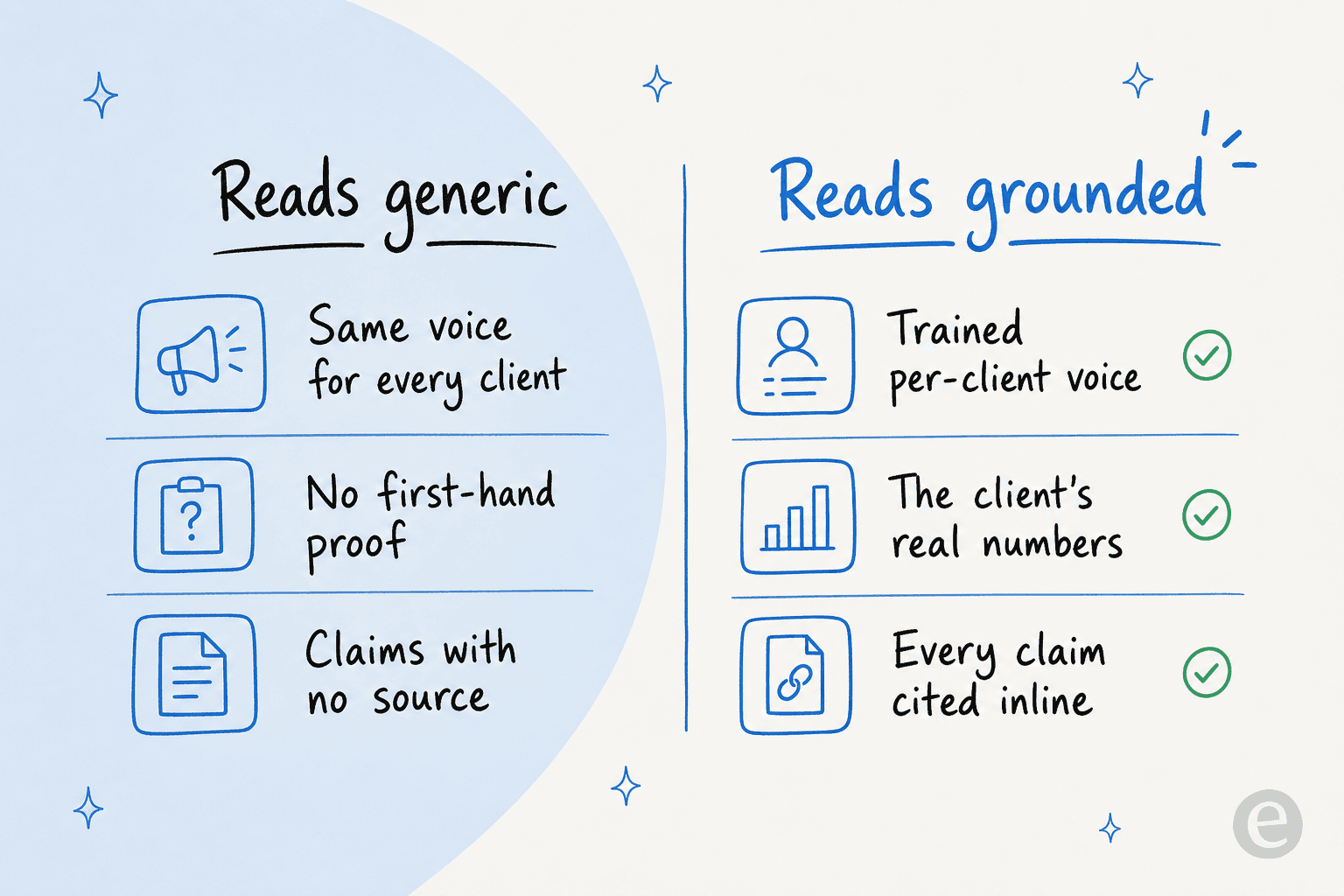
The good news is that "reads generic" has named, fixable causes. It almost always comes down to three: the same voice across every account, no first-hand proof, and claims with no source. Notice none of those is "the model isn't smart enough." A frontier model writes a perfectly competent sentence; what it can't do on its own is know that this client says "members" not "users," or that they ran a webinar last month that hit 2,000 signups. Generic content is what you get when you give a capable writer nothing specific to work with. So the agency fix is an inputs discipline, the same one behind E-E-A-T-compliant content: feed it the client's real voice, real numbers, and primary sources, and the floor rises a lot. An AI humanizer can catch the obvious tells, but it's those specifics that do the real work.
That's also why the choice of tool matters more for agencies than for individuals. A general chat tool makes you re-paste the brand context every single time. A purpose-built AI blog writer lets you set each client up once, with their own brand voice training and their own knowledge sources, then keeps that context attached to every draft for that account.
The workflow that actually scales across clients
The pattern that works isn't "AI writes the post." It's a pipeline where the per-client work happens once and the production work is shared. Set up the client (voice, sources, rules), then the same engine researches, drafts, reviews, and ships across every account.
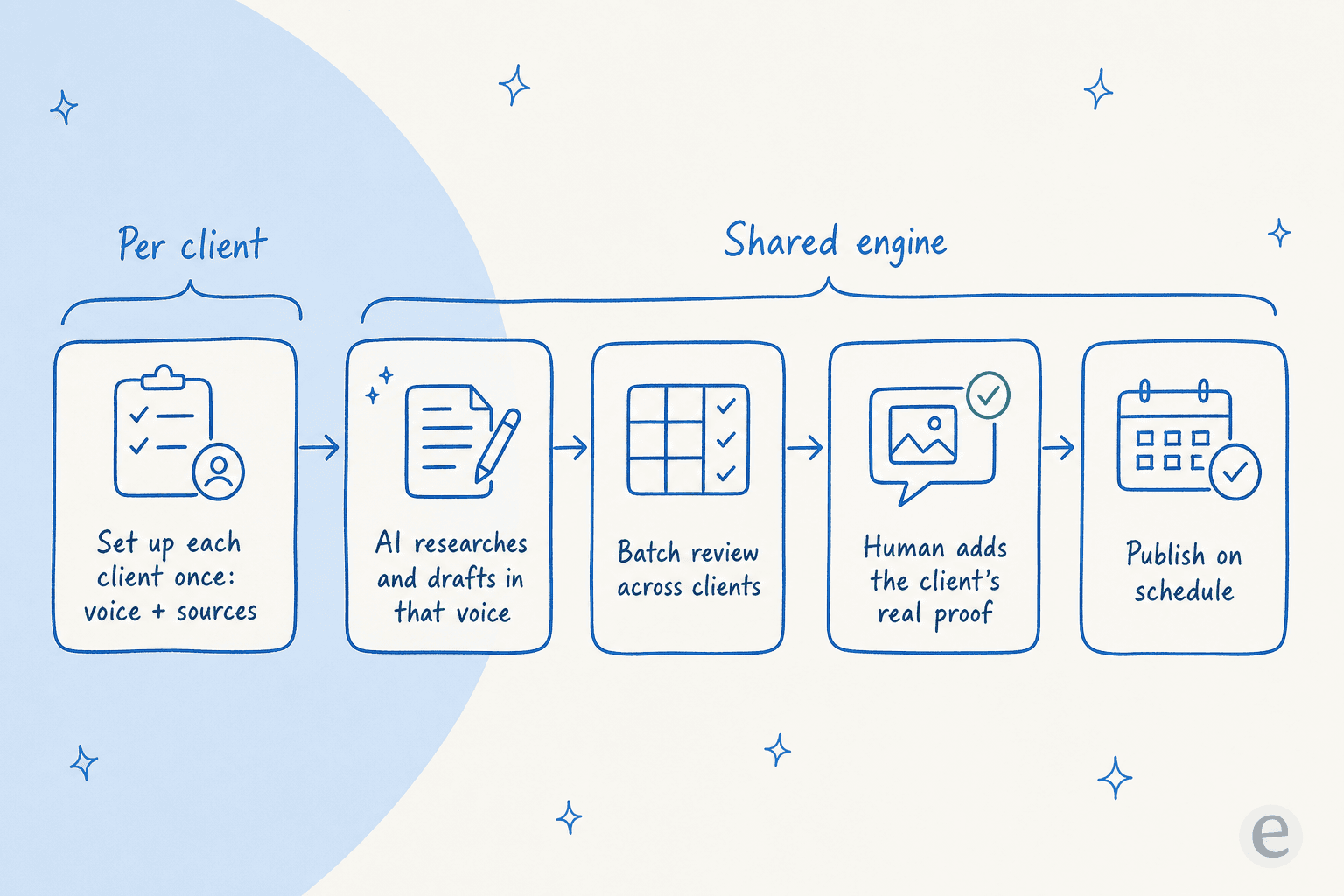
1. Set up each client once. This is the highest-leverage hour in the whole relationship. Load their existing content so the tool can learn the voice, connect their knowledge sources (help center, product docs, past posts), and write down the rules, the words they use, the competitors they won't name, the claims legal won't sign off on. eesel claims a 94% voice match from day one off this setup, and it gets better with every edit. Do this per client, not per post.
2. Let the engine research and draft in that voice. This is the legwork AI is genuinely good at: pull the sources, build the structure, write the first pass in the right voice, generate the images, draft the meta title and meta description. A good AI blog writing workflow front-loads all of it so nobody on your team stares at a blank page. The bar to hold here: it should read Reddit threads, industry reports, and primary sources, and cite every claim inline, not assert things into the void.
3. Review in batches, not one at a time. This is the move that unlocks agency volume. Instead of treating each post as a project, your editor reviews a stack across clients in one sitting, checking voice, claims, and links. It's the difference between a writer's pace and an editor's pace.
4. Add the proof only the client has. This is the five-minute step that separates content that ranks from content that gets buried. A real number, a real screenshot, a real "here's what bit us" from the client's actual experience. AI can't invent these, and they're the entire reason the post won't read generic. If you skip nothing else, don't skip this.
5. Publish on schedule. Push to the CMS, Google Docs, or wherever the client signs off, and keep the cadence steady.
The trap is treating step 2 as the whole process. Skipping the human proof pass is exactly how you end up with AI posts that don't rank, the ones that read fine and convert nobody. The hybrid isn't "AI plus a quick proofread," it's "AI does the volume, a human does the value." For the detailed version of running this across an account list, our agency content tool guide goes deeper on the batch-review side.
What it actually costs at agency scale
The economics are where this gets persuasive for an agency owner, because the math changes shape, not just size. A freelance B2B post runs a few hundred dollars and lands in a few days; an in-house writer is a salary you pay whether they publish four posts or fourteen. An AI draft costs a few dollars and lands while you're still reading the brief.
Here's a rough per-post comparison for a 1,500-2,000 word researched post:
| Approach | Cost per post | Turnaround | Scales to many clients? |
|---|---|---|---|
| Freelance B2B writer | ~$300-500 | 3-7 days | Slowly, each new voice is a new onboarding |
| In-house writer (salaried) | High fixed cost, amortised | 1-3 days | Only by hiring more |
| General AI chat tool | Cheap per draft, but re-prompted each time | Minutes + heavy editing | Poorly, no persistent per-client voice |
| Purpose-built AI blog writer | A few dollars per draft + edit time | Minutes to a reviewable draft | Yes, voice and sources held per client |
With eesel specifically, the pricing is per post: a full blog draft is $4, with no per-seat fee and 100 free credits to start, so you can pilot it on one client before committing anything. The headline is simple, the cheap part of writing got nearly free, and the expensive part, editing and judgment, stayed expensive, which is exactly where your margin should be. The full breakdown is in our AI blog writer cost comparison.
What this does to your P&L: you stop paying for first drafts and start paying for editing and strategy, the work clients actually value and the work you can defend on a renewal call. For agencies weighing the staffing question directly, agency vs freelancer lays out where each still wins.
"Should we just use ChatGPT, or build our own?"
Two questions every agency asks before committing. On raw ChatGPT: it's a writing tool, you prompt it and it generates. For one-off drafts that's fine, and our best AI blog writer roundup covers where general tools still earn a slot, but across a roster of clients you're re-pasting brand context all day and nothing persists, which is precisely the setup that produces generic output. The agency case wants a teammate you configure once per client, not a blank box you re-brief every morning.
On building your own wrapper over the OpenAI or Claude API, plenty of technical agencies consider it, and a few should. But the maintenance cost is the part the build estimate always misses. A real eesel customer put the trade-off well:
"We could try to write our own LLM application but we didn't want to invest our time into that. We wanted something that we would not have to maintain."
Karel, GENERAL BYTES (case study)
That's the build-vs-buy calculus in one line. Your agency's edge is content and client relationships, not maintaining a research-and-citation pipeline against models that change every few months. If you genuinely want to go the DIY route, our best AI content writing software roundup covers the tradeoffs, and free utilities like the SEO keyword generator and meta description generator can patch gaps in the meantime.
Pitfalls that get AI agency content fired (or deindexed)
A few traps I see agencies fall into, each avoidable:
- One voice for all clients. The cardinal sin. If you're not setting up brand voice per account, you're shipping the thing that gets you fired. Set it up once per client and the problem disappears.
- Shipping unedited drafts to hit a number. Volume without the human proof pass is how you flood a client's blog with posts that read competent and rank for nothing. Scale SEO content safely instead.
- No citations. Uncited claims read as AI vapor to both readers and Google. Insist the tool cites inline as it writes.
- Letting old posts rot. An agency's best ranking opportunity is often the client's existing content. Run a periodic content audit to catch broken links, missing metadata, and thin pages before they drag the domain down.
- Skipping the human in regulated niches. Health, finance, legal, someone has to sign off. The model can't be accountable for a published claim.
Try eesel for agency content
If you want the hybrid workflow as an actual product rather than a process you babysit, eesel's AI blog writer is built around the agency shape of the problem. You set each client up once with their own voice and knowledge sources, and it researches across primary sources, writes in that client's voice with a 94% voice match from day one, generates the visuals, and cites every claim inline, then hands you a draft to edit instead of a blank page. Billing is per post, so it's $4 per draft with 100 free credits to start, which means you can run it against a single client this week before rolling it across the roster.

It plugs into where your team already works, drafts and change requests over Slack or the dashboard, and publishing into the tools your clients sign off in. For the strategy layer on top, our guide to the AI agency content tool workflow covers running it across many accounts without quality drifting.
Frequently asked questions
What is the best AI blog writer for agencies?
How much does an AI blog writer cost for an agency?
Will an AI blog writer make my clients' content read generic?
Can AI write SEO blog content for multiple clients at once?
Is an AI blog writer better than hiring freelancers for an agency?


Article by
Kurnia Kharisma
Kurnia is a software engineer and writer at eesel AI with two years of SEO experience, writing about AI tools, helpdesk software, and customer support. He pairs a developer's understanding of how these products are built with search-driven research into what actually ranks and resonates with the people searching for them.