If you run a digital agency in 2026, you are not really shopping for an AI writer. You are shopping for an AI content operation. There is a difference. A solo creator can pick whichever model writes the cleanest paragraph and call it a day. An agency has to think about brand voice for five clients at once, who approves what before it ships, how SEO targets get hit on every brief, and what happens when one of your writers leaves and takes their prompt notes with them.
That is why the listicles you usually see fall flat for agency work. They rank tools on prose quality and prompt UX, then move on. Useful if you are a freelancer. Less useful if you are juggling client logins, brand voices, and a content calendar that has to defend itself in a quarterly review.
We pulled together the AI writing tools that actually keep showing up in agency stacks this year, ones agencies stay on once the trial ends. We weighed them on brand voice control, multi-client architecture, SEO depth, collaboration, and pricing that does not punish you for adding a sixth client.
If your agency also looks after support inboxes for clients (live chat, tickets, internal helpdesks), the writing-tool layer is only half the picture. The other half lives over in support automation, which is where eesel AI sits, but more on that at the end.
What we looked for in an agency-grade AI writing tool
Six picks below, but here is the lens we used so you can argue with our shortlist.
- Brand voice that travels. A real brand voice profile, not a tone slider. Trained from a client's own copy and reusable across writers, projects, and channels.
- Multi-client workspaces. A separate space, library, and permission scope per client. Bonus if the pricing model is built around client count rather than seat count.
- SEO and AI-search depth. Real SERP analysis, content briefs, internal linking, and increasingly, visibility tracking inside ChatGPT, Perplexity, and Gemini.
- Collaboration that includes the client. Comments, approvals, version history, and a way for a non-licensed reviewer to leave feedback.
- Pricing that scales. No nasty cliffs at the moment you grow from three to seven clients. White-label and API access matter for larger agencies.
We also weighed community signals. A 4.7 on Capterra after 1,800 reviews tells you more than a polished landing page does, so review averages go in the table below.
Quick comparison
| Tool | Best for | Brand voice | Multi-client feature | Starting price |
|---|---|---|---|---|
| Jasper | Marketing-led agencies running campaigns at scale | Brand IQ with multiple voices, knowledge, audiences | Business plan with unlimited voices and SSO | $69 per seat per month |
| Writer | Enterprise agencies needing governance and compliance | Voice profiles backed by Palmyra LLMs and a Style Guide | Knowledge Graph and unrestricted connectors on Enterprise | Starter trial-led, Enterprise custom |
| Copy.ai | Agencies wiring content into a wider GTM workflow | Brand Voice plus an Infobase for grounding | Enterprise workflow contracts; Chat ships 5 seats | $29 per month for Chat, Enterprise custom |
| Surfer SEO | SEO agencies and content shops chasing rankings | Custom Voice on top of NLP-driven guidelines | Brand Workspaces and white-label on Enterprise | $49 per month on Discovery |
| Frase | Research-first content teams and SEO agencies | Brand governance enforced across AI Agent outputs | Multi-domain audits, programmatic SEO, agency portal | $49 per month on Starter |
| StoryChief | Agencies that need writing plus distribution in one place | Brand Voices learned from URL or pasted text | Per-customer Agency plans with isolated workspaces | $58 per customer per month |
Now to the actual write-ups. Each follows the same template (what it is, what stands out for agencies, what users say, pricing, who it is for, where it falls short) so you can skim or read end to end.
1. Jasper
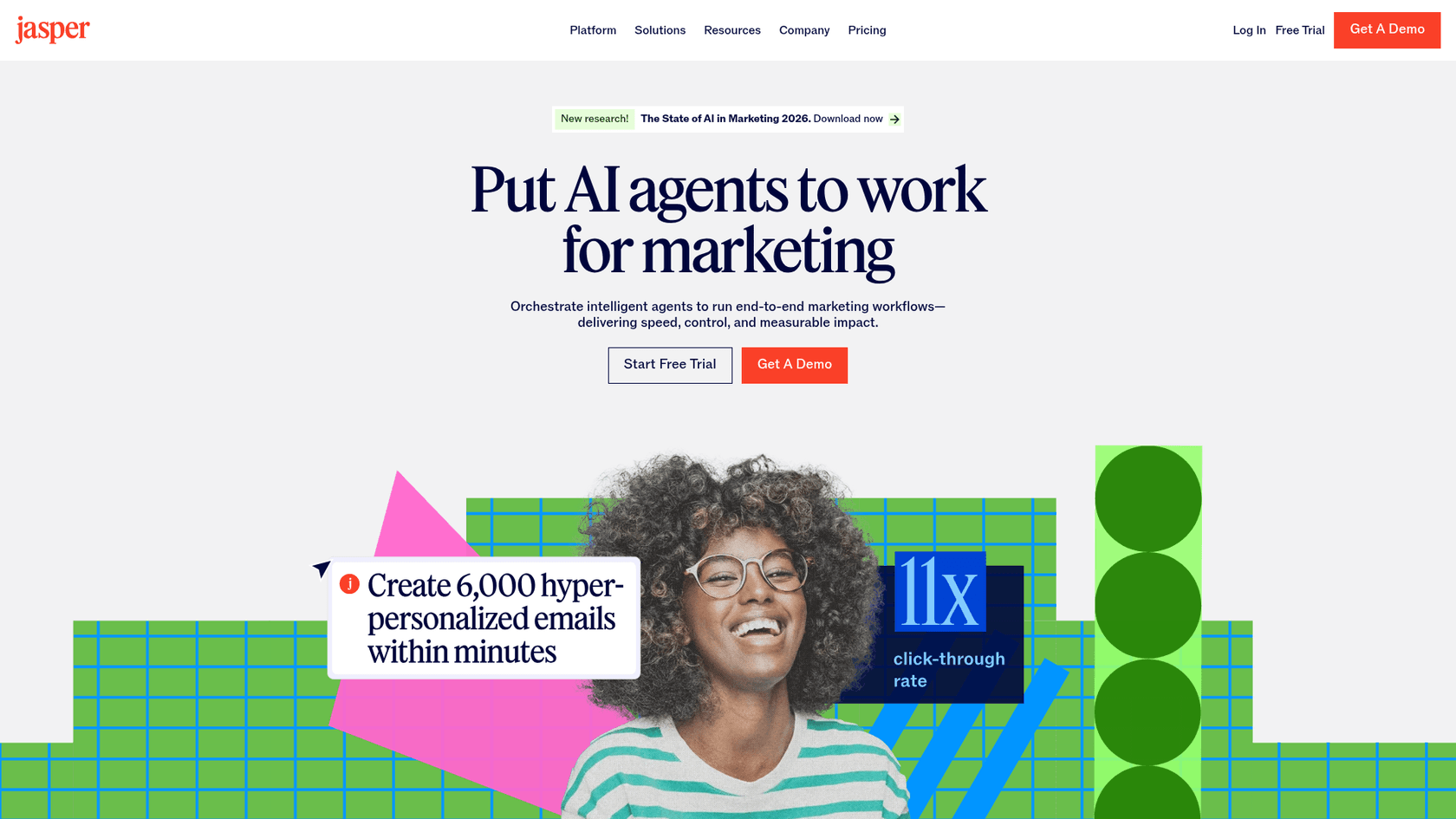
Jasper used to be a long-form blog writer. In 2026 it is positioning itself as an agent workspace for marketing teams, with over 100 specialised agents, an AI editor called Canvas, and a content automation grid. For agencies, that means you are not just buying a draft button. You are buying a workspace that wants to do SEO optimisation, personalisation, and research as separate steps in a pipeline.
The piece that matters most for client work is Jasper IQ. It bundles brand voices, knowledge assets, and audiences into a single context layer. On the Pro plan you get 2 brand voices, 5 knowledge assets, and 3 audiences, which is enough for a small shop with one or two clients. On the Business plan those limits go to unlimited, and you also pick up a no-code AI App Builder, the Jasper Grid for scaled execution, and SSO and SCIM for proper team management.
Reviewers describe Jasper as a content factory rather than a writer:
"Jasper AI is less of a 'writer' and more of a marketing content factory with a personality disorder, that you train. It's built primarily for: marketers and agencies, not casual writers or hobbyists. Its mission: produce on-brand content at scale across blogs, ads, and social media." (Roddy T., Capterra, April 2026)
Note "marketers and agencies" right there, written by a customer. Jasper holds a 4.8 out of 5 across 1,855 Capterra reviews, one of the best aggregate scores in the category.
What stands out for agencies is the fit between Jasper IQ, the agents, and Canvas. You define a client's voice once, plug it into a personalisation agent, then feed that agent into a multi-channel campaign brief. That is closer to how an account team works than a chat box that resets every Monday.
Pricing
| Plan | Price | Seats | Brand voices | Notable inclusions |
|---|---|---|---|---|
| Pro | $69 per month per seat ($59 annual) | 1 | 2 | Canvas, essential agents, 5 knowledge assets, 3 audiences |
| Business | Custom | Scalable | Unlimited | AI App Builder, Jasper Grid, SSO, SCIM, API access, dedicated CSM |
A 7-day free trial is available on Pro, and there is a 20% discount for non-profits. There is no PayPal option, which has surprised more than a few finance teams.
Pros and cons
Pros: deep brand voice management, agency-friendly Business plan, large agent library, mature ecosystem with over $125 million in funding and around $75 million ARR in 2025 after a restructure.
Cons: the Pro plan is a single seat at $69 per month, which makes it expensive once you stack a few writers. Some reviewers report that Jasper's value over general models is thin if you are not using the brand and workflow features:
"Unfortunately, I found the Jasper AI starting plan to be underwhelming. The features offered didn't provide any significant advantage over free alternatives like GPT or Gemini." (Gabriel O., Capterra, October 2024)
Who it is for
Marketing-led agencies running multi-channel campaigns for mid-market or enterprise clients, where the budget supports the Business plan and the brand layer pays for itself in fewer revisions.
2. Writer
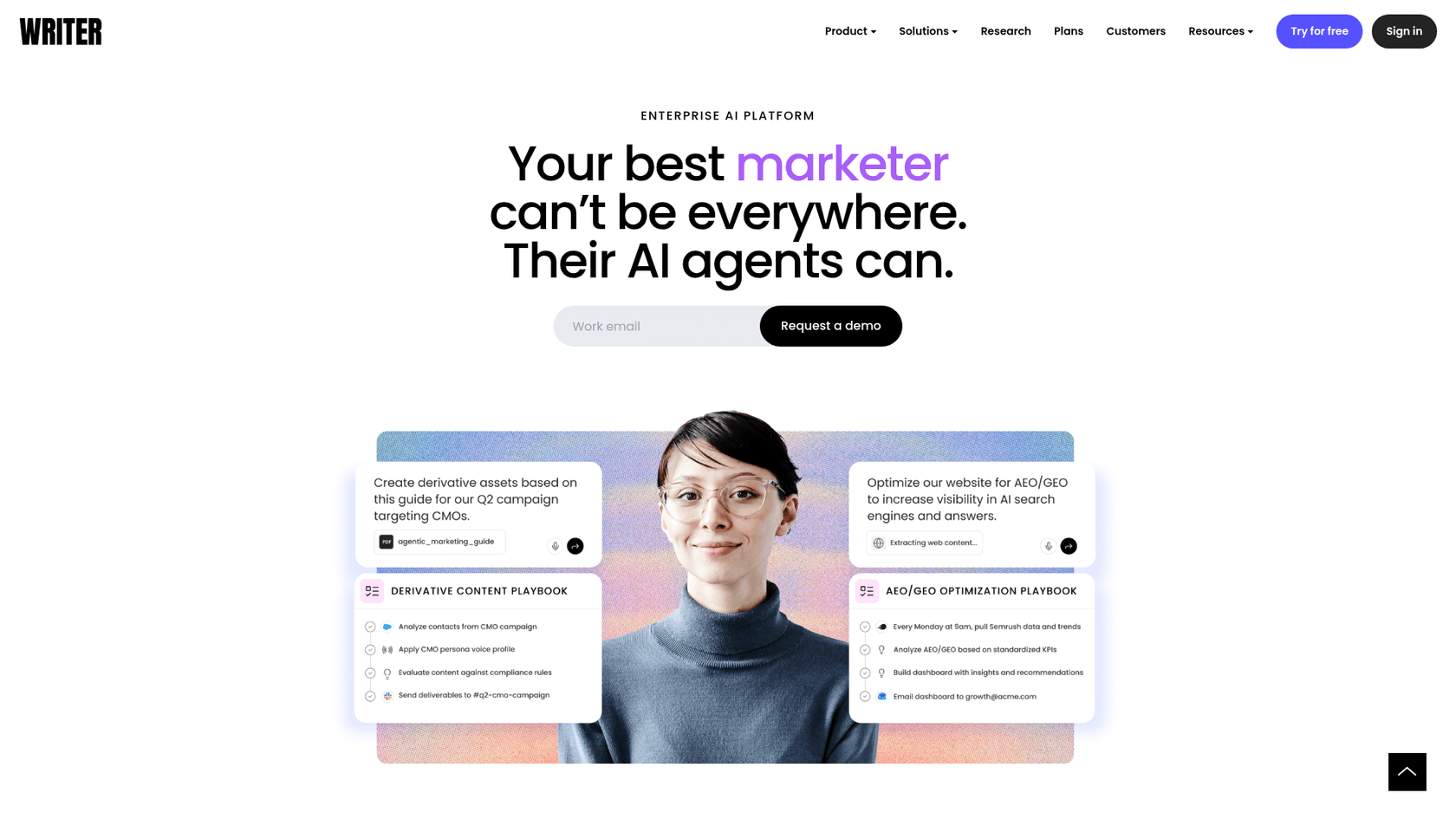
Writer is the most enterprise-leaning option here. It runs on its own Palmyra LLM family, which includes specialised models like Palmyra Med and Palmyra Fin, offers up to a 1 million token context window on Palmyra X5, and pairs all of that with a Knowledge Graph based RAG system that the company benchmarks at 86.31% on RobustQA, faster and cheaper than vector-based alternatives.
For agencies, the headline is governance. Writer's Voice feature builds a brand profile from sample copy (300 to 500 words is the recommended input, spread across up to 8 text boxes) and the platform enforces it through a governance layer that sits across every AI app, every rewrite, every output. There is also a terminology system inside the Style Guide that lets you flag approved and unapproved terms per brand.
Capterra reviewers tend to focus on this part:
"Qordoba is not a generic style guide. On top of standard spelling, grammar and usage checks, Qordoba lets us add the custom rules of our brands' particular style decisions, word choices, inclusivity guidance, etc. to fit our customer experience." (Jennifer S., Capterra, May 2020)
(Writer was previously called Qordoba before the 2020 rebrand, which is why older reviews use the old name.)
Pricing
| Plan | Price | Users | Knowledge Graph | Connectors |
|---|---|---|---|---|
| Starter | Not displayed; 14-day free trial, no credit card | Up to 5 | 1 graph, 1 GB | 3 basic |
| Enterprise | Custom, quote-based | Unlimited Pro plus unlimited free Lite seats | Unlimited, 50 GB per graph | Unlimited |
Writer does not publish a price on either plan card. You start the 14-day Starter trial to see in-app pricing, or contact sales for Enterprise. Writer offers a 20% non-profit and education discount and supports HIPAA via BAA on Enterprise.
Pros and cons
Pros: serious brand voice control, governance that holds across the whole platform, a Knowledge Graph that handles spreadsheets, PDFs, and structured data, and zero data retention.
Cons: enterprise pricing for enterprise problems. If you are a five-person agency without a procurement process, the platform is overbuilt and the contract structure can be a barrier. Reviewers also flag occasional slowness and hallucinations on long documents:
"Total limit of 10 million word count, which is huge... Its a average tool with good capabilities around summarising stuff, checking grammar, reading lengthy pdfs, combining links and producing insights but slow in terms of output and hallucination." (Nishant T., Capterra, March 2025)
Who it is for
Agencies serving regulated industries, large brands, or any client where a legal or compliance team has opinions about AI output. Also useful for agencies that want to bake AI into their own internal operations and need SSO and audit logs.
3. Copy.ai
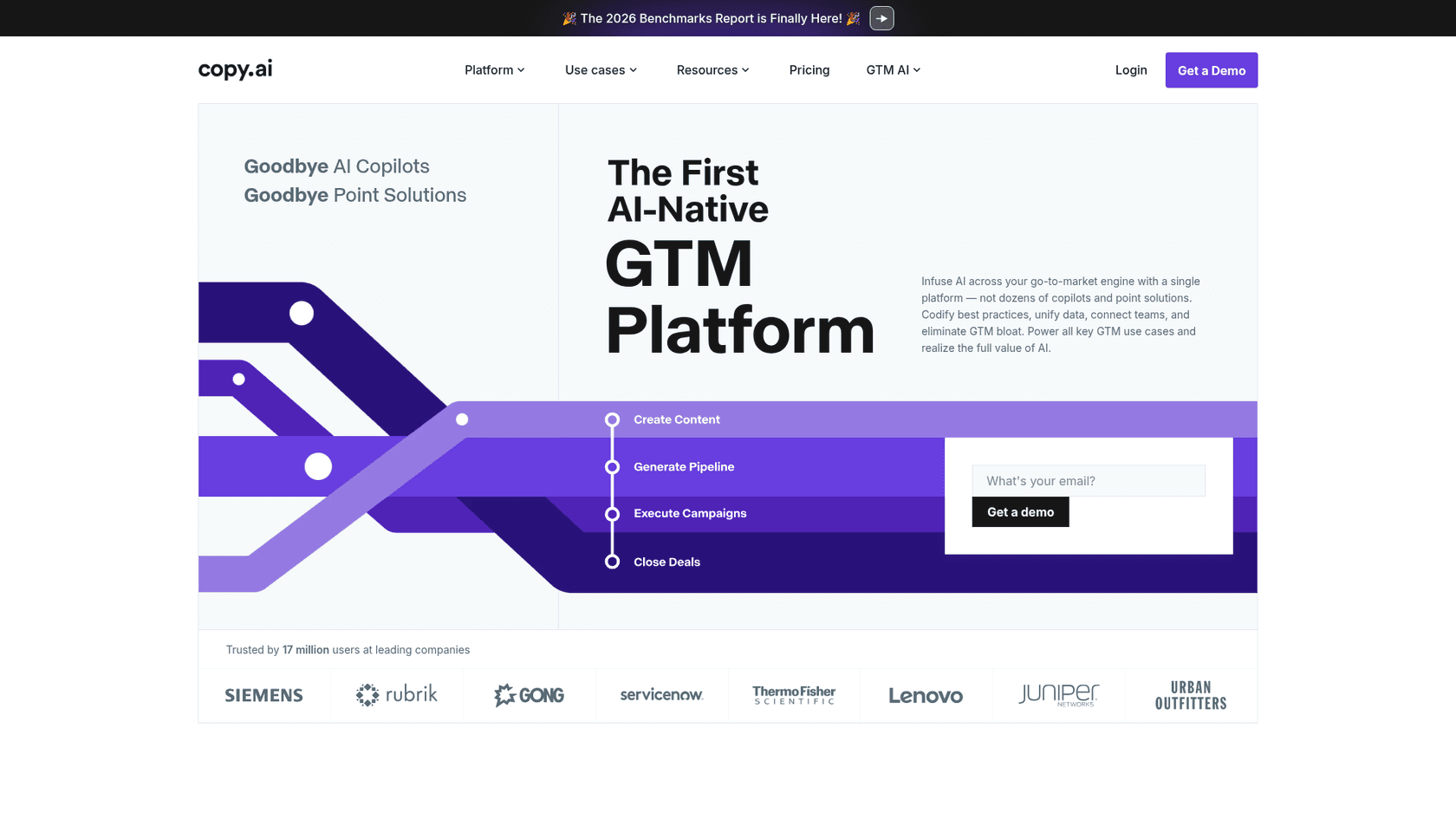
Copy.ai made a hard pivot in 2024 from "AI copywriter" to "GTM AI platform." The new positioning is about ending GTM bloat, the messy mix of tools agencies and in-house teams use to research, write, prospect, and follow up. The result: revenue grew 480% in 2024, with case studies like Lenovo claiming up to $16 million in saved agency fees by automating workflows.
For agencies, the relevant primitives are Workflows (automated sequences across content, sales, and customer success) and Copy Agents (named agents for specific GTM roles). Underneath sits a model-agnostic layer with access to OpenAI, Anthropic, and Gemini, plus a library of 90+ templates for the everyday work: blog ideas, cold emails, product descriptions, LinkedIn headlines, AIDA and PAS frameworks. Brand consistency lives in the Brand Voice and Infobase features.
Reviews are friendlier on short content than long:
"User friendly and fast for short content generation but needs heavy fact checking and edits for long form writing." (Nishant T., Capterra)
The aggregate score sits at 4.4 out of 5 across 67 Capterra reviews, which is decent but lower than Jasper or Frase.
Pricing
The pricing page splits into two tabs at the top: Self-Serve and Enterprise. The only price displayed publicly is the Chat plan; Enterprise is a custom quote.
| Plan | Price | Seats | What you get |
|---|---|---|---|
| Chat (Self-Serve) | $29 per month, $24 per month annual ($288 per year) | 5 | Unlimited Words in Chat, Unlimited Chat Projects, OpenAI/Anthropic/Gemini access |
| Enterprise | Custom, get a demo | Custom | Unlimited Customizable Workflows, API access, 20+ tech integrations, Bulk Workflow Runs, designated account team, SOC 2 |
The structure is intentional. Chat is a starter plan for small teams. Workflows, the GTM automation layer that drives Copy.ai's headline case studies, lives on Enterprise contracts and gets quoted by sales rather than priced on the page.
Pros and cons
Pros: workflow automation that goes well beyond writing, generous seat counts on the higher tiers, and a Brand Voice plus Infobase combo that keeps content grounded in real company facts. Strong agency story now that it is part of Fullcast.
Cons: the gap between Chat ($29 per month) and Enterprise (quote-only) is steep, and the GTM repositioning means casual writers feel like the wrong audience. If you only need a content writer, this is not the cheapest path.
Who it is for
Agencies with sales or RevOps clients, especially those running outbound campaigns, since Copy.ai blurs the line between writing copy and operating the GTM funnel.
4. Surfer SEO
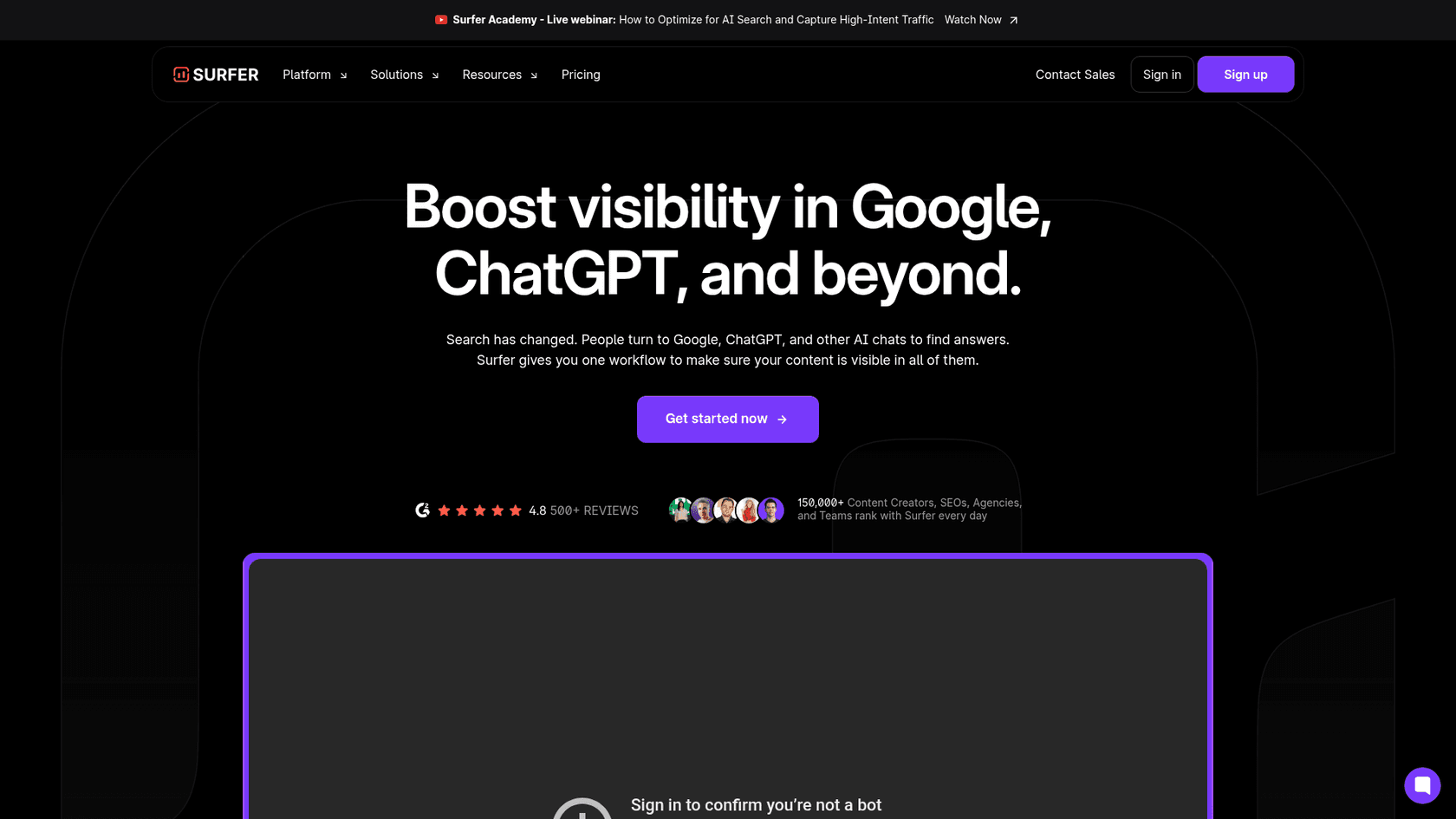
If your agency lives or dies on rankings, Surfer SEO is probably already on the shortlist. The company has rebranded as an AI Visibility Platform, with optimisation aimed at Google as well as ChatGPT, Perplexity, and Gemini. They report around $15 million in revenue and are still based in Wrocław, Poland.
The flagship is the Content Editor, with its real-time Content Score driven by 500+ ranking factors and an NLP analysis of the top 10 ranking competitors per keyword. On top of that sits Surfer AI, a one-click long-form generator using GPT-4o with a 128k context window that scans up to 300,000 words per article before drafting. Add in topical maps, automated internal linking, an AI Detector, an AI Humanizer, and you have most of an in-house SEO team in one tab.
For agencies specifically, Surfer leans hard into multi-client work. Brand Workspaces keep client data isolated, white-labeling ships on the Enterprise tier, and external freelancers can edit a brief without a Surfer seat through a shareable link.
Pricing
| Plan | Price (annual) | Brand workspaces | Team seats | Pages tracked | Notable inclusions |
|---|---|---|---|---|---|
| Discovery | $49 per month | 1 | 1 | 10 | Draft and optimise content, baseline AI search presence |
| Standard | $99 per month | 1 | 3 | 50 | Plagiarism checker, team collaboration, AI tracker prompts |
| Pro | $182 per month | 5 | 5 | 200 | Rank Drop Detection, Cannibalisation Report, 1-click internal linking |
| Peace of Mind | $299 per month | Unlimited | 10 | 500 | API access, VIP support, uncapped optimisation |
| Enterprise | $999 per month | Tailored | Tailored | Tailored | SSO, white-label, dedicated advisory |
Pros and cons
Pros: hard to beat for SEO depth, real agency-aware features, and a comprehensive view across traditional search and AI search. The agency tier specifically is well-loved by content shops:
"I write better articles faster. When I have outside writers create content I make sure it's Surfer optimized as that saves me a LOT of time in dealing with their content." (Jonathan G., Capterra, June 2022)
Cons: the price climbs quickly once you outgrow Standard, and the tool is most powerful when used hands-on by writers who already know SEO. Reddit is also full of pushback on the "gamified" Content Score, with some agency owners arguing that chasing 100 makes content robotic and over-optimised. Some reviewers find the AI features overpriced relative to results:
"At nearly five times the cost of comparable tools, Surfer AI simply doesn't deliver enough unique value to justify the premium... I consistently found myself double-checking the statistics and references provided by the AI, only to discover they were either inaccurate or completely fabricated." (Amin N., Capterra, April 2025)
Who it is for
SEO and content agencies whose deliverables include rank tracking and ranking outcomes, where a shareable Content Editor link to outside writers cuts hours per brief.
5. Frase
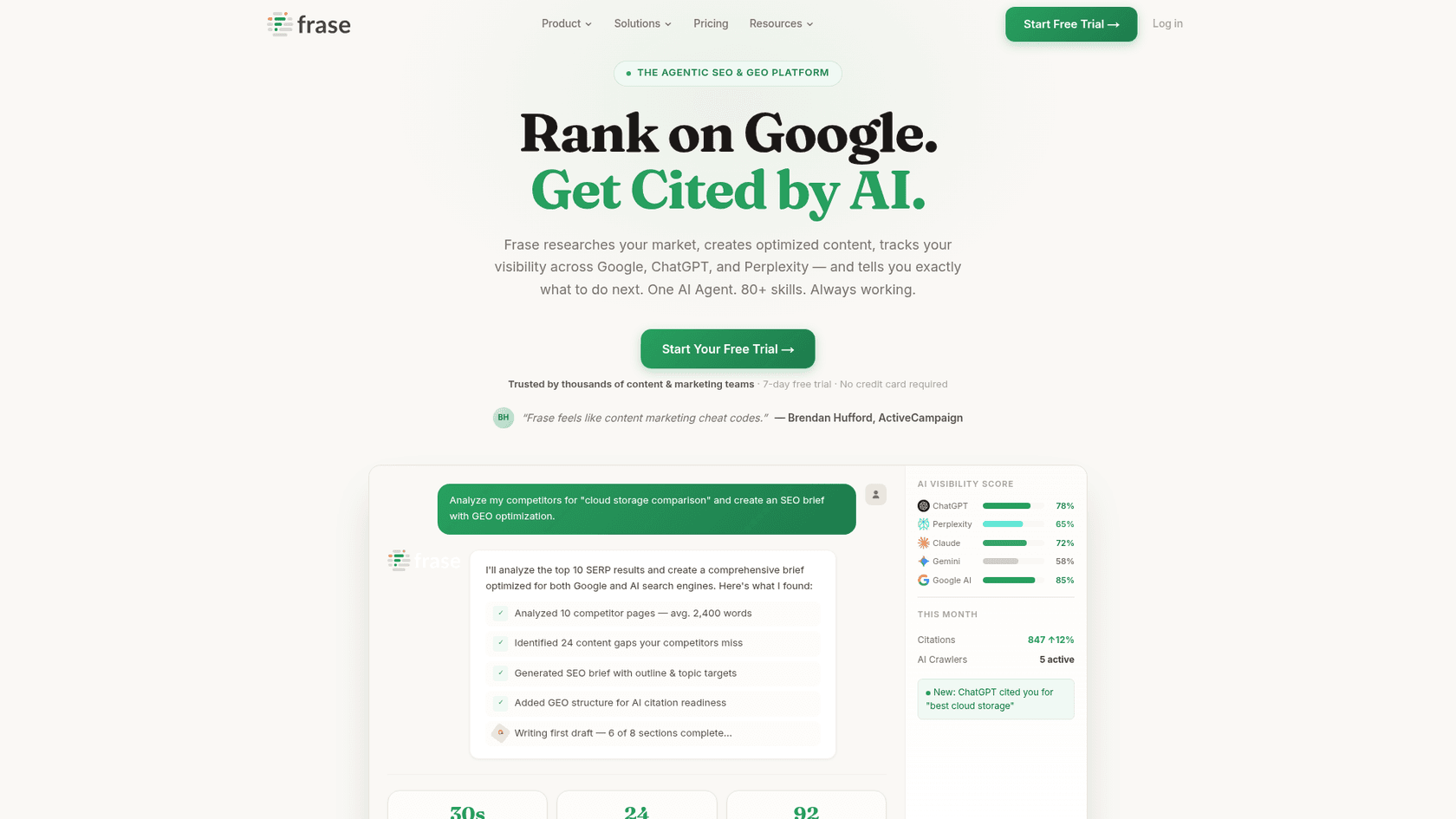
Frase is the best example of the research-first school of AI writing. The pitch: an Agentic SEO and GEO Platform where one AI Agent with 80+ skills handles the whole loop, brief to draft to optimise to track. GEO here means Generative Engine Optimization, which is Frase's term for ranking inside ChatGPT, Perplexity, Claude, and Gemini answers, not just Google.
For agencies, the most useful pieces are content briefs (which scrape the top 20 SERP results in seconds), GEO content optimisation, and AI search tracking that monitors brand share of voice across 8 AI search platforms. The platform also supports content atomisation (turning one blog post into LinkedIn carousels and Twitter threads) and programmatic SEO for sites that need 1,000+ pages from structured data.
Frase scores 4.8 out of 5 across 301 G2 reviews, with reviewers consistently calling out the time savings:
"I love how Frase scrapes the top 20 listings for you! Saves a great deal of work for those of us who used to have to manually search for the best titles, headers, and keywords." (Pam M., G2)
The brand governance layer is positioned as a multi-client feature too, enforcing brand voice and terminology automatically across AI-generated content. On the corporate side, Frase was acquired by Copysmith in October 2022 and now sits inside Copyrytr after Copysmith's merger with Rytr, with around $1.8M ARR and a 16-person team as of 2025. Older lifetime-deal customers were largely left on a legacy version when Frase 2.0 launched, which is worth knowing if you are looking at second-hand deals.
Pricing
| Plan | Monthly | Annual effective | Articles | Seats | Search queries |
|---|---|---|---|---|---|
| Starter | $49 | $39.20 | 10 | 1 | 50 |
| Professional | $129 | $103.20 | 40 | 3 (+$29 each) | 200 |
| Scale | $299 | $239.20 | 100 | 5 (+$29 each) | 500 |
There is a 7-day free trial with no credit card. Enterprise customisation covers SSO, white-label client portals, and custom SLAs.
Pros and cons
Pros: research-first workflow that mirrors how agencies actually scope content, AI search tracking that very few competitors offer, and the AI Agent is included on every plan including Starter. The Claude MCP integration is also a small but real win for teams that already work in Claude.
Cons: small team behind it (16 people), and the article credit model can be limiting once you cross 100 briefs a month. Frase is more research powerhouse than full editor, so most agencies still pair it with a doc tool.
Who it is for
Agencies that build content strategies around briefs and SERP coverage, especially ones starting to track AI search visibility for clients.
6. StoryChief
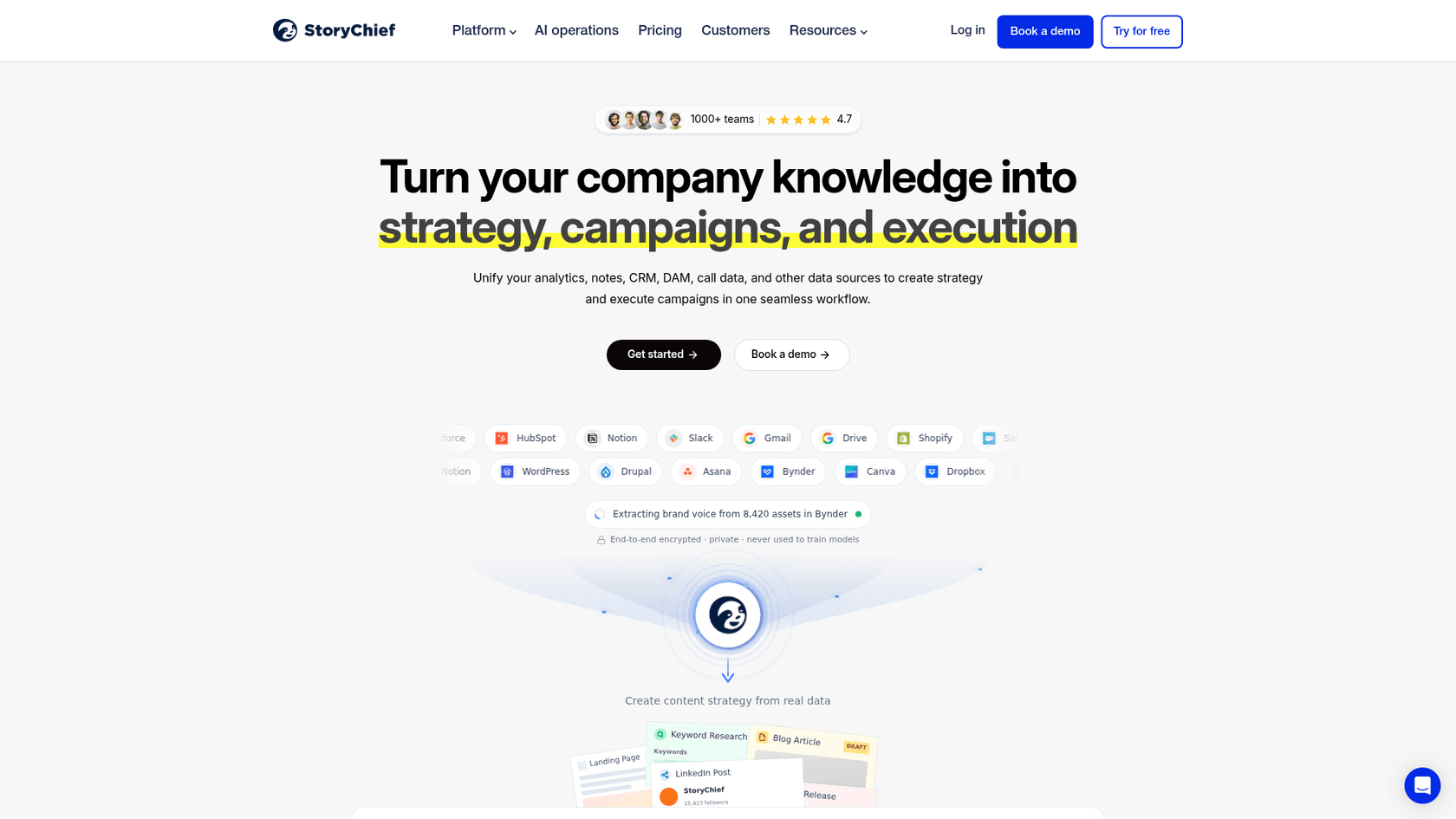
StoryChief is the only tool here that treats publishing and distribution as a first-class part of the writing workflow. Founded in Ghent, Belgium in 2017, the company has raised about €4.5 million and built itself around the agency use case explicitly: per-customer pricing, per-customer workspaces, per-customer AI credits.
The AI engine is called William, an agent backed by Company Intelligence (brand voices, content pillars, competitor tracking, custom instructions). Brand voices can be created from a URL, pasted text, or built from scratch, which is the cleanest onboarding flow we tested. Around William sits the rest of the platform: an AI Canvas for campaign planning, an article AI editor with SEO assistance, autofill for excerpts and meta descriptions, and AI image and video generation.
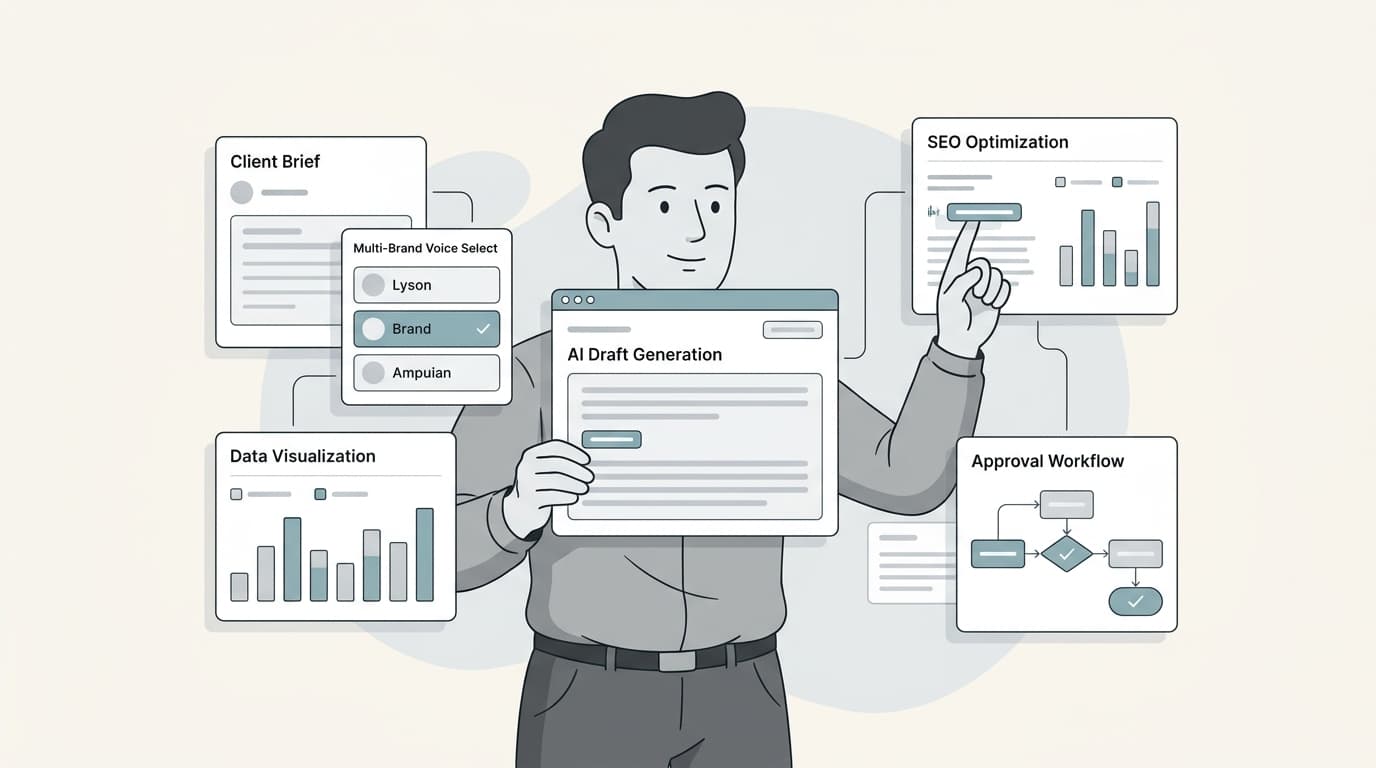
The agency-specific feature that matters most is Multi-Brand Workspaces. Each client gets a dedicated environment with isolated content, roles, and approvals, and the Agency plans bill per customer rather than per seat, which makes the cost model line up with how agencies actually invoice. Native integrations cover WordPress, Webflow, Shopify, HubSpot, LinkedIn, TikTok, and many more, plus Zapier for the tail.
Reviewers focus on speed and consolidation:
"The main benefit has been the speed with which I can go from a blank screen to published Blog. I also love that it syndicates the content across my social media channels which also saves a lot of time." (Marilyn D., Capterra)
The aggregate score sits at 4.7 out of 5 across 129 Capterra reviews.
Pricing
| Plan | Price (annual) | Users | Social channels | AI credits |
|---|---|---|---|---|
| Free | $0 | - | - | - |
| Social Media Calendar | $22 per month | 1 | 3 | 1,000 |
| Team Social | $34 per seat per month | Per seat | 4 | 5,000 |
| Team Editorial | $81 per seat per month | Per seat | 6 | 8,000 |
| Agency Social | $58 per customer per month | Unlimited | 4 per customer | 5,000 per customer |
| Agency Editorial | $93 per customer per month | Unlimited | 6 per customer | 8,000 per customer |
| Enterprise | Custom | Custom | Unlimited | Custom |
AI Extension Pack ($57 per month) adds 50,000 credits per month with image and video generation, and AI Pro Pack ($119 per month) adds 100,000 credits with tailored agent training. SSO is a $25 per user add-on with a 5-user minimum. All paid plans include a 7-day free trial with no credit card.
Pros and cons
Pros: per-customer pricing built for agencies, the strongest distribution layer in this list, brand voices that learn from a URL in seconds, and approval workflows that keep client comments inside the platform.
Cons: smaller community than Jasper or Surfer (under 50 employees), G2 review depth is limited because of bot blocking, and the article editor is competent rather than best-in-class. If your priority is the prose itself, this is not the tool.
Who it is for
Agencies that publish across multiple CMSes and social channels for many clients, where collapsing the writing, approval, and distribution stack into one tool saves more time than chasing the perfect AI prose.
How to choose between them
The honest answer is that most agencies end up running two of these together rather than picking one. A typical agency stack looks like this:
- A research and SEO layer (Surfer or Frase) where briefs and rankings live.
- A drafting and brand-voice layer (Jasper, Writer, or Copy.ai) where the actual writing happens.
- A distribution and workflow layer (StoryChief, sometimes Copy.ai's workflows) where content gets approved and published across channels.
To narrow it down further, ask three questions about your agency:
- What is your dominant deliverable? If most of your work is SEO-led blog content, start with Surfer or Frase. If most of your work is multi-channel campaigns or social, start with Jasper or StoryChief. If you are deeply involved in your clients' GTM motion (sales sequences, product copy, lifecycle), Copy.ai is built for that shape.
- How important is governance? Regulated clients (healthcare, finance, legal) push you towards Writer fast. The Knowledge Graph, Palmyra Med and Fin models, and zero data retention are not optional checkboxes; they are the price of entry.
- What does your pricing model look like to clients? If you bill per-client retainers, a per-customer tool like StoryChief mirrors that cleanly. If you bill projects, seat-based tools work fine.
Two tips that come up in every agency conversation we have had this year:
- Always train brand voices on real client copy before you ship anything. Most of the bad output you see attributed to AI is really the result of nobody bothering with the voice setup.
- Watch the credit and seat limits carefully on the cheaper plans. Going one tier up halfway through the month is fine; getting cut off mid-deliverable is not.
Wrapping up
The 2026 version of "best AI writing tool for agencies" looks different from the 2024 version. The interesting tools are no longer the ones that produce the cleanest paragraph. They are the ones that handle multiple clients without friction, govern voice and terminology automatically, and stretch into SEO, GEO, and distribution.
For most agencies, the winning move is to combine an SEO research tool (Frase or Surfer), a drafting and brand-voice tool (Jasper, Writer, or Copy.ai), and a distribution tool (StoryChief). Start with one client's workflow, prove it out, then extend to the rest.
If your agency also handles support inboxes for clients (live chat, ticket queues, internal helpdesks for ops or HR), the writing-tool layer is half of what you need. The other half is an AI agent for support, which is where eesel comes in. We focus specifically on the inbox side: agents that learn from your past tickets, knowledge bases, and macros, and reply with the right voice on Zendesk, Freshdesk, Slack, and many more channels. The same brand voice discipline you apply to writing tools applies there too. If you want to see how that side fits next to your content stack, our blog covers it in more depth, and you can browse pricing when you are ready.