
Ever wondered how companies like Zapier, Wise, and TripAdvisor generate millions of organic visits without manually writing each page? The answer is programmatic SEO, a strategy that uses automation, structured data, and templates to create hundreds or thousands of search-optimized pages at scale.
Instead of crafting individual blog posts or landing pages one by one, programmatic SEO (pSEO) identifies a repeatable search pattern and builds content around it automatically. It's how Zapier generates over 800,000 integration pages, how Wise ranks for every currency conversion pair, and how TripAdvisor owns search results for "best hotels in [city]" across thousands of destinations.
And in 2026, the concept is expanding beyond landing pages. AI tools like eesel AI blog writer now apply programmatic principles to blog content itself, turning a single keyword into a complete, SEO-optimized article with research, assets, and formatting built in.
This guide covers what programmatic SEO is, how it works, real-world examples, the step-by-step process, the risks to avoid, and how AI is reshaping pSEO in 2026.
What is programmatic SEO and how does it work?
Programmatic SEO is the practice of using automation to create large numbers of search-optimized web pages by combining structured data with page templates. Rather than writing each page from scratch, you build one reusable template and populate it with data from a database, spreadsheet, or API to produce unique pages at scale.
The core formula is straightforward:
Scalable keyword pattern + structured data + page template = pages at scale
Here's how that breaks down. First, you identify a keyword pattern with a consistent structure, something like "best [X] in [Y]" or "[product] vs [product]." Then you collect the data needed to fill in those variables (city names, product specs, pricing, reviews). Finally, you design a page template that pulls in that data dynamically, so each page is unique but follows the same layout.
How does this differ from traditional SEO? With traditional SEO, you manually research and write individual pages targeting specific high-volume keywords. Programmatic SEO flips the approach: instead of going deep on a few keywords, you go wide across hundreds or thousands of long-tail variations. Traditional SEO might target "best project management tools," while programmatic SEO targets "best project management tools for [marketing teams / startups / remote workers / agencies]" across every variation.
One important distinction: programmatic SEO is not the same as programmatic advertising. Programmatic advertising refers to automated ad buying (display ads, retargeting). Programmatic SEO is purely an organic search strategy focused on creating content pages.
Worth noting: Google's John Mueller has called programmatic SEO "often a fancy banner for spam." He's not wrong about the risk. The difference between legitimate pSEO and doorway pages comes down to quality. If every page provides genuine, unique value to the person searching, it's solid SEO. If pages are thin, repetitive, or exist only to capture clicks, that's spam.
Real-world programmatic SEO examples
The best way to understand programmatic SEO is to look at companies already doing it well. Each of these businesses identified a repeatable keyword pattern, built a structured data source, and scaled content creation around it.
Zapier (app integration pages)
Zapier built over 800,000 landing pages, each targeting a specific app integration like "How to connect Slack to Google Sheets" or "Salesforce to Mailchimp integration." The keyword pattern follows a "[App A] + [App B]" structure, and each page pulls from Zapier's internal database of supported integrations. Zapier now ranks for thousands of long-tail keywords that collectively drive massive organic traffic.
Wise (currency conversion pages)
Wise generates pages for every possible currency conversion pair, targeting queries like "USD to EUR exchange rate" or "GBP to INR conversion." Each page populates with live exchange rate data from financial APIs, along with fee comparisons and historical charts. Because the data updates dynamically, every page stays fresh without manual intervention.
TripAdvisor (destination pages)
TripAdvisor owns search results for travel queries across thousands of destinations. Their programmatic pages target patterns like "Best hotels in Paris," "Top restaurants in Tokyo," and "Things to do in Barcelona." Each page combines user-generated reviews, ratings, photos, and structured location data to create genuinely useful content at a scale no editorial team could match manually.
Canva (design template pages)
Canva generates landing pages for every design template type in their library, targeting keywords like "free invoice template," "resume template," and "Instagram story template." The data source is their template library metadata, and each page showcases relevant templates with preview images, making the pages both SEO-friendly and immediately useful.
Nomad List (city comparison pages)
Nomad List creates pages for cities worldwide, targeting queries like "Lisbon for digital nomads" or "Chiang Mai cost of living." Each page aggregates data on cost of living, internet speed, safety scores, weather, and community ratings. The data is a mix of scraped public sources and user-submitted information.
| Company | Keyword pattern | Estimated pages | Data source |
|---|---|---|---|
| Zapier | "[App A] to [App B] integration" | 800,000+ | Internal integration database |
| Wise | "[Currency A] to [Currency B]" | 10,000+ | Real-time financial APIs |
| TripAdvisor | "Best [X] in [city]" | Millions | User reviews + location data |
| Canva | "Free [document type] template" | 100,000+ | Template library metadata |
| Nomad List | "[City] for digital nomads" | 1,000+ | Scraped + user-submitted data |
How to build a programmatic SEO strategy step by step
Building a programmatic SEO strategy follows a consistent process regardless of your industry or niche. Here's the step-by-step approach, synthesized from what the top-ranking guides on this topic recommend.
1. Find a scalable keyword pattern
The foundation of any pSEO strategy is a keyword pattern that generates enough variations to justify building at scale. Look for a "head term + modifier" structure where the modifier can change across dozens or hundreds of values.
For example, "best [tool] for [use case]" might produce hundreds of variations: "best CRM for startups," "best CRM for real estate," "best CRM for nonprofits." Use keyword research tools to validate that enough of these variations have search volume. If only three variations get searched, programmatic SEO isn't the right approach. If three hundred do, you're in business.
A helpful technique is keyword clustering, where you group related long-tail keywords together to identify patterns that lend themselves to programmatic content.
2. Collect and structure your data
Your data is the fuel. Without clean, structured data, programmatic SEO doesn't work. Common sources include proprietary databases, public datasets (government data, open APIs), web scraping, and user-generated content.
Organize your data in a structured format where each row represents one page and each column represents a content element: title, meta description, body text, images, and any other dynamic fields. Tools like Google Sheets, Airtable, or SQL databases work well depending on your scale.
3. Design your page template
The template is your reusable layout with dynamic content slots. It should include all the SEO essentials: title tag, meta description, H1 and H2 headings, structured data (schema.org markup), and content blocks that pull from your database.
The key here is making sure every page provides genuinely unique, useful content. Swapping out a city name in otherwise identical text isn't enough. Each page needs enough unique data, context, or information to justify its existence.
4. Generate and publish pages
Connect your database to your CMS to generate pages programmatically. Popular combinations include WordPress with WP All Import, Webflow with Whalesync, or a headless CMS with custom API connections. Publish in batches rather than all at once. This helps you manage crawl budget, monitor indexation, and catch issues early.
5. Build internal links and optimize technical SEO
Programmatic pages need strong internal linking to signal relevance and distribute link equity across your site. Create topic clusters that connect related pages (e.g., all city pages within a region link to each other).
Submit XML sitemaps to Google Search Console, monitor for crawl errors, and add structured data markup where appropriate. Technical SEO becomes even more important when you're publishing at scale because small errors multiply across hundreds of pages.
6. Monitor, measure, and iterate
Track three key metrics: indexation rate (what percentage of your pages are Google indexing?), rankings (are pages actually appearing in search results?), and traffic per page (are they driving visits?).
Identify thin or underperforming pages and either improve them with richer data or prune them entirely. Update your data regularly to keep pages fresh, as stale content loses rankings over time.
How AI is changing programmatic SEO in 2026
Traditional programmatic SEO has always focused on landing pages: product pages, location directories, integration listings, and data-driven comparison pages. The template-plus-database approach works well for structured, data-heavy content. But it has a limitation. Template-generated pages can feel mechanical, and they don't work as well for content that needs nuance, context, or narrative flow.
That's where AI changes the equation.
In 2026, AI content tools are extending programmatic SEO principles to blog content, articles, and long-form guides. Instead of just swapping variables in a template, AI can generate unique introductions, contextual paragraphs, FAQs, and even media assets for each page, making programmatic content feel genuinely human-written.
There's also a new dimension to consider: AEO (Answer Engine Optimization). Programmatic pages in 2026 need to be optimized not just for Google's traditional search results, but for AI answer engines like Google AI Overviews, ChatGPT, and Perplexity. This means structuring content with clear, direct answers, proper headings, and schema markup that AI systems can easily parse.
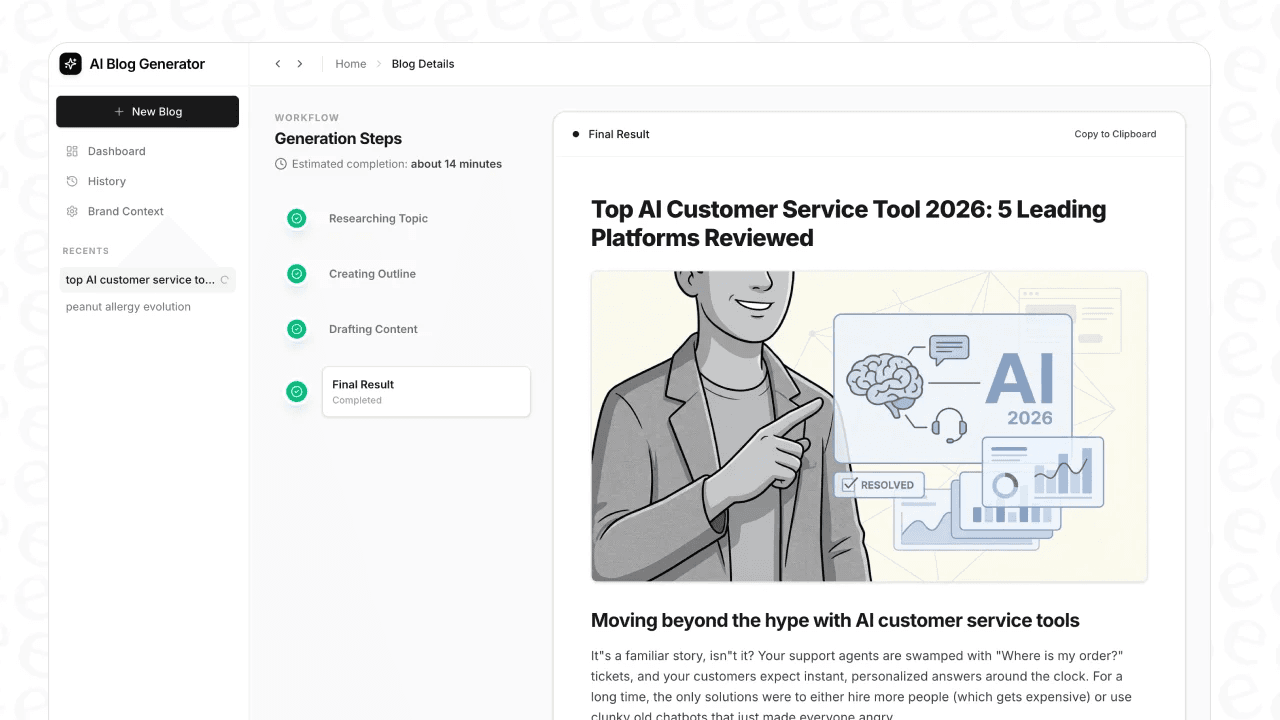
Tools like eesel AI blog writer apply this approach to blog production at scale. You enter a keyword, and it generates a complete, SEO-optimized blog post with research, assets (infographics, screenshots, charts), Reddit quotes for social proof, and AEO-ready formatting. It's the same approach the eesel AI team used to grow from 700 to 750,000 daily search impressions in just three months, publishing over 1,000 optimized blogs. And it's free to try.
The quality bar is higher than ever. Google's helpful content system evaluates whether content is genuinely useful to readers. AI-generated content that reads like generic filler will hurt rankings, not help them. The principle stays the same whether you're doing traditional pSEO or AI-powered content creation: use automation for scale and efficiency, but never as a replacement for genuine value.
Risks and common mistakes to avoid with programmatic SEO
Programmatic SEO can drive significant organic traffic, but it can also backfire if executed poorly. Here are the most common risks to watch for.
Thin or duplicate content is the number one pitfall. If your pages are just the same template with a single variable swapped out (e.g., only changing the city name), Google will recognize them as low-quality and may refuse to index them. Every page needs enough unique data and context to stand on its own.
Google penalties for doorway pages are a real threat. Doorway pages are pages created solely to rank for specific searches that funnel users to a single destination without providing standalone value. If your programmatic pages don't offer genuine utility, they risk being flagged as spam.
Indexation problems emerge when you publish too many similar pages at once. Google allocates a crawl budget to each site, and flooding it with thousands of near-identical pages can waste that budget. The result: Google crawls your pages but decides not to index most of them.
Poor keyword research can undermine the entire strategy. If you build 500 pages targeting keyword variations that nobody searches for, you've invested time and resources for zero return. Validate search volume before building.
Neglecting maintenance is a slower-burning risk. Programmatic pages with outdated pricing, broken links, or stale data lose rankings over time. Plan for regular data updates from the start.
Ignoring search intent means creating pages that technically target the right keyword but don't actually answer what users want. Before building, check what already ranks for your target queries and make sure your pages match (or exceed) that level of usefulness.
A practical tip from Zapier's guide: validate demand before building your full page set. Run a small Google Ads campaign or test affiliate traffic for a sample of your target keywords. If the traffic converts, scale up. If not, pivot before investing further.
Getting started with programmatic SEO using AI tools
Programmatic SEO makes sense when you have three things: a repeatable keyword pattern with enough search volume variations, a structured data source to populate pages, and a scalable business model that benefits from long-tail organic traffic.
For landing pages (product directories, location pages, integration listings), the traditional approach still works well. Set up a database in Airtable or Google Sheets, design your template in WordPress or Webflow, connect them with a sync tool like Whalesync or WP All Import, and publish.
For blog content at scale, the game has changed. AI blog generators like eesel AI blog writer let you apply programmatic thinking to content marketing. Enter a keyword, and you get a complete, research-backed, SEO-optimized blog post with automatic assets (infographics, comparison tables), social media integration (Reddit quotes, YouTube embeds), and AEO-ready formatting. It's free to try, so you can see the quality of output for yourself before committing.
Bottom line? Programmatic SEO is about finding patterns in search demand and meeting them at scale. Whether you're building structured landing pages from a database or generating blog content with AI, the core principle is the same: automation, structure, and quality. Get those three right, and you have a scalable engine for organic growth.