

SEO in 2026 is a different beast. Forget just chasing the top spot on Google's blue-link page. Now, the goal is to get featured in AI Overviews and become a source for chatbots like ChatGPT. The game has completely changed.
With the rise of AI, many tools have emerged, but their output quality can vary. Some produce generic content that may not rank well, making it difficult to determine which tools are most effective.
This article will explore several options, including tools like the eesel AI blog writer, which can turn a keyword into a complete blog post.
What are SEO optimization AI tools?
Put simply, they're software that uses artificial intelligence to handle the grunt work of getting your website noticed online.
Been using a lot of ai for seo about a year now and its the biggest thing isn't the writing, its the research part. keyword insights does this clustering thing based on what actually ranks together instead of just similar words. saves me from making pages that compete with each other. i still write most of it myself but ai gets me like 70% there and we went from 2 posts a month to like 8.

But it's not all about writing. The really good ones help with keyword research, checking out what your competitors are up to, fixing technical site issues, and even tracking your mentions in AI answer engines. This new area is often called Answer Engine Optimization (AEO).
The goal isn't just about speed, although that’s a nice bonus. It's about using data to make better choices and stay ahead in a search world that seems to change every other week.
How the tools for this list were chosen
This list was compiled to be a practical resource beyond a simple collection of popular tools. To earn a spot here, each tool had to meet a few key criteria.
First, each tool has been used personally, and the review is based on direct experience.
Second, it had to deliver results. I looked for tools that made a real difference, whether that was better rankings, more traffic, or getting cited in AI answers.
It also had to be user-friendly. Can a busy marketer start using it without a massive learning curve? I prioritized tools that were intuitive.
I also included a mix of specialized and all-in-one platforms. Some do one thing exceptionally well, while others are a jack-of-all-trades.
Finally, the list prioritizes tools designed to enhance human workflows rather than those that produce low-quality, fully automated content.
A quick comparison of SEO optimization AI tools
| Tool | Best For | Key AI Feature | Pricing |
|---|---|---|---|
| eesel AI blog writer | Generating complete, publish-ready blog posts from a keyword. | Deep research with automatic assets (images, videos, quotes). | Starts at $99/mo for 50 blog posts. |
| Surfer SEO | On-page content optimization for human writers. | Real-time Content Score and AI Visibility Tracker. | Starts at $99/mo (AI Tracker is an add-on or in higher tiers). |
| Semrush | All-in-one SEO and marketing platform. | AI Visibility Toolkit for tracking brand mentions in AI. | Starts at $199/mo, or $99/mo for the AI Visibility Toolkit add-on. |
| Clearscope | Optimizing human-written content to rank faster. | AI-powered term suggestions and AI Drafts feature. | Starts at $129/mo. |
| Rankscale.ai | Granularly tracking brand visibility in AI search engines (GEO). | Multi-LLM tracking (ChatGPT, Perplexity, Gemini, etc.). | Starts at $20/mo (credit-based). |
| Search Atlas | Agencies looking for an all-in-one, automated platform. | OTTO SEO agent for automated on-page and technical fixes. | Starts at $99/mo. |
6 notable SEO optimization AI tools
Alright, let's get into the details. Here’s an overview of six tools, including what they do well and their limitations.
1. eesel AI blog writer
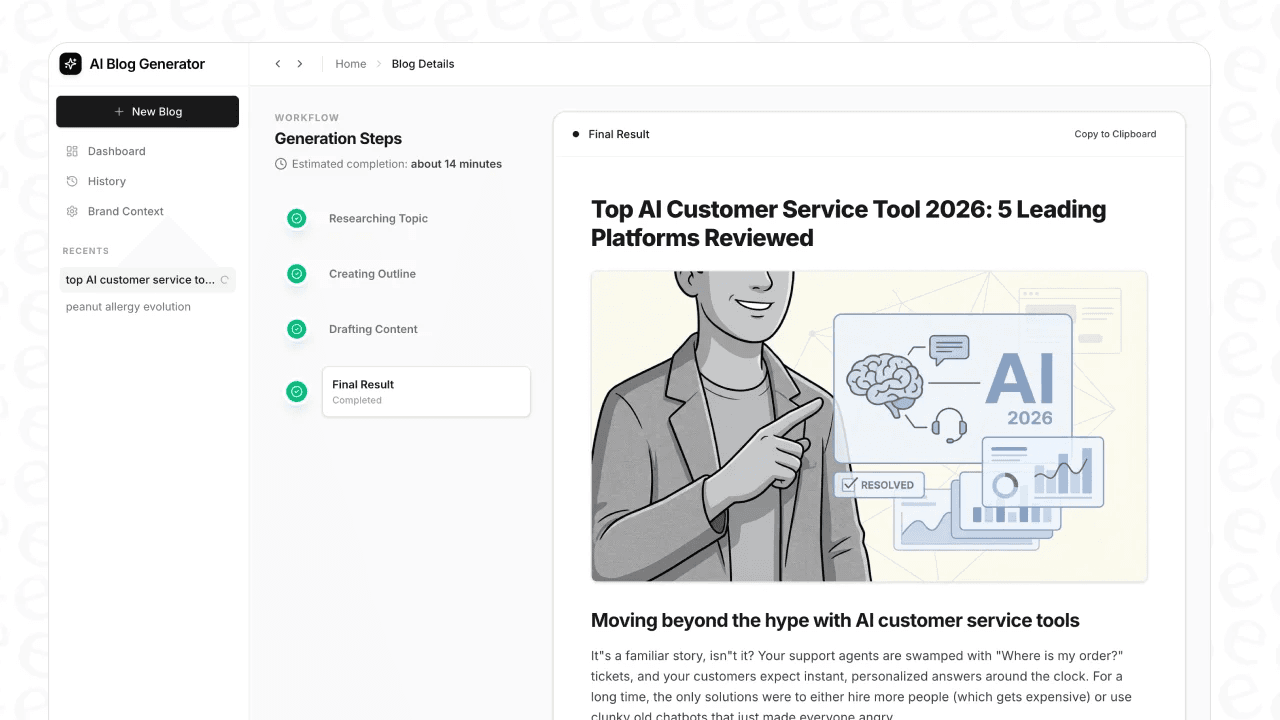
For those who need to scale content production, the eesel AI blog writer is a tool designed for this purpose. You give it a keyword, and it gives you back a complete, researched, and SEO-optimized article that's ready to publish.
-
Pros: This tool is designed for efficient content creation. It produces a complete, well-structured blog post rather than just a block of text. A key feature is its automatic asset generation, which can include AI images, YouTube videos, and quotes from Reddit. It's also built with Answer Engine Optimization (AEO) to help content perform better in AI search results.
-
Cons: It is a specialized tool for creating full-length articles from scratch. It may not be the right fit for users looking to only tweak a meta description or rewrite a short paragraph.
-
Pricing: The Early Bird plan is $99 per month for 50 complete blog posts. A free trial is available to test the platform.
-
Best for: Businesses and agencies looking to automate parts of their content workflow and publish articles at scale.
2. Surfer SEO
Surfer SEO is a well-known tool in on-page optimization. It provides writers with a data-driven guide for creating content aligned with current top-ranking pages.
Surfer - really strong for on-page/content optimization. Helps structure articles to match SERP and AI search expectations, with clear keyword and heading suggestions.
-
Pros: The Content Editor is a core feature. It gives you a live "Content Score" while you write, which can help gamify the optimization process. Their AI Tracker is also a useful addition. It shows how often your brand appears in Google AI Overviews, ChatGPT, and Perplexity.
-
Cons: Surfer is primarily for optimizing content written by people. It has an AI writer, but it’s not as powerful as tools dedicated solely to generation. A potential drawback is that the AI Visibility tracking isn't included in the basic plan. You have to upgrade or purchase it as an add-on.
-
Pricing: The Essential plan starts at $99/month. To get the AI Tracker, you'll need the Scale plan, which starts at $175/month when billed annually.
-
Best for: Content teams and SEOs who handle their own writing but want a solid framework to ensure every article is optimized.
3. Semrush
Semrush is a comprehensive digital marketing platform that offers a wide range of functions, including a growing suite of AI-powered tools.
A few that have been game changers for us: Semrush AI → clustering keywords + analyzing SERPs at scale.
-
Pros: Semrush covers many aspects of digital marketing. Their AI Visibility Toolkit is particularly useful. It gives you a detailed look at your brand's presence in AI answers and helps you monitor competitors. They also added an "AI Search Health" check to their Site Audit tool, which flags technical issues.
-
Cons: The number of features can be overwhelming for new users. It is also a higher-priced platform. If you only need content tools, you may be paying for extras you don't use. The AI toolkit is a $99/month add-on unless you're on a higher-priced plan.
-
Pricing: The Semrush One "Starter" plan, which includes the AI Visibility Toolkit, starts at $199/month ($165.17/month if you pay for a year upfront).
-
Best for: Larger in-house marketing teams and agencies that need one central hub to manage everything from SEO to social media.
4. Clearscope
Clearscope is a tool designed to help writers create comprehensive content that aligns with search engine expectations. It focuses more on augmenting the writing process than on full automation.
-
Pros: Clearscope is effective at identifying which terms and topics to include to make content more thorough. They’ve also added features for tracking visibility in AI chatbots and an "AI Drafts" option to provide a starting point. The Google Docs integration is smooth.
-
Cons: The AI drafting feature is a starting point, but Clearscope is fundamentally a tool for optimizing human-written content. It is also on the pricier side, considering the number of reports and drafts included in the monthly plan.
-
Pricing: The Essentials plan starts at $129/month, which gets you 20 AI Drafts and 20 AI Tracked Topics.
-
Best for: Teams that already have strong writers and want to give their content a better chance at ranking and being cited by AI.
5. Rankscale.ai
Rankscale.ai is a specialized tool focused on what it terms Generative Engine Optimization (GEO). Its primary function is to track visibility in AI-generated answers.
-
Pros: The primary strength of Rankscale.ai is its focus. It tracks performance for keywords across multiple AI engines like ChatGPT, Perplexity, Claude, Gemini, and Google AI Overviews. The data is detailed, giving you a "Visibility Score," sentiment analysis, and the sources the AI used. The flexible, pay-as-you-go pricing is also a benefit.
-
Cons: This is strictly a tracking tool. It doesn't help with writing or optimizing content; it reports on performance after publication. You'll need to pair it with other tools to manage your full SEO process.
-
Pricing: It uses a credit-based model. The Essentials plan starts at $20/month for 120 credits, making it very accessible.
-
Best for: Data-focused SEO strategists and marketers who need precise, actionable data on their performance in AI search.
6. Search Atlas
Search Atlas is an all-in-one platform with a notable focus on AI-powered automation.
-
Pros: The OTTO SEO feature is an AI agent that can suggest and implement fixes (with approval). The platform also includes LLM Visibility tracking for models like ChatGPT, covering both classic and AI-focused SEO.
-
Cons: As a newer tool, it competes in a market with established platforms. Teams already comfortable with other tools might be hesitant to switch.
-
Pricing: The Starter plan is competitively priced at $99/month, offering a lot of value for an all-in-one suite.
-
Best for: SEO agencies and businesses looking for a cost-effective and highly automated platform that can compete with more established enterprise tools.
How to choose the right SEO optimization AI tools
Feeling a bit lost with all these options? No problem. Here’s a simple breakdown to help you find the right fit, which is also summarized in the flowchart below.
If your main challenge is scaling content, meaning you can't create enough good articles fast enough, you might need a dedicated content generator. The eesel AI blog writer is designed for this, as it can take care of everything from research to a finished draft.
If you need help with on-page optimization and already have a writing team, look at tools like Surfer SEO or Clearscope. They give your writers a data-backed roadmap to help improve rankings.
For those who want all-in-one management, a single platform to handle keyword tracking, site audits, and competitor research, then a suite like Semrush or Search Atlas is the way to go.
And if your top priority is tracking AI search performance, a specialized tool like Rankscale.ai will give you the most detailed data available.
Pro tip
Figure out your biggest pain point and your budget first. Don't overspend on features you won't use. Identify your main bottleneck (like 'it takes us forever to write one blog post') and choose the tool that directly solves it.
Final thoughts
SEO is changing, but it's here to stay. AI has provided us with useful new tools to figure out what people are looking for and create content that answers their questions.
A common approach is to use AI as a capable assistant. Let it do the tedious work, the research, the data crunching, the first draft. Your job is to bring the human touch: your expertise, your unique viewpoint, and your voice. That's the part AI can't copy.
For those looking to explore an AI content partner, the eesel AI blog writer can generate a full, SEO-ready blog post from a single keyword, complete with images and social proof. You can try it for free to generate your first article.
Frequently asked questions
What are the best free SEO optimization AI tools available?
While most advanced tools have a cost, some offer free trials or limited free plans. For example, you can try the eesel AI blog writer for free to generate your first complete article. Other tools might offer free keyword research or basic site audit features, but for comprehensive work, you'll likely need a paid plan.
How can SEO optimization AI tools help with keyword research?
They make keyword research much faster and more insightful. Instead of just giving you a list of terms, these tools can analyze competitor strategies, identify topic clusters, find question-based keywords, and predict search trends. This helps you target keywords that will actually drive traffic.
Can SEO optimization AI tools replace human SEO experts?
Not really. It's better to think of them as powerful assistants. SEO optimization AI tools can handle the data analysis, content drafting, and technical checks, which frees up human experts to focus on strategy, creativity, and understanding the nuances of user intent. The best results come from combining AI efficiency with human expertise.
What is the main benefit of using SEO optimization AI tools for content creation?
The biggest benefit is speed and scale without sacrificing quality. A tool like the eesel AI blog writer can produce a well-researched, structured, and optimized blog post in minutes, a task that could take a human writer hours or even days. This allows you to publish consistently and cover more ground.
How do I choose the right SEO optimization AI tools for my business?
Start by identifying your biggest bottleneck. Are you struggling to produce content? Get a content generator. Need to improve existing articles? An on-page optimizer is best. Want to track everything in one place? Go for an all-in-one suite. Match the tool to your specific problem and budget.
Are SEO optimization AI tools effective for improving rankings in AI Overviews?
Yes, absolutely. Many modern SEO optimization AI tools are now designed for Answer Engine Optimization (AEO). They help you structure your content with clear answers, use natural language, and include credible sources, all of which increase the likelihood of your content being featured in AI Overviews and cited by chatbots.