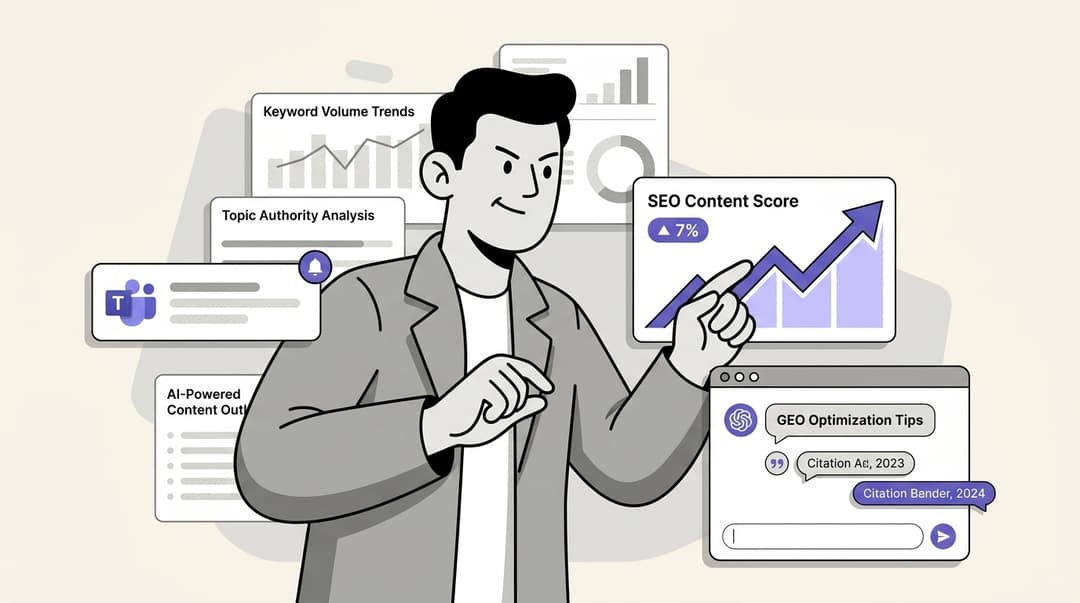
If you're in marketing, you’ve heard the buzz around AI and search. It seems like every week there's a new discussion about whether Generative Engine Optimization (GEO) is the new game in town or if the old SEO rules still apply. It’s enough to make you wonder if anything has really changed.
The problem is that businesses aren't sure whether to stick with their current SEO playbook or pivot to a new "AI optimization" strategy. This post is here to clear things up. We'll break down the real differences and show you how the two actually work together.
This isn't about AI replacing traditional SEO; it's an evolution. The fundamentals of creating valuable, human-first content are more important than ever. What's changing is how that content gets discovered. The goal has expanded from just ranking on a results page to becoming the direct source for an AI-generated answer.
Understanding traditional SEO
Let’s start with the basics. Traditional Search Engine Optimization (SEO) is the process of optimizing your website and its content to rank higher on search engine results pages (SERPs) like Google.
The main goal has always been straightforward: drive organic traffic to your website by getting people to click on those familiar "blue links." You want your page to show up as high as possible when someone searches for a relevant term, because higher rankings usually mean more visitors.
- On-page SEO: This is all about the content on your site. It focuses on things like content quality, keyword research and placement, meta tags (the little title and description you see in search results), and internal linking to other pages on your site.
- Off-page SEO: This revolves around building your site's authority and reputation. The main tactic here is getting high-quality backlinks, which are links from other reputable websites pointing to yours. Think of them as votes of confidence from other players on the internet.
- Technical SEO: This part ensures your website is a well-oiled machine. It covers everything that makes your site fast, secure, mobile-friendly, and easy for search engine bots to crawl and index. If the bots can't understand your site, it doesn't matter how great your content is.
Understanding AI SEO
AI SEO, or what’s becoming known as Generative Engine Optimization (GEO), is a bit different. It’s the practice of optimizing your content so it can be understood, referenced, and featured directly within AI-generated answers and summaries. Here, the goal shifts from just earning a click to becoming the authoritative source for the answer itself.
The term Generative Engine Optimization was formally introduced in an academic paper in November 2023 by researchers from institutions including IIT Delhi and Princeton University. It describes the specific practice of adapting content to get better visibility in the results produced by generative AI.
This strategy applies to new search features like Google's AI Overviews but also to standalone platforms like ChatGPT, Perplexity AI, and Claude. When you ask one of these tools a question, you want your content to be what it uses to formulate its response.
Key differences: AI vs traditional SEO
While the core principles of creating high-quality, authoritative content still apply to both, the strategic focus, tactics, and how you measure success have started to split. Let's break down the most important distinctions.
| Aspect | Traditional SEO | AI SEO / Generative Engine Optimization (GEO) |
|---|---|---|
| Primary Goal | Rank high in SERPs to earn clicks. | Be cited as a source in AI-generated answers. |
| Content Focus | Content targeting specific, often short, keywords. | Direct, conversational content that answers detailed prompts. |
| Key Tactic | Keyword placement, meta descriptions, and backlink building. | Semantic clarity, structured data (Schema), and multimodal content. |
| Authority Signal | Primarily high-quality backlinks and domain authority. | Broader signals, including source reputation, consistency, and freshness. |
| Measurement | Organic traffic, keyword rankings, click-through rate (CTR). | Citation count, visibility in AI responses, and brand sentiment. |
The shift from keywords to prompts
In traditional SEO, strategy is built around researching and targeting specific keywords, which are usually two to five words long. You find what people are searching for and create content that matches those exact terms.
With AI, the focus is shifting to answering long, conversational questions that people ask AI assistants. These prompts are often 10 to 25 words long and provide much more context and intent. For example, a keyword search for "meal plan for runners" evolves into a prompt like, "Create a 7-day vegetarian meal plan for a beginner runner training for a half-marathon." This requires content that's far more detailed and specific. According to a Semrush study, AI Overviews were already appearing in over 13% of all Google queries by mid-2025, showing that this conversational trend is growing fast.
Evolving content structure for machines
For traditional SEO, a well-organized article with clear headings (H2s and H3s) is enough for both crawlers and human readers to understand the hierarchy of information.
For AI, your content needs to be structured for easy extraction. This means providing direct answers and making sure each section is "chunkable," or able to be understood on its own without needing the rest of the article for context. Using structured data like Schema.org markup has become critical. Schema is code that you add to your site to give AI explicit context about your content, clearly identifying it as an FAQ, a how-to guide, or a product review. While it isn't a direct ranking factor in the old sense, it makes your content much more digestible for the knowledge graphs that AI models rely on.
A broader definition of authority
AI models, on the other hand, infer trust from wider signals. According to research, this includes:
- Source and Provenance: The reputation of both the domain and the author matters. Is the source known for expertise in this area?
- Consistency: How well does your content align with what other high-quality sources are saying on the topic? Conflicting information can be a red flag.
- Evidence and Verifiability: AI models look for proof. This means including citations, linking to primary sources, and being transparent about your methodology.
- Freshness: For topics that change over time, AI models prioritize up-to-date content. In some experiments, fresh brand mentions have been shown to improve visibility in AI answers more than historical backlinks.
Do you have to choose between AI and traditional SEO?
After all that, you might be wondering if you need to throw out your old SEO strategy. The answer is a clear no. AI SEO is not a replacement for SEO. In fact, a strong traditional SEO foundation is a prerequisite for success in the new world of AI search.
The simple version is it does not replace SEO, it builds on it. Traditional seo focuses on ranking links, while AI seo focuses on how content gets pulled into AI answers and summaries.

A website that isn't technically sound, easily discoverable, and already seen as authoritative in its niche is highly unlikely to be chosen as a source by an AI model.
The right mindset is to think of this as an expansion, not a replacement. Your traditional SEO work ensures your content can be retrieved by search engines. Your GEO work ensures that once it's retrieved, the content is easy for an AI to process, understand, and cite. All the work you do for traditional SEO, like improving site speed, creating high-quality content, and fixing broken links, directly supports your AI SEO efforts.
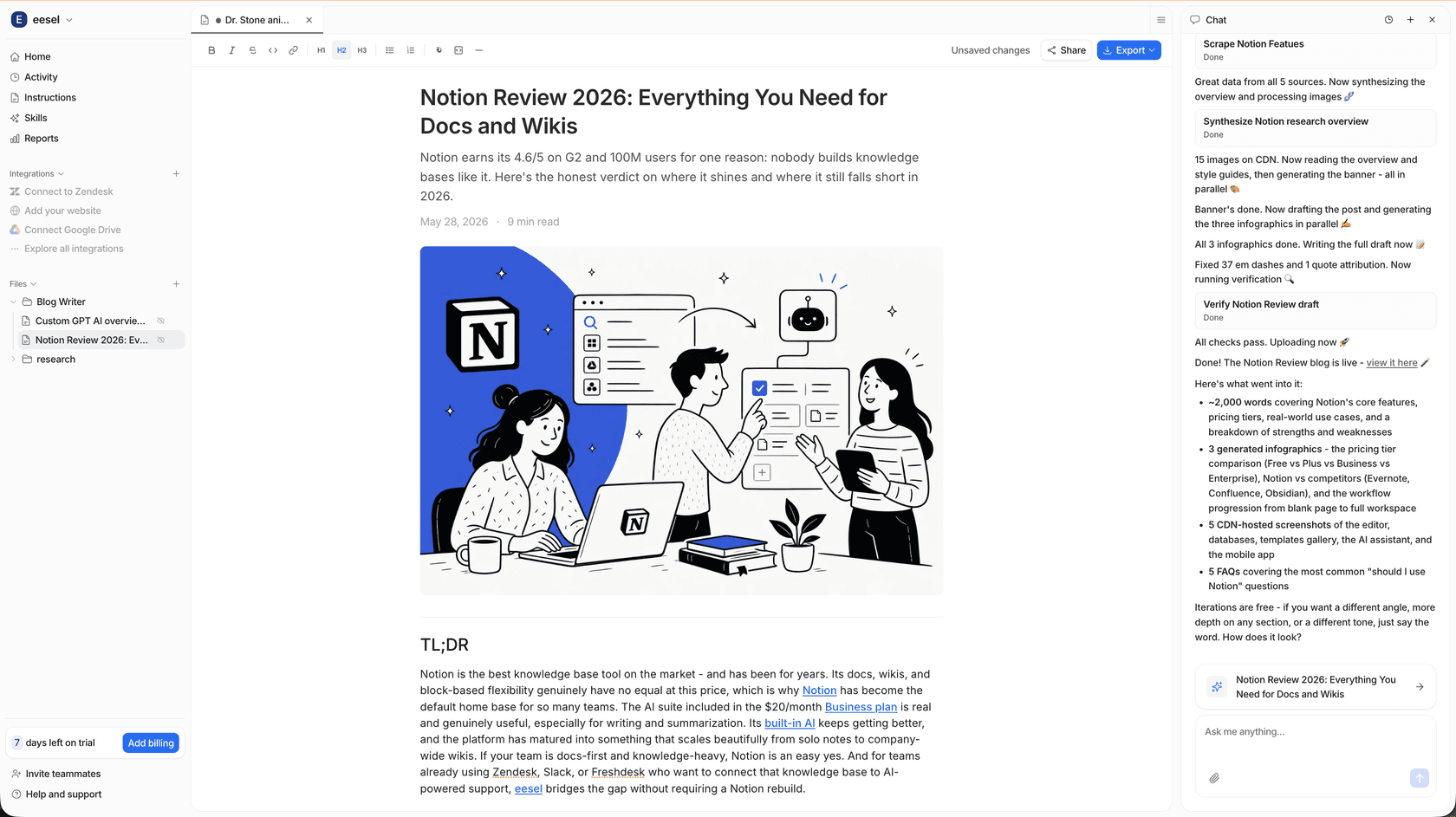
Adapting your content strategy with the eesel AI blog writer
The biggest challenge now is creating content that satisfies both traditional search algorithms and new AI answer engines, and doing it efficiently. Your content needs to be both discoverable and citable, which often feels like serving two masters at once.
Here's how it helps you adapt to the new AI era:
- AEO-Optimized Structure: eesel AI automatically formats content with the clear headings, tables, and bullet points that answer engines need. It creates an effective "chunked" structure that makes it easy for AI to extract specific pieces of information.
- Context-Aware Research: The tool doesn't just write; it researches. It integrates real insights from sources like Reddit and cites credible external data, building the kind of verifiable authority that both search engines and AI models reward.
- Automatic Multimodal Assets: It generates infographics, tables, and images to accompany the text. This creates the kind of rich, multimodal content that generative engines prioritize when they're looking to create comprehensive, easy-to-understand answers.
This approach allows your team to consistently produce content that ranks in traditional search while also positioning your brand as a go-to source for AI-generated answers, all without doubling the workload. It's the same tool we used at eesel AI to grow our organic impressions from 700 to 750,000 per day in just three months.
For a deeper dive into how these strategies compare in practice, the following video offers a clear breakdown of the differences and overlaps between traditional SEO and Generative Engine Optimization.
An evolution, not a revolution
The core principles of good SEO haven't changed. Creating high-quality, authoritative content that serves user intent is still the name of the game.
What has changed is how that content is discovered and consumed. The goal is no longer just to be a link in a list; it's to be the answer itself. The strategic focus has expanded from keywords to conversational relevance and from backlinks to a broader, more holistic sense of trust.
The best way to stay ahead is to start creating content that's ready for this new reality. You can generate a free article with the eesel AI blog writer to see just how simple it can be to adapt your strategy for what's next.