

What an AI glossary generator actually does
I've spent the last couple of years mapping keywords to what people actually search for, and at eesel I've watched the AI blog writer draft thousands of posts across live customer sites. A glossary generator is a narrower cousin of that: instead of one long article, you feed it a list of terms, and it returns a short, structured definition page for each, ideally in your brand voice and ready to drop into your CMS.
The mechanics are pure programmatic SEO. Ahrefs defines that as "the creation of keyword-targeted pages in an automatic (or near automatic) way," and Semrush calls a marketing glossary a textbook example, an agency targeting long-tail terms like "marketing definition" with programmatically generated pages. It's the same pattern behind a content scaling tool, just pointed at definitions.
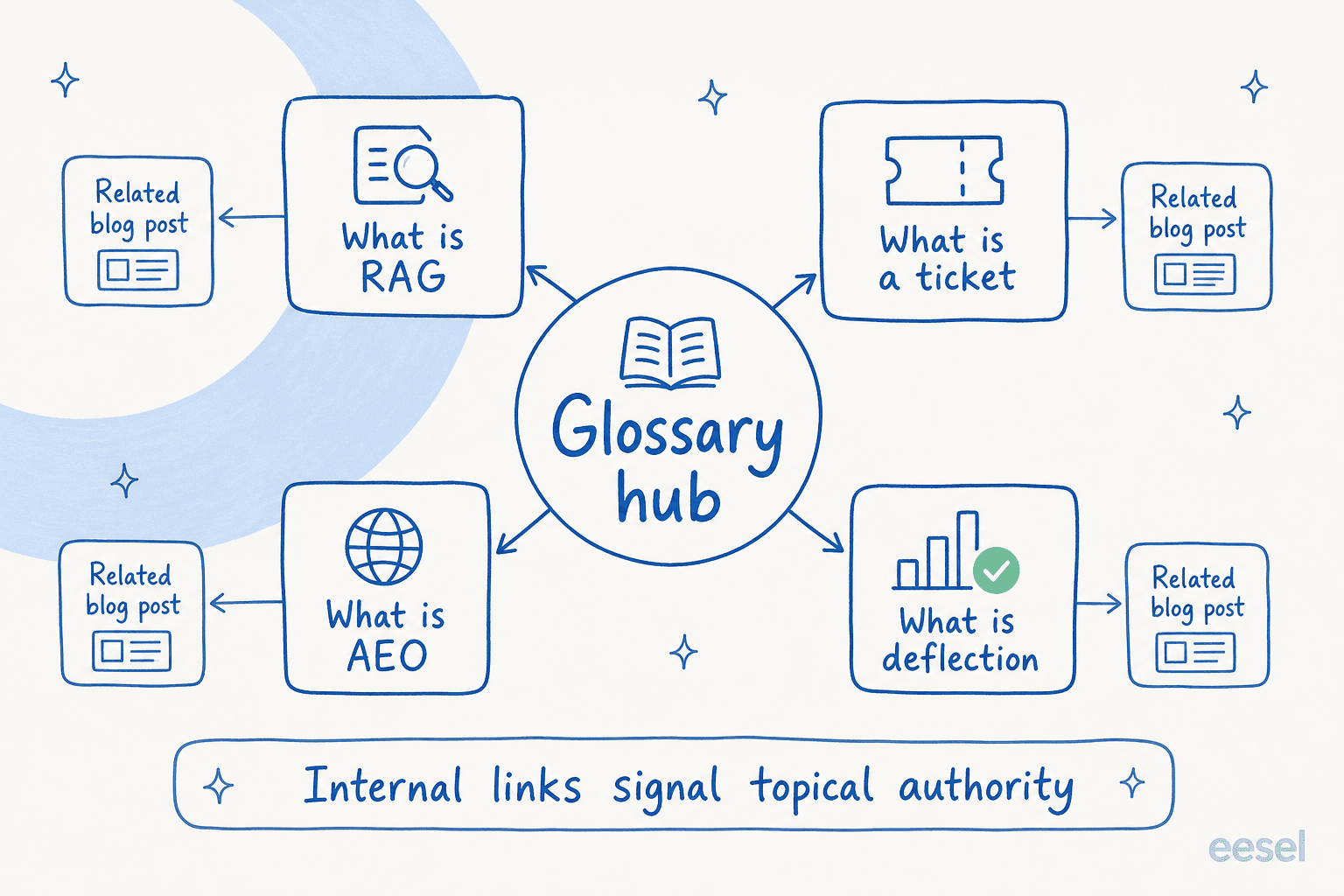
Worth noting that the SEO authorities don't just recommend this format, they run it themselves. Ahrefs' SEO glossary and Semrush's glossary are both live content assets that rank for hundreds of definition queries. When the people who write the rulebook on SEO maintain a glossary, that's a decent signal the format works.
Why a glossary is one of the best SEO assets you can build
Three things make glossary pages punch above their weight, and it's worth being specific about each because they're also the things a lazy generator throws away.
They catch the long tail. Every "what is [term]" query is a small piece of informational demand, and there are thousands of them in any niche. Individually tiny, collectively huge.
They build topical authority. Ahrefs describes topical authority as Google recognising "your site as the expert source on a specific subject... for the full range of related queries within a topic," and points to the 2024 API leak where "internal signals, including site focus score and site radius, confirmed Google models each site's topical identity." A dense glossary is one of the cleanest ways to cover a subject's full vocabulary.
They're an internal-linking engine. This is the underrated one. Ahrefs calls internal links "just as important as external ones" for how Google discovers content and understands topical relationships, and frames a hub that links to every page beneath it as the core of a content hub. A glossary is a natural hub: every entry links up to the index and out to the deeper articles that use the term.
When it works, the numbers get silly. Ahrefs' own breakdown of programmatic pages at scale shows why people chase this:
| Site | Programmatic pages | Monthly organic | Why it works |
|---|---|---|---|
| Wise | 14,888 currency pages | 4,667,719 pageviews | Real rate data and bank comparisons per page |
| Zapier | ~800,632 pages | 306,000 visits | Integration combinations people actually search |
| Nomadlist | 25,873 location pages | 41,200 visits | Unique cost-of-living data per city |
| Webflow | 31,516 template pages | 27,600 visits | Each template is a distinct, useful asset |
Ahrefs is blunt about the pattern: Wise wins because each page carries "historical conversion rate data, rate comparisons," as Ahrefs puts it, real data, not a bare template. Hold that thought, because it's the whole game.
The trap: where AI-generated glossaries blow up
Here's the reframe most "spin up 500 pages" tutorials skip. The thing that makes a glossary generator powerful (it'll write 500 entries while you get coffee) is the exact thing that gets sites buried.
Google's spam policies define the failure mode in plain language: "Scaled content abuse is when many pages are generated for the primary purpose of manipulating search rankings and not helping users," and the policy explicitly names "using generative AI tools or other similar tools to generate many pages without adding value for users." A glossary of 500 near-identical definition stubs is close to the textbook example. The same policy also flags thin affiliation and doorway abuse, "cookie-cutter sites or templates with the same or similar content replicated," which is what a low-effort glossary becomes.
Google's own engineers have been sharp about this. As quoted on Ahrefs' programmatic SEO guide, Search Advocate John Mueller put it bluntly:
"I think it's mostly that programmatic SEO is often a fancy banner for spam."
John Mueller, Google, quoted by Ahrefs
Practitioners echo it. On LinkedIn, Sk Sahin framed the risk the same way:
"Programmatic SEO might seem tempting, but it's nothing more than spam on Google. Using AI & scraped content lacks real value for users and Google."
Sk Sahin, LinkedIn

Ahrefs adds the practical kicker, that "this type of thin content isn't likely to generate meaningful traffic for a sustained period of time," and Semrush warns that near-duplicate pages also create indexation problems because Google may treat them as duplicates. So even setting penalties aside, the lazy version just doesn't work. This is the same trap behind so many AI blogs that don't rank: volume without value.
What separates an entry that ranks from one that gets ignored
The dividing line is simple to state and the part everyone underinvests in: a glossary entry earns its place when it adds something the reader couldn't get from a dictionary.
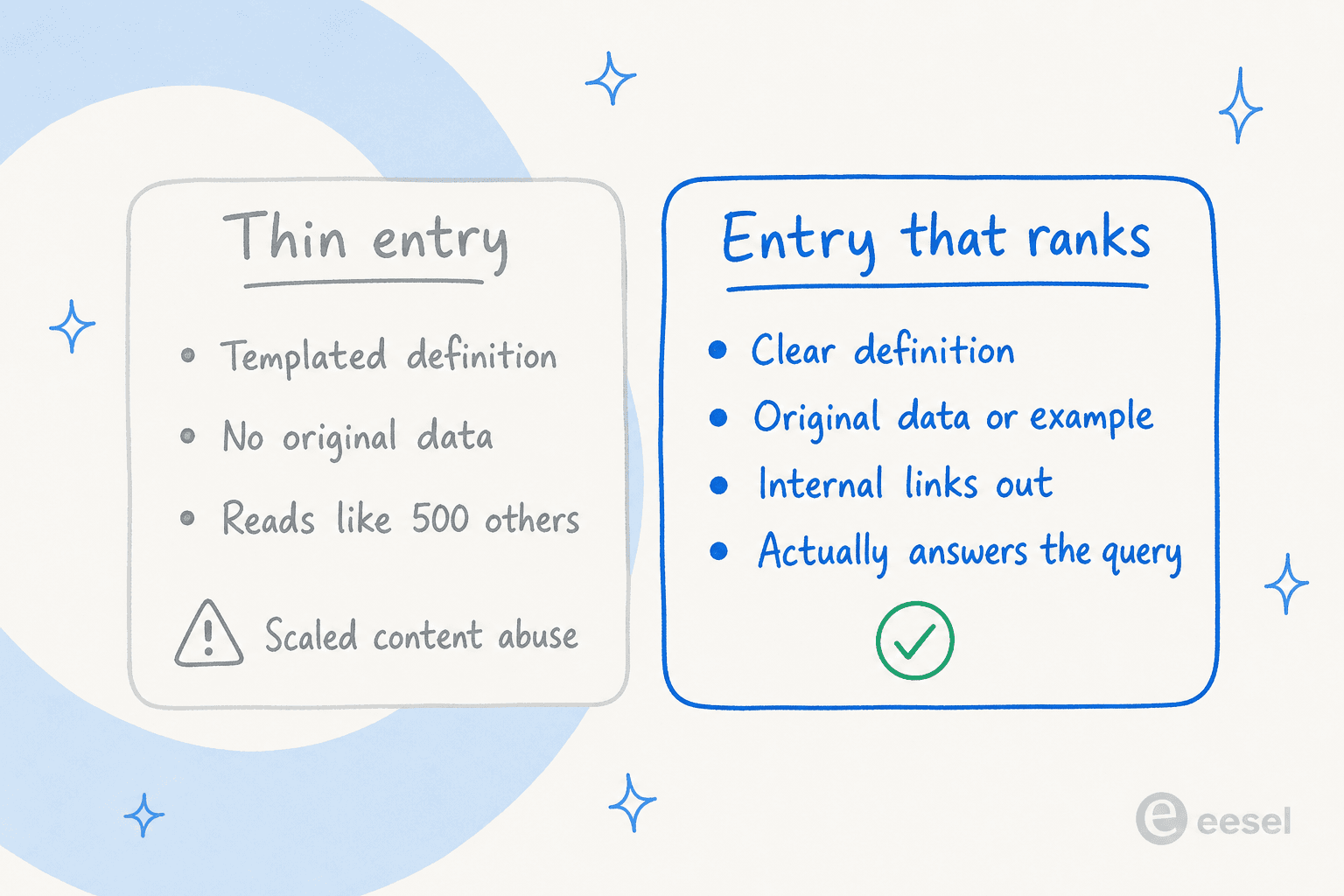
A weak entry restates the term in a slightly longer way and stops. A strong entry gives the clean definition up front, then does one or more of these:
- Adds a concrete example from your own world (how the term shows up in your product, an industry, a real workflow).
- Adds a real number or data point you actually have, the way Wise attaches rate data to every page.
- Answers the adjacent question the searcher will ask next ("how is X different from Y?").
- Links out to the deeper article where you cover the term properly.
This is also where grounding matters more than model quality. An entry written from your own docs and tickets is specific by default, because it's drawing on something only you have. An entry written from the open web is, definitionally, the same thing a hundred other sites already published. If you want the EEAT signals Google rewards, the source you generate from matters as much as the prompt.
Glossaries in the age of AI search
There's a hopeful theory going around that glossary pages are a cheat code for AI search, that if you write tidy, schema-marked definitions, ChatGPT and Google's AI Overviews will quote you. Half right.
The "tidy definitions get cited" part is real: clear, self-contained answers are the easiest thing for an AI search engine to extract. The "schema cheat code" part is not. Google's AI features guidance deflates it directly: "Structured data isn't required for generative AI search, and there's no special schema.org markup you need to add," and "you don't need to create new machine readable files, AI text files, markup, or Markdown to appear in Google Search."
What Google says actually moves the needle is the line worth pinning above your glossary project. Google's guide puts it this way: "creating content that people find unique, compelling, and useful will likely influence your website's presence in generative AI search in the long run more than any of the other suggestions." Which loops right back to the value test. There's no markup shortcut around a thin entry.
I hear the AI-search angle from real users too. One eesel customer, a licensed therapist running a solo practice, told me she "just wanted a way to be discovered by AI, voice search, and browsers." That's the genuine motivation behind most glossary projects now, and it's a good one. It just doesn't change the work: be the most useful answer, and the AI-search visibility follows.
How to generate a glossary with AI without getting penalized
Here's the workflow I'd actually run. It's deliberately not "paste 500 terms and hit go."
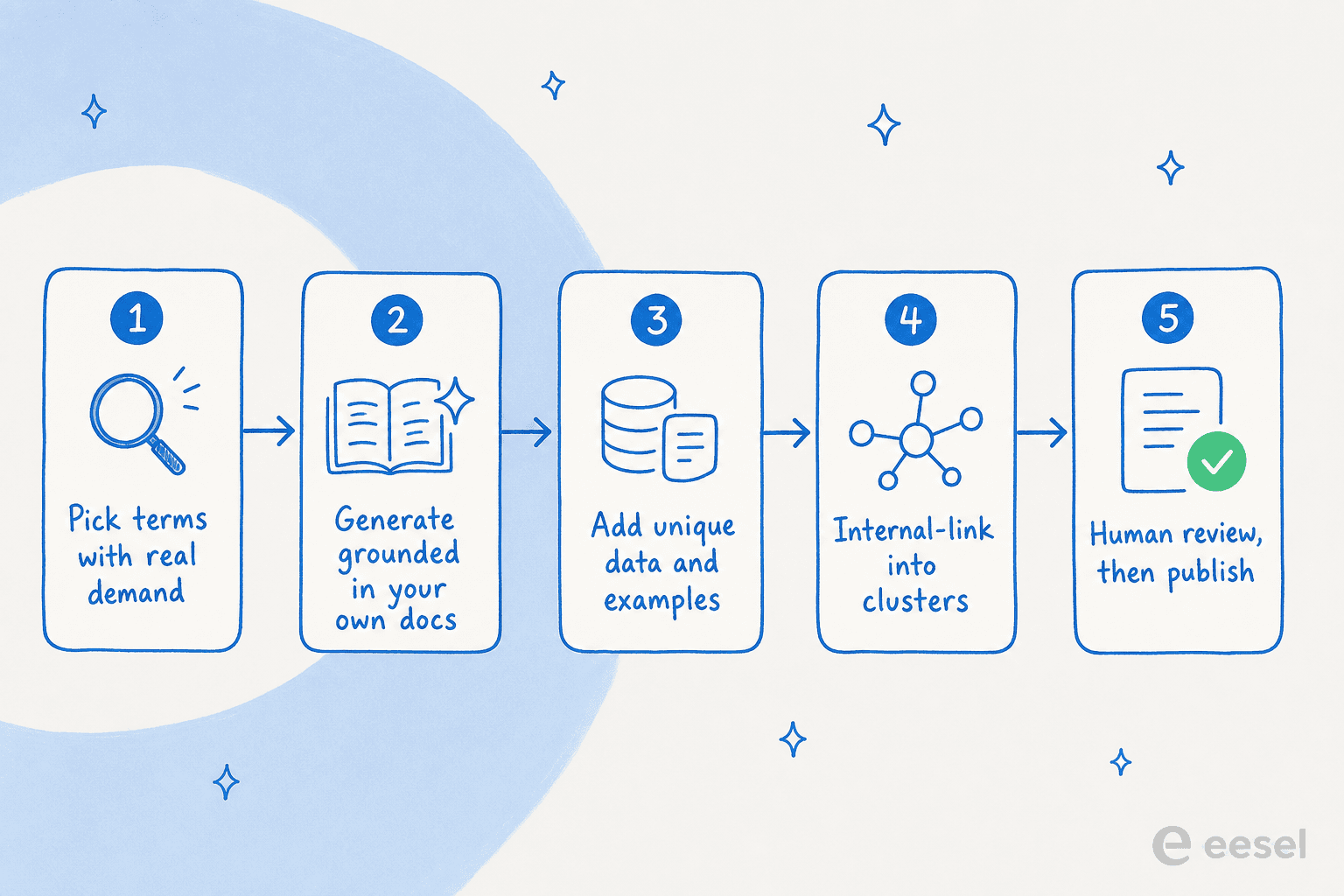
- Start from terms with real demand. Don't generate a definition for every word you can think of. Pull the terms people actually search using a keyword tool or eesel's free SEO keyword generator, and group them with a keyword clustering tool so each entry maps to a real query, not a guess.
- Generate grounded in your own knowledge. Point the generator at your docs, help center, and past content, not the open web. This is the single biggest lever on quality, and the reason to train AI on your knowledge base before you generate a word.
- Add the unique thing. Every entry gets at least one example, number, or comparison the dictionary version wouldn't have. If you can't add anything unique to a term, that's your signal to cut it, not pad it.
- Internal-link into clusters. Each entry links up to the glossary index and out to the deeper articles that use the term, and those articles link back. That's the structure that turns a pile of pages into topical authority content. Tools that handle internal linking automation save a lot of manual cross-referencing here.
- Keep a human on publish. Review for accuracy and for the value test before anything goes live, and stage releases rather than dumping 500 pages in a day. Google's guidance even suggests being transparent about how content was created. The discipline is the same one in my guide to scaling SEO content safely.
A couple of mistakes I see constantly: publishing the whole glossary at once (a giant batch of new thin pages is a textbook spam signal), and forgetting the CMS step. Beautiful entries that won't paste into your platform without losing formatting are a real problem, and a common enough one that AI content CMS integration deserves its own guide. The best entry in the world helps nothing if it's stuck in a draft.
Try eesel for your glossary and the content around it
eesel is an AI platform that runs autonomous teammates inside the tools you already use, and one of those teammates is a content and blog writer that drafts in your brand voice. For a glossary specifically, the part that matters is grounding: eesel generates from your connected knowledge sources (docs, help center, past tickets, websites), so each definition carries the specific detail that keeps it off the wrong side of Google's scaled-content line, and it'll draft the longer cluster articles your glossary links into.
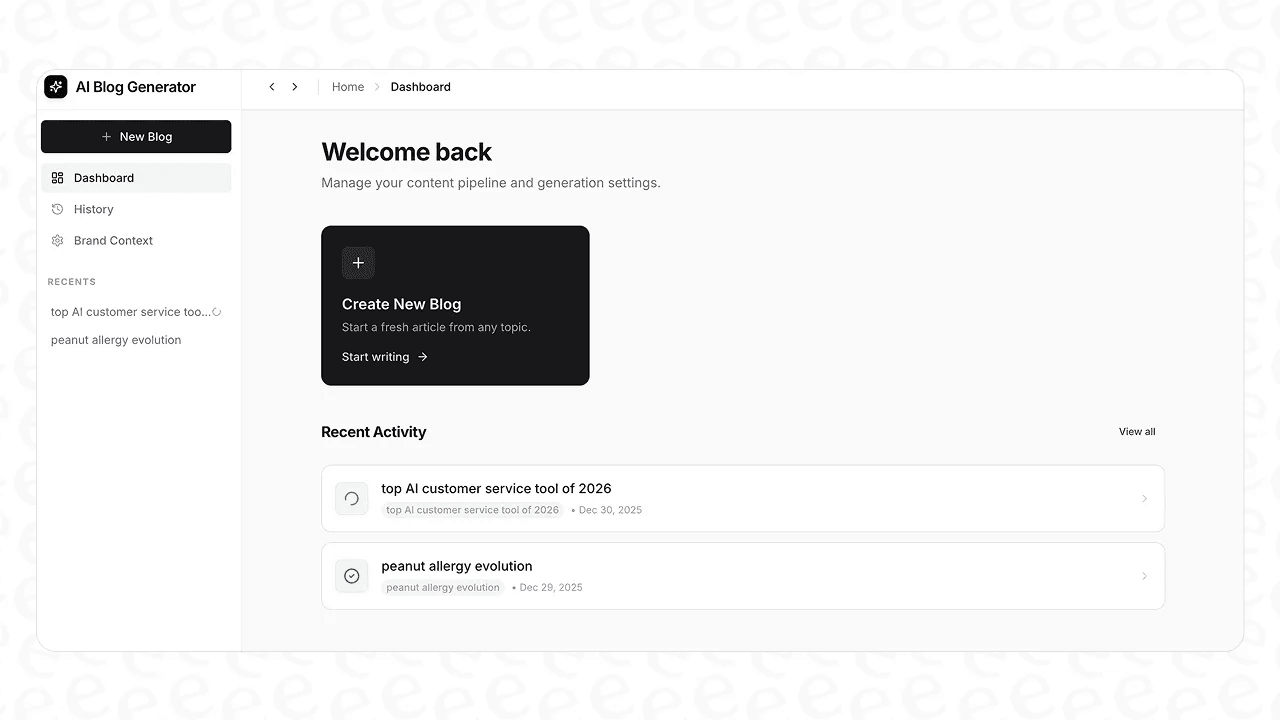
It's pay-as-you-go, with free usage to start and no credit card needed, so you can generate a few entries and judge the quality yourself before committing. If you just want to feel out the front end of the workflow, the free SEO keyword generator turns a topic into a keyword list and hands any of them straight to the blog writer. Try eesel.
Frequently Asked Questions
What is an AI glossary generator?
Do AI-generated glossary pages hurt your SEO?
How many glossary pages should I generate?
Can an AI glossary generator help with AI search and AI Overviews?
What's the best way to build a glossary with AI for free?


Article by
Kurnia Kharisma Agung Samiadjie
Kurnia is a software engineer and writer at eesel AI with two years of SEO experience, writing about AI tools, helpdesk software, and customer support. He pairs a developer's understanding of how these products are built with search-driven research into what actually ranks and resonates with the people searching for them.