Generative AI
A category of AI that creates new content such as text, images, audio, or code by learning patterns from large training datasets.
What generative AI means
Generative AI is a category of artificial intelligence that creates new content, such as text, images, audio, video, or code, by learning the patterns in large training datasets and then producing original output that follows those patterns. It is named for what it does: it generates, rather than only classifying, ranking, or predicting from existing data the way earlier AI systems mostly did.
The most familiar form is text generation, powered by a large language model, but the same idea covers image generators, voice synthesis, and coding assistants. In customer support, generative AI is what lets software write a fresh, natural reply to a customer's exact question, instead of returning the closest matching canned response or a link to a help article.
What makes generative AI different
Earlier "AI" in support was usually predictive: it sorted tickets, flagged sentiment, or routed conversations. Generative AI shifts from sorting to creating, which means it can:
- Produce original responses worded for the specific customer and situation, not pulled from a fixed library of canned responses.
- Work across formats, drafting a reply, summarizing a thread, or rewriting copy in a different tone from the same underlying model.
- Handle open-ended requests that no one scripted in advance, because it generates rather than retrieves a pre-written answer.
- Adapt to instructions in plain language, so changing its behavior often means changing the prompt, not retraining.
- Scale content creation, which is why the same technology powers both support automation and tools like an AI blog writer.
The tradeoff is that generated content is fluent by design but not factual by default, so it has to be anchored to a source of truth.
The cleanest way to see the shift is to put the two side by side: where older support AI sorts what already exists, generative AI writes something new.
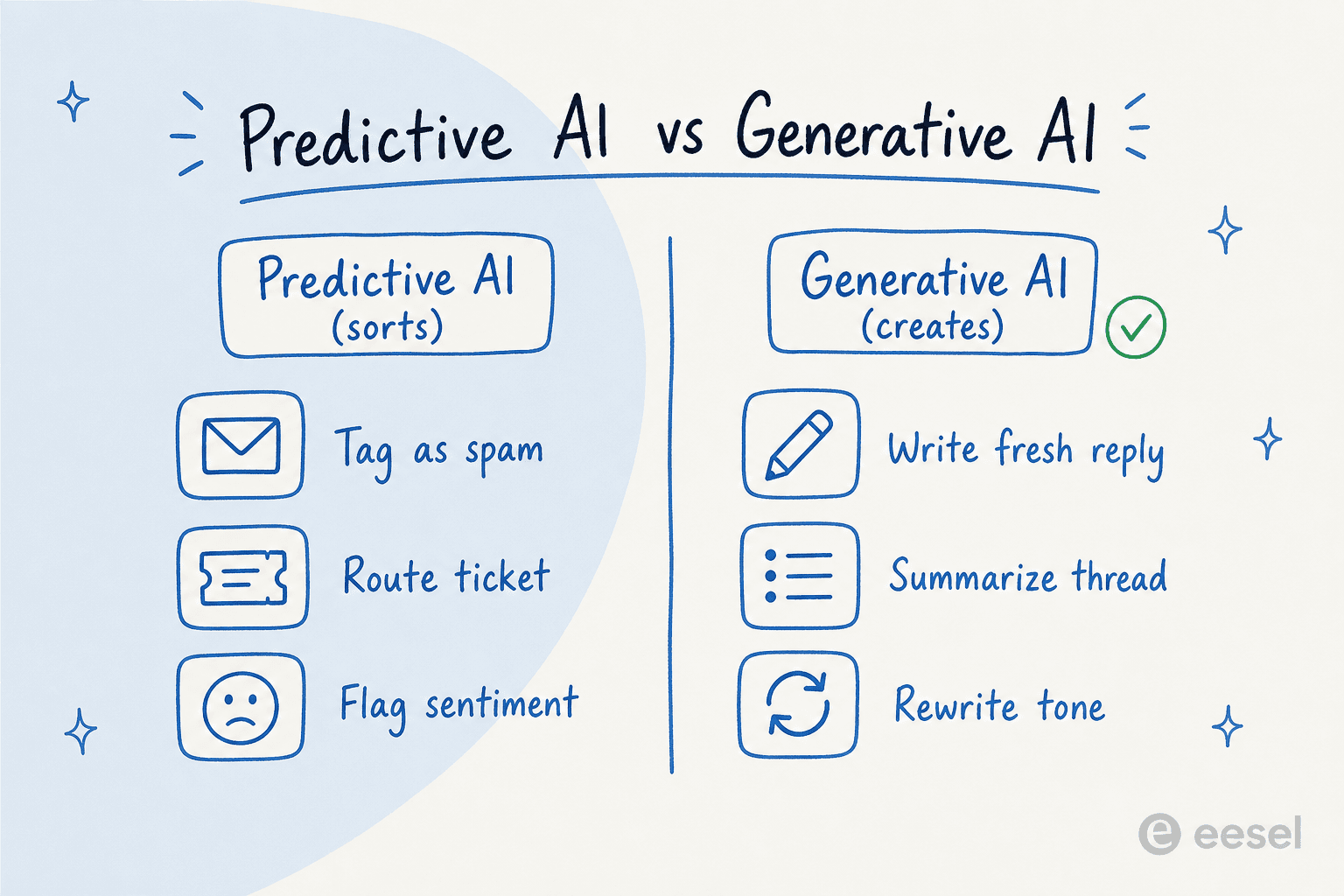
Predictive AI labels, routes, and flags. Generative AI takes the same ticket and produces a reply, a summary, or a tone rewrite from scratch. Most modern support stacks use both: classify first, then generate the answer.
How generative AI works
In a support setting, a generative system usually runs a pattern like this:
- Understand the request. The model reads the customer's message and any context attached to the ticket.
- Retrieve the facts. Before generating, a grounded system pulls relevant passages from your knowledge so the output is based on real content.
- Generate the output. The model writes a new reply, summary, or draft, conditioned on both the request and the retrieved facts.
- Review or act. A human approves a draft, or an agent sends it and takes any follow-up action automatically.
A support agent like eesel AI generates each reply on the fly but grounds it in your help center, docs, and past tickets, so the answer is written fresh for the customer while staying tied to what is actually true for your business.
Generative AI in practice
The fluency of generative AI is both its strength and its trap. A confident, well-written answer is more persuasive than a clumsy one, which means a wrong generated answer can do more damage than no answer at all. That is why serious deployments never let a generative model speak unsupervised: they ground it in trusted content, set guardrails on what it can say, and have it escalate when it has no solid basis for a reply. The generation is the easy part, the controls around it are what make it usable.
For a hands-on walkthrough, read generative AI for support teams.
Generative AI that resolves real tickets
eesel AI uses generative models to draft and send accurate replies grounded in your own help center and past tickets.