Customer satisfaction
Customer satisfaction is a measure of how well a product, service, or interaction meets a customer's expectations.
What customer satisfaction means
Customer satisfaction is a measure of how well a product, service, or interaction meets, or fails to meet, a customer's expectations. When the experience matches or beats what someone expected, satisfaction is high; when it falls short, satisfaction drops.
It is fundamentally about the gap between expectation and reality. The same wait time can leave one customer satisfied and another annoyed, depending on what each expected going in, which is why satisfaction is measured by asking customers directly rather than inferred from internal data alone.
In customer support, satisfaction is usually captured per interaction: after a ticket is resolved, the customer is asked how the experience went. Those answers roll up into a picture of whether support is actually landing. Satisfaction is the customer's verdict, not the company's self-assessment.
Why customer satisfaction matters
Customer satisfaction is one of the most-watched signals in support because it predicts what comes next:
- It forecasts retention. Satisfied customers renew and repurchase; dissatisfied ones quietly leave, often without complaining first.
- It drives word of mouth. People share both delight and disappointment, so satisfaction feeds directly into reputation and referrals.
- It is fast feedback. Unlike revenue, which lags, a post-interaction rating tells you within minutes whether support is working.
- It pinpoints problems. Low scores on a specific topic or agent flag exactly where the experience is breaking down.
- It ties to the wider experience. Satisfaction is a core input to overall customer experience, not just a support vanity metric.
The practical value is that satisfaction is an early, actionable signal: it moves before churn does, so it gives teams a chance to fix things while they still can.
It helps to picture satisfaction not as a score but as a distance:
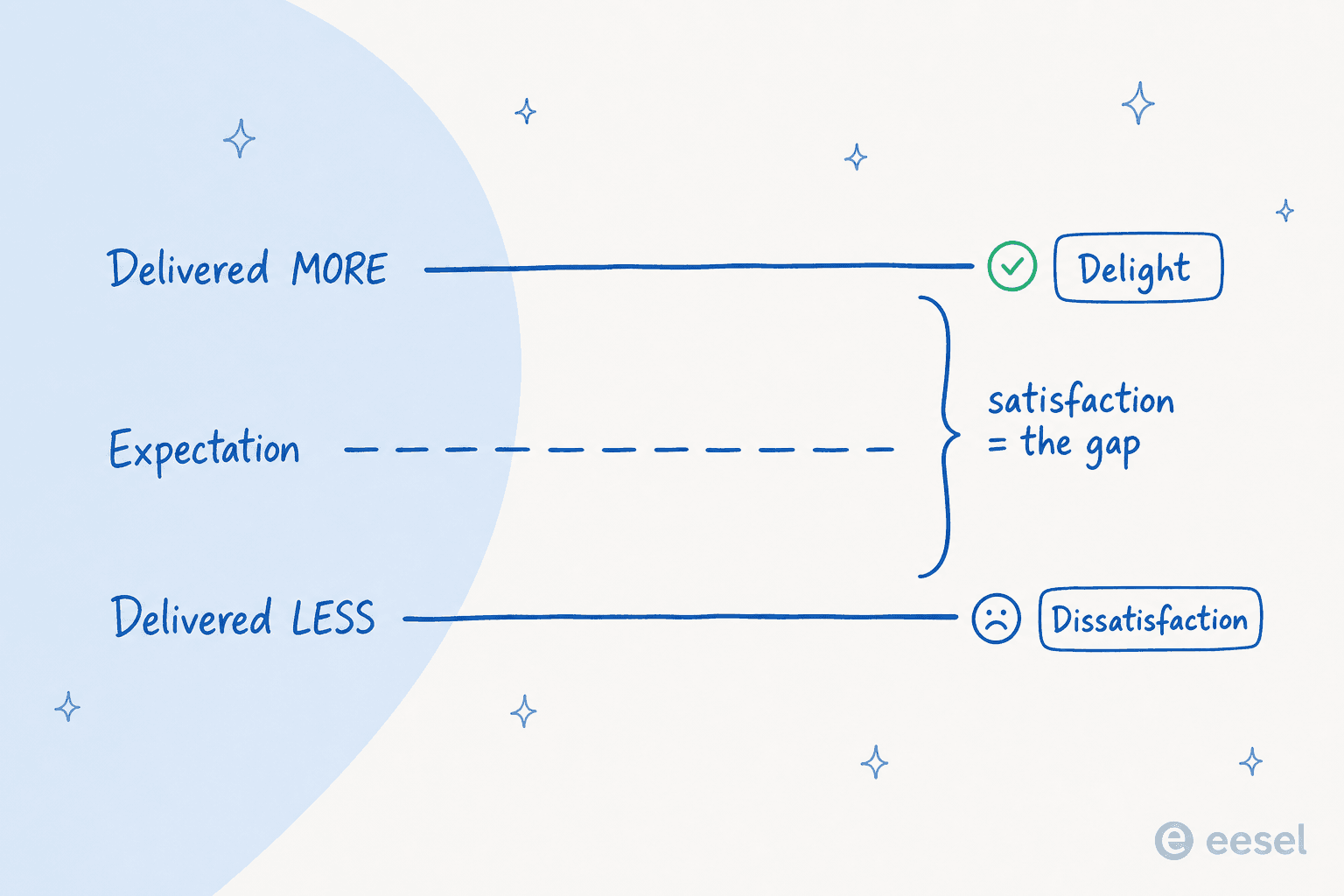
Whatever you deliver gets measured against the expectation the customer walked in with. Clear that bar and you get delight; land below it and you get dissatisfaction, even if the raw service was identical. The gap, not the absolute effort, is what the customer actually feels.
How customer satisfaction works
Teams turn satisfaction from a feeling into something they can manage:
- Ask at the right moment. A short CSAT survey goes out right after an interaction, while the experience is fresh.
- Score and aggregate. Individual ratings roll up into a CSAT score, often alongside NPS for the longer-term loyalty view.
- Find the drivers. Teams segment the scores by channel, topic, and agent to see what is helping and what is hurting.
- Act and recheck. They fix the friction, then watch whether the next round of scores moves.
Support speed and accuracy are the biggest levers here. A support agent like eesel AI lifts satisfaction by answering common questions instantly, grounding each reply in your help center and past tickets so the answer is correct, and escalating to a person the moment it is unsure. That removes the two things that crater satisfaction most often, long waits and confidently wrong answers, while keeping a human on the cases that need one.
Customer satisfaction in practice
The risk with customer satisfaction is optimizing the score instead of the experience. Chasing a higher number, by surveying only happy moments or nudging customers toward five stars, produces a metric that looks good and means nothing. The teams that get real value treat satisfaction as a diagnostic: they read the low scores carefully, trace them back to a slow channel or a recurring wrong answer, and fix the cause. Paired honestly with CSAT and resolution data, satisfaction tells you not just that customers are unhappy, but where and why.
For a hands-on walkthrough, read AI CSAT and analytics.
Raise satisfaction with faster, accurate answers
eesel AI replies instantly from your own knowledge and escalates when unsure, removing the slow waits and wrong answers that drag CSAT down.