Customer effort score (CES)
A metric that measures how much effort a customer had to put in to get their issue resolved or their goal met.
What customer effort score means
Customer effort score (CES) is a metric that measures how much effort a customer had to put in to get their issue resolved or their goal met. It is usually captured by asking respondents how strongly they agree with a statement such as "The company made it easy for me to handle my issue," answered on a scale, commonly 1 to 7. A lower-effort experience scores higher, and the metric is built on the finding that reducing friction keeps customers loyal more reliably than trying to exceed their expectations.
In customer support, CES is the metric that asks not "were you happy?" but "how hard did we make you work?". Effort shows up as repeating information across replies, getting bounced between channels, waiting on hold, or needing multiple contacts to close one issue. Because friction is what drives people to churn, a CES survey fired after a resolved ticket often predicts loyalty better than a satisfaction score from the same interaction.
Why customer effort score matters
- Effort predicts disloyalty. High-effort experiences are one of the strongest drivers of churn, which makes CES a leading indicator that CSAT can miss.
- It points at process, not tone. A low score usually traces to a structural friction (a clunky handoff, a missing answer, a required login) rather than a rude agent, so the fix is operational.
- It is interaction-specific. Like a satisfaction survey, CES is tied to a resolved issue, so you can attribute it to a channel, a topic, or a workflow.
- It rewards getting it right the first time. Effort drops sharply when issues are solved in one go, which is why CES and first contact resolution move together.
- It catches hidden friction. Comments on low-effort surveys surface the small annoyances (re-verifying identity, re-explaining context) that no operational metric records on its own.
It helps to picture effort as a sliding scale, with specific kinds of friction pushing a customer from the easy end toward the hard end:
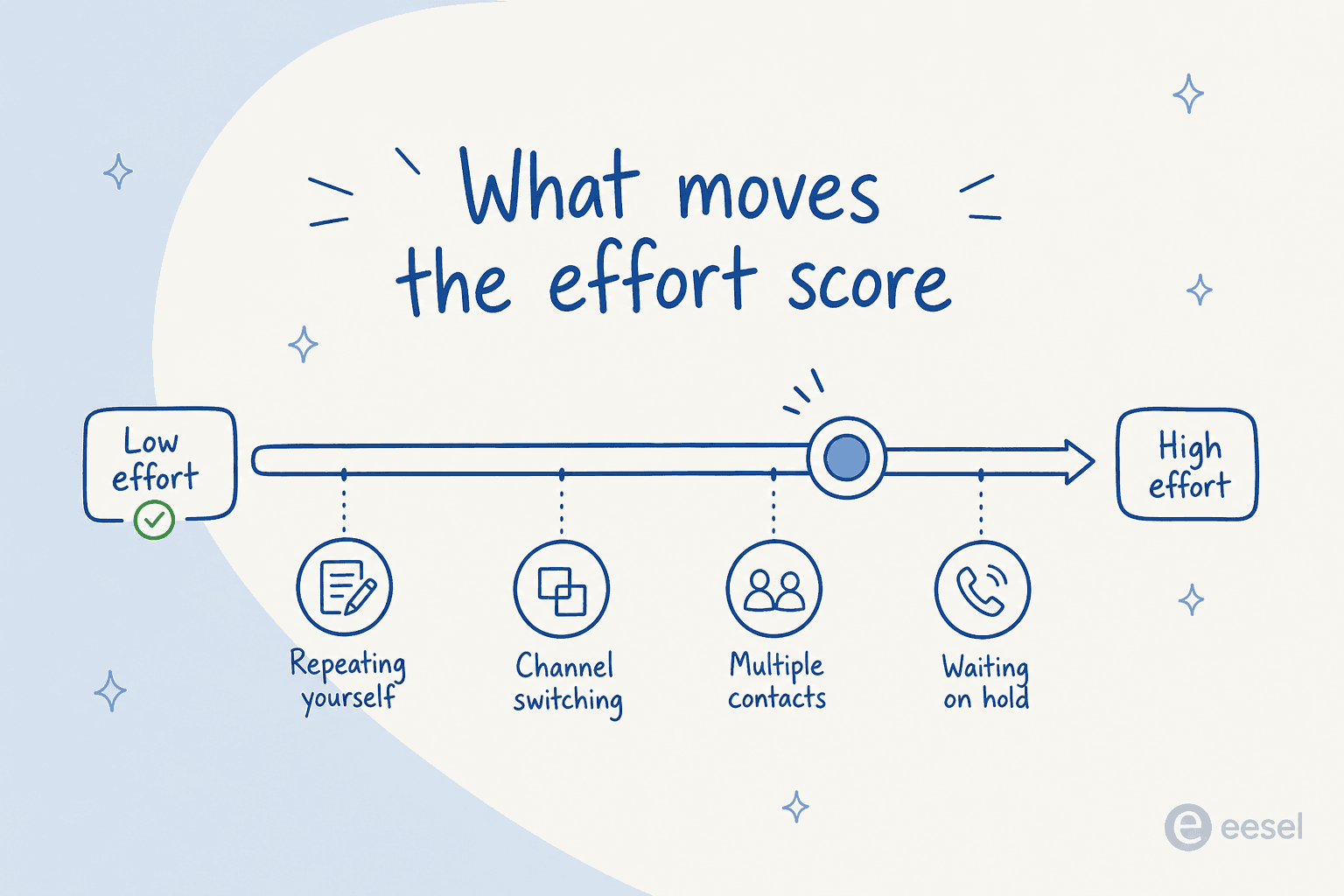
Each of those markers, repeating yourself, switching channels, contacting again, sitting on hold, nudges the dial toward the high-effort end and drags the score down. That is what makes CES so actionable: lowering it is mostly a matter of removing the markers one by one.
How to measure customer effort score
A standard CES program runs like this:
- Trigger after resolution. Send the survey right after the issue is closed, while the effort is still fresh in the customer's mind.
- Ask the effort statement. Use a single agree or disagree statement about ease, on a fixed scale such as 1 to 7.
- Score the responses. Average the scores, or report the percentage of respondents who agreed it was easy.
- Find the friction. Read the free-text replies for the specific step that cost effort, like "I had to explain it three times."
- Remove the cause. Fix the workflow, fill the knowledge gap, or cut the handoff that the comments keep naming.
The biggest lever on effort is removing back-and-forth. An AI agent like eesel AI answers instantly from your help center and past tickets, so the customer does not wait in a queue or repeat themselves, and it escalates with full context attached so a human handoff does not reset the conversation. Cutting that friction is exactly what a low effort score rewards.
Customer effort score in practice
CES is most powerful when you read the comments behind the low scores, because the metric is really a friction detector. A cluster of high-effort responses on one topic almost always names a fixable cause: a confusing policy, a step that forces a channel switch, an answer buried where customers cannot find it. Watch CES alongside how many contacts each issue took to close, since rising contact counts and rising effort tend to show up together. Treated as a backlog of friction to remove rather than a number to celebrate, CES is one of the most operationally useful metrics a support team can run.
For a hands-on walkthrough, read our guide to AI customer effort score.
Take effort out of every resolution
eesel AI answers instantly from your own knowledge and skips the back-and-forth, which is the single biggest driver of a low effort score.