Customer journey
The full path a customer takes with a company across every stage and touchpoint, from first awareness through purchase, onboarding, support, and renewal.
What customer journey means
The customer journey is the complete path a person takes in their relationship with a company, across every stage and touchpoint, from the moment they first become aware of a brand through buying, using, getting help, and deciding whether to stay. It treats the relationship as one continuous experience rather than a series of disconnected interactions, so a company can see how a billing question, a product update, and a renewal email all connect for the same person.
In customer support, the journey lens matters because support is rarely the customer's first or last touchpoint. The person reaching out has already been through awareness, purchase, and onboarding, and the quality of the help they get now shapes whether they renew later. Mapping support into the wider journey shows how a single bad ticket experience can undo months of good marketing.
Why the customer journey matters
- It exposes the friction points. Mapping each stage surfaces the exact moments where customers stall, get confused, or leave, which a single-touchpoint view hides.
- It connects teams that act in silos. Marketing, sales, onboarding, and support all touch the same person, and the journey view forces them to look at one shared experience instead of their own slice.
- It ties support to revenue. A resolved ticket is not just a closed case, it is a step toward renewal, so the journey frames support as part of customer retention rather than a cost center.
- It reveals where automation pays off. Stages with high volume and repetitive questions, like onboarding and tier-1 support, are the clearest candidates for self-service and AI.
- It anchors the metrics. Journey thinking maps each stage to a measure, like conversion at purchase, time-to-value at onboarding, and CSAT or resolution speed at support.
One way to see why support carries so much weight is to plot customer emotion across the stages:
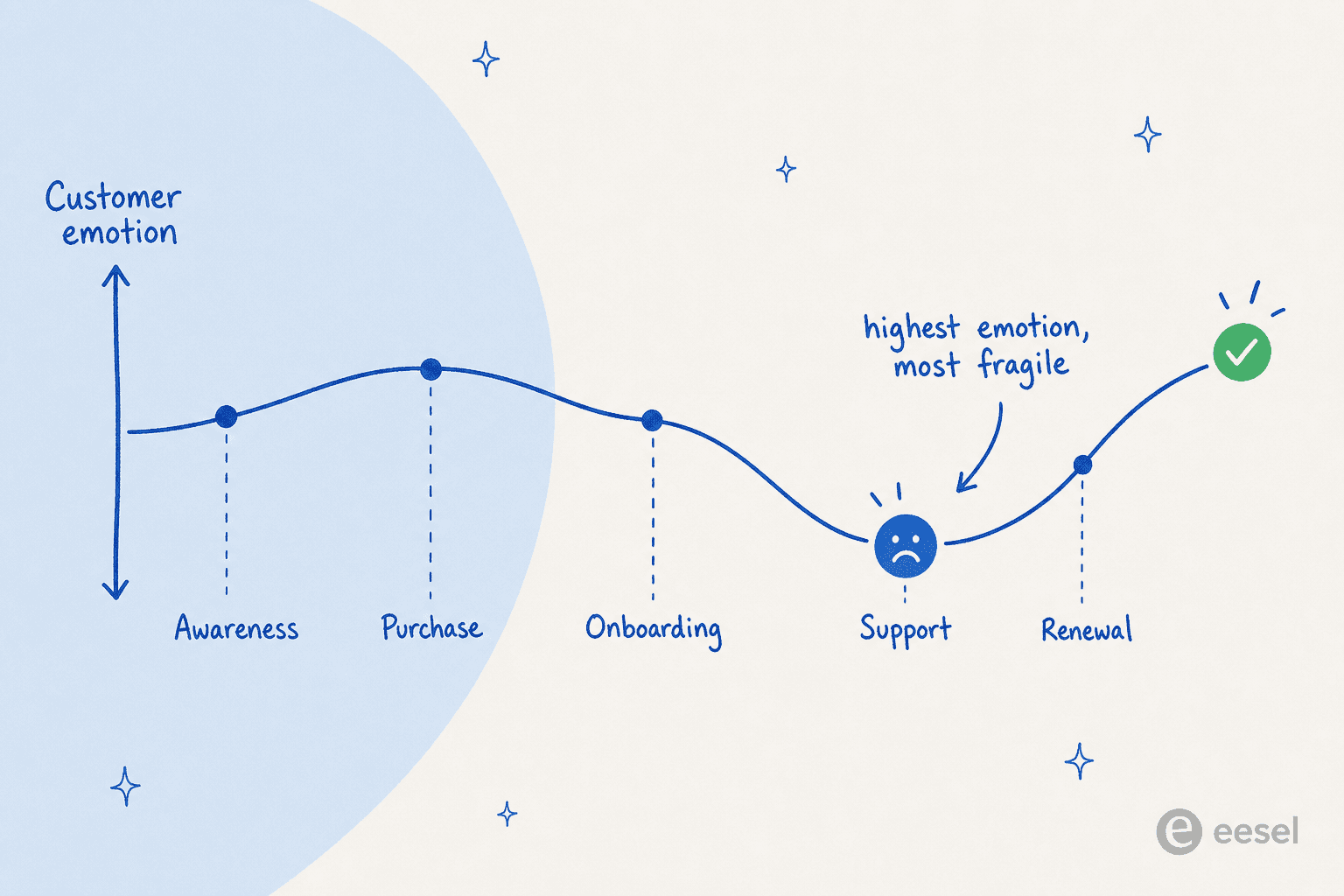
The line tends to sit comfortably through awareness and purchase, then sags at support, the stage where something has already gone wrong and the customer is most frustrated. Recover well there and the curve climbs back to renewal; handle it poorly and the whole relationship can tip negative.
How the customer journey works
Teams usually work the journey in a repeatable way:
- Define the stages. Lay out the path a customer actually takes, from first contact to renewal, in the language of your business.
- Map the touchpoints. For each stage, list every point of contact: the website, the signup flow, the product, the help center, the support queue.
- Find the friction. Use data and voice of the customer feedback to mark where customers get stuck or drop off.
- Fix the worst moments. Prioritize the stages with the most impact and redesign them.
The support stage is where a tool like eesel AI does its work: it learns from your help center, docs, and past tickets, answers the customer instantly, takes actions inside the helpdesk, and escalates to a human when it is unsure. That turns one of the most fragile points in the journey, the moment something goes wrong, into a fast resolution instead of a long wait.
Customer journey in practice
The honest version of journey work is that you cannot fix every stage at once, so the value is in prioritization. Most teams find the support leg punches above its weight: it is where emotions run highest, where a delay does the most damage, and where small improvements in speed and accuracy compound into loyalty. Starting there, with clear data on where customers actually struggle, beats redrawing a beautiful journey map that nobody acts on.
Smooth out the support leg of the journey
eesel AI answers customers instantly at the support stage of the journey, grounding every reply in your help center and past tickets.