Resolution time
The total time it takes to fully resolve a customer support request, measured from when the ticket is opened to when it is closed.
What resolution time means
Resolution time is the total time it takes to fully resolve a customer support request, measured from the moment the ticket is opened to the moment it is closed as solved. It captures the whole span a customer waits for their problem to be fixed, including any back-and-forth, internal handoffs, and idle time, not just the active work an agent puts in. Teams usually report it as an average or a median across all tickets, and often break it down by channel, queue, or issue type.
In customer support, resolution time is one of the metrics customers feel most directly. A person does not experience your internal workflow, they experience how long they waited for their problem to go away. Long resolution times are a leading cause of frustration and, over time, of customers giving up on a product altogether, which is why it sits at the heart of most support scorecards.
Why resolution time matters
- It maps directly to customer satisfaction. The longer a problem stays open, the lower satisfaction tends to run, so it correlates closely with CSAT.
- It is distinct from first reply speed. A fast first response that still leaves the issue unresolved for days does not help, which is why this metric tracks the full fix, not the greeting.
- It exposes process drag. Slow resolution often reveals handoffs, missing knowledge, or routing problems rather than slow agents.
- It drives retention. Customers stuck waiting are more likely to churn, so cutting resolution time is a direct lever on keeping them.
- It is sensitive to deflection. When repetitive questions get answered instantly, the remaining queue resolves faster because agents focus on the complex cases.
It helps to see where that clock actually runs once a ticket is open:
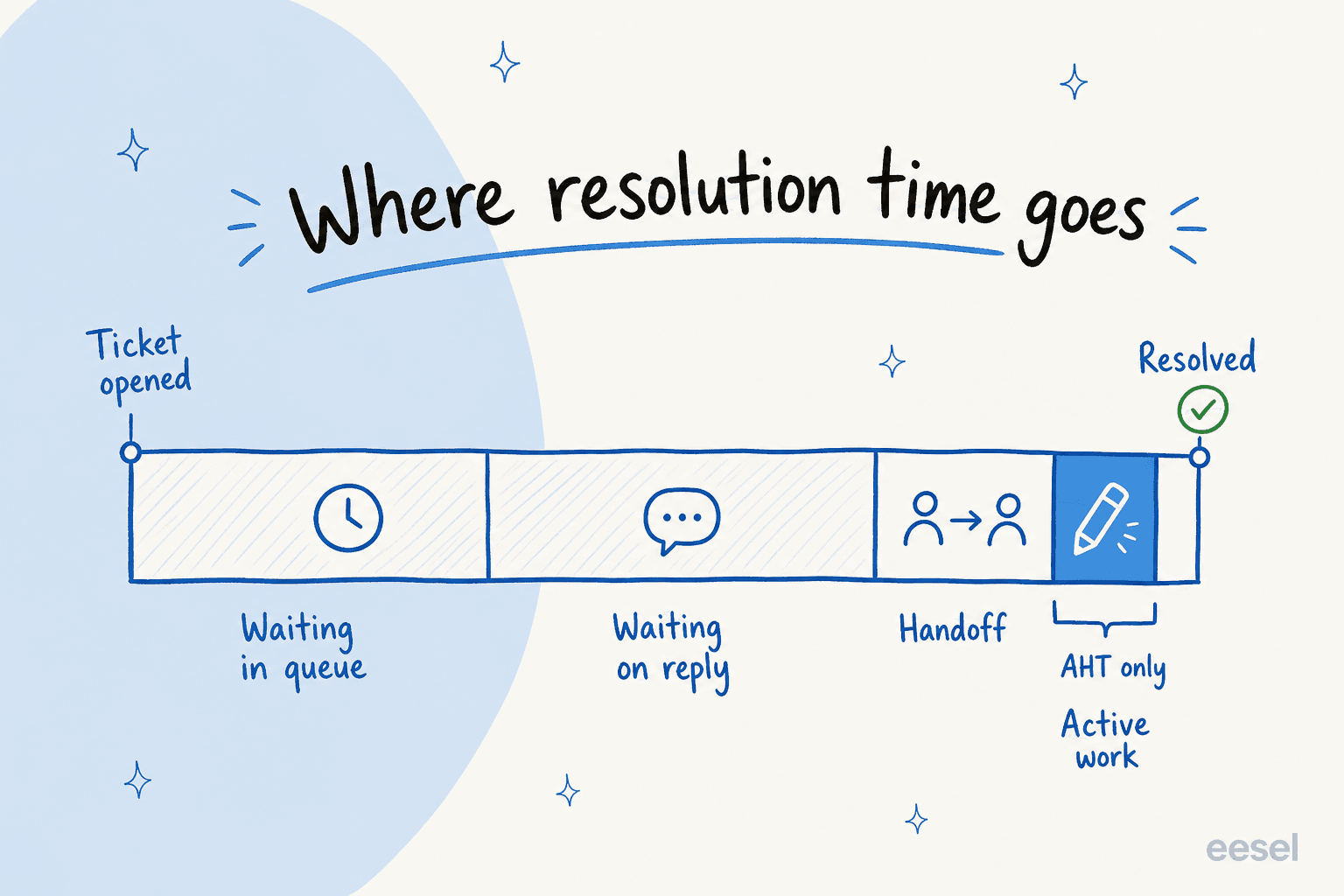
Most of the elapsed clock is waiting, time in the queue, time between replies, and handoffs, while the active work an agent actually does is only a sliver. That is why resolution time differs so sharply from average handle time, and why removing waiting often beats speeding up agents.
How resolution time works
Reducing resolution time follows a clear sequence:
- Deflect the easy questions. Answering common, well-documented requests instantly removes them from the queue entirely.
- Route correctly the first time. Sending a ticket straight to the agent who can solve it avoids the handoffs that stretch the clock.
- Give agents instant context. Surfacing the relevant knowledge, history, and account details up front cuts the research time inside each ticket.
- Resolve completely. A ticket that reopens restarts the clock, so a slightly more thorough fix often lowers true resolution time.
A tool like eesel AI attacks this on two fronts: it resolves common questions instantly from your help center and past tickets, and for the tickets that reach a human, it arms the agent with grounded context and a drafted reply. By removing volume and prep time, it pulls average resolution time down across the whole queue, while escalating cleanly when it is unsure.
Resolution time in practice
The nuance operators learn is to avoid optimizing resolution time in isolation. It is easy to game by closing tickets prematurely, which just sends the issue back as a reopen and quietly inflates the real number. The healthy way to read it is alongside reopen rate and first contact resolution: a falling resolution time only counts if tickets stay closed and customers stay satisfied. Watched together, those metrics show whether the queue is genuinely getting faster or just churning cases through.
Cut resolution time on your queue
eesel AI resolves common questions instantly and arms agents with context on the rest, pulling resolution time down across the board.