Average handle time (AHT)
The average total time an agent spends resolving a single contact, including talk time, hold time, and after-contact work.
What average handle time means
Average handle time (AHT) is the average total time an agent spends resolving a single contact, including active talk or chat time, any time the customer spent on hold, and the after-contact work such as logging notes, tagging, and updating records. It is calculated across a set of contacts to give one efficiency figure, and it is a classic contact center metric that has carried over into chat, email, and messaging support.
In customer support, AHT is a workload and capacity metric: it tells you roughly how long each interaction ties up an agent, which feeds staffing, scheduling, and cost-per-ticket calculations. It is not a quality metric on its own, and it is distinct from resolution time, which measures the full clock from the customer's first message until the issue is closed, idle waiting included.
Why average handle time matters
- It drives staffing math. Handle time multiplied by ticket volume tells you how many agent-hours a queue needs, which is the core of any capacity plan.
- It feeds cost-per-contact. Because agent time is the largest cost in most support operations, AHT is a direct input into what each ticket costs to resolve.
- It exposes friction in the workflow. A creeping AHT often means agents are hunting for information, switching tools, or doing manual wrap-up that could be automated.
- It must be read with quality, not alone. A very low AHT can hide rushed contacts that create repeat tickets, so it should always sit next to first contact resolution and a satisfaction metric.
- It varies by channel and topic. A password reset and a billing dispute have very different healthy AHTs, so a single blended number can mislead if you do not segment it.
It also helps to picture what the figure is actually made of before you try to move it.
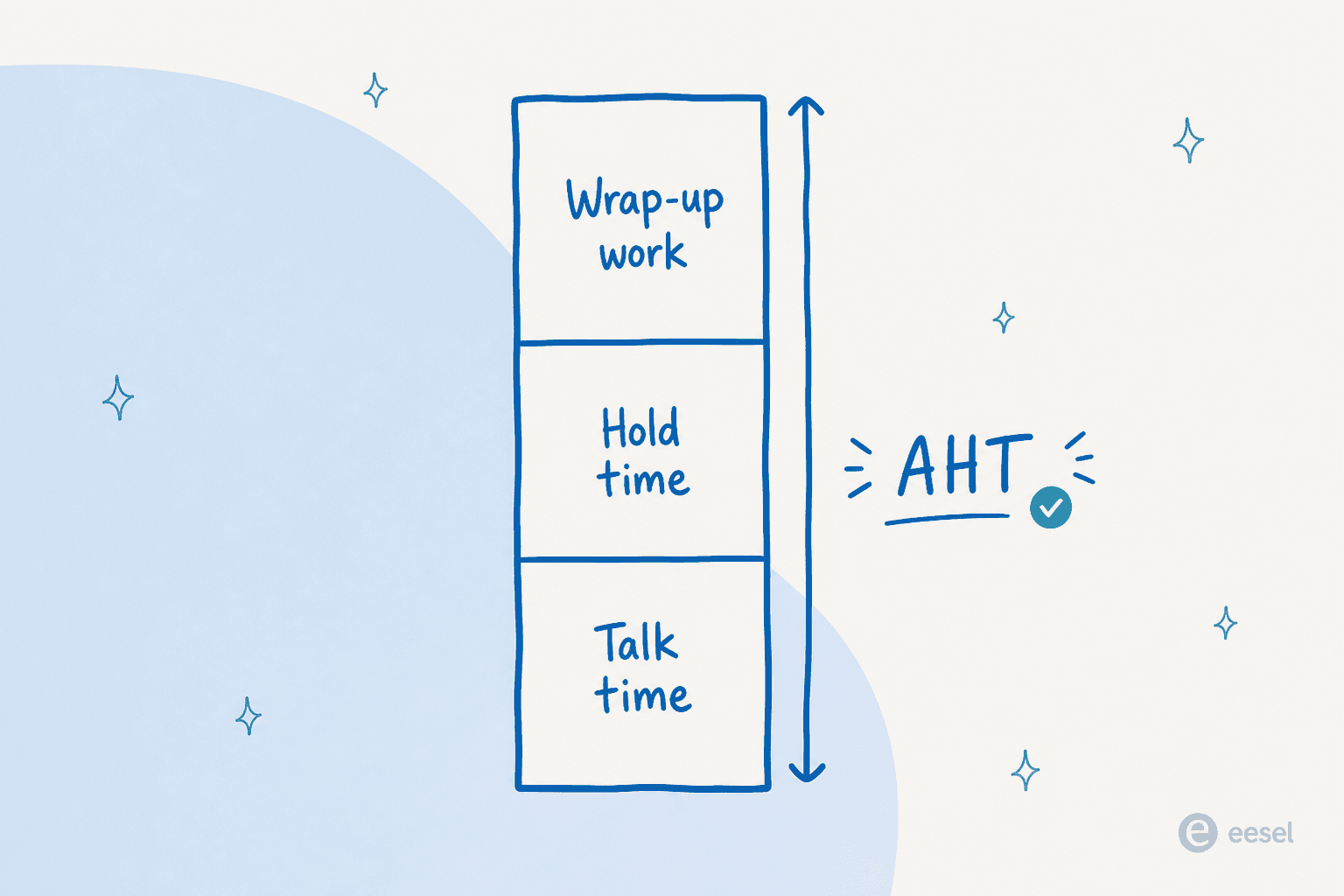
AHT is really three pieces stacked together: the active talk or chat time, any hold or wait time, and the after-contact wrap-up. Seeing them separately makes it obvious that wrap-up and hold are often where the easy minutes hide, not the conversation itself.
How to measure average handle time
The formula is straightforward:
- Sum talk or active time. Add up the time agents spent actively working contacts in the period.
- Add hold time. Include any time the customer waited on hold or the conversation was paused mid-handling.
- Add after-contact work. Include wrap-up: notes, tagging, follow-up actions, and updating the ticketing system.
- Divide by contacts handled. Take the total of those three numbers and divide by the number of contacts. The result is your AHT.
So AHT equals (total talk time plus total hold time plus total after-contact work) divided by the number of contacts.
The most durable way to improve AHT is to take work off the agent rather than make them rush. An AI agent like eesel AI resolves repetitive tickets end to end, so they never become an agent's handle time at all, and for the tickets that do reach a person it can draft a grounded reply and summarize the context, which trims the reading and the wrap-up. That lowers AHT on the remaining work without pressuring agents to cut a conversation short.
Work out your own AHT, then see how much agent time even a modest cut frees up.
Type the talk, hold, and wrap-up minutes for one contact and watch the bar show exactly where your handle time goes.
Average handle time in practice
The classic mistake with AHT is managing it as a target in isolation, which pushes agents to close contacts fast at the cost of solving them properly, and the saved minutes come straight back as repeat tickets. Read AHT next to first contact resolution and satisfaction so you can tell a genuine efficiency gain from a quality cut. Segment it by channel and topic, because a blended average hides the queues that are actually slow. The healthiest way to bring AHT down is to remove steps (better knowledge, fewer tool switches, automated wrap-up, deflected simple tickets) rather than to ask people to type faster.
Cut handle time without cutting corners
eesel AI resolves repetitive tickets end to end and drafts replies for the rest, so agents spend their handle time only on what needs a human.