First response time (FRT)
First response time is how long a customer waits between submitting a request and receiving the first human or automated reply from a support team.
What first response time means
First response time (FRT) is the amount of time that passes between a customer submitting a support request and receiving the first reply to it. It measures speed of acknowledgement, not speed of resolution: the clock starts when the ticket is created and stops the moment any reply, automated or human, is sent back. Teams usually report it as an average or median across all tickets in a window, often broken out by channel.
In customer support, FRT is one of the first metrics buyers and customers notice, because a long silence after sending a message reads as being ignored even when the eventual answer is good. It sits alongside resolution time and average handle time as a core measure of how responsive a team feels.
Why first response time matters
- It sets the tone for the whole interaction. A reply within seconds signals the team is on it, while a multi-hour wait creates frustration before anyone has even read the request.
- It is frequently written into an SLA. Many support contracts promise a first response within a set time per priority level, so FRT becomes a tracked, reportable commitment rather than a soft goal.
- It varies by channel and has to be measured per channel. A one-minute reply is fine for email but slow for live chat, so a single blended number hides where you are actually behind.
- It drives downstream metrics. Slow first responses tend to produce follow-up "any update?" messages, which inflate ticket volume and drag down CSAT.
- It is the easiest metric to game badly. An empty auto-reply technically stops the clock but does not help anyone, so a healthy FRT has to mean a useful first reply, not just any reply.
This is why a single company-wide FRT target rarely holds up. The same number that feels generous on email feels glacial on live chat, so the bar slides depending on where the customer reached out.
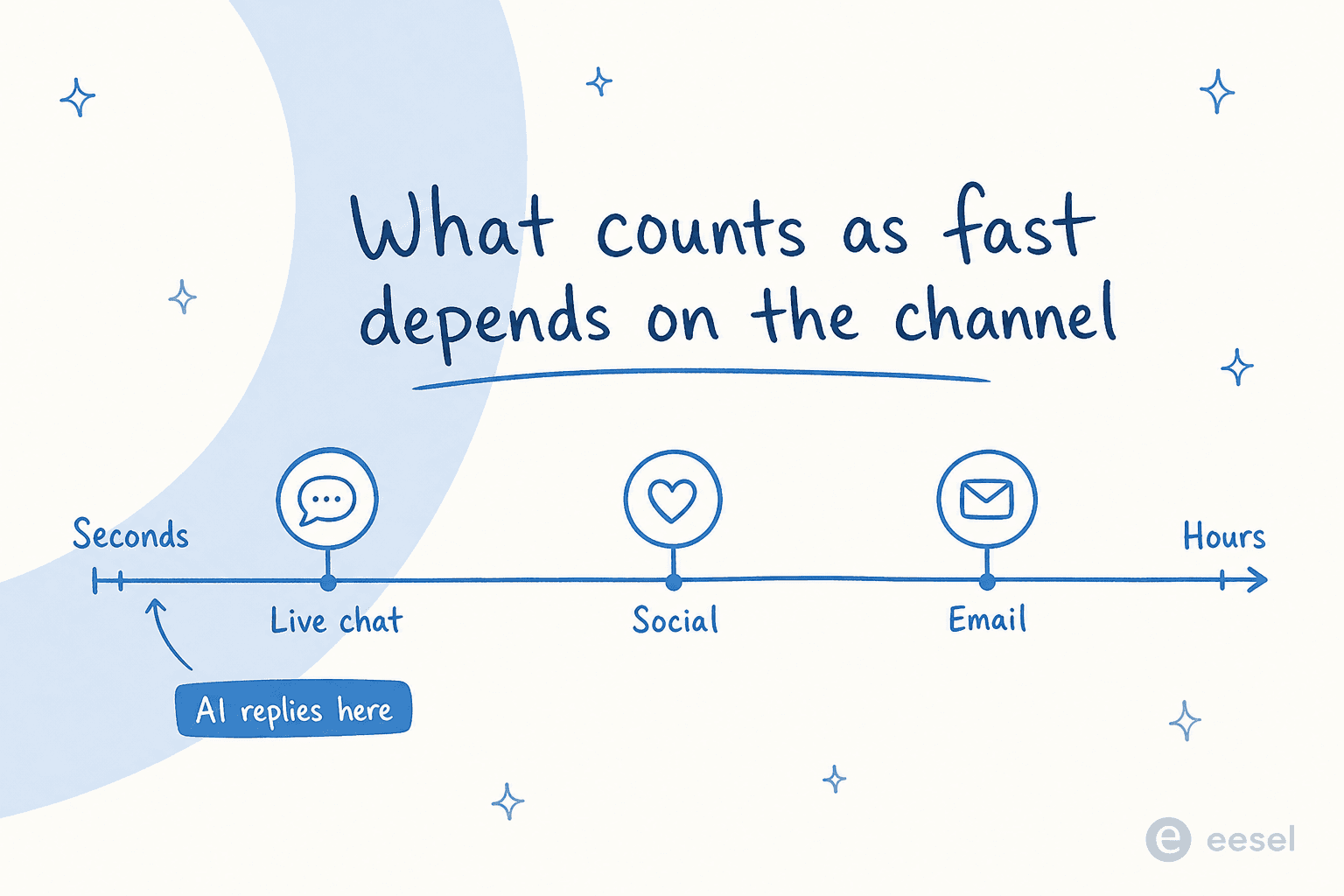
Live chat customers are watching the screen and expect a reply in seconds, while an email sender is comfortable waiting hours. Setting one blended target across all of them either over-promises on email or quietly fails on chat, which is why FRT is read per channel.
How to measure first response time
The core formula is straightforward:
- Mark the start. Record the timestamp when the ticket or message arrives.
- Mark the first reply. Record the timestamp of the first response sent to the customer.
- Subtract. The difference is that ticket's first response time.
- Aggregate. Average (or take the median of) those gaps across all tickets in the period, ideally segmented by channel and priority.
Whether you count business hours only or calendar hours matters a lot, since a ticket sent at 2am looks terrible on a 24-hour clock but fine on a business-hours clock. A support agent like eesel AI changes the shape of this metric: for the questions it can answer, it replies the instant a ticket lands, so FRT for those tickets effectively drops to seconds, and the tickets it does escalate arrive with context attached so the human first reply lands faster too.
First response time in practice
The trap with FRT is optimizing it in isolation. It is trivial to drive the number down with canned auto-acknowledgements that say nothing, and customers see straight through that. The metric only means something when the first response is also a useful one, which is why mature teams pair FRT with first contact resolution and CSAT. Read together, those three tell you whether you are answering fast, answering well, and answering once, rather than just answering quickly into the void.
Want the full playbook? See our guide to reducing first response time.
Cut first response time to seconds
eesel AI replies to common tickets instantly, so first response time drops without adding headcount.