SLA (Service Level Agreement)
A service level agreement is a documented commitment to deliver a service to a defined standard, such as replying to or resolving support requests within a set time.
What an SLA means
An SLA (service level agreement) is a documented commitment to deliver a service to an agreed standard, with specific, measurable targets and an understanding of what happens if those targets are missed. It can be a formal contract between a vendor and a customer, or an internal agreement between teams. The defining feature is that the standard is written down and tracked, so "good service" becomes a number both sides can check rather than a matter of opinion.
In customer support, an SLA usually sets target times for two things: how quickly the first reply goes out (tied to first response time) and how quickly the issue is fully resolved (tied to resolution time). These targets are typically defined per priority level, so an urgent outage gets a much tighter clock than a routine how-to question.
Why an SLA matters
- It turns expectations into commitments. Instead of hoping replies are "fast", an SLA names the actual target, so customers know what to expect and the team knows what to hit.
- It is usually tiered by priority. A well-built SLA assigns different targets to urgent, high, normal, and low priority tickets, so the most painful issues get the fastest clock.
- It distinguishes response from resolution. Most SLAs track first-response and resolution targets separately, because a fast acknowledgement with a slow fix is a different failure than a slow acknowledgement.
- It drives routing and escalation. When a ticket is at risk of breaching its target, good systems flag it, reprioritize it, or trigger an escalation automatically.
- It defines the consequence of a miss. Enterprise SLAs often attach credits or penalties to breaches, which is what makes the commitment real rather than aspirational.
Put the tiering and the response-versus-resolution split together and a support SLA looks less like a single promise and more like a grid:
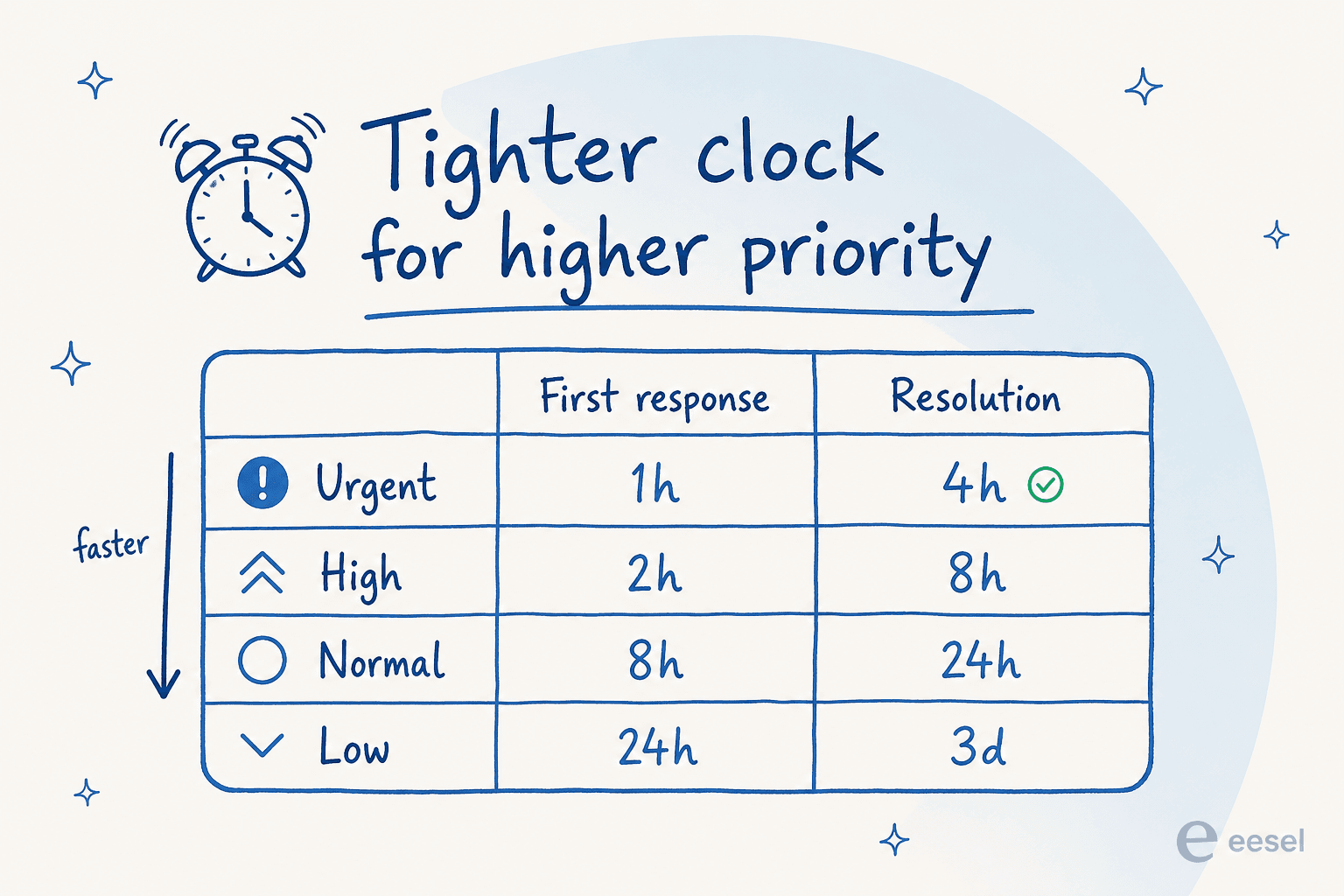
Each priority level carries its own pair of clocks, and the targets tighten as the issue gets more painful. An urgent outage might owe a one-hour first reply and a four-hour fix, while a low-priority how-to can wait a day or more for each. The numbers here are illustrative; the shape is what matters.
How an SLA works
A support SLA usually runs through this cycle:
- Define the targets. Set response and resolution times for each priority level and each channel.
- Attach the clock to every ticket. When a ticket arrives, it inherits the target that matches its priority, and a timer starts.
- Track progress. The helpdesk monitors each ticket against its target and surfaces anything approaching a breach.
- Route and escalate. At-risk tickets get reprioritized, reassigned, or escalated so a person can intervene before the deadline.
- Report compliance. The team reviews how many tickets met their targets, usually as an SLA compliance percentage, and adjusts staffing or targets from there.
A support agent like eesel AI helps on the front of this cycle: it answers common tickets the instant they land, so first-response targets stay green even during volume spikes, and it hands off anything it cannot safely resolve with full context, giving human agents more of the clock to meet the resolution target.
SLAs in practice
The most common SLA mistake is setting one blanket target for everything, which forces the team to treat a password reset and a production outage with the same urgency. Mature teams tier their SLAs tightly by priority and channel, and then watch the compliance rate as the headline number rather than any single ticket. The other quiet failure is setting targets that look impressive in a sales deck but the team cannot actually staff for, which produces a wall of breaches and erodes trust faster than a slower but honest target ever would.
We go deeper on this in our SLA management guide.
Hit your SLAs without firefighting
eesel AI answers common tickets the instant they arrive, so first-response and resolution SLAs stay green even during volume spikes.