Deflection rate
The percentage of incoming customer questions resolved through self-service or automation without being handled by a human agent.
What deflection rate means
Deflection rate is the percentage of incoming customer questions that are resolved through self-service or automation without ever being handled by a human agent. It expresses, as a single number, how much of the support demand the front-line channels absorb before it reaches a person. The basic formula is the count of questions resolved without a human-handled ticket, divided by total incoming questions, times one hundred.
In customer support, deflection rate is the headline metric for any self-service or AI program: it answers the question "of everything customers asked, how much did we handle without an agent?" A higher deflection rate means agents spend their time on fewer, harder tickets, but only when the deflected questions were truly resolved and not just abandoned.
Why deflection rate matters
Deflection rate is a load-bearing metric, but it has to be read carefully because it:
- Quantifies automation impact directly, turning a fuzzy "the bot is helping" into a number you can track over time and tie to cost.
- Maps to capacity and cost, since each point of deflection is demand that never consumes agent time, which is the most expensive resource in support.
- Pairs with quality or it lies, because a deflection that left the customer unhappy is worse than a ticket, so the rate is only trustworthy next to a CSAT check on the deflected set.
- Reveals knowledge gaps, as the questions that fail to deflect map directly to what is missing from your knowledge base.
- Gets confused with neighbors, so it should never be reported without saying whether it means the same thing as your containment rate or resolution rate.
Seeing the inbound load as a funnel makes it obvious which slices the deflection rate is actually counting.
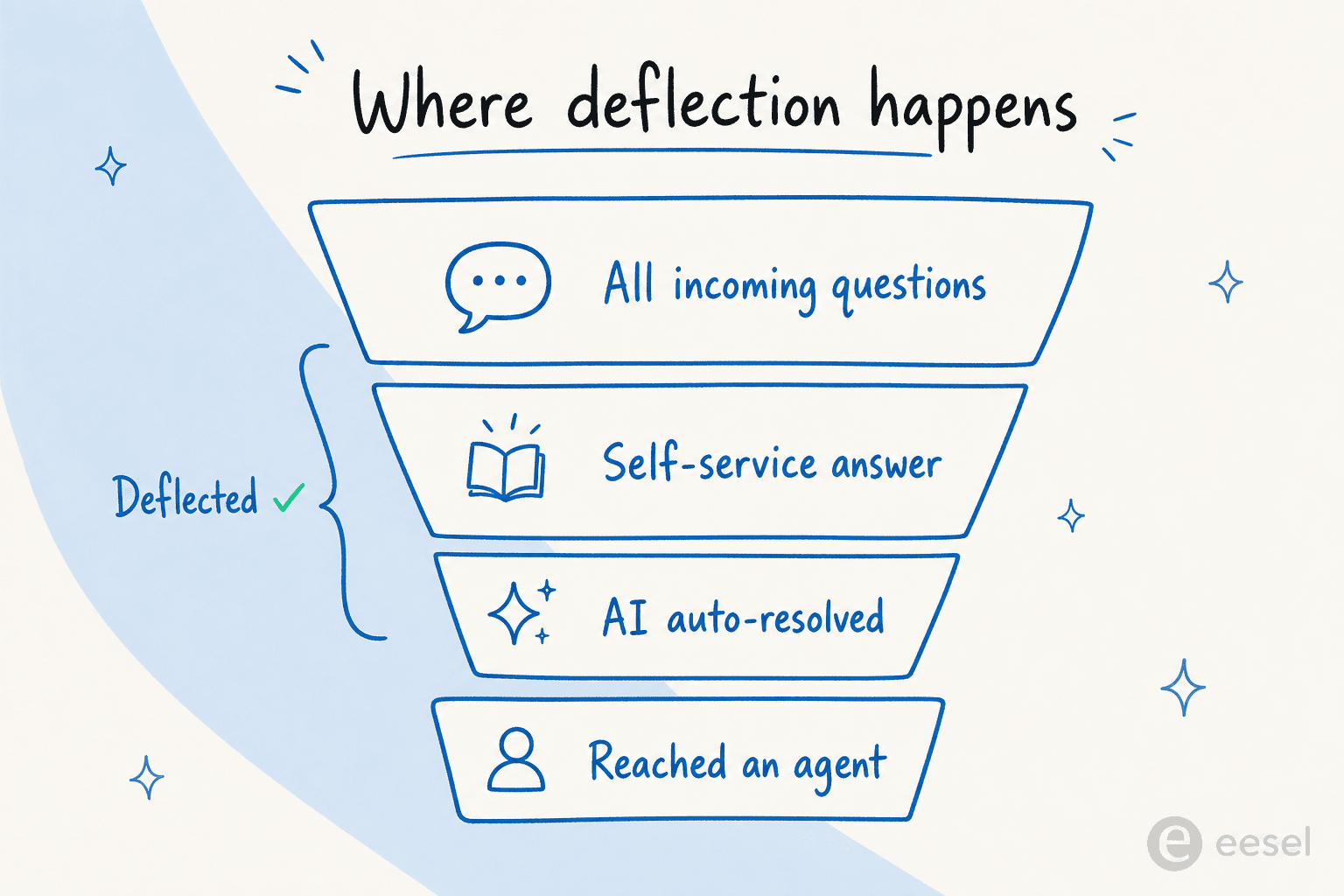
Everything resolved before a customer reaches a person, whether through a help article or an AI answer, is the deflected share. Only the bottom slice consumes agent time, so deflection rate is really just the size of the bracketed top of this funnel relative to the whole.
How deflection rate works
Measuring deflection rate honestly looks like this:
- Define a deflection. Decide what counts: a self-service answer the customer accepted, an automated reply that closed the question, and crucially, not an abandoned session.
- Count the deflected questions. Track every interaction that ended without creating a human-handled ticket.
- Count total inbound demand. Capture all questions that entered any channel over the same window.
- Divide and validate. Compute the rate, then sample the deflected interactions to confirm the customer was actually helped.
A tool like eesel AI lets you forecast this before go-live by simulating against your historical tickets: it replays past conversations to estimate how many it would have deflected and at what confidence, so the deflection rate you plan for is grounded in your real ticket history rather than a vendor's blended average.
Deflection rate in practice
The single most useful habit with deflection rate is refusing to read it alone. The number is trivially easy to inflate by counting the wrong things, so operators who trust it pair it with a satisfaction signal on the deflected interactions and watch whether reopen and follow-up rates climb when deflection does. A deflection rate that rises while CSAT holds steady is real progress; a deflection rate that rises while complaints quietly grow is a self-service experience pushing people away. Treat the headline number as a question, not an answer, and the metric earns its place.
Want the full playbook? See our guide to improving deflection rate.
See your deflection rate before go-live
eesel AI simulates against your past tickets so you can forecast deflection rate before it ever answers a live customer.