Containment rate
The percentage of conversations an automated channel handles to completion without escalating to a human agent.
What containment rate means
Containment rate is the percentage of conversations that an automated channel handles to completion without escalating to a human agent. It measures how much of the conversational load a bot, IVR, or AI agent "contains" inside automation, rather than passing up the chain to a person. The standard calculation is the count of conversations resolved without escalation, divided by the total conversations the automated channel handled, times one hundred.
In customer support, containment rate is the core metric for any self-service or AI channel, and it is closely related to deflection: deflection often looks at questions kept out of the ticket queue, while containment looks at conversations the automated channel saw and finished on its own. A contained conversation is one the customer started and the automation ended, ideally with the customer's problem solved.
Why containment rate matters
Containment rate is a key automation metric, with an important caveat baked in, because it:
- Measures automation effectiveness in its own channel, showing what share of conversations the bot or AI agent finishes without help.
- Connects directly to cost and staffing, since every contained conversation is one an agent never has to join, which is where the savings come from.
- Can be gamed dangerously, because counting abandoned chats or hard-to-find escalation paths as contained inflates the rate while customers leave frustrated.
- Means little without quality, so it should always be read next to CSAT and resolution rate to confirm contained conversations were actually resolved.
- Depends on clean escalation, because the conversations that should not be contained need a smooth path to a person, and an escalation that loses context turns a good handoff into a bad experience.
Plotting the rate against satisfaction is the quickest way to tell a healthy number from a misleading one.
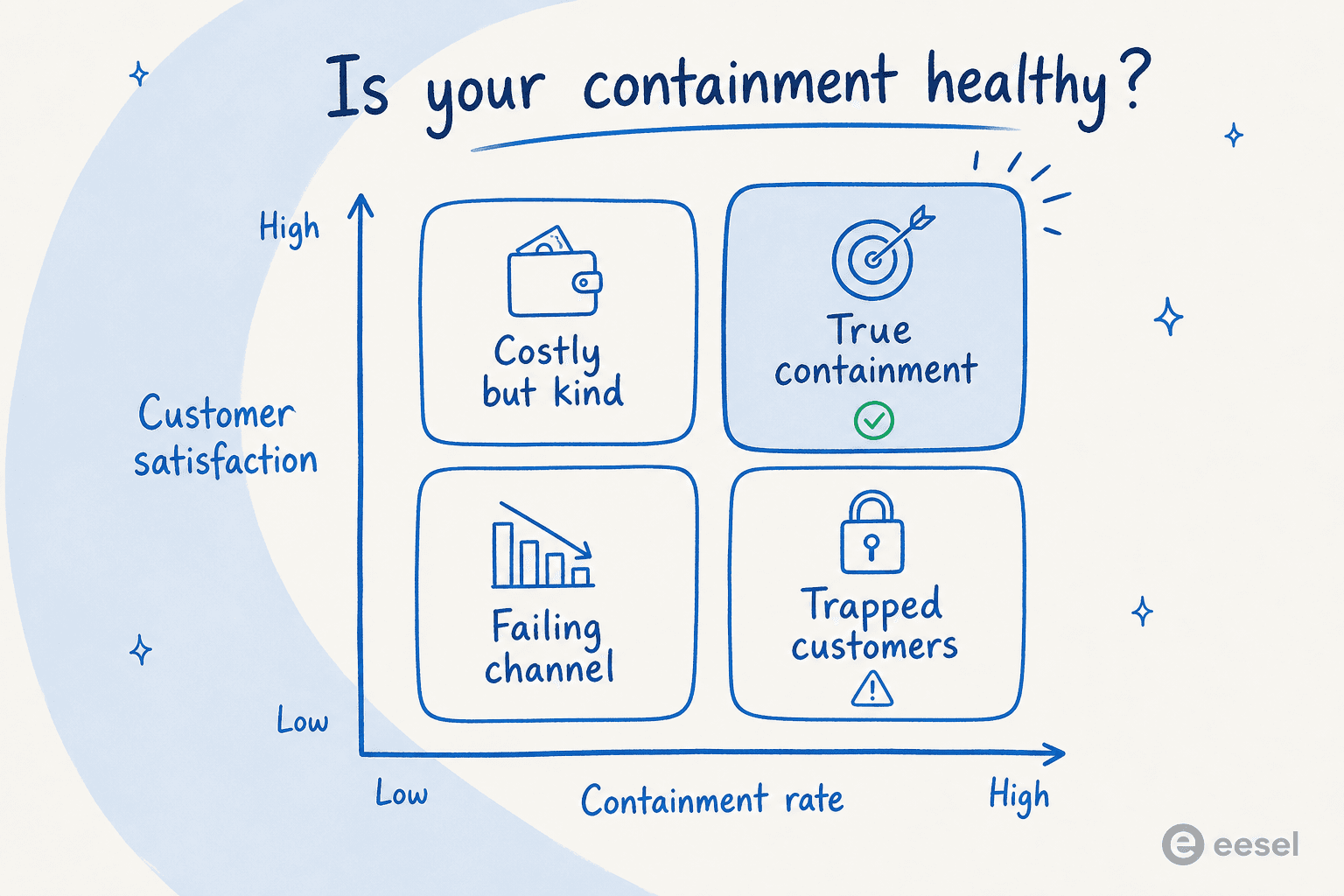
Only the top-right cell, high containment with high satisfaction, is the number worth chasing. A high rate paired with low satisfaction sits in the "trapped customers" corner, which looks like a win on the dashboard and reads as a failure to the people in it.
How containment rate works
Measuring containment honestly follows this pattern:
- Define containment. Decide what counts as contained: a conversation the automation resolved, and specifically not one the customer abandoned out of frustration.
- Track escalations. Log every conversation that handed off to a human, since containment is the inverse of that.
- Compute the rate. Divide non-escalated, resolved conversations by total automated conversations.
- Validate against satisfaction. Sample contained conversations to confirm the customer got an answer rather than giving up.
An AI agent like eesel AI is built to raise containment the right way: it resolves the conversations it can answer confidently from your knowledge and escalates the rest to a person with the full thread and context attached. Because the escalation path stays clean, the contained conversations are the ones it actually handled, not the ones it trapped.
Containment rate in practice
The fastest way to ruin a containment number is to chase it. Make the "talk to a human" button harder to find and containment jumps, right up until the complaints arrive. Operators who use the metric well treat clean escalation as a feature, not a leak, and judge containment only on conversations the customer was actually satisfied with. The honest version of the metric rises when the automation gets better at answering, and the unhealthy version rises when the human gets harder to reach. Knowing which one you are looking at is the whole skill.
For the full playbook, see measuring containment rate.
Raise containment without lowering quality
eesel AI resolves what it can confidently handle and escalates the rest with full context, so containment rises without abandoned customers.