Resolution rate
The share of support requests that end in a confirmed solution, calculated as resolved tickets divided by total tickets over a period.
What resolution rate means
Resolution rate is the percentage of support requests that end in a confirmed solution over a given period, calculated as resolved tickets divided by total tickets. It answers a single question: of everything customers asked, how much actually got fixed?
The metric is only as honest as the word "resolved." A ticket marked solved that the customer re-opens two days later was never resolved, so a credible resolution rate counts only closures that stayed closed. In customer support, the rate is one of the headline measures of whether a team is keeping up with demand, because it reflects both throughput and effectiveness rather than just activity.
Why resolution rate matters
- It links effort to outcomes. Reply counts and handle times measure work, but resolution rate measures whether that work solved the problem.
- It exposes hidden failure when paired with reopen rate: a strong resolution rate with high reopens means tickets are being closed prematurely.
- It is the natural home for automated resolution, since AI-closed tickets feed straight into the same numerator.
- It complements speed metrics like resolution time: fast but unresolved is worse than slightly slower but solved.
- It only holds up next to satisfaction, because a resolution the customer disagrees with still counts in the math but fails in reality, which is why teams read it alongside CSAT.
That is why the rate is best read as one corner of a set of three metrics that have to move together:
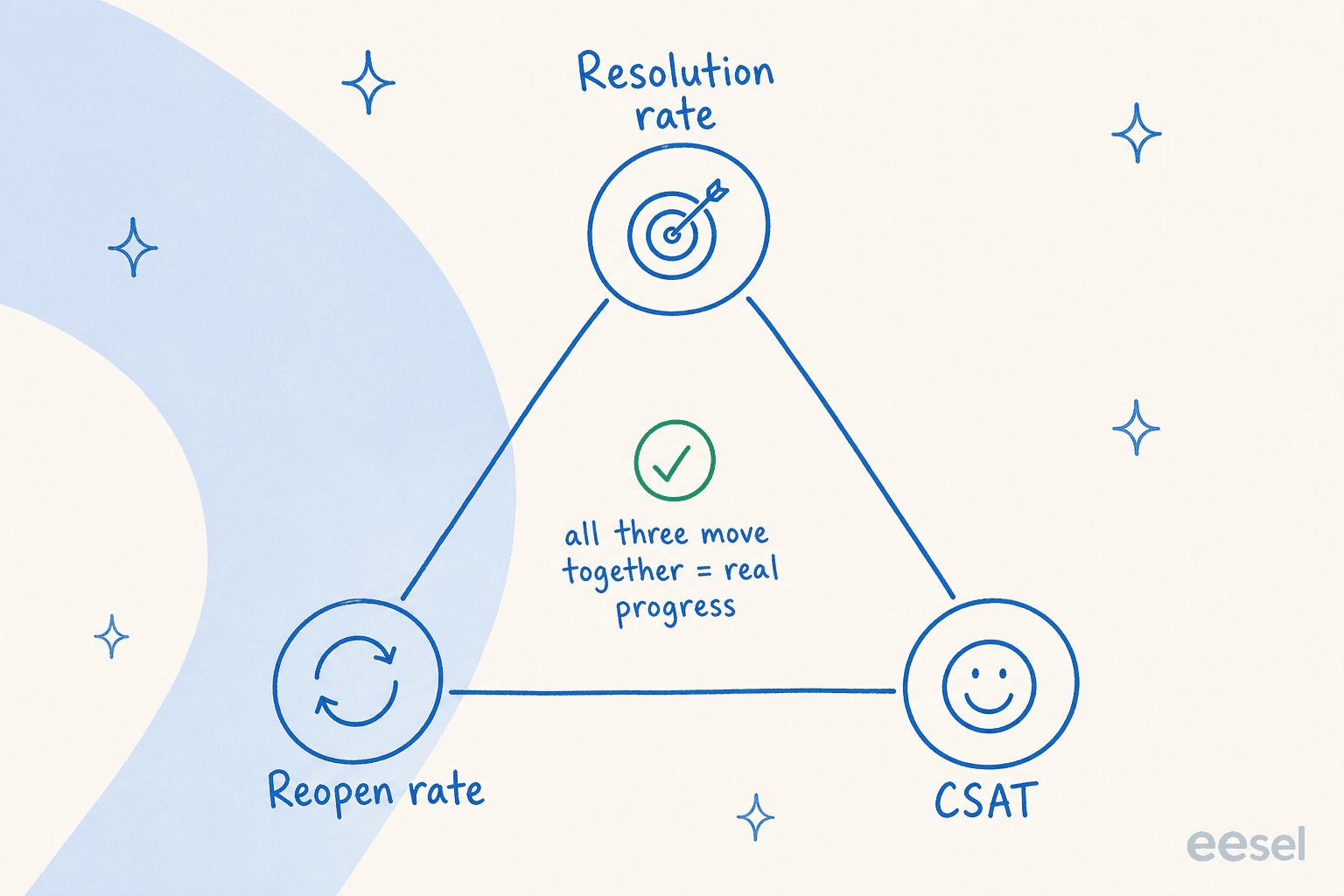
Resolution rate sits at one corner, with reopen rate and CSAT at the other two. When all three improve together the rate reflects real progress; when only the rate climbs while reopens or satisfaction slip, it is usually being gamed upstream.
How resolution rate works
Tracking resolution rate with an AI agent like eesel AI follows a clear pattern:
- Define resolved. The team sets what counts: a confirmed answer, a completed action, or a non-reopened closure.
- Tag each closure. Every ticket is recorded by how it ended and who or what handled it, human or automated.
- Split the numerator. Resolutions are separated into human-handled and AI-handled so the contribution of each is visible.
- Measure quality alongside. Reopens and satisfaction scores are tracked against the same tickets to keep the rate honest.
- Simulate before scaling. Before widening what the AI handles, it is run against historical tickets to estimate the resolution rate it would have achieved on real cases.
The simulation step is what makes the number predictable rather than a hopeful estimate, because it shows the likely rate on requests the team has already seen.
Resolution rate in practice
The trap operators fall into is optimizing the rate in isolation. A team can lift its resolution rate by closing tricky tickets fast and low, only to watch reopens and complaints climb. The figure is most useful as one corner of a triangle with satisfaction and reopen rate: when all three move in the right direction together, the resolution rate reflects real progress, and when only the rate moves, it is usually being gamed somewhere upstream.
Want the full playbook? See our guide to AI resolution rate.
Lift your resolution rate with AI
eesel AI resolves repetitive tickets end to end from your own knowledge, raising the share of requests closed without a human.