Reopen rate
Reopen rate is the percentage of resolved support tickets that get reopened because the customer's issue was not actually solved.
What reopen rate means
Reopen rate is the percentage of resolved support tickets that get reopened because the customer's issue was not actually solved. It is calculated by dividing the number of reopened tickets by the number of resolved tickets over a period. A ticket reopens when a customer replies after closure to say the problem persists, or when an agent reopens it on discovering the fix was incomplete.
In customer support, reopen rate is a quality measure rather than a speed measure. A team can close tickets quickly and still serve customers badly if many of those closures bounce back. Reopens are expensive twice over: they consume handling capacity a second time, and they signal to the customer that the first answer wasted their time. A low reopen rate means resolutions are sticking, which is the real goal behind every closed ticket.
Why reopen rate matters
Reopen rate catches the failures that raw resolution counts hide:
- It validates resolutions. A high resolution rate only means something if those resolutions hold; reopen rate is the audit that confirms they do.
- It is a CSAT predictor. Reopened tickets correlate strongly with low CSAT, because nothing frustrates a customer like being told their issue is solved when it is not.
- It exposes premature closures. Agents under pressure to hit speed targets sometimes close tickets early; reopen rate makes that visible instead of letting it pass as a fast resolution.
- It doubles handling cost. Every reopen means re-reading the history and re-working the problem, which inflates both handling time and the effective cost of that ticket.
- It flags symptom-only fixes. Recurring reopens on the same topic usually mean answers are treating symptoms rather than root causes.
When you segment a backlog of reopens, the same handful of causes tend to dominate the chart:
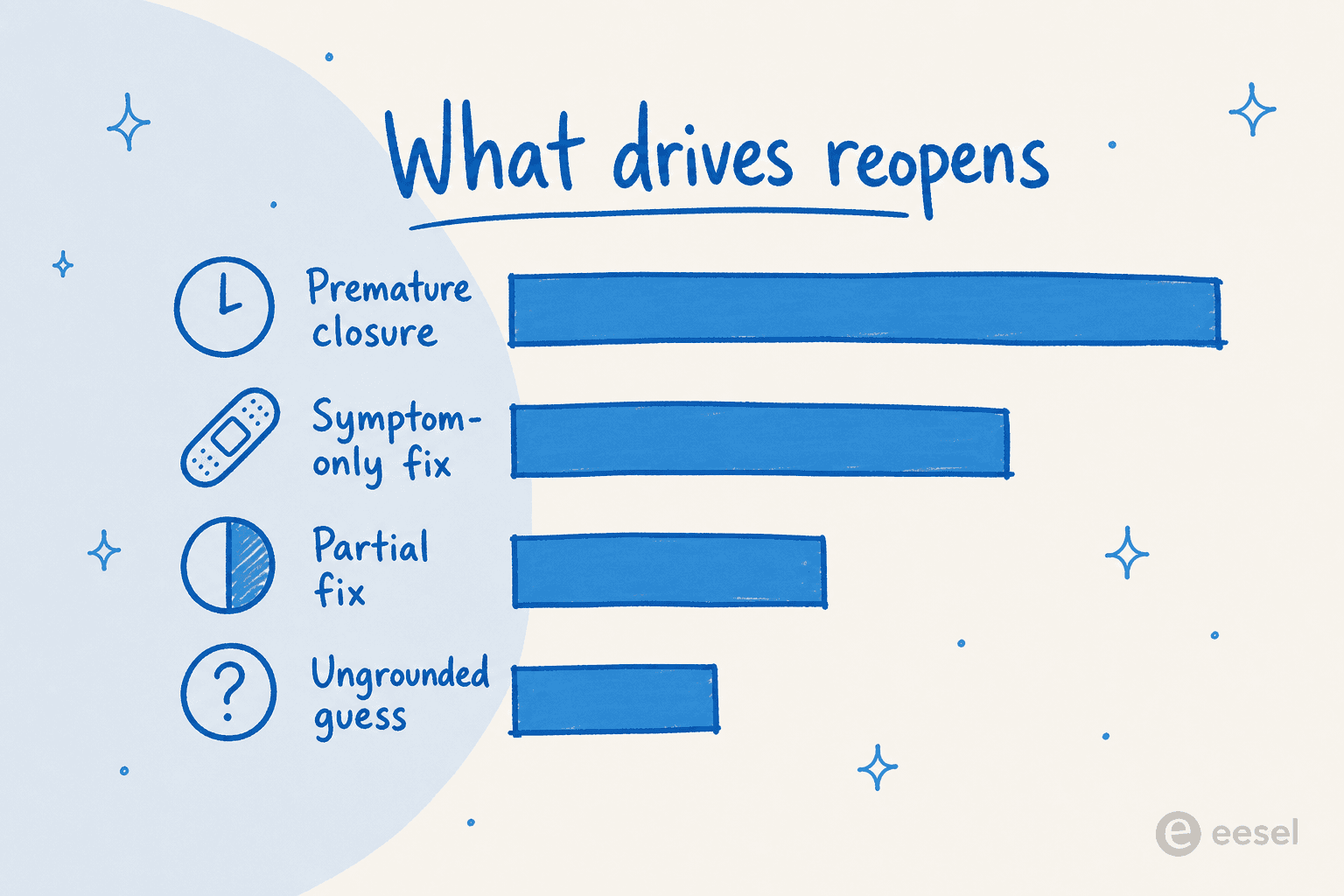
Premature closures usually top the list, followed by fixes that treat the symptom or only solve part of the request. Knowing which driver is biggest tells you where to act, since closing a few rushed-closure habits removes far more reopens than reworking tickets one by one.
How reopen rate works with AI
Keeping reopens low depends on getting the first answer right, which is exactly where the source of an answer matters:
- Ground the answer. Pull the response from trusted, current knowledge rather than the model's best guess.
- Solve the real request. Address what the customer actually asked, not a near-match, so the fix holds.
- Gate on confidence. When the agent is not sure, escalate rather than close, using a confidence score threshold.
- Watch the bounce-back window. Track reopens within a fixed window after closure to see whether resolutions are sticking.
A support agent like eesel AI is built around this: it grounds every reply in your help center and past tickets, so the answers it gives are drawn from your own facts rather than invented, and it escalates the cases it cannot confidently solve. An answer grounded in real knowledge is far less likely to bounce back than one improvised by a model with no source.
Reopen rate in practice
Operators read reopen rate as the counterweight to closure speed. A team that optimizes for fast closures without watching reopens can post great numbers while quietly making customers angrier, because the speed gain is borrowed from quality. The most informative view segments reopens by agent, by topic, and by closing reason, which usually reveals that a small set of issue types or a few rushed closure habits drive most of the reopens. Those are the patterns worth fixing, since each one removes a reopen at the source rather than just reworking it after the fact.
Resolve tickets so they stay closed
eesel AI grounds every answer in your own knowledge, so the tickets it closes are solved on the first pass instead of bouncing back.