Automated resolution
A support interaction that is fully closed out by software, with no human agent touching it, from the customer's first message to the resolved outcome.
What automated resolution means
Automated resolution is a support interaction that software closes out completely, from the customer's first message to a resolved outcome, without a human agent handling any part of it. The defining test is the ending: the customer's problem is actually solved and the conversation is closed, not just acknowledged or redirected.
This is a higher bar than it sounds. Pointing someone to a help article, sending an automatic reply, or filing a ticket into a queue are all things automation can do, but none of them resolve anything on their own. In customer support, automated resolution means the system understood the request, produced the correct answer or took the correct action, and the customer left satisfied, all without a person stepping in.
What makes automated resolution different
Automated resolution is often confused with adjacent metrics, so it helps to pin down what sets it apart:
- It requires a confirmed outcome, not just a sent reply. A bot that answers wrongly and the customer re-opens the ticket did not resolve anything.
- It is stricter than deflection, which only counts requests that never became tickets and assumes the self-service content did the job.
- It can include actions, not just answers, like processing a refund, resetting a password, or updating an order, which is what separates a resolving agent from a reply generator.
- It is the cleanest input to resolution rate, because it isolates exactly which closures happened without human cost.
- It exposes quality, not just deflection volume, since a high automated-resolution number only holds up if those resolutions were correct and did not bounce back.
Stacking these three outcomes against each other shows why only the top one earns the name.
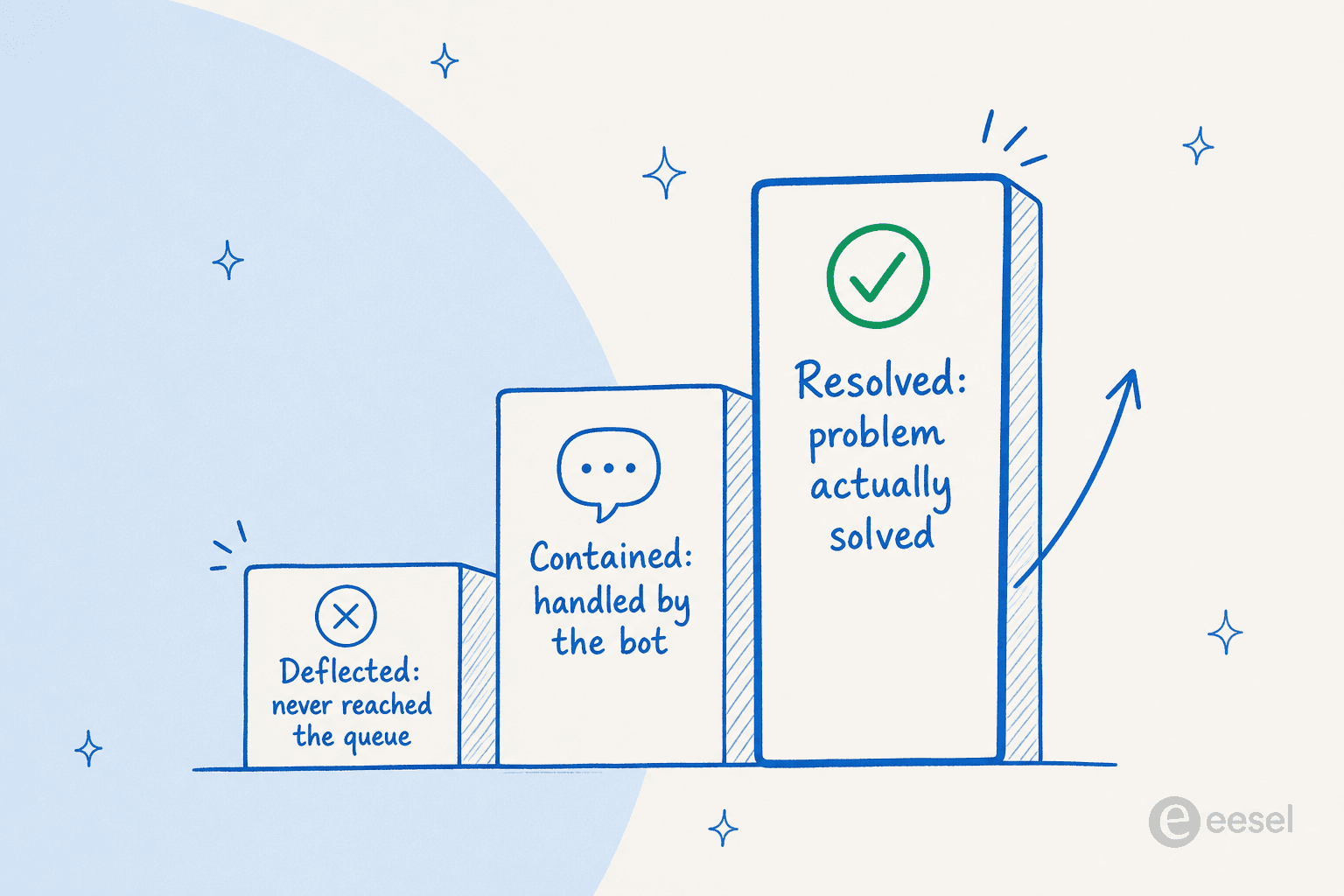
Deflected only means the question never hit the queue, and contained only means a bot took the conversation. Resolution sits a step above both: the customer's problem is actually solved, which is why it is the only one of the three that earns a check.
How automated resolution works
A resolving support agent like eesel AI reaches an automated resolution through a repeatable loop:
- Interpret the request. The agent reads the full message and works out the customer's actual intent, often using intent classification.
- Ground the answer. It retrieves the relevant facts from your help center, internal docs, and past tickets so the response reflects your policies, not a generic guess.
- Act if needed. Where the request implies an action, it performs it in the connected helpdesk: a refund, a status change, a tag.
- Confirm or escalate. If confidence is high, it closes the loop with the customer. If not, it escalates to a person with full context attached rather than risk a wrong answer.
- Record the outcome. The closed conversation is tagged as automated, which is what makes the number measurable later.
The escalation step is what protects the metric: an agent that guesses to inflate its resolution count erodes trust faster than it saves time.
Automated resolution in practice
The honest version of this metric depends on definition discipline. Teams that count every auto-reply as a resolution post impressive numbers that fall apart under audit, while teams that only count confirmed, non-reopened closures get a figure they can actually trust and act on. The practical move is to start narrow, automate a well-documented set of repetitive requests, prove the resolutions hold up against real ticket history, and widen the scope from there rather than chasing a headline percentage on day one.
Want the full playbook? See our guide to automated ticket resolution.
Resolve tickets automatically, end to end
eesel AI reads a ticket, answers from your own knowledge, takes the action, and closes the conversation without a human in the loop.