Intent detection
The process of figuring out the underlying goal behind a person's message, so a system can respond to what they actually want.
What intent detection means
Intent detection is the process of figuring out the underlying goal behind a person's message, so a system can respond to what they actually want rather than to the literal words. Two people can ask for the same thing in completely different language, and one person can phrase a single request in a way that buries the real ask, so intent detection is the step that reads past the surface to the purpose. It is a central capability within natural language understanding.
In customer support, intent detection is the first real decision in handling a ticket. "I've been charged twice," "why is there an extra line on my bill," and "your billing is wrong" are different sentences with the same intent, a billing dispute, and detecting that shared goal is what lets the system route or resolve all three the same way.
Why intent detection matters
- It works across phrasings. Customers never use your internal category names, so detecting intent from natural language is what bridges their words to your workflows.
- It sets up everything downstream. Routing, automated answers, and auto-triage all depend on a correct read of intent, so an early error compounds.
- It handles context, not just keywords. Good detection accounts for the conversation so far, distinguishing "I want to cancel" from "I almost cancelled last year."
- It can surface multiple goals. A single message often carries more than one intent, and detecting all of them prevents half-answered tickets.
- It flags uncertainty. When the goal is genuinely unclear, a strong system says so and asks a clarifying question or escalates, instead of guessing.
The core move is reading past the wording. Three customers can describe the same problem in three unrelated sentences, and detection collapses all of them onto the goal underneath.
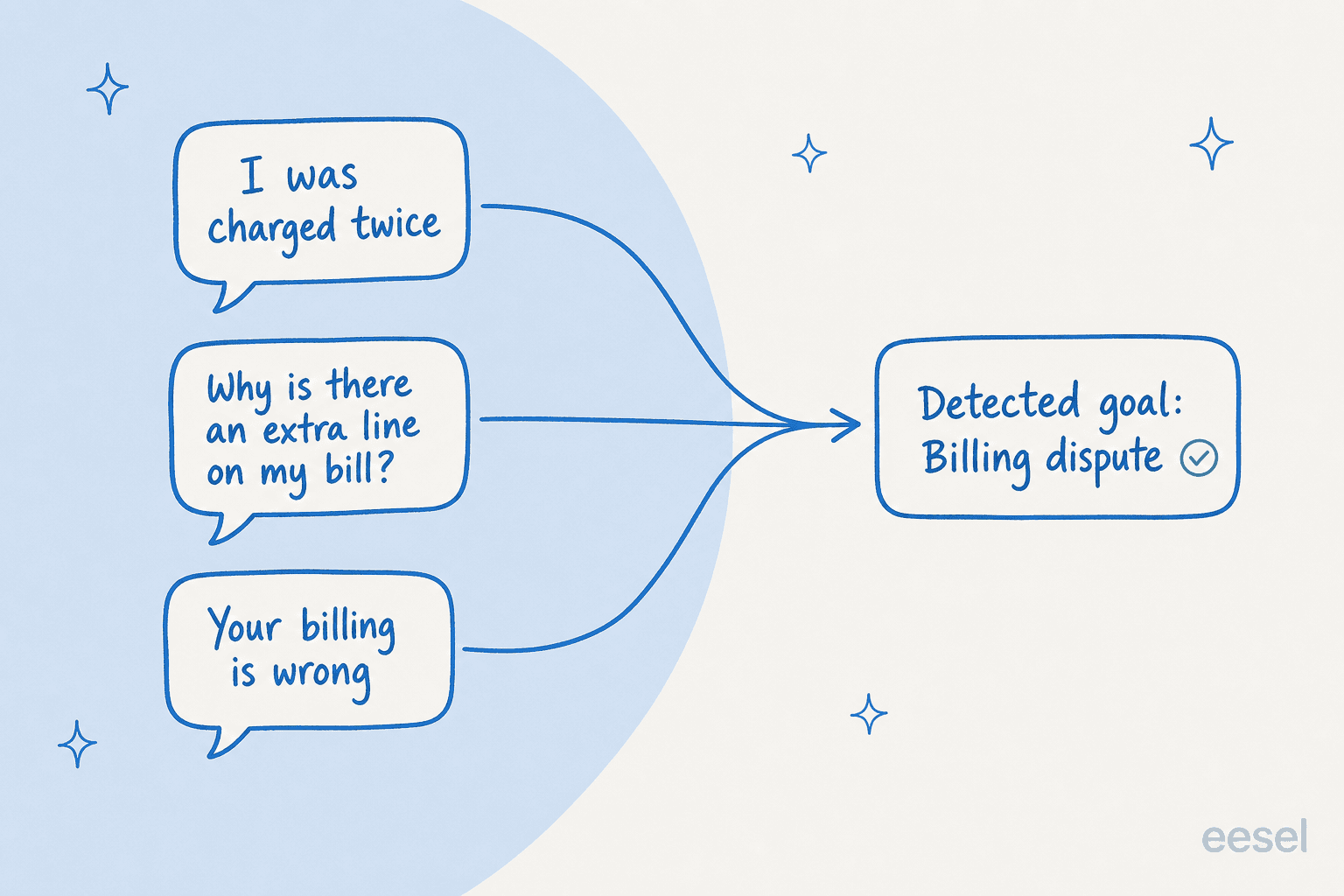
Where a keyword match would treat those three lines as separate cases, detection recognizes the shared purpose, a billing dispute, so all three can be routed and resolved the same way.
How intent detection works
A support agent like eesel AI detects intent before it decides how to respond:
- Read the message in context. It takes the customer's text along with the thread history and any account context, not the latest line in isolation.
- Infer the goal. It works out what resolution the customer is after, often using intent classification against a defined set of labels, or open-ended reasoning for messages that do not fit a clean category.
- Attach confidence. It produces a read of the intent with a confidence score, and may flag secondary intents in the same message.
- Route the decision. A clear, in-scope intent gets resolved automatically from your knowledge, while an ambiguous or out-of-scope one gets a clarifying question or an escalation.
The payoff is that the system answers the question the customer meant to ask, not the one a keyword match would have inferred.
Intent detection in practice
Detection quality shows up most at the edges: sarcasm, mixed intents, and messages where the stated request and the real problem differ ("reset my password" when the real issue is a locked account). The teams that get this right do not chase perfect detection on every message; they make sure the system knows when it is unsure and behaves safely there, asking or escalating rather than committing to a wrong read. Testing detection against real historical tickets, where the actual outcomes are known, is the most reliable way to see where it breaks before customers do.
For a hands-on walkthrough, read routing tickets with intent detection.
Detect what customers want, then resolve it
eesel AI reads the goal behind each ticket and answers from your own knowledge or routes it where it should go.