Natural language understanding (NLU)
The branch of AI focused on reading human language and extracting its meaning, intent, and structure so a machine can act on it.
What natural language understanding means
Natural language understanding (NLU) is the area of artificial intelligence concerned with reading human language and extracting its meaning, intent, and structure so a machine can act on it. It is the comprehension side of language AI: taking messy, ambiguous text written by a person and turning it into something a system can reason about, like an intent, a set of entities, or a sentiment. NLU is a subset of the broader field of NLP, which also covers generating language and other text operations.
In customer support, NLU is what lets software tell that "my package never showed up," "where's my order?," and "still waiting on a delivery from last week" are all the same request, even though none of them share the same words. It reads for meaning, not for keywords, which is why it is the foundation under triage, routing, and any AI that answers tickets.
What makes NLU different
NLU does several things that simple text matching cannot:
- Intent recognition figures out what the person is trying to accomplish, like requesting a refund or resetting a password, often through intent classification.
- Entity extraction pulls out the specific details that matter, such as an order number, a product name, or a date.
- Context and coreference track what "it" or "that one" refers to across a multi-turn conversation rather than treating each message in isolation.
- Sentiment and tone detect whether the customer is frustrated, neutral, or satisfied, which feeds sentiment analysis.
- Ambiguity handling lets it cope with typos, slang, and incomplete sentences, the way real people actually write to support.
It helps to picture understanding as a climb rather than a single switch that flips on:
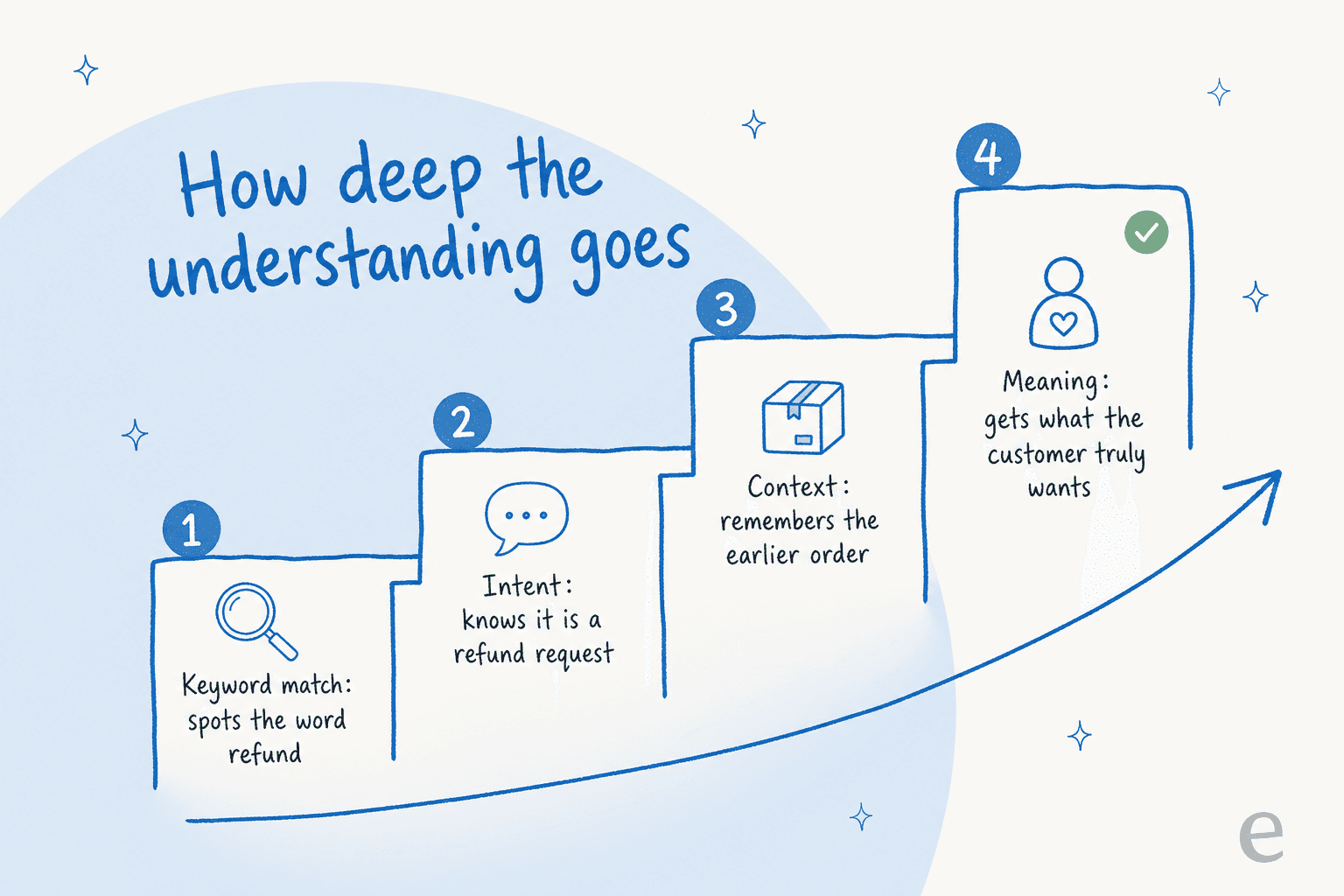
A keyword filter sits on the bottom step, spotting words but missing meaning. Real NLU climbs higher: it pins the intent, carries context across the thread, and lands on what the customer actually wants. The further up that staircase a tool gets, the less brittle it is when phrasing drifts from the script.
How NLU works
A modern support assistant runs roughly this sequence:
- Ingest the text. It takes the raw message from a chat, email, or ticket.
- Interpret meaning. It maps the text to an intent and extracts the relevant entities, using a language model to handle phrasing it has never seen verbatim.
- Add context. It factors in earlier messages in the thread and known facts about the customer.
- Hand off the result. It passes the structured understanding to the next step, whether that is retrieving an answer, routing the ticket, or taking an action.
A support agent like eesel AI starts here: it uses NLU to work out what a customer truly means, then grounds its answer in your help center and past tickets rather than guessing. Without accurate understanding at the front, everything downstream answers the wrong question well.
NLU in practice
The quality of NLU shows up most when phrasing drifts from the script. Rule-based bots break the moment a customer words a request unexpectedly, while strong NLU absorbs the variation and still lands on the right intent. The practical test for any support tool is not how it handles the textbook question, but how it handles the same question typed at 2am with a typo and half the context missing. That gap is where NLU either earns its place or quietly fails.
Want the full breakdown? See our guide to NLU vs NLP.
Understand every ticket before you answer it
eesel AI uses natural language understanding to read what a customer actually means, then grounds its reply in your own knowledge.