Natural language generation (NLG)
The branch of AI that turns structured data or an internal representation into fluent, human-readable text.
What natural language generation means
Natural language generation (NLG) is the area of artificial intelligence that turns structured data or an internal representation of meaning into fluent, human-readable text. It is the production side of language AI: taking facts, an intent, or a model's reasoning and expressing it in clear sentences a person can read. NLG is a subset of NLP and the mirror image of NLU, which reads language rather than writes it.
In customer support, NLG is what produces the words the customer actually sees. Once a system understands the question and finds the right facts, NLG writes the reply in clear, on-brand language instead of returning a raw data field or a link to a help article. It is the difference between a useful answer and a database lookup.
What makes NLG different
Good NLG does more than string facts together:
- Fluency produces sentences that read like a person wrote them, not a template with the blanks filled in.
- Tone control matches the voice you want, warm and apologetic for a complaint, crisp and factual for a status update, which ties to tone of voice.
- Faithfulness to the source stays anchored to the underlying facts so the wording does not introduce claims the data never supported.
- Summarization condenses a long thread or article into a short, accurate version, the basis of ticket summarization.
- Adaptation reshapes the same information for different formats, a one-line chat reply, a detailed email, or a suggested macro.
NLG is easiest to place when you see it sitting opposite its counterpart in a single support reply.
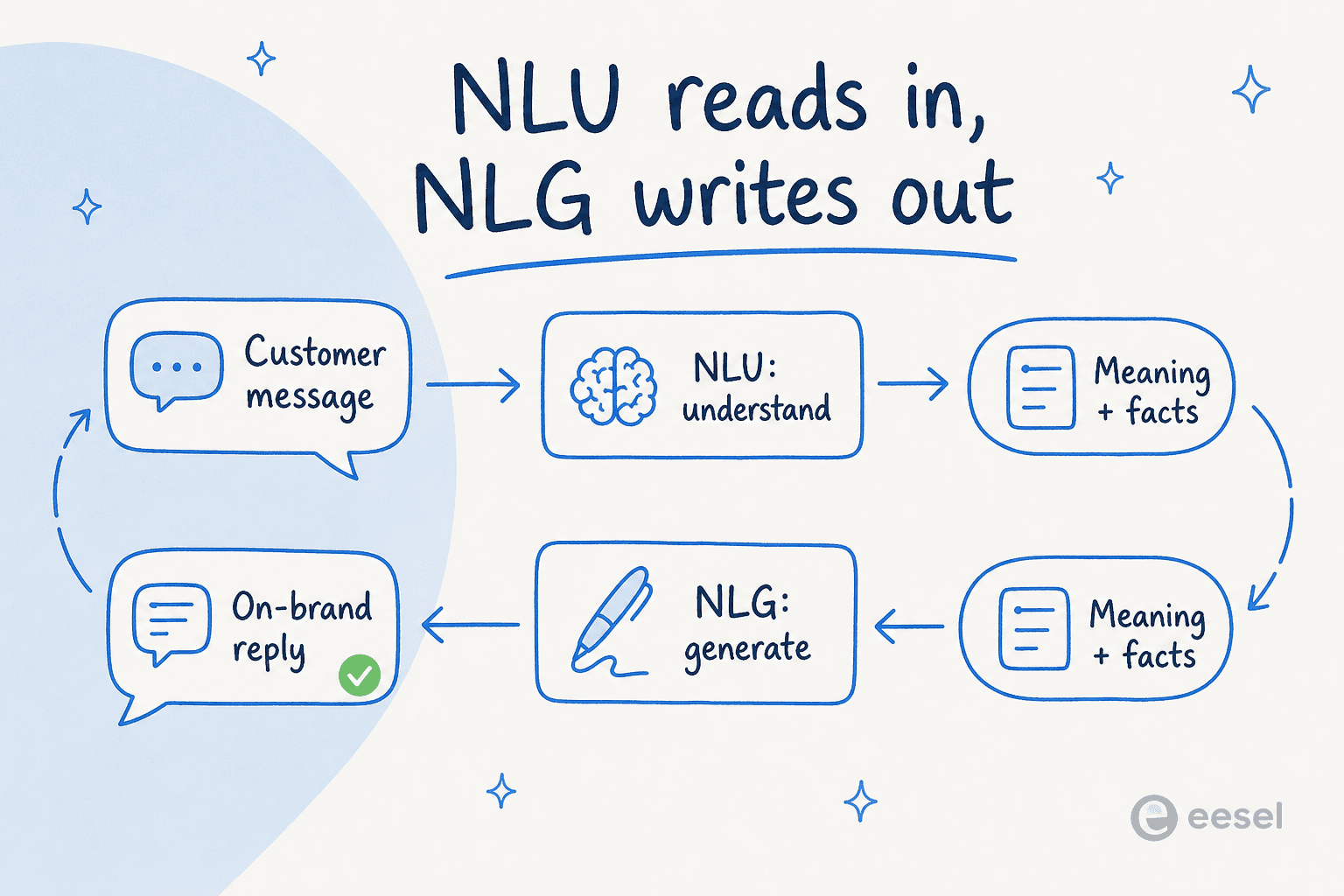
The two halves run in opposite directions. NLU reads a customer message inward into meaning and facts, then NLG turns those same facts outward into the reply the customer reads. That hand-off is why a generated answer is only as good as the meaning and facts feeding it.
How NLG works
A support assistant generates a reply roughly like this:
- Receive the meaning. It takes the understood intent plus any retrieved facts from your knowledge base or order systems.
- Plan the message. It decides what to include, in what order, and at what length for the channel.
- Produce the text. A language model writes the sentences, choosing wording and tone.
- Constrain to the facts. It keeps the output tied to the retrieved sources so it does not drift into a hallucination.
A support agent like eesel AI uses NLG at the final step: after it understands the ticket and pulls the right answer from your help center and past tickets, it writes a reply in your team's tone rather than pasting a stiff canned response. The generation is only as trustworthy as the grounding behind it.
NLG in practice
The risk with NLG is that fluency is convincing whether or not the content is correct, so a confident, well-written wrong answer is worse than an awkward right one. That is why production support systems pair generation tightly with retrieval and grounding: the model writes well, but it writes about facts the system actually retrieved. When teams evaluate an NLG-driven tool, the question to ask is not whether the prose is smooth, but whether every claim in it traces back to a real source.
Generate replies that sound like your team
eesel AI generates support answers grounded in your own knowledge, written in your tone, not generic boilerplate.