Natural language processing (NLP)
The field of AI focused on letting computers understand, interpret, and generate human language, from reading a support ticket to writing a reply.
What natural language processing means
Natural language processing (NLP) is the field of artificial intelligence focused on letting computers understand, interpret, and generate human language. It covers everything from detecting the tone of a message to translating text, summarizing a document, or writing a reply.
Human language is ambiguous, full of context, slang, and implied meaning, which is what makes it hard for machines. NLP is the set of techniques that bridge that gap, turning messy text and speech into something software can act on, and turning structured intent back into fluent language. In customer support, NLP is the layer that lets a system read a free-text ticket and actually understand what the customer needs, instead of just scanning for keywords.
Why NLP matters
NLP is what makes most language-driven software possible, and in a support context it matters because:
- It unlocks unstructured text. The bulk of support knowledge lives in emails, tickets, docs, and chats, all of it language.
- It enables automation. Routing, tagging, and answering all start with a machine understanding what was actually written.
- It scales understanding. A system can read and classify far more tickets than any team could by hand.
- It powers conversation. Chatbots and voice assistants rely on NLP to understand a question and respond in kind.
The clearest way to see NLP at work is to watch what it extracts from a single message:
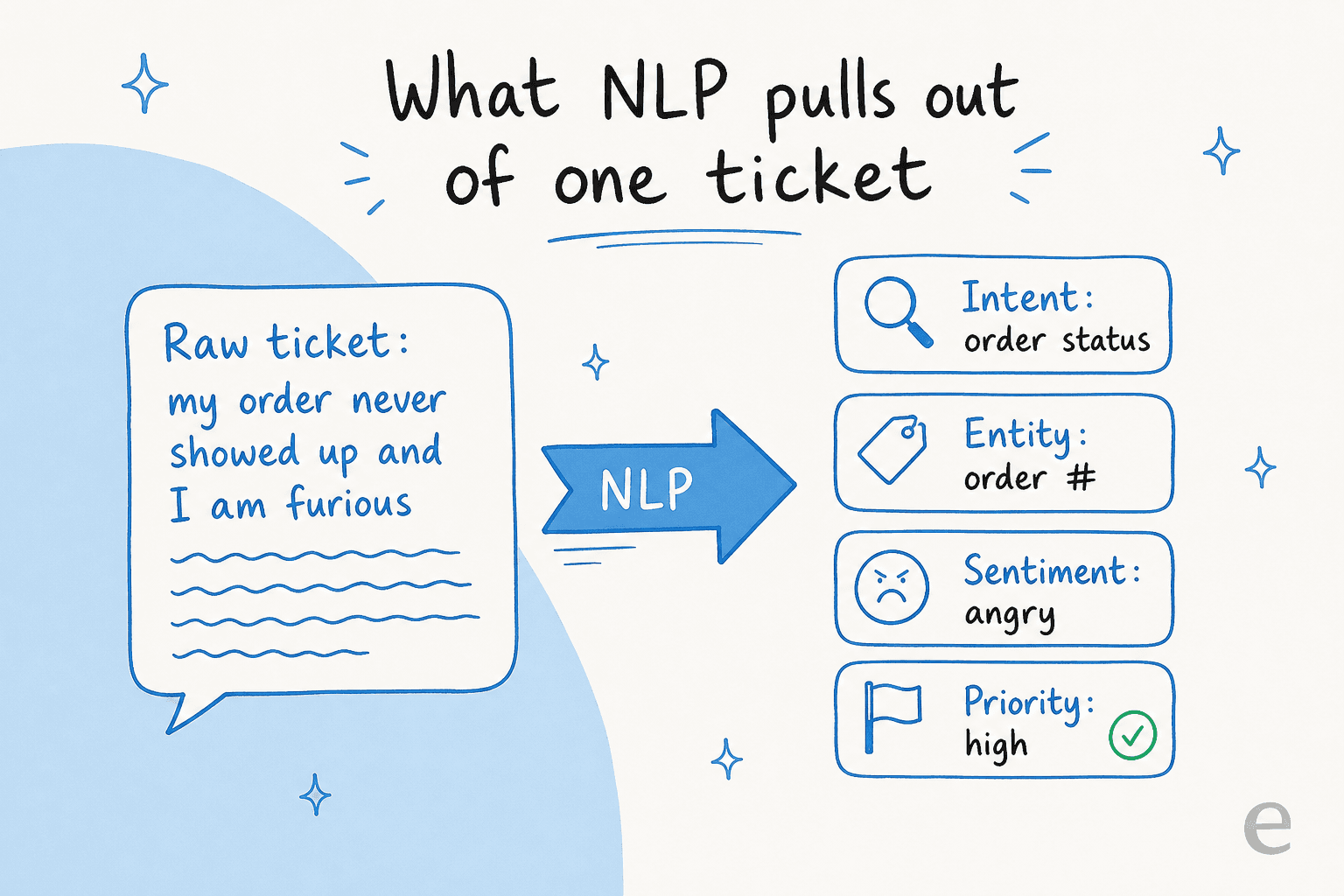
One free-text complaint goes in, and NLP turns it into structured signals a system can route and act on: the intent, the entity being asked about, the sentiment, and a priority. That conversion from prose to data is the work the rest of the support stack depends on.
How natural language processing works
Modern NLP usually combines understanding and generation:
- Preprocess the text. Input is cleaned and broken into units the model can work with.
- Understand meaning. The system extracts intent, entities, and sentiment, often through intent classification and related tasks.
- Reason or retrieve. It works out what the request needs, which may include looking up relevant information.
- Generate language. It produces a reply or summary in fluent, natural text.
Today this is largely powered by LLMs, which handle understanding and generation in one system. A support tool like eesel AI uses NLP to read a customer's message, work out what they actually need, and answer from your knowledge in clear language, the same way a good agent would.
NLP in practice
NLP has moved from rigid, rule-based pipelines to flexible models that learn language from data. The remaining challenge is rarely fluency; it is accuracy and context. A system can write a perfect-sounding sentence and still be wrong, which is why grounding its answers in real, trusted sources matters as much as the language ability itself, especially in support, where a confident wrong answer costs more than no answer at all.
We go deeper on this in NLU vs NLP.
NLP that understands your tickets
eesel AI reads support requests in plain language and answers from your own knowledge.