Semantic search
Semantic search is a search method that ranks results by meaning and intent rather than exact keyword matching, so it can return relevant items that share no words with the query.
What semantic search means
Semantic search is a search method that ranks results by their meaning and the intent behind a query, rather than by matching exact keywords. Where traditional search looks for documents containing the same words a user typed, semantic search compares the underlying meaning, so a query and a relevant result can match even if they share no vocabulary at all. It works by representing both the query and the content as embeddings and measuring how close they are in vector space.
In customer support, semantic search is what lets an AI connect a customer's casual phrasing to the article that actually answers it. A customer types "the app keeps logging me out" and the system surfaces a troubleshooting doc titled "session expiration issues," because the two are close in meaning even though the words differ. It removes the requirement that customers guess your internal terminology.
Why semantic search matters
- It matches intent, not vocabulary, so synonyms, typos, and natural phrasing all still find the right content.
- It handles the long tail of phrasing. People ask the same thing a hundred ways, and keyword search needs each variation anticipated, while semantic search generalizes.
- It improves retrieval quality, which directly raises the accuracy of any AI answer built on top of it through RAG.
- It works across languages and formats, since meaning-based comparison is not tied to exact strings.
- It degrades gracefully, returning the closest available match rather than an empty "no results" page when nothing matches word-for-word.
Picture one customer query taking two different search paths to see why this matters.
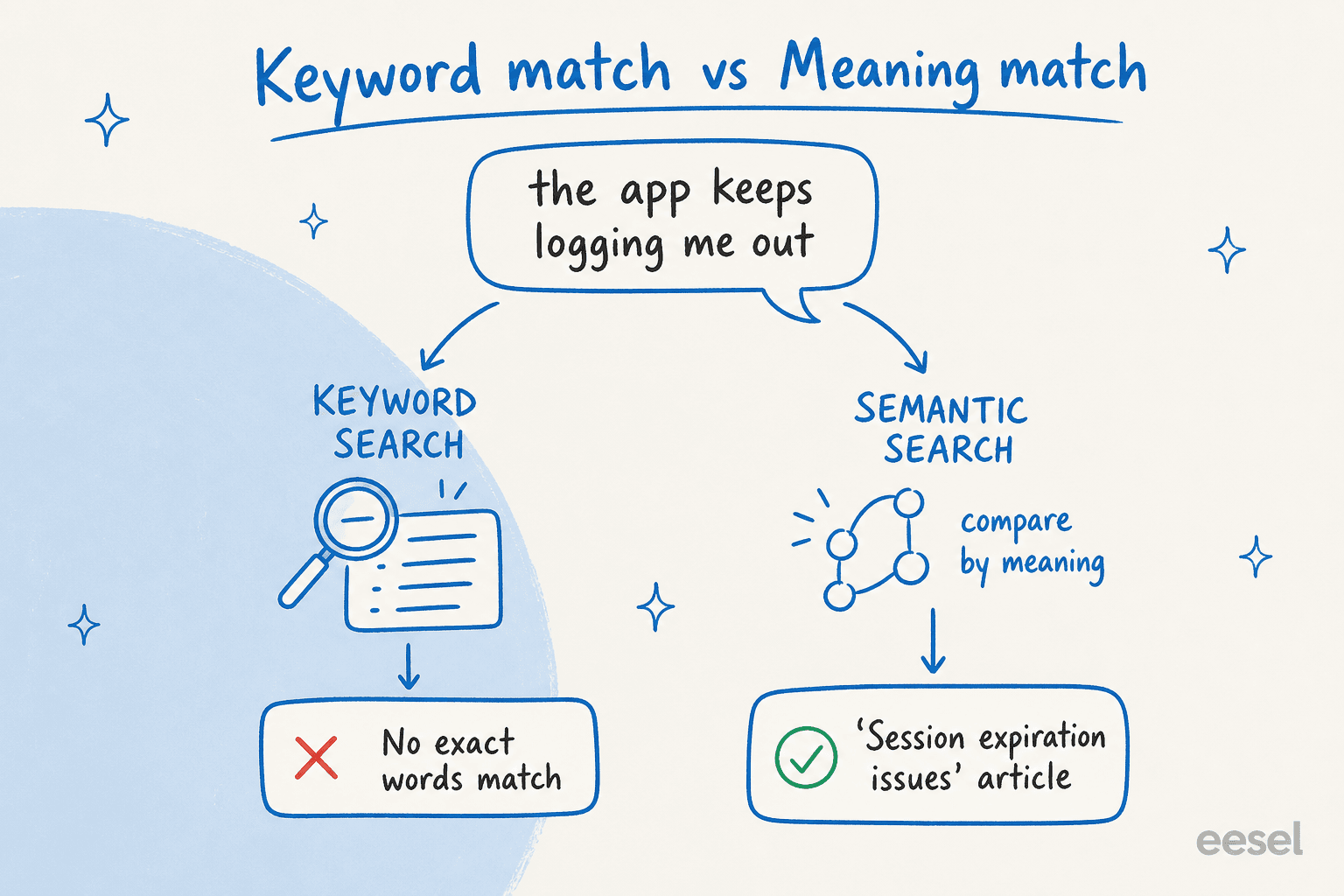
A keyword engine hunts for the literal words "logging me out" and comes up empty when your article is titled differently. Semantic search compares the meaning instead, so the same phrasing lands on your "session expiration issues" doc.
How semantic search works
The mechanism follows a clear sequence:
- Embed the content. Each chunk of your knowledge base is converted into a vector that encodes its meaning.
- Store the vectors. They are kept in a vector database optimized for similarity lookups.
- Embed the query. When a question arrives, it is turned into a vector with the same model.
- Rank by similarity. The system returns the stored passages whose vectors are closest to the query, ordered by relevance.
A support agent like eesel AI uses semantic search as its retrieval step: it semantically searches your help center, docs, and past tickets for the passages closest to a customer's question, then grounds its written answer in them. Semantic search finds the right material; grounding makes sure the answer stays true to it.
Semantic search in practice
The nuance operators learn quickly is that semantic search is powerful but not infallible: it returns the closest match even when nothing in your knowledge base truly answers the question. That is why a confidence threshold matters as much as the search itself. A well-run system pairs strong retrieval with a rule that escalates to a human when the best match is still weak, rather than letting the AI stretch a loosely related article into a confident-sounding wrong answer. The search finds what is there; the guardrail decides whether what is there is good enough to use.
For a hands-on build, read semantic search over Zendesk.
Find the right answer by meaning
eesel AI uses semantic search over your help center and tickets so it matches a customer's intent, not just their keywords.