Content gap
A content gap is a topic or question your audience is searching for that your existing content does not adequately cover.
What a content gap means
A content gap is a topic, question, or search query that an audience wants answered but that a site's existing content does not cover, or covers poorly. It is the space between what people are looking for and what is actually published. A gap can be a whole subject you have never written about, a sub-question inside a topic you cover only partially, or a query where your page exists but ranks too weakly to capture the traffic.
In content marketing and SEO, finding content gaps is how a team decides what to write next. Rather than guessing at topics, you compare real demand against current coverage and target the spaces where interest is high and your presence is low. Closing those gaps is one of the most direct ways to grow organic traffic, because each one represents demand that already exists and is currently flowing to someone else.
Why content gaps matter
Content gaps are worth chasing because each one is measurable, addressable demand. Specifically, they:
- Represent uncaptured search demand, where people are already typing a query and landing on a competitor instead of you.
- Reveal holes in a topic cluster, so a subject you thought you owned turns out to have missing sub-topics that weaken the whole cluster.
- Surface competitor advantages, since the keywords rivals rank for and you do not are usually the clearest gap list you can get.
- Point to intent you are not serving, like a buyer asking a comparison or pricing question that your educational content never answers.
- Prioritize the roadmap, turning a vague "we should blog more" into a ranked list of specific pieces tied to real volume.
Once you have a gap list, the harder question is sequencing it. Plotting each gap by demand against the authority you already hold makes the order obvious.
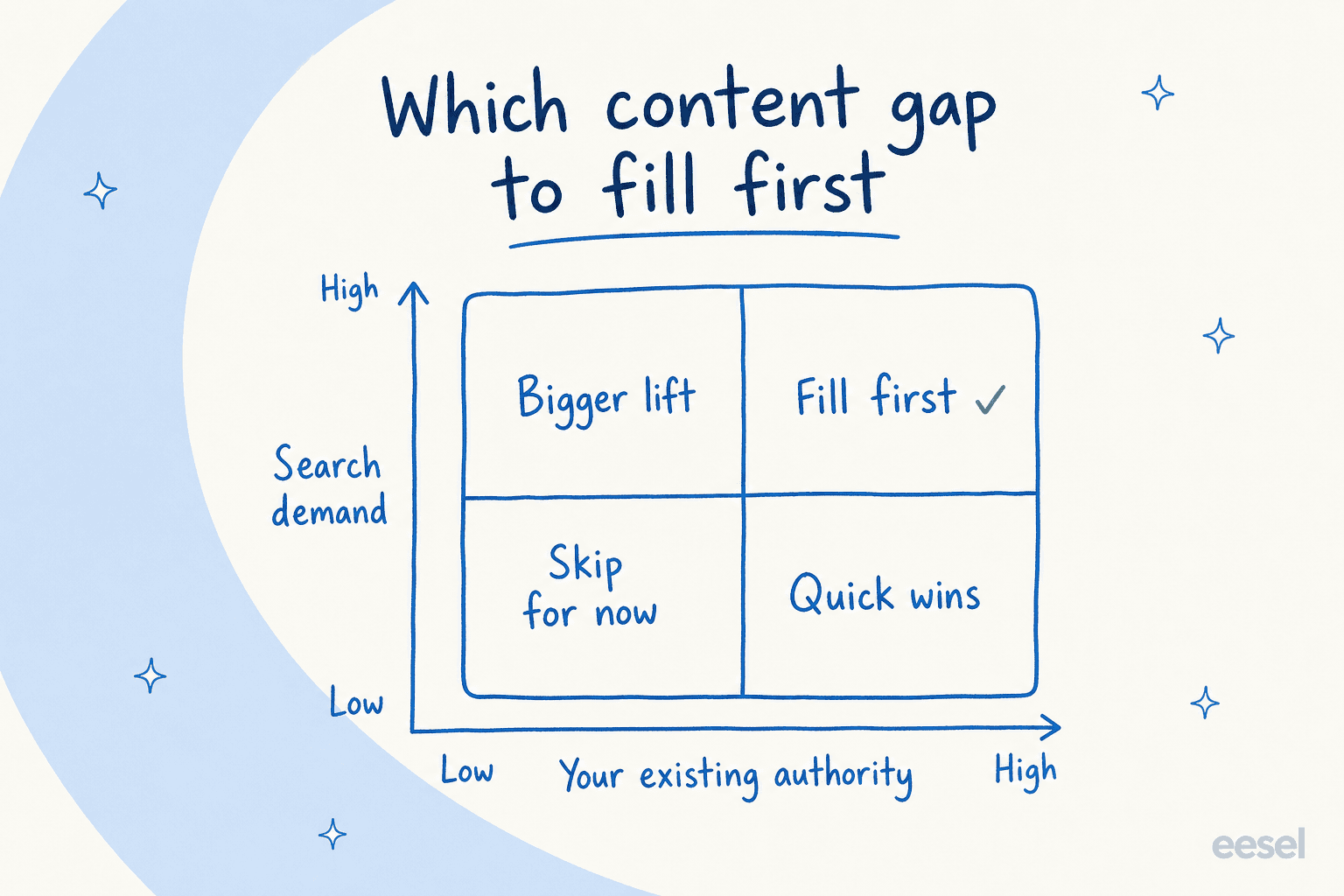
High-demand gaps near a topic you already own are the ones to fill first, since a new page there ranks faster. Gaps with demand but no surrounding authority are real but a heavier lift, and low-demand ones in unfamiliar territory can wait.
How finding a content gap works
A content gap analysis usually runs in a few steps:
- Map your current coverage. List the topics and queries your existing pages already address well.
- Pull the demand. Use keyword research and competitor keyword exports to build the full set of queries your audience searches for.
- Compare the two. Subtract what you cover from what people want, and what remains is your gap list.
- Prioritize. Rank gaps by search volume, intent, and how close they sit to topics you already have authority in.
- Fill them. Brief and produce a page for each priority gap, then track whether it ranks.
Step five is where most programs stall, because writing enough to close a long gap list is slow. An AI blog writer like eesel AI shortens that step by researching a gap topic and drafting a grounded, source-backed post, so the list a team finds can actually get filled instead of sitting in a spreadsheet.
Content gaps in practice
The trap is treating a content gap list as a backlog to clear in order. The gaps that matter are the ones near subjects where you already have some authority, because a new page there inherits the credibility of the surrounding cluster and ranks faster. A gap in a topic you have zero presence in is real, but it is also a much heavier lift, since you are starting a cluster from nothing. The disciplined move is to close gaps that deepen your strongest clusters first, then expand outward, rather than scattering one-off pages across every gap the tools surface.
Close content gaps faster
eesel AI researches a topic and drafts a grounded, source-backed post, so the gaps you find can be filled without bottlenecking on writers.