Content refresh
A content refresh is the process of updating an existing published page to restore or improve its accuracy, relevance, and search rankings.
What a content refresh means
A content refresh is the process of updating an existing published page to restore or improve its accuracy, relevance, and search performance, while keeping the same URL. Rather than building a new page, a team revisits one that already exists and brings it up to date: correcting outdated facts, adding new information, improving the structure, and re-optimizing for current search intent. The existing URL keeps its accumulated backlinks and ranking history, which is exactly why a refresh is often more efficient than starting over.
In SEO and content marketing, a content refresh is the standard remedy for a page that has lost ground. Search results are competitive and time-sensitive, so a post that ranked well two years ago can slip as the facts age and rivals publish fresher coverage. A refresh re-arms that page to compete again.
Why a content refresh matters
A disciplined refresh program is one of the highest-leverage moves in content, because it can:
- Recover lost rankings on pages suffering content decay, often faster and cheaper than ranking a brand-new page.
- Reuse existing authority, since the refreshed URL keeps the backlink profile and trust it has already earned.
- Restore accuracy, replacing stale prices, dated screenshots, old years in the title, and obsolete claims that erode reader trust.
- Match current intent, since what searchers want from a query shifts over time and the original angle may no longer fit.
- Compound the catalog, keeping a library of evergreen content genuinely evergreen instead of letting it quietly rot.
Before touching a page, it helps to decide whether a refresh is even the right move, or whether the page needs a rewrite or should be left alone.
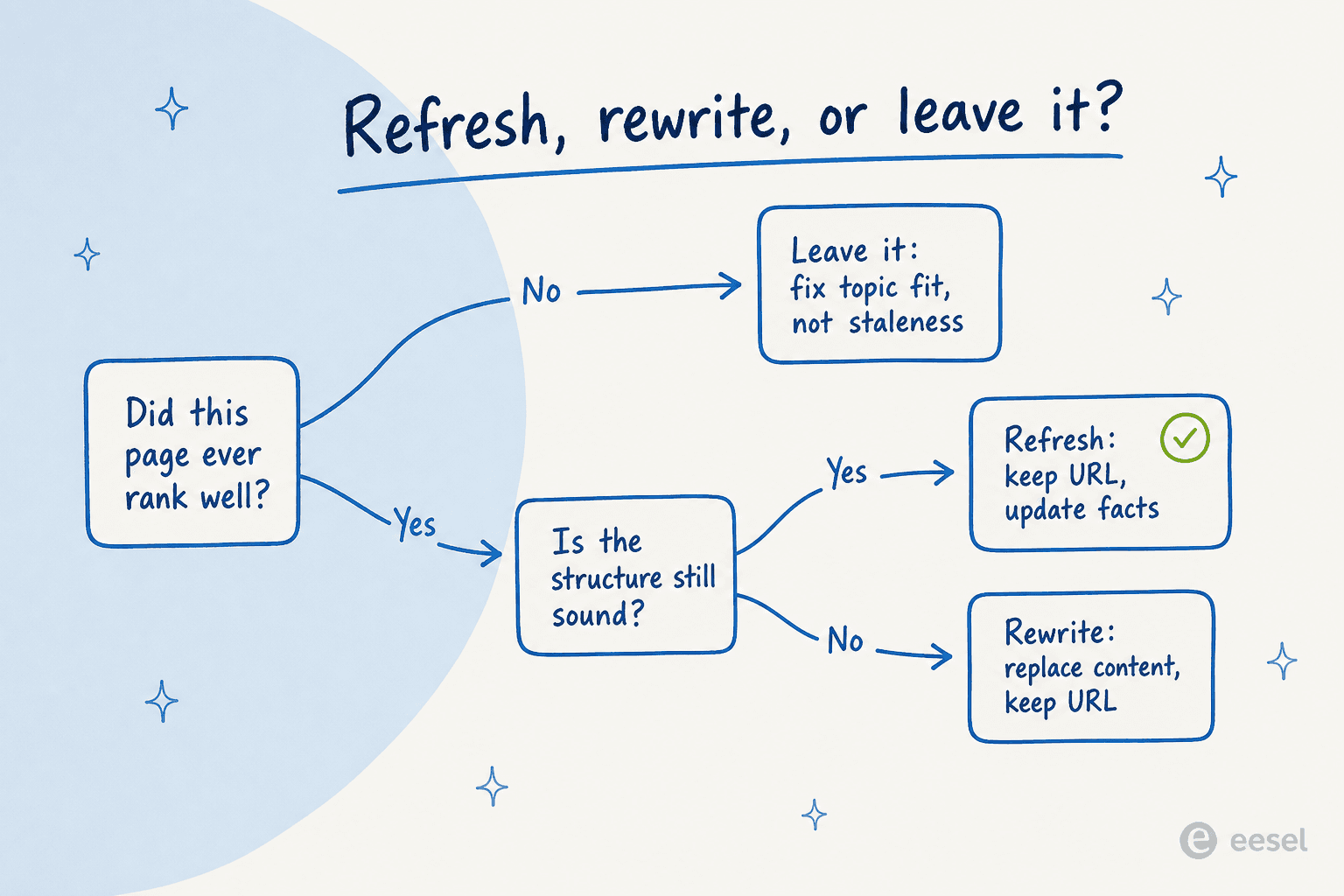
A page that once ranked and has only aged is the ideal refresh candidate. If the structure has fallen behind too, a rewrite on the same URL fits better, and a page that never ranked usually has a topic or intent problem that a refresh will not solve.
How a content refresh works
A typical refresh follows a clear sequence:
- Find the candidates. Look for pages where traffic or rankings have declined, or where the facts are now wrong.
- Re-research the topic. Gather current data, new sources, and what the top-ranking pages now cover.
- Update the content. Fix the facts, add missing sections, tighten the intro, refresh examples, and re-optimize for current intent.
- Keep the URL. Publish over the same URL so the page retains its links and history, and bump the visible update date.
- Track the result. Watch whether rankings and traffic recover, and re-queue the page if they do not.
An AI blog writer like eesel AI shortens step two and three: it can re-research the topic against current sources and update the draft with fresh facts and examples, which turns a refresh from a half-day rewrite into a quick review-and-publish pass on the parts that actually changed.
A content refresh in practice
The teams that get the most from refreshing pick targets by data, not by gut. The best candidates are pages that once ranked well and have since slipped, because the authority is already there and only the content has aged. Refreshing a page that never ranked rarely pays off, the problem there is usually the topic or the intent fit, not staleness. A practical rhythm is to reserve a recurring slot on the calendar for refreshes, audit the catalog quarterly for decaying winners, and treat the visible update date as a promise to the reader that the page reflects current reality.
For a hands-on walkthrough, read how to refresh content for SEO.
Refresh stale posts faster
eesel AI re-researches a topic and updates the draft with current facts and sources, so refreshing a decaying page is a quick pass instead of a rewrite.