Programmatic SEO
Programmatic SEO is the practice of generating large numbers of search-targeted pages from a template and a structured data set.
What programmatic SEO means
Programmatic SEO is the practice of creating large numbers of search-targeted pages automatically by combining a page template with a structured data set. Instead of writing each page by hand, a team defines one template and feeds it data (locations, products, comparisons, attributes), generating hundreds or thousands of pages that each target a specific query. The technique is built for long-tail demand: many low-competition searches that individually get little traffic but add up to a lot in aggregate.
In SEO and content practice, programmatic SEO is how directories, marketplaces, and tool sites cover query spaces no human team could write out one page at a time. A page for every "X vs Y" comparison, every city, or every use case lets a site own a wide surface of long-tail searches that competitors targeting only head terms never capture.
What makes programmatic SEO different
Programmatic SEO is distinct from regular content creation in a few concrete ways:
- It scales by data, not by writing, so adding a thousand pages is a matter of adding a thousand rows, not a thousand drafts.
- It targets the long tail deliberately, aiming at specific long-tail keyword variations rather than a handful of competitive head terms.
- It depends on a unique dataset, because the value of each page comes from the data behind it, not from prose alone.
- It lives or dies on per-page quality, since thin, near-duplicate pages trigger scaled-content penalties while data-rich ones rank.
- It requires technical infrastructure, including templates, an internal linking system, and a clean XML sitemap so the pages get crawled and indexed.
At its core the method is an assembly line: one template combined with a dataset where each row becomes a page, run through a quality gate before anything ships at scale.
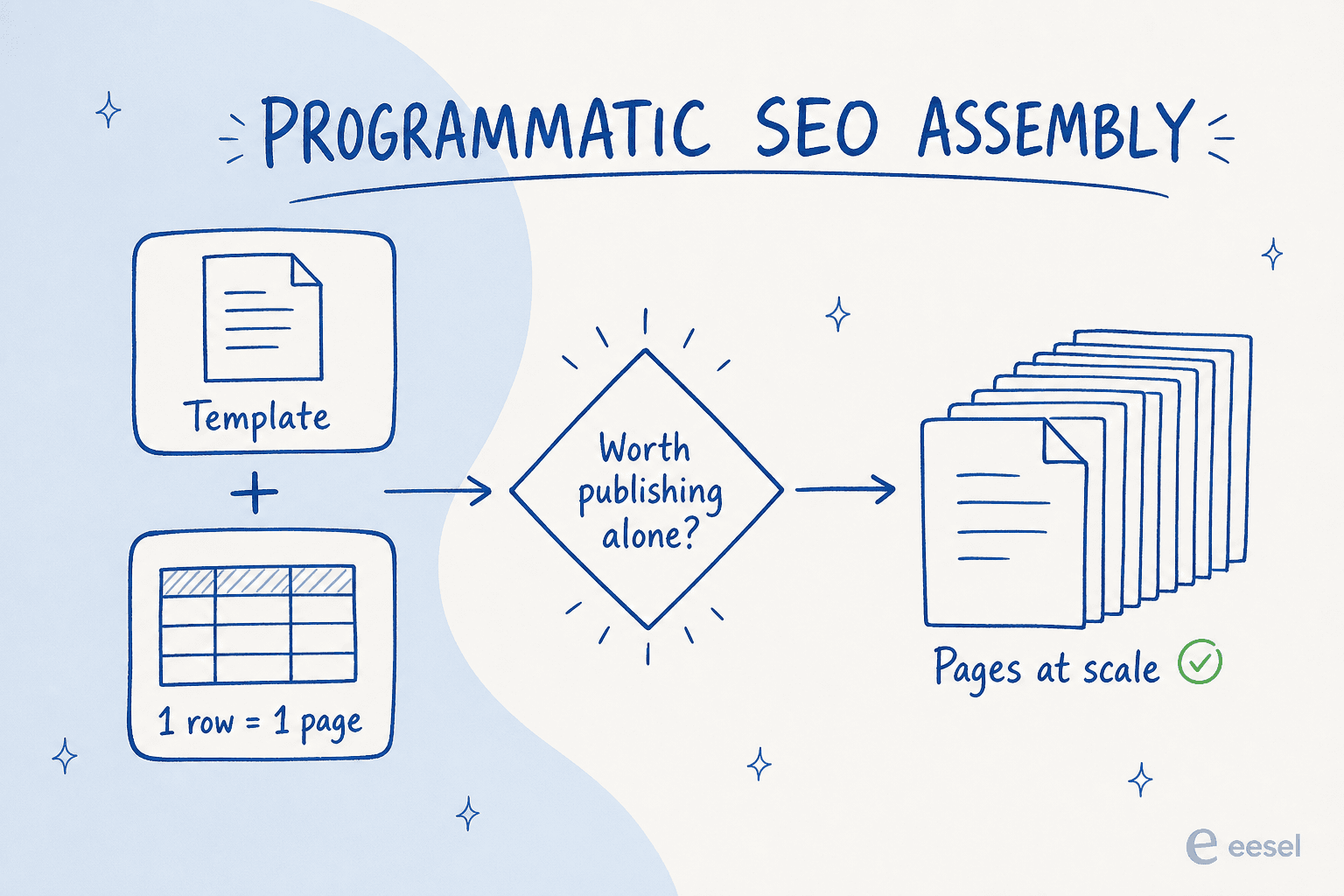
The gate in the middle is the part teams skip. If a single generated page would not be worth publishing on its own, the template only multiplies a thin page across the whole set.
How programmatic SEO works
A typical programmatic SEO build follows these steps:
- Find the query pattern. Identify a repeatable search shape, like "best CRM for [industry]," that has demand across many variants.
- Build the dataset. Assemble structured data where each row maps to one page and carries something genuinely useful.
- Design the template. Create a page layout that surfaces the data clearly and reads as a real page, not a filler shell.
- Generate and link. Produce the pages, wire up internal links between related ones, and submit them for crawling.
- Monitor and prune. Track which pages rank, expand the winners, and remove or merge the thin ones.
The hardest part is keeping each page substantive. An AI blog writer like eesel AI can research and draft grounded content for the high-value pages in a set, so the pages worth investing in read like real articles rather than thin template fills, which is the difference between a programmatic set that ranks and one that gets flagged as scaled abuse.
Programmatic SEO in practice
The teams that succeed with programmatic SEO treat the dataset as the product. A template married to weak, scrapeable data produces pages that all look the same to a crawler and get ignored or penalized, while a template fed with proprietary data, real comparisons, or genuinely fresh information produces pages people link to and share. The practical test before launching a programmatic set is simple: would a single one of these pages be worth publishing on its own? If not, the template will just multiply a thin page a thousand times.
For a deeper walkthrough, read our programmatic SEO guide.
Add depth to programmatic pages
eesel AI researches and drafts grounded long-form content, so the high-value pages in a programmatic set read like real articles instead of thin templates.