Chatbot
A software application that simulates a conversation with a user through text or voice, answering questions and guiding them through tasks.
What a chatbot means
A chatbot is a software application that simulates a conversation with a user through text or voice, answering questions and guiding them through tasks. The earliest chatbots matched keywords to canned responses; today the term spans everything from a simple menu of buttons on a website to AI systems that hold a fluent, open-ended dialogue. What unites them is the conversational interface: the user interacts by chatting rather than by clicking through a form or reading a manual.
In customer support, the chatbot has become one of the most common ways to handle inbound questions at scale. A simple version greets a visitor, offers a few preset options, and routes them to the right place. A more advanced one understands a typed question and answers it directly. The capability gap between those two is large, which is why "chatbot" alone says little about how useful it actually is, the type and the underlying technology matter far more than the label.
The main types of chatbot
Chatbots fall into a few categories that behave very differently:
- Rule-based chatbots follow fixed decision trees and scripted flows. They are predictable but break the moment a customer asks something off-script.
- Menu or button bots present preset choices and route the user, useful for simple navigation but not for answering real questions.
- AI chatbots interpret free-form natural language and generate original replies, the basis of an AI chatbot.
- Voice chatbots apply the same ideas to spoken interaction, often behind an interactive voice response system.
- Hybrid bots combine scripted flows for known paths with AI for the open-ended long tail.
The practical takeaway is that a chatbot is only as helpful as the type chosen for the job and the knowledge behind it.
It also helps to see these types not as a flat list but as a climb, where each step understands more of what the customer actually typed.
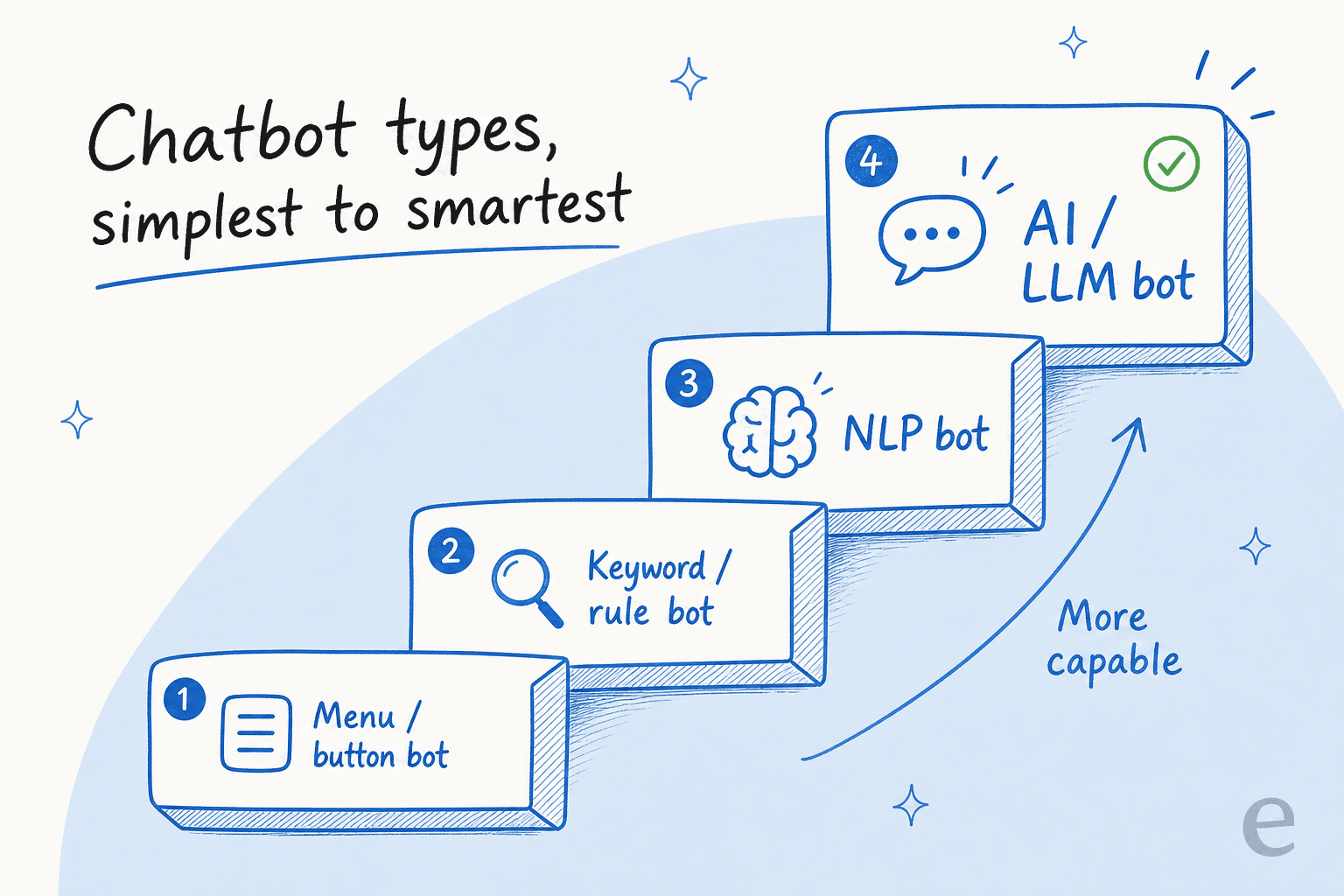
At the bottom, a menu or button bot only knows preset choices, and a keyword or rule bot matches fixed triggers. Higher up, an NLP bot starts interpreting language, and an AI or LLM bot at the top understands open-ended questions and answers from real knowledge.
How a chatbot works
The mechanism depends on the type. A rule-based chatbot matches the user's input against a set of predefined triggers and returns the mapped response. An AI chatbot does more:
- Interpret the message. It works out what the user means rather than matching a keyword.
- Find the relevant information. It searches connected knowledge for the facts that answer the question.
- Generate a reply. It composes an answer in natural language rather than returning a canned line.
- Hand off when needed. It escalates to a person or another system when it cannot resolve the request.
A support chatbot like eesel AI sits at the capable end of this range: rather than scripting flows, it learns from your help center and past tickets, answers from that knowledge, and escalates cleanly when it is unsure. That difference, grounded AI versus a fixed script, is what separates a chatbot that resolves issues from one that just deflects.
Chatbots in practice
When people complain about chatbots, they are almost always describing a rule-based bot that trapped them in a loop with no human exit. The fix is not to abandon the chatbot but to choose the right kind and ground it properly. A chatbot that answers from real, current knowledge and offers a fast path to a person when it is stuck is a help, not a wall. The most reliable approach is to map the questions customers actually ask, ground the bot in the content that answers them, and keep escalation one step away at all times.
We go deeper on picking one in our customer service chatbot guide.
From scripted chatbot to real resolution
eesel AI goes beyond a scripted chatbot, answering from your own knowledge and taking actions in your helpdesk to resolve tickets.