Virtual agent
A software program that uses AI to hold a conversation with a person and complete the task they are asking for, rather than just answering a single question.
What a virtual agent means
A virtual agent is a software program that uses artificial intelligence to hold a natural-language conversation with a person and carry their request through to a result, rather than answering a single isolated question. It interprets what the person actually wants, draws on a knowledge source to form a response, and, when it is connected to other systems, performs the action that resolves the request.
The term shows up most often in customer support and contact centers, where the virtual agent is the customer-facing assistant in a chat window, on a help page, or over the phone. In that setting it is the difference between an FAQ box that returns links and an assistant that reads the question, finds the answer, and acts on it.
What makes a virtual agent different
Older self-service tools matched keywords to canned replies. A virtual agent is a step up because it can:
- Understand intent in plain language across a multi-turn chat, instead of waiting for the customer to phrase things the way a script expects. This usually runs on intent detection underneath.
- Ground answers in real knowledge, pulling from a knowledge base, past tickets, and product docs rather than a fixed list of responses.
- Take actions, like checking an order, resetting a password, or updating a record, through connected systems.
- Hold context, remembering earlier turns in the same conversation so the customer does not repeat themselves.
- Escalate cleanly, handing the conversation to a person with full context when it is unsure or the request is out of scope.
Lining the virtual agent up against a scripted bot and a human agent shows where it actually lands.
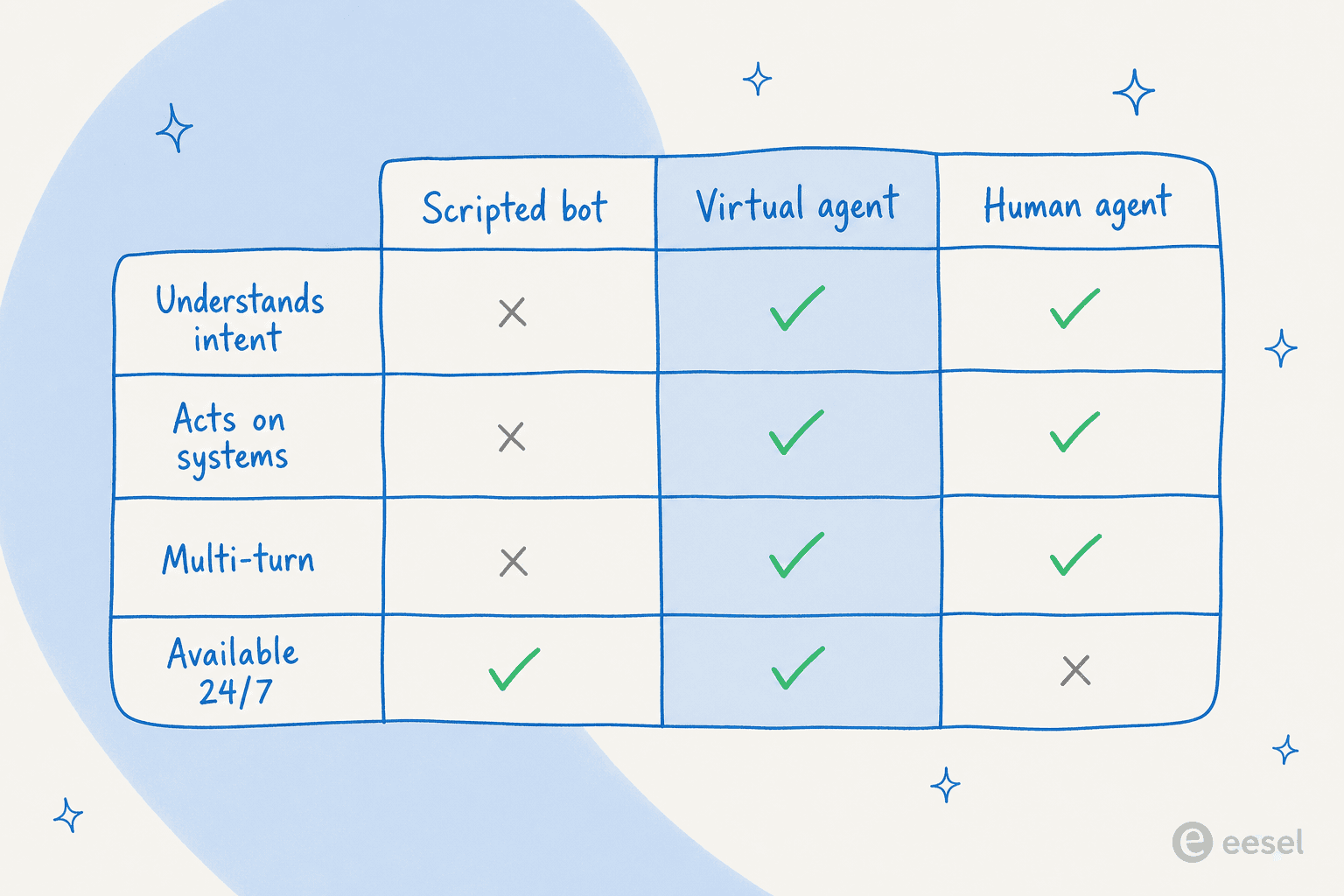
A scripted bot is always on but cannot read intent or act, and a human agent does all three but is not available around the clock. A virtual agent is the column that ticks every box, which is what separates it from both.
How a virtual agent works
A support virtual agent typically runs the same loop:
- Read the request. It interprets the customer's message and works out the real goal behind it.
- Find the answer. It retrieves relevant content from the knowledge sources it is connected to.
- Respond or act. It replies in natural language, and where it has permission, performs the action that resolves the issue.
- Check confidence. If it cannot answer safely, it escalates to a human instead of guessing.
A virtual agent like eesel AI follows this pattern: it learns from your help center, docs, and historical tickets, grounds every reply in those sources, takes the actions you allow inside your helpdesk, and is simulated against past tickets before it goes live so you can see how it would have handled real conversations.
Virtual agents in practice
The quality of a virtual agent is set less by the model behind it and more by two operational things: the knowledge it can reach and the limits on what it is allowed to do. A tightly scoped virtual agent pointed at a clean knowledge base, with clear rules for when to escalate, resolves more and makes fewer mistakes than a powerful model wired up to everything at once. Most teams start it on a narrow band of common questions, validate it against real ticket history, and widen its remit from there.
We go deeper on this in our guide to the AI virtual assistant.
Put a virtual agent on your support queue
eesel AI is a virtual agent that learns from your help center and past tickets, answers from your own facts, and escalates when it should.