Skills-based routing
A routing method that matches each support request to the agent whose specific skills, language, or expertise best fit it, rather than the next available person.
What skills-based routing means
Skills-based routing is a method of directing support requests that matches each one to the agent whose specific skills, language, or expertise best fit it, rather than simply assigning it to the next available person. It treats agents as a set of distinct capabilities, not interchangeable slots, and pairs each ticket with the closest match.
The skills in question can be almost anything that affects who should handle a request: product area, language, seniority, certification to issue refunds, or familiarity with an enterprise account. In customer support, skills-based routing is the upgrade from generic ticket routing, which gets a ticket to the right queue, to a finer match that gets it to the right individual inside that queue.
What makes skills-based routing different
- It optimizes for fit, not availability. A ticket waits for the right agent rather than landing on the first free one who may not be equipped.
- It models agents as capability sets, tagging each person with the skills, languages, and permissions they hold.
- It reduces handoffs, because the first agent to open the ticket is already the one who can solve it.
- It tends to lift first contact resolution, since the right expertise meets the request on the first touch.
- It introduces a load tradeoff, since concentrating tickets on the most-skilled agents can overload them when one skill spikes in demand.
Underneath the routing decision is a simple match between what a ticket needs and what each agent can do:
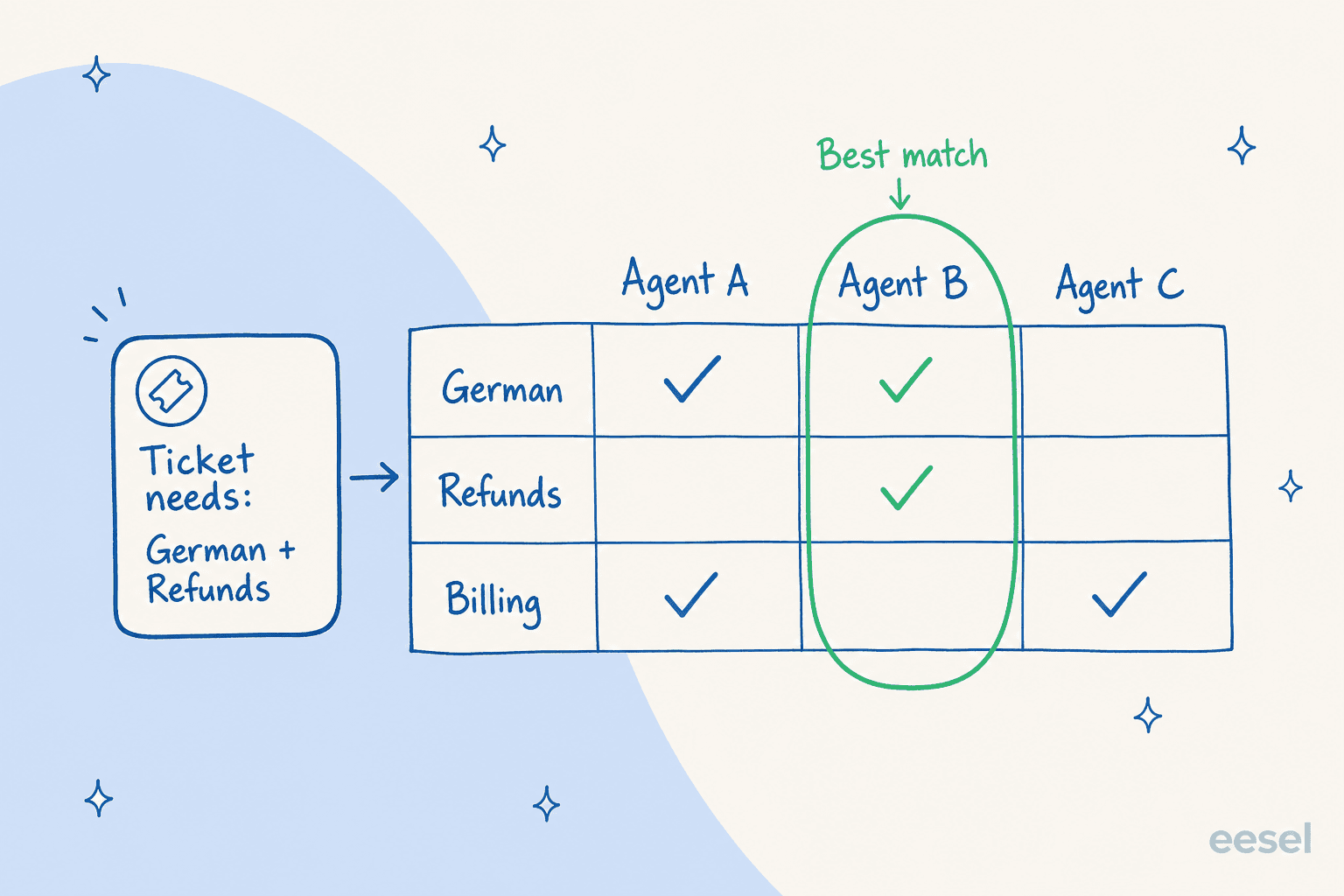
The engine lists the skills a ticket requires, then checks them against each agent's profile and picks the one that covers all of them. eesel AI runs the same match after it resolves what it can on its own, so only the truly specialist tickets reach a person, and they reach the right one.
How skills-based routing works
An AI agent like eesel AI layers skills-based logic on top of automated resolution:
- Read the request. The system interprets the message and identifies the topic and any special requirements, like language or account tier.
- Resolve what it can. Requests that need no human specialist are handled directly through automated resolution.
- Map required skills. For the rest, it determines which skills the ticket actually needs to be solved.
- Match to an agent. It compares the required skills against the agent skill profiles and picks the best available fit.
- Route with context. The chosen agent receives the ticket with the classification, history, and reasoning attached, so no time is lost re-reading.
The discipline that makes it work is keeping agent skill profiles current, because stale tags send specialist tickets to people who can no longer handle them.
Skills-based routing in practice
The hard part of skills-based routing is not the matching logic, it is the data behind it. Skill profiles drift as people learn, move teams, or lose permissions, and a routing engine pointed at outdated tags quietly degrades. Teams that get value from it treat the skill matrix as a living thing, reviewed regularly, and they watch for the load imbalance that comes from over-relying on a handful of specialists. The strongest setups combine it with automation: let the AI clear the requests that need no skill at all, and reserve skills-based routing for the truly specialist work where the match actually changes the outcome.
For a deeper look, read our guide to intelligent routing.
Match every ticket to the right skill
eesel AI handles the requests that fit its knowledge and routes the rest to the agent whose skills match, with context attached.