Few-shot learning
Few-shot learning is when a model learns to perform a task from a small number of examples shown directly in the prompt, rather than from a large training dataset.
What few-shot learning means
Few-shot learning is when a model learns to perform a task from a small number of examples shown directly in the prompt, rather than from a large labeled training dataset. Each example pairs an input with the desired output, and the model infers the underlying pattern from those few demonstrations and applies it to a new input.
The "few" refers to the number of examples, typically two to ten, placed inside the prompt itself. This is different from the way models are trained: nothing about the model changes. The examples simply steer how it responds for that one request, a behavior large language models exhibit naturally once they reach a certain scale. Show a model three messages already labeled by category and a fourth unlabeled one, and it will usually label the fourth correctly by following the pattern.
In customer support, few-shot is how you get an AI to match the exact tone, structure, and phrasing your team uses, by showing it a handful of real, well-handled replies instead of describing the style in the abstract.
Why few-shot learning matters
- It sharpens output format. A couple of examples lock in the structure you want, like a greeting, a fix, and a sign-off, far more reliably than an instruction alone.
- It captures tone by demonstration. Showing two on-brand replies conveys voice better than trying to describe "friendly but concise" in words.
- It handles edge cases. An example covering a tricky scenario teaches the model how you want that scenario handled, without retraining anything.
- It is cheap and immediate. Unlike fine-tuning, there is no training run; you just add examples to the prompt and use the model right away.
- It costs context. Every example consumes tokens from the context window, so there is a practical ceiling on how many you can include.
It is easiest to place few-shot next to its neighbors on a single dial: how many examples you hand the model before it answers.
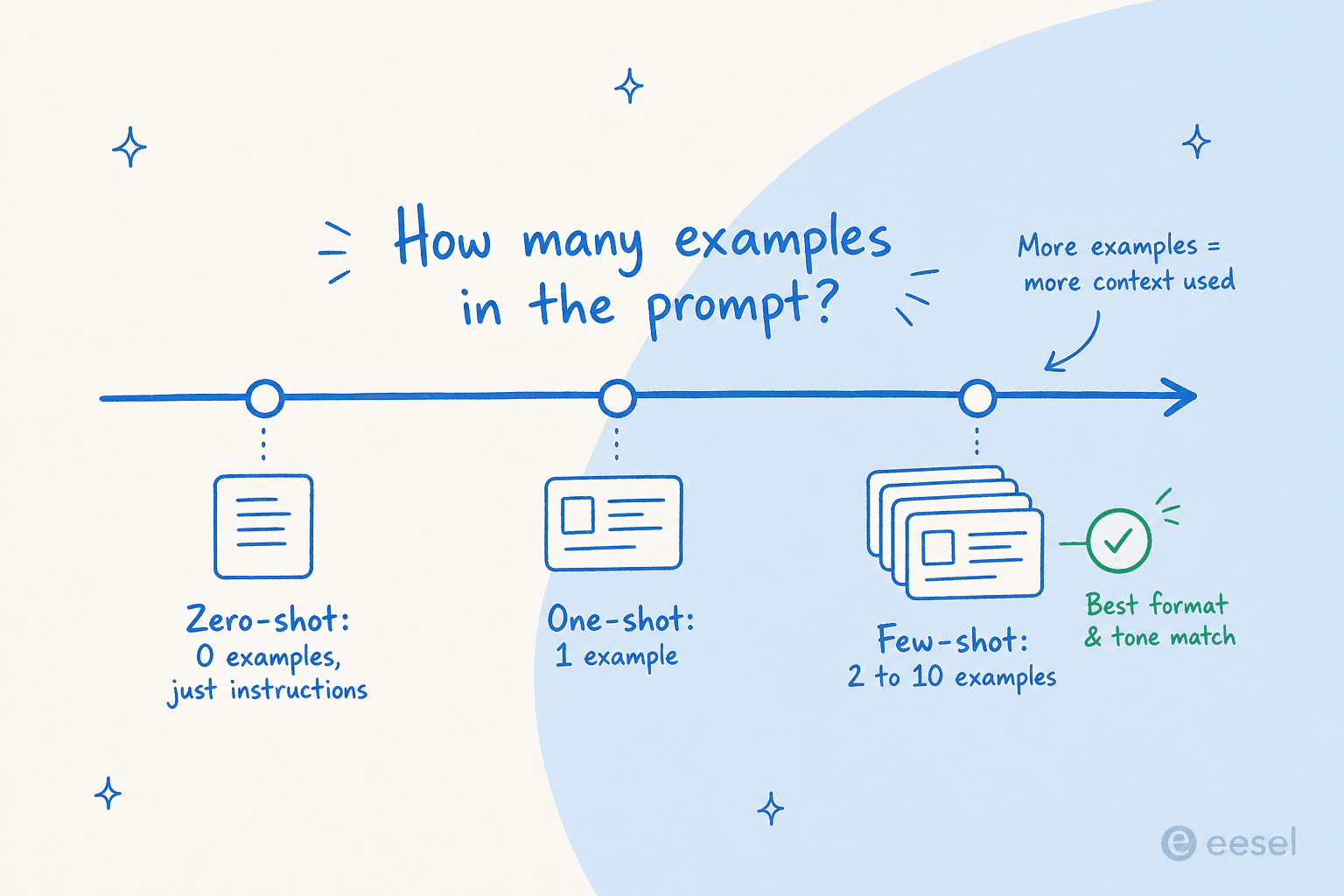
Slide right and you trade context for control. Zero examples leans on instructions alone, one example sets a loose pattern, and two to ten examples pin down the format and tone you want, at the cost of more tokens spent.
How few-shot learning works
- Pick representative examples. Choose a few input-output pairs that clearly show the task, the format, and any edge cases that matter.
- Place them in the prompt. The examples go ahead of the real input, so the model sees the pattern before it has to apply it.
- The model infers the pattern. It generalizes from the demonstrations to produce an output for the new input in the same shape and style.
- Refine the set. If outputs still drift, swap in clearer examples or add one covering the failing case, rather than reaching for a heavier training step.
A support agent like eesel AI gets a richer version of this by learning from your actual ticket history, so its replies are shaped by how your team has really answered similar questions, then grounded in your help center so the content is correct as well as on-brand.
Few-shot learning in practice
Few-shot is the workhorse middle ground between giving the model nothing and retraining it. The skill is curation: a few sharp, varied examples beat a long list of similar ones, and a single example covering a known failure often does more than five that all look alike. When the example set starts growing past what fits comfortably in context, or the same task runs at high volume, that is the cue to consider fine-tuning or stronger retrieval instead.
Teach support AI by example
eesel AI learns your tone and answers from your real past tickets, so its replies match how your team actually responds.