Zero-shot learning
Zero-shot learning is when a model performs a task it was never explicitly trained on, using only a description of the task and no labeled examples.
What zero-shot learning means
Zero-shot learning is when a model performs a task it was never explicitly trained on, using only a natural-language description of the task and no labeled examples to copy from. Instead of being shown sample inputs and outputs, the model relies on the general knowledge and patterns it absorbed during pretraining to figure out what is being asked and respond accordingly.
The term comes from the idea of "shots," meaning examples shown in the prompt. Zero shots means the model gets the instruction and nothing else, for example "classify this message as billing, technical, or sales" with no sample classifications attached. A large LLM can often do this well because it has already seen enough text during training to generalize to tasks it never saw labeled.
In customer support, zero-shot is what lets an AI handle a brand-new kind of request the moment it appears, without anyone first building a training set for that intent.
Why zero-shot learning matters
- No labeled dataset required. You can ask the model to do a task immediately from a plain description, instead of collecting and annotating hundreds of examples first.
- Fast to adapt. When a new product launches or a new question type starts arriving, the model can attempt it right away, so coverage is not gated on data collection.
- Broad task coverage. One model can classify, summarize, extract, and rewrite across many tasks, because each is just a different instruction rather than a separately trained system.
- A baseline to beat. Zero-shot performance is the natural starting point; if it is not accurate enough, that is the signal to add examples or grounding rather than the other way around.
- It exposes the limits of pretraining alone. Where zero-shot fails, it usually means the task needs context the model does not have, which points toward retrieval or examples.
It helps to see where zero-shot sits relative to the alternatives you would reach for next.
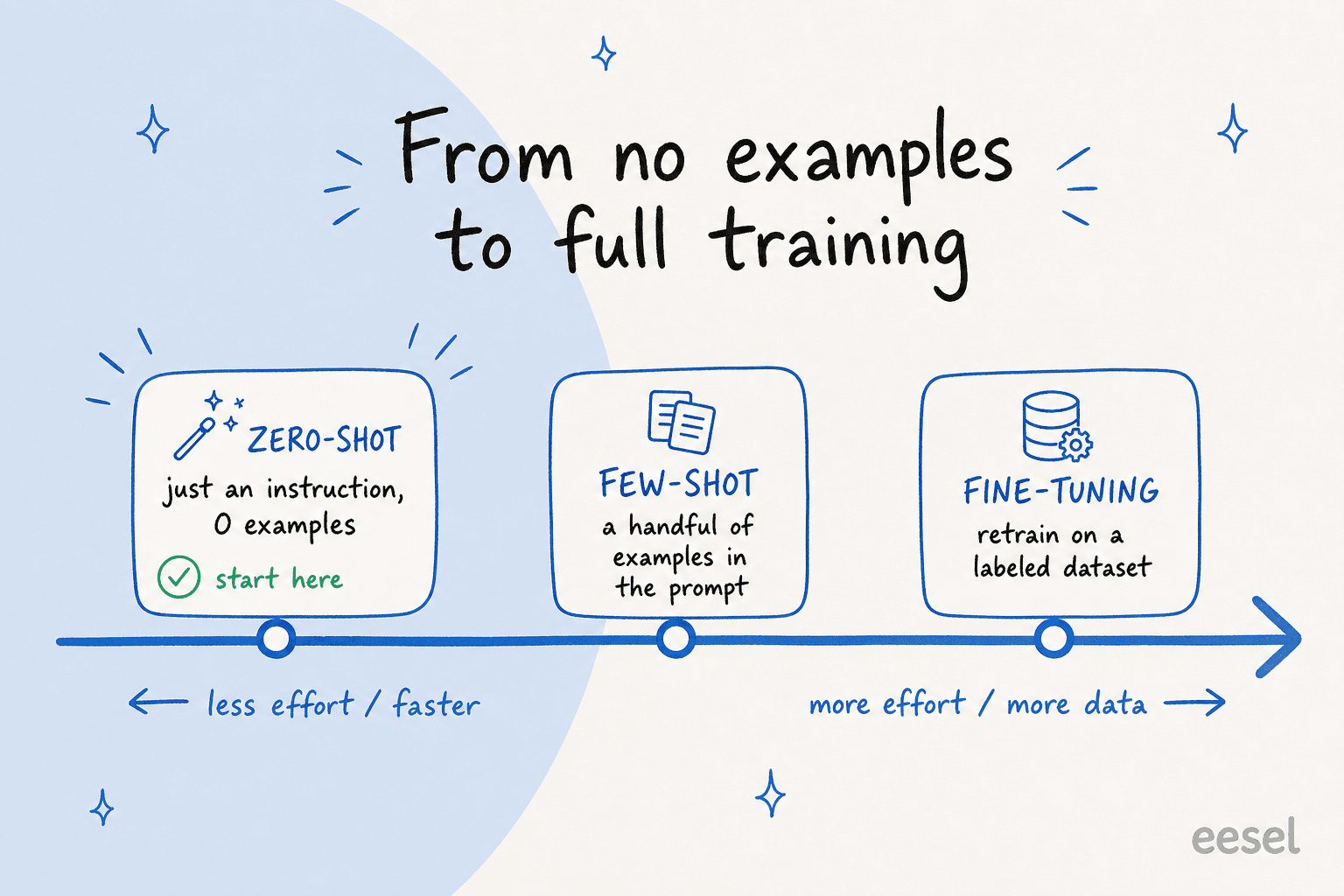
Zero-shot is the cheapest move on the left of the spectrum: just an instruction, no examples. If accuracy falls short you slide right, adding a few examples (few-shot) or, only when needed, retraining the model with fine-tuning.
How zero-shot learning works
- Frame the task as an instruction. The prompt describes what to do in plain language, with no example outputs included.
- The model interprets intent. It maps the instruction onto patterns it learned during pretraining to understand what a correct response looks like.
- It generates a response. The model produces an answer directly, generalizing from its training rather than from in-prompt examples.
- You evaluate and decide. If the output is accurate and well-formatted, zero-shot is enough; if not, the next step is usually to add examples or ground the model in source documents.
In a support setting, an agent like eesel AI leans on zero-shot ability to understand the wide variety of ways customers phrase the same question, then grounds the actual answer in your help center and past tickets so the reply is based on your facts rather than the model's general guess.
Zero-shot learning in practice
Zero-shot is the right first move for most tasks because it costs nothing to try and reveals quickly whether the model already knows enough. The catch is consistency: with no examples, output format and edge-case handling can drift. The usual fix is not always to train a model but to tighten the instruction, add a couple of examples, or supply grounding, escalating only as far as the accuracy target demands.
Automate support without training data
eesel AI handles new ticket types from your knowledge base and instructions, with no per-intent training set to build first.