
What Plain is, and who it is really for
Plain (legal entity Not Just Tickets Ltd) is a B2B support platform founded in London in 2020 by Simon Rohrbach and Matt Vagni, both of whom helped scale Deliveroo. It has raised about $21M, including a $15M Series A led by Battery Ventures in February 2025, which the team used to open a San Francisco office and invest in product.
The positioning is not subtle, and I mean that as a compliment. Plain calls itself "support infrastructure" and pitches itself at teams that ship software. Its customer wall is a who's-who of dev tools: Vercel, Raycast, Sourcegraph, n8n, Resend, Sanity, Clerk, Tinybird, and Laravel. The whole product reflects that audience. It is keyboard-first, it unifies Slack, Microsoft Teams, Discord, email, live chat, and in-app forms into one thread-based queue, and it treats Linear and Jira as first-class citizens rather than afterthoughts.
That focus is the single most important thing to understand about Plain. If your support happens in Slack and spills into your issue tracker, Plain was built for you. If you are running a 500-ticket-a-day ecommerce queue or a non-technical team, you are not the target user, and it will feel like it. This is the opposite of a generic AI helpdesk, and that is the point.
One honest limit up front on the security side: Plain's trust center lists SOC 2 Type II, GDPR, and a 2025 penetration test. There is no ISO 27001 or HIPAA attestation published as of this writing. For most SaaS teams that is fine. If you are in healthcare or a regulated vertical that needs a signed BAA, that gap matters, and you should ask Plain directly rather than assume.
Ari: the customer-facing AI agent
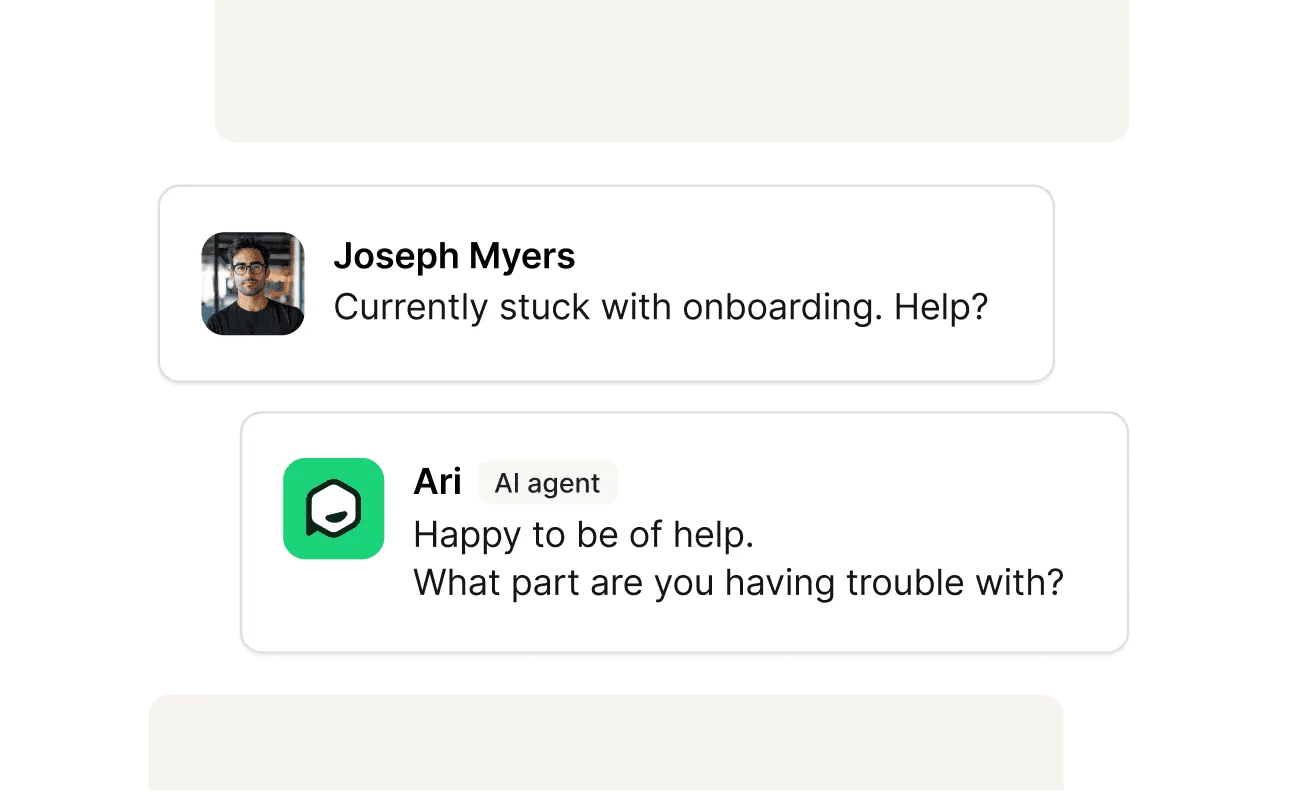
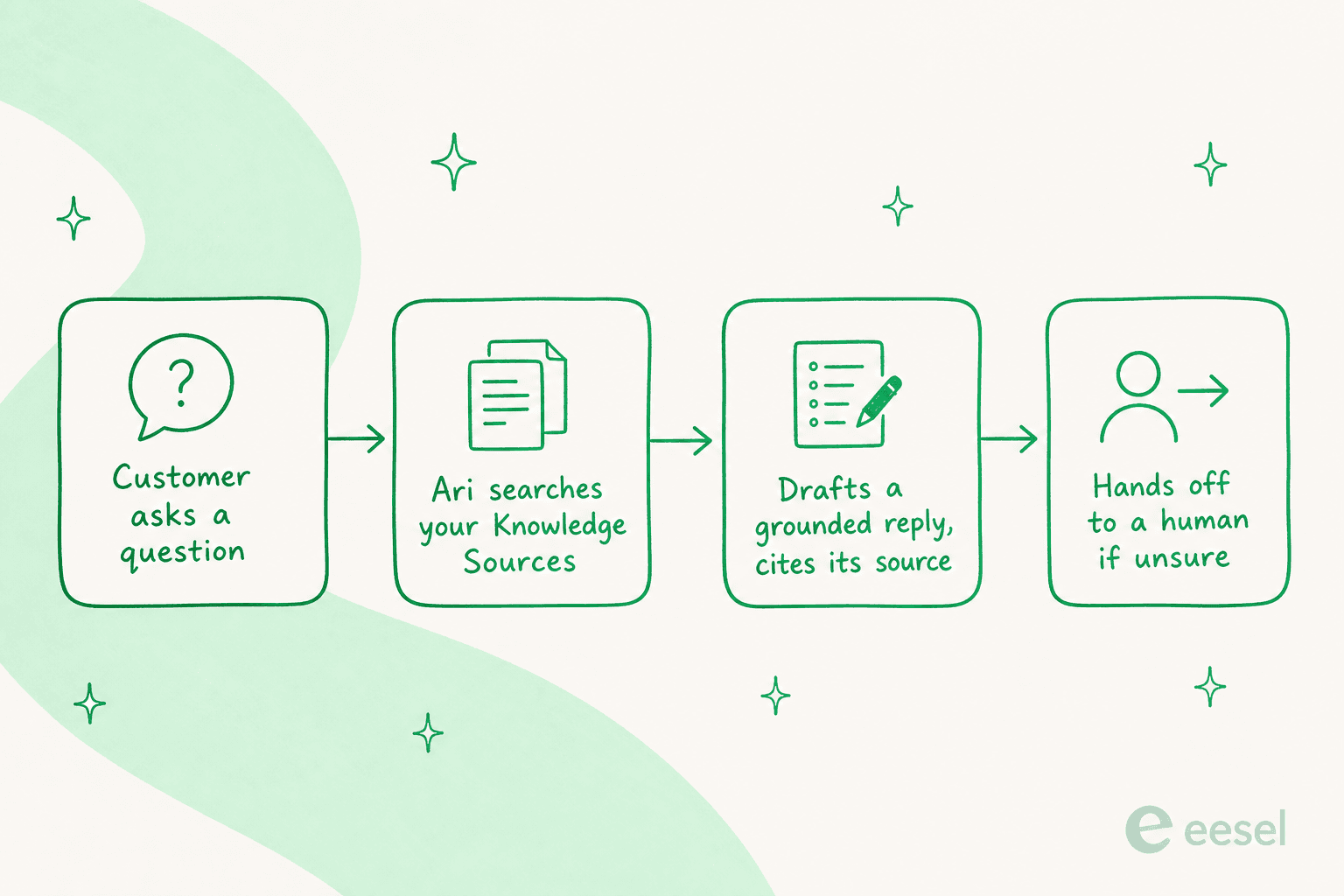
Ari is Plain's autonomous support agent, and it is the part of the product I liked most. The design philosophy is refreshingly restrained: Ari answers what it can from your knowledge, cites where the answer came from, and hands off to a human the moment it is unsure. There is no flow builder and no decision tree to configure. In Plain's words, you turn Ari on, point it at your knowledge, and it starts answering.
Where Ari gets its knowledge is the detail most reviews skip, and it is the one I care about most. Ari answers only from your Knowledge Sources: it reads your customer-facing help center automatically, and you can add a sitemap or individual URLs that it reindexes every Monday morning. Per thread, it also reads that thread's own recent history. What it does not do is learn from a corpus of your past resolved tickets. That is a deliberate guardrail against hallucination, and it keeps answers grounded, but it also means Ari is only ever as good as your written docs. Plain is upfront about this: without solid knowledge sources, it warns, Ari "will have a high deflection rate," meaning it hands off rather than guessing.
Ari adapts to the channel too, writing fuller replies over email, shorter ones in chat, and staying under Discord's character limit, all in the customer's language. It records a knowledge gap whenever it cannot answer, ranked by how many threads asked, so your team knows exactly which doc to write next. The headline marketing claim is that B2B teams trust Ari to handle 40%+ of volume, which is a "handle" figure rather than a guaranteed resolution rate, so treat it as a directional promise rather than an SLA.
Testing Ari before it goes live
This is a real strength, and I want to give it full credit. Plain ships two testing modes. Shadow Mode runs Ari on your real, live threads but sends nothing to customers: it adds private notes showing what it would have replied, what it would have handed off, or where no response was needed. New agents start in shadow mode by default. There is also a Playground, an ephemeral chat to poke at Ari against your real knowledge without touching a live thread.
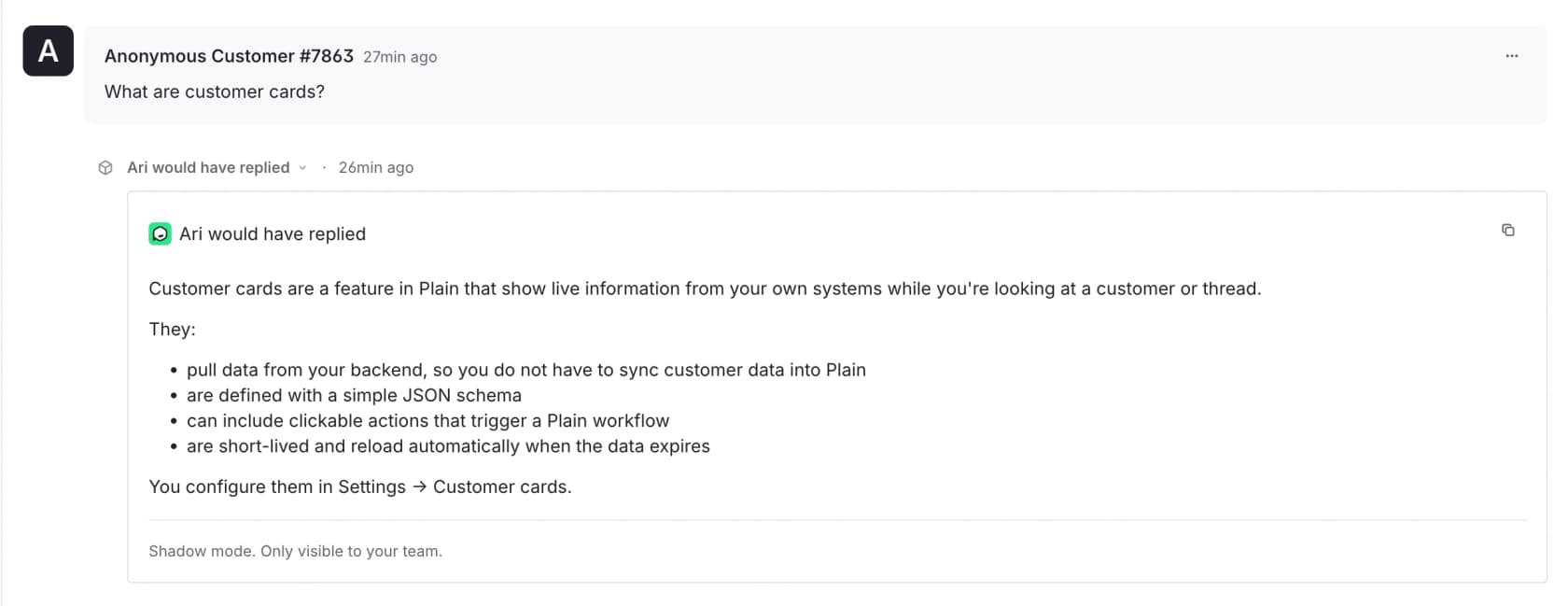
Here is the nuance I would want a buyer to catch. Shadow Mode is a dry run over new, incoming traffic going forward. It is not a bulk simulation over your historical ticket archive that hands you a projected resolution rate before you commit. That distinction is exactly the thing my team obsesses over, because "watch it on the next few live threads" and "replay it against the last 5,000 tickets and show me the number" answer very different questions when a VP asks whether the agent is ready. Plain's approach is good and safe; it is just forward-looking, not a backtest.
Sidekick and the credit question
Sidekick is Plain's other AI, and it is aimed at your team rather than your customers. It researches, drafts, and executes: it reads the full thread, reaches into tools like Linear, Jira, Sentry, Datadog, and GitHub, and can run on a schedule for recurring jobs. Crucially, Sidekick cannot message customers on its own. It drafts, and irreversible actions wait for a human to approve them. There is also a neat developer touch called "Lookup with Cursor" that lets Sidekick query your own GitHub codebase from inside a thread.
Sidekick is also the thing that spends money, and this is where I want any buyer to slow down. Plain's AI billing runs on credits at a published rate of 50 credits = $1. Each Sidekick session is metered after it ends: a flat $0.10 base fee plus 1.2x the cost of every AI model call it made, then converted to credits. Cost scales with how much context it reads, how many tools it calls, and how long its answer is.
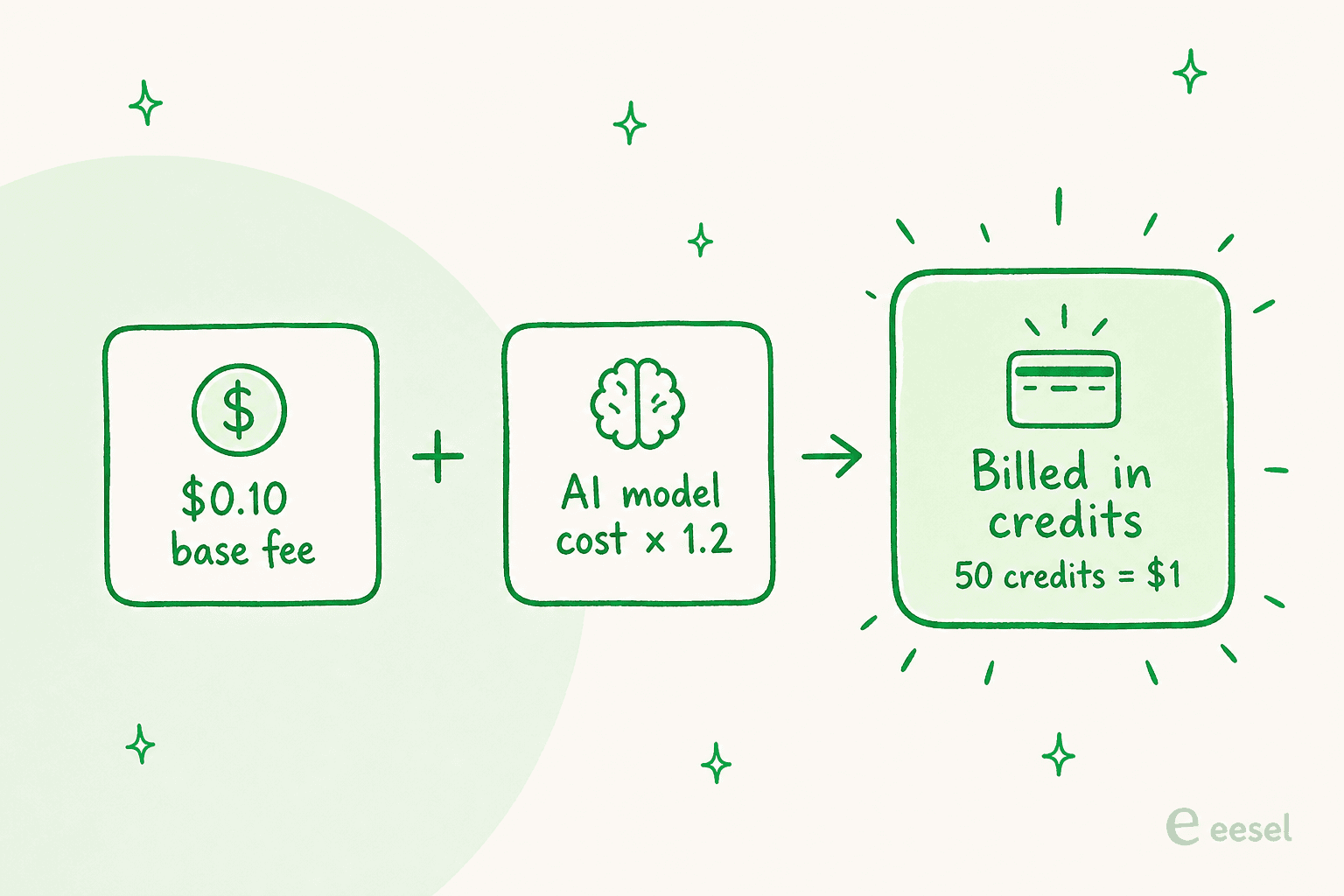
The part I keep coming back to is Plain's own guidance: it says plainly that it cannot forecast usage before you build a workflow. Its advice is to run Sidekick on 5 to 10 real threads and divide to estimate a per-thread cost. That is refreshingly honest, and it is also a genuine planning tax. Your included allowance converts to a set Sidekick budget (Foundation's 2,000 credits is $40 of usage, Horizon's 15,000 is $300), plan credits reset monthly and do not roll over, and when you run out, Sidekick pauses until you top up. Everything else in Plain keeps working.
To make that concrete, here is a rough estimator. Plug in your own numbers and it will show where you land against each plan's included credits.
None of this makes Plain expensive, exactly. It makes Plain's AI cost variable in a way you have to actively manage. If you are the kind of team that likes to model spend to the dollar before you commit, that is the friction point.
Plain pricing in plain terms
Here is the full breakdown. All prices are the annual (billed-yearly) rate; monthly billing runs about 10% higher.
| Plan | Price (billed yearly) | Seats | Extra seat | Credits/mo | Key features |
|---|---|---|---|---|---|
| Foundation | $35/mo | 1 (max 5) | +$35 | 2,000 | Slack (25 channels), email (2), in-app, live chat, Ari included free, Sidekick, Linear + Jira, 1 Help Center |
| Horizon | $299/mo | 3 (max 10) | +$99 | 15,000 | Everything in Foundation, plus Microsoft Teams, SLAs and business hours, escalation paths, CRM integrations, AI suggested responses, unlimited channels |
| Frontier | Custom | Custom | Custom | Custom | Everything in Horizon, plus Discord, Lookup with Cursor, SSO and SCIM, advanced security, bring-your-own-agent, dedicated CSM |
A few things worth flagging. Viewer seats are free and unlimited on every plan, which is a genuinely nice touch for looping in engineers who only occasionally jump into a thread. There is a 7-day free trial with no credit card, and an early-stage startup program offering up to 50% off. But note the seat caps: Foundation tops out at 5 users and Horizon at 10, so a growing team will hit the jump to per-seat pricing (and then to a custom Frontier contract) sooner than the sticker price suggests. And the enterprise essentials, SSO and SCIM, sit only on Frontier, which is standard for the category but worth budgeting for.
For a small startup team, a worked example: three support engineers on Horizon is $299/month flat, plus whatever Sidekick burns against your 15,000 included credits. That is very reasonable for the polish you get. The number that moves is the AI meter, not the seats.
What real users say about Plain
Plain is still an early-stage, developer-audience product, so third-party sentiment is thin but consistent. On G2 it holds 4.5 out of 5 across 27 reviews, with 77% five-star. The praise clusters hard around the same things: the UI, the Slack and Linear integrations, and how responsive Plain's own team is.
"It has a clear, modern, nice designed UI. I use Plain every day for customer tickets. [...] Plain is really self-explanatory, on my first day as a support engineer I didn't need an onboarding to Plain - I simply just used it!"

That "no onboarding needed" note came up more than once, and it matches my read of the product. It is genuinely intuitive. An unprompted recommendation on Hacker News echoed the same core value:
"Not a founder but our support org is a huge fan of Plain (plain.com) which has some AI features but is mostly a great way to manage both Slack and Email support in one place."

The complaints are worth hearing too, because they are specific and they come from otherwise-happy reviewers. The one I would weigh most heavily, given how Ari works, is search:
"The search functionality is a little limited in its ability to search the contents of past threads."
Others flagged buggy rich-text formatting for code blocks and bullet lists (a real irritation for a tool aimed at engineers) and that internal notes are not editable and there is no Notion integration yet. None of these are dealbreakers, but they are the rough edges of a young product still filling in its knowledge base and search story.
Where Plain fits, and where I would look elsewhere
After all of it, my verdict is clear and mostly positive. Plain is a beautifully built, opinionated support tool for software teams, and Ari is one of the more sensible customer-facing agents I have seen this year. The reservations are about audience and billing model, not quality.
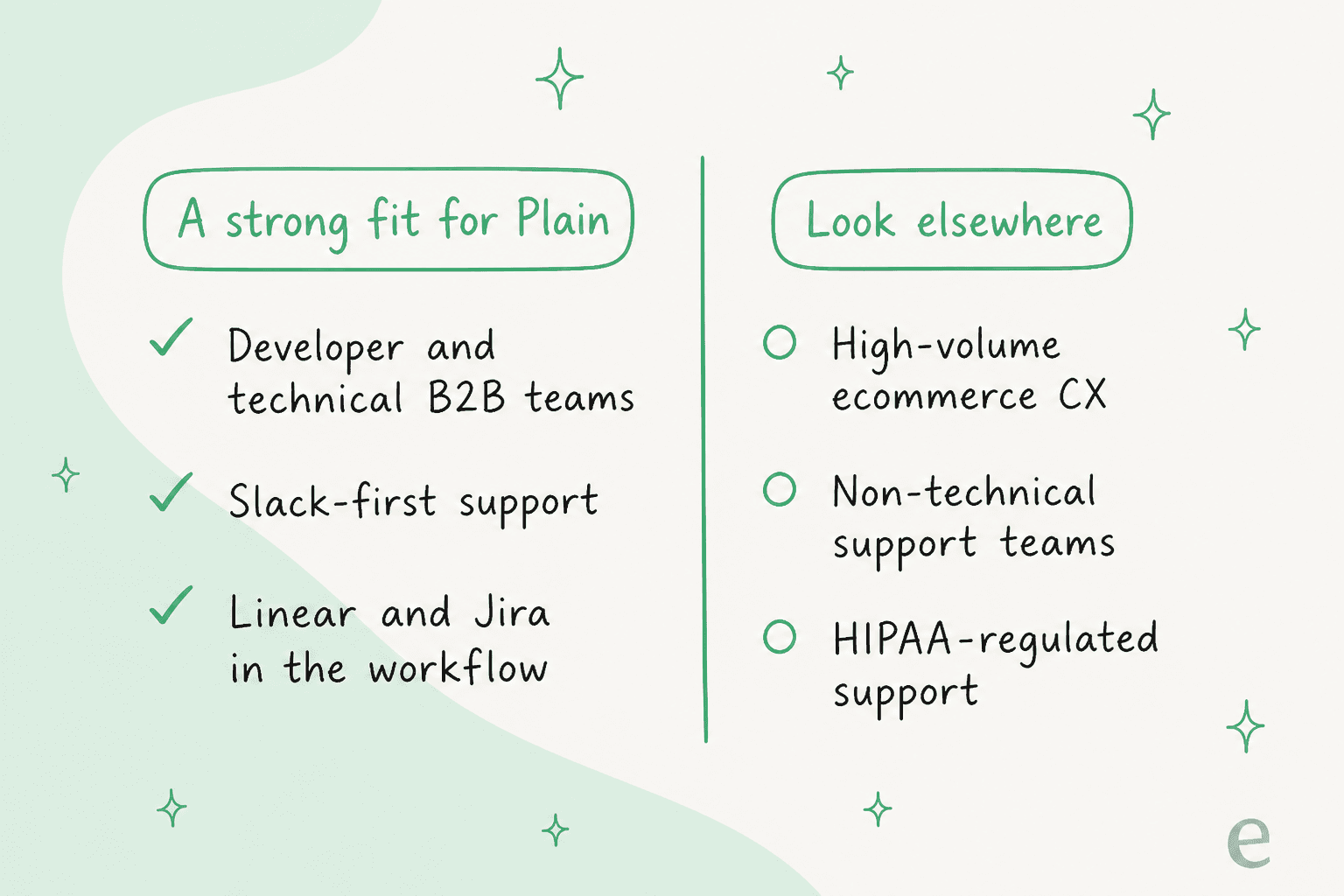
Pick Plain if you are a developer-facing B2B team, you run support out of Slack, and you want your issue tracker wired in from day one. Look elsewhere if you need HIPAA coverage today, you are a high-volume ecommerce or non-technical team, or you need to know your AI bill to the dollar before you sign. Those are not knocks on Plain; they are just honest statements of what it is optimized for.
Try eesel for AI support that plugs into your existing helpdesk
If what pulled you toward Plain was the AI (an agent that resolves tickets, drafts replies, and works alongside your team) but you do not want to move your whole support stack onto a new platform, that is exactly the gap eesel fills. eesel is an AI helpdesk teammate that plugs into the helpdesk you already run, whether that is Zendesk, Freshdesk, Gorgias, or a Slack-and-Jira setup much like Plain's, and starts resolving tickets from day one.

Two differences map directly onto the reservations above. First, knowledge and testing: eesel learns from your past tickets, not just your docs, and it lets you simulate a rollout over thousands of your real historical tickets so you see a projected resolution rate before a single customer is touched. In one rollout for a gig-economy analytics team on Zendesk, that approach resolved 73% of their tier-1 tickets in the first month. Second, pricing: eesel charges one predictable price per ticket it handles, with no separate credit meter to reconcile and no "we cannot forecast this for you" caveat.
And because Plain's audience is developers, the last piece will feel familiar: eesel exposes the same teammate through a proper CLI and MCP server. A person can drive it from a terminal, scripts can automate it, and coding agents like Claude Code, Codex, and Cursor can operate the same workspace programmatically, so the AI is not locked inside a dashboard. It is free to try, and you can have it running against your own tickets in minutes.
Frequently Asked Questions
How much does Plain cost?
Is Plain's Ari AI agent free?
What are Plain credits and how are they billed?
Is Plain good for non-technical or high-volume support teams?
Can Plain's AI answer from my past tickets?


Article by
Rama Adi Nugraha
Rama is a software engineer at eesel AI with two years of experience writing about B2B SaaS, AI tools, and customer support technology. Based in Bali, Indonesia, he brings a developer's perspective to product comparisons — cutting through marketing copy to what the integrations and APIs actually do.