

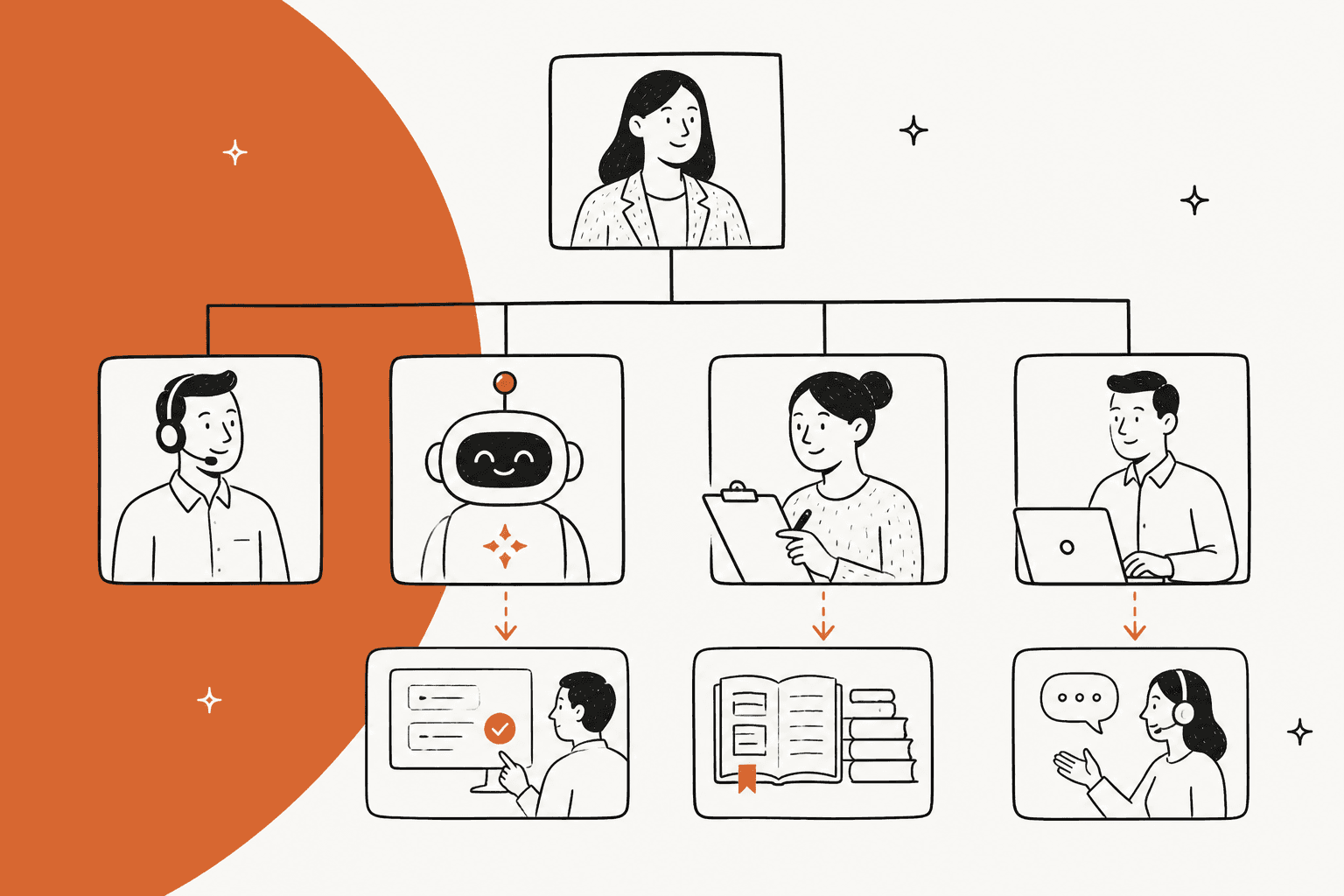
When an AI agent takes part of the ticket queue, support jobs change before the org chart does: four jobs need a named owner on day one, and they are agent owner (writes the rules), reviewer (approves drafts), knowledge owner (fills the gaps) and escalation owner (takes the handoffs). On a small or mid-size team, those are hats your existing lead and senior agents wear, not new hires.
Dedicated AI support roles are real and they pay well. In postings I checked on 30 October 2026, Vanta pays $110K-$129K for an AI Agent Support Specialist, Okta CAD $124K-$186K for an AI Trainer, and Harvey $88K-$132K for a CX Knowledge Specialist. But they show up once volume makes the hats a full-time job, and they are mostly filled from the support bench.
At eesel, every customer story I can point to has a named person wearing the agent-owner hat inside their existing job: a Manager of Tech Support at Cactus Club Cafe, the COO at Rúngne, the Customer Success lead at smava, where the AI sorts and drafts across 27,000 tickets a month and a person still does the sending.
What changes in a support job when an AI agent takes tickets?
The repeat questions leave first. Password resets, order status, "where is my refund", the same shipping question 40 times a day: that is the work an AI agent picks up first, because the answer already lives in your knowledge base or your order system. What stays is the work that needs judgment, and a few kinds of work that did not exist before.
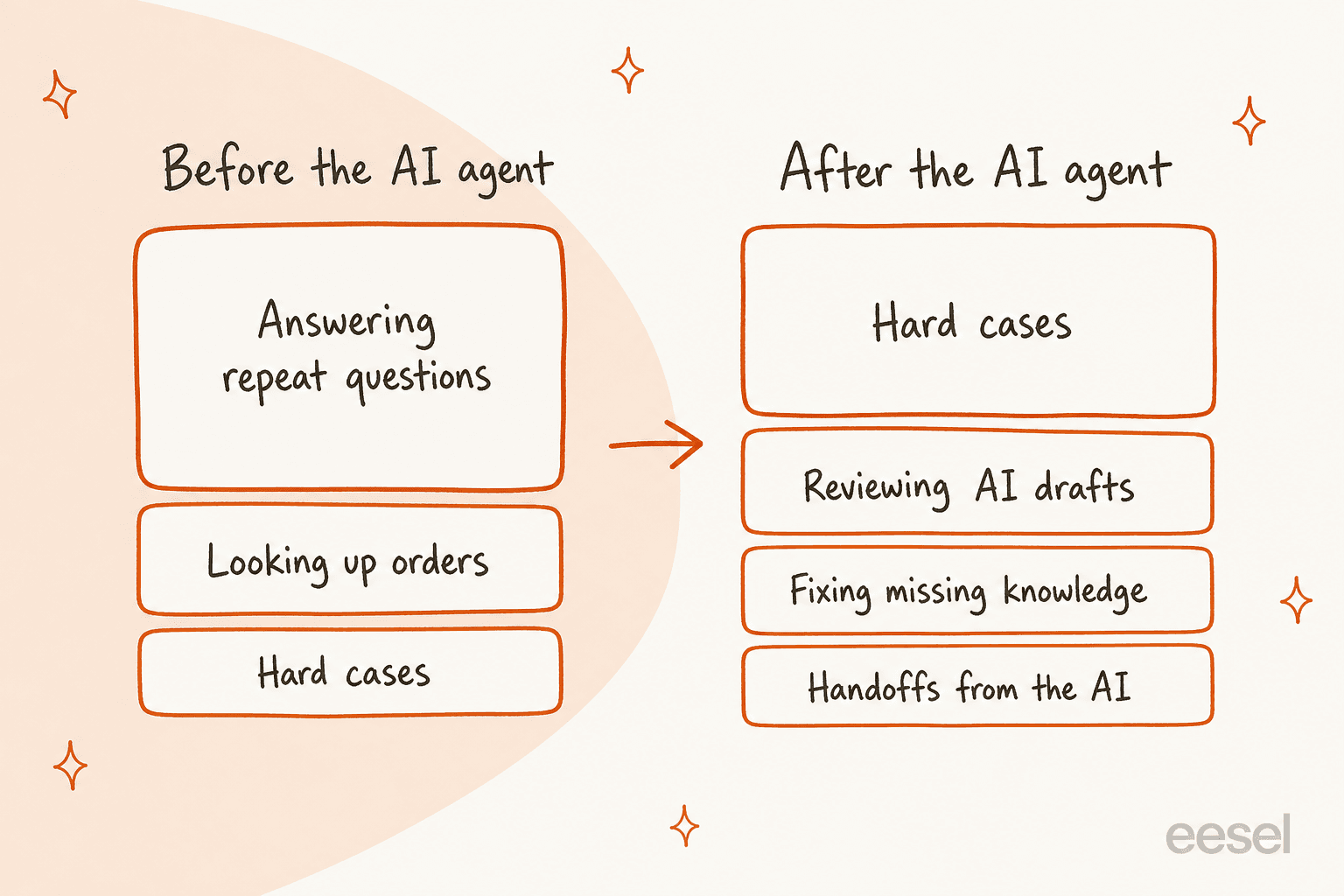
I work eesel's support queue every day, and the shift I'd warn any team about is this: the hard cases become most of the job. That sounds like good news, and mostly it is. But a day of nothing except angry customers, edge cases and refunds is a heavier day than one padded with easy wins, so the team structure and the coaching have to change with it.
Three new kinds of work show up alongside the hard cases:
- Reviewing what the AI wrote. Most teams start in draft mode, where the agent writes and a person sends. At smava, a regulated loan comparison site in Berlin, the eesel drafting agent ran on about
12,200tickets in a month, and every one of those drafts waited for a person. - Fixing missing knowledge. Every time the AI cannot answer, it is telling you something your help center does not say. Someone has to read those signals and write the missing article.
- Taking the handoffs. The AI passes refunds, complaints and anything outside its rules to a person, ideally with a note so nobody starts from zero. At Adverscale, a US passport application service, eesel left
2,700internal notes in a month: a recap on every ticket, and a handoff where a person was needed.
One thing I did not expect from eesel's own trial data: when agents rewrote an eesel draft, roughly two thirds of the edits were about length and tone, and only about one in twenty fixed a wrong fact. The reviewer's job is less "catch the AI lying" and more "make it sound like us", which is very trainable. More on that in the guide to training an AI agent.
Which four jobs need a named owner on day one?
Here is the part most org-chart posts skip. Before you think about new titles, there are four jobs that have to belong to a specific person from the first day the AI touches a ticket. If nobody owns them, the agent's quality drifts and nobody notices until a customer does.
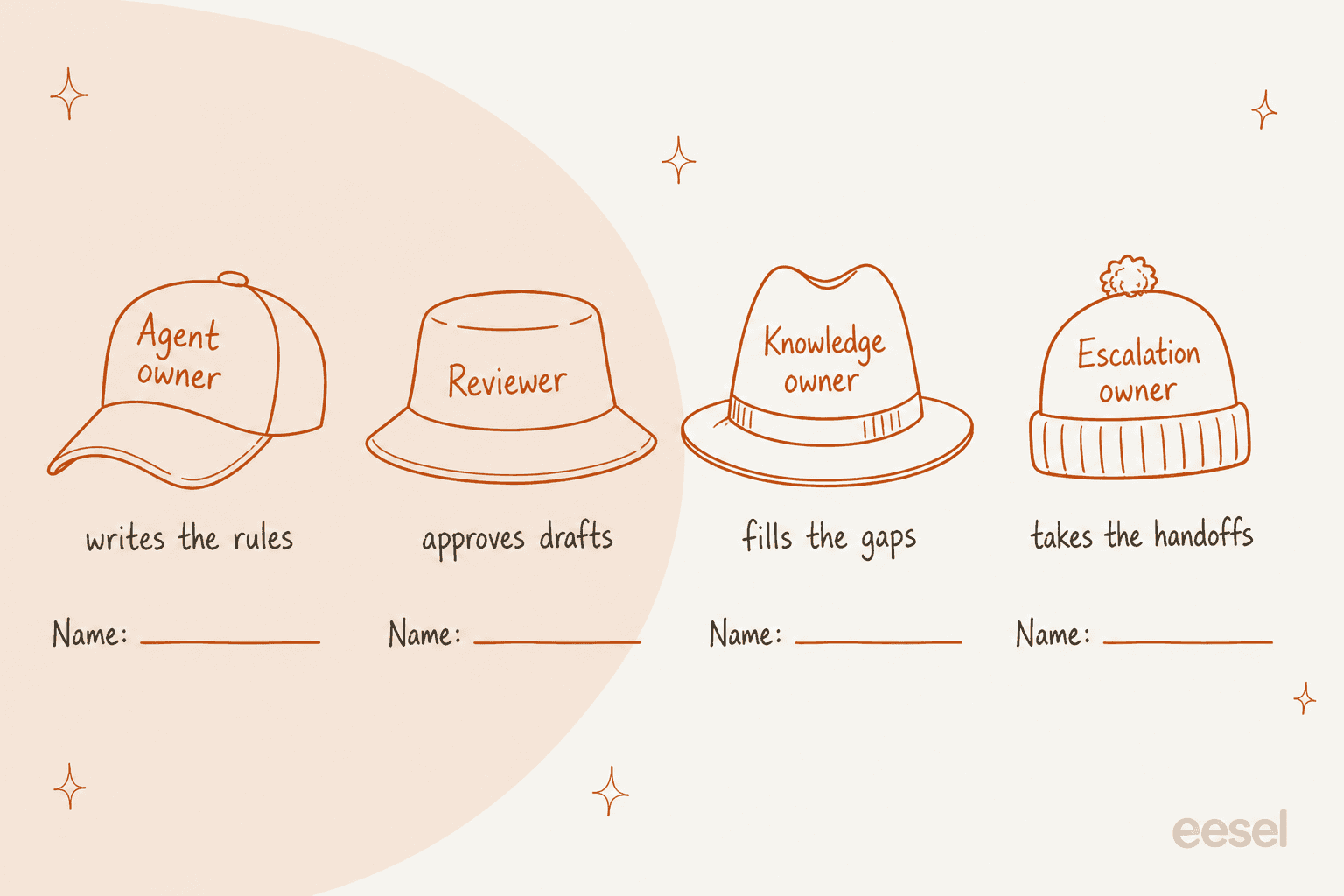
Write a name under each one. One person can wear all four on a small team. What you cannot do is leave a hat on the table.
Agent owner: writes the rules
The agent owner decides what the AI is allowed to answer, what it must never touch, and when it hands over. They read its mistakes every week and turn them into rules. In job-posting language, Vanta describes this person as someone who treats an AI agent "like a product: something to measure, tune, test, and improve every week."
In practice this is usually your support lead or ops manager. At Cactus Club Cafe, a Vancouver restaurant group running internal tech support on Zendesk, it is Gerardo Moran, Manager of Tech Support. He wanted an agent that follows the team's runbooks "and nothing more: no improvised troubleshooting, no guessing when a document is missing", and he has been shaping the setup week by week since. At Rúngne, a Norwegian climbing apparel brand on Gorgias, the COO split the first one-agent-does-everything setup into three agents with one job each within a week.
Neither of them is a full-time "AI person". The agent-owner job is a few hours a week of reading, deciding and correcting, and it sits best with whoever already owns your support policies.
Reviewer: approves drafts
The reviewer reads what the AI wrote and decides whether it goes out. On day one, that is usually every agent on the team, because draft mode is the safe way to start: the AI drafts as an internal note and a person sends. At Cactus Club Cafe, eesel left 790 draft replies for the tech support team in a month, against 51 sent directly.
Over time the reviewer hat narrows. Once a ticket type is approved without edits week after week, it can move to answering on its own, and review becomes spot checks instead of every ticket. That is the core of support QA with AI: your QA people move from scoring human tickets to scoring the agent's.
"I cannot go and check all my 7,000 tickets to see if the AI actually made a good answer - then the point is a little bit gone. I need an AI who is only handling the tickets that it's confident to handle and all the other ones, leave them alone."
A CX lead handling about 7,000 tickets a month, on an eesel sales call
That lead is right. Review has to scale down as trust goes up, or it eats the time the AI saved.
Knowledge owner: fills the gaps
The knowledge owner keeps the source of truth current: help center articles, macros, internal runbooks, policy changes. When the AI hits a question it cannot answer, this person decides whether that is a missing article, a stale one, or a ticket that should always go to a human.
This hat existed before AI, usually as a side job nobody wanted. It gets more important now, because the AI repeats whatever your docs say, at volume. Harvey's posting puts it plainly: the CX Knowledge Specialist "owns the source of truth: the articles, troubleshooting guides, and product knowledge that specialists and our AI Support agent answer from", and must "structure knowledge for both humans and AI."
The good news is that knowledge stops being a one-person job. In eesel, a correction anyone makes in chat or on a ticket can become a saved memory the agent reads before every conversation, with a note of who taught it and where.
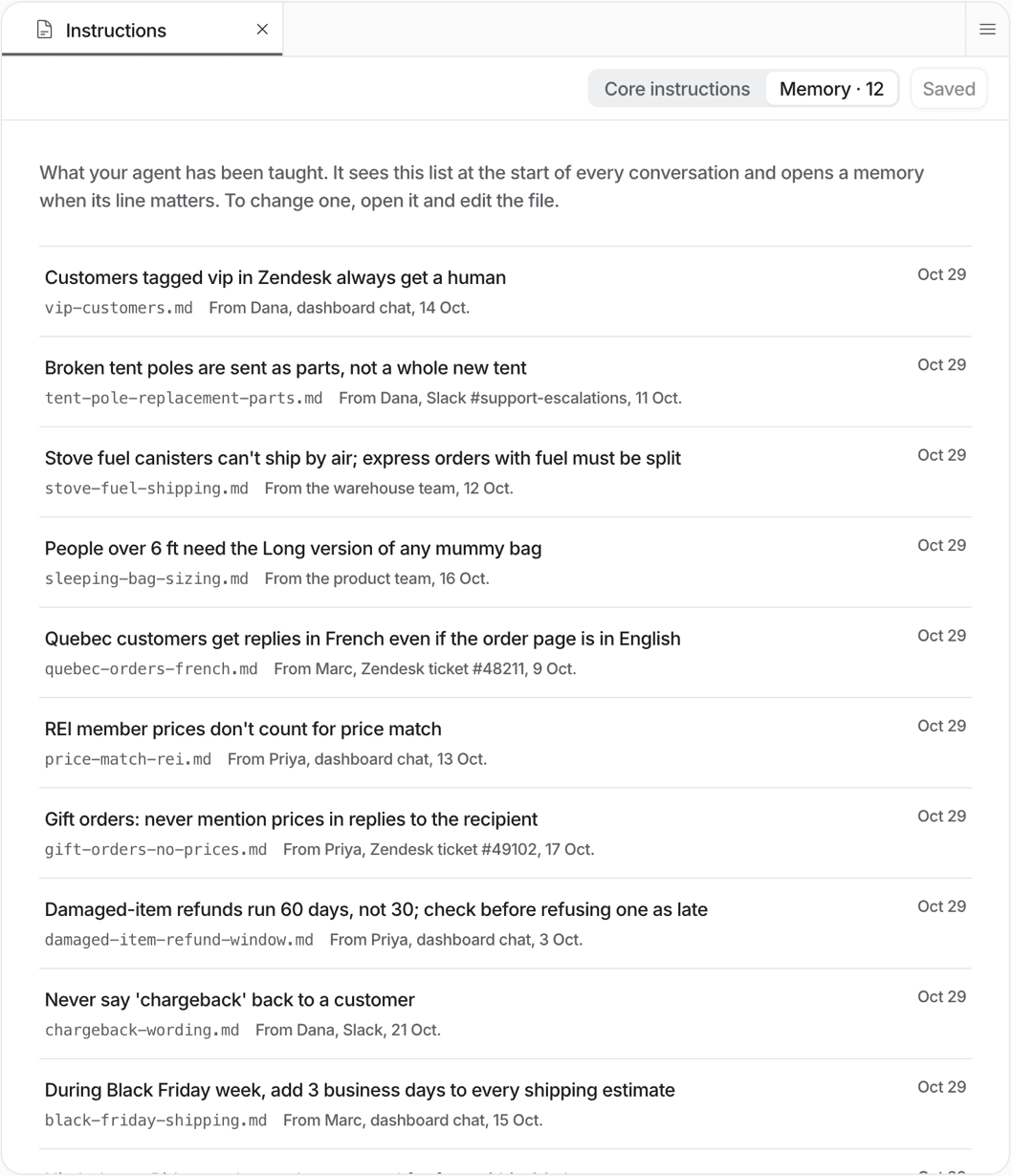
At Innr, a Dutch smart lighting brand on Freshdesk, eesel pulls the past week's question, return and replacement tickets every Monday morning, so what the team answered last week is in its knowledge this week. The knowledge owner still decides what is true. They just spend less time copying it around. For a deeper process, see support knowledge gap analysis.
Teams that make this work treat knowledge updates as part of shipping, not a cleanup job for later:
"Everytime we release new product features, we update the documentation and feed it into our AI agent. We also update the API's for functionality where our AI agent is pulling data from our app. The process is just a part of our go live steps on every release."

Escalation owner: takes the handoffs
The escalation owner is the person or group the AI hands work to: refunds, cancellations, complaints, VIPs, anything outside its scope. Their job is to set the rules for what always goes to a human and to make sure handoffs land with context, so the customer never repeats themselves.
Question Beauty, a direct-to-consumer cosmetics brand on Gorgias and Shopify, hands refunds, returns, complaints, chargebacks, wholesale and creator requests to a person. eesel replies briefly, assigns the ticket, and leaves a note with what the customer asked, what it found in Shopify and why a person is needed. Out of 990 tickets in a month, about 250 were assigned to a person. Those 250 are now most of what the human team does, so the escalation owner is usually your most experienced agent, the one you would give the angriest customer anyway.
If you want the mechanics, the guides to AI escalation management and AI agent handoff go deeper.
What new AI support roles are companies actually hiring for?
Once volume is high enough, the hats become full-time jobs with their own titles. I pulled live postings from each company's own careers page or job board on 30 October 2026. Here is what the new role family looks like, with the pay each posting lists.
| Role type | Company and title | What it owns | Posted pay range |
|---|---|---|---|
| AI agent owner | Vanta, AI Agent Support Specialist | Accuracy, guardrails, handoffs and launch readiness for the customer-facing AI agent | $110K-$129K + equity |
| AI agent owner | Okta, AI Trainer | "Full ownership of our customer support agentic experiences", tone and guardrails | CAD $124K-$186K |
| AI agent owner | Lyft, Senior PM, Customer Care AI | Builds AI agents for chat and voice, writes prompt logic and conversation flows | $148K-$185K |
| AI ops owner | Doctolib, Senior AI Specialist (Operations) | AI for Operations and Customer Success, quality standards, evaluation routines | Not listed |
| Knowledge for AI | Harvey, CX Knowledge Specialist | The articles and guides both the AI and human specialists answer from | $88K-$132K + equity |
| Knowledge for AI | Robinhood, Knowledge & Operational Readiness Specialist | Help Center, SOPs, runbooks, escalation paths, launch readiness | $73K-$110K by location |
| Knowledge for AI | Coinbase, TPM, Knowledge Systems | Knowledge infrastructure for self-service and AI-assisted support | $148.8K-$175.1K |
| Knowledge for AI | Airbnb, Senior Manager, Content & Knowledge Architecture | Help Center and internal knowledge used by agents and AI chatbots | $196K-$245K |
| Support automation | Toast, AI/Agent Engineer, Care Automation | Agentic workflows across care systems "with appropriate human-in-the-loop checkpoints" | $151K-$309K by zone |
| AI QA and escalations | Workday, Sr. Associate Customer Support Analyst | Reviews AI chat logs for wrong answers and hallucinations, triages P1 queues | Not listed |
| Complex cases | OpenAI, AI Support Engineer | "Critical escalation point" for complex technical issues | $180K-$260K + equity |
| Support operations | OpenAI, Service Design Program Manager, Support | Customer journeys and the handoffs between teams | $216K-$310K + equity |
Three patterns stand out once you read the full postings:
- The AI agent is treated like a product with an owner. Okta's AI Trainer monitors "deflection rates, resolution rates, and customer satisfaction (CSAT) scores" and reviews "high-volume AI conversations to identify new customer intents, common misclassifications, and critical content gaps in the knowledge base."
- Knowledge is the fastest-growing role. Four of the twelve postings are knowledge jobs, and two of them (Harvey and Coinbase) say outright that the goal is to scale support without adding headcount.
- Humans keep a hand in the queue. Vanta's posting asks the specialist to "handle a small volume of tickets to stay close to real customer problems." The people who own the AI are expected to stay close to real customers.
What I did not find was a large open market for "conversation designer" inside support teams. The live posting with that title was at an AI support vendor, designing agents for its customers. On in-house teams, conversation design is folded into the agent-owner or PM role.
What does an AI agent owner do every week?
If you are about to give someone the agent-owner hat, here is what the job looks like week to week, pulled from the postings above and from how eesel customers run it:
| Weekly task | What it looks like in practice |
|---|---|
| Read the misses | Go through tickets where the AI was wrong, stuck, or handed over when it should not have. Vanta's posting asks the owner to "dig into low CSAT ratings and dead ends, and fix the root cause." |
| Rank the fixes | Keep a short list of improvements ordered by volume and risk, not by whoever complained loudest. |
| Turn corrections into rules | Every fix becomes an instruction, a saved memory or a knowledge article, so the same mistake does not happen twice. |
| Decide what moves to autopilot | Ticket types that get approved without edits for weeks can move from drafts to direct answers. Anything involving money stays behind an approval. |
| Prepare for launches | Before a product or policy change ships, update the knowledge and test the agent on the new questions. |
| Stay on live tickets | Answer a few real tickets so the rules stay grounded. |
At Swiftreg, a UK private number plate dealer on Zendesk, the team runs this like software: its eesel instructions are kept as numbered releases and rolled out through Swiftreg's own procedure rather than edited live. You do not need to go that far on day one, but it shows where the job goes once it matures. The AI agent coaching guide covers the weekly loop in more detail.
Should you hire for these roles or train your own people?
Train first, in almost every case. The postings tell you where the hires come from: Vanta asks for 3+ years of B2B SaaS technical support, and Harvey wants a background in knowledge management, support operations or technical writing. The best AI agent owner on your team is probably already answering tickets. They know the product, the policies and the customers, which is exactly what the agent lacks.
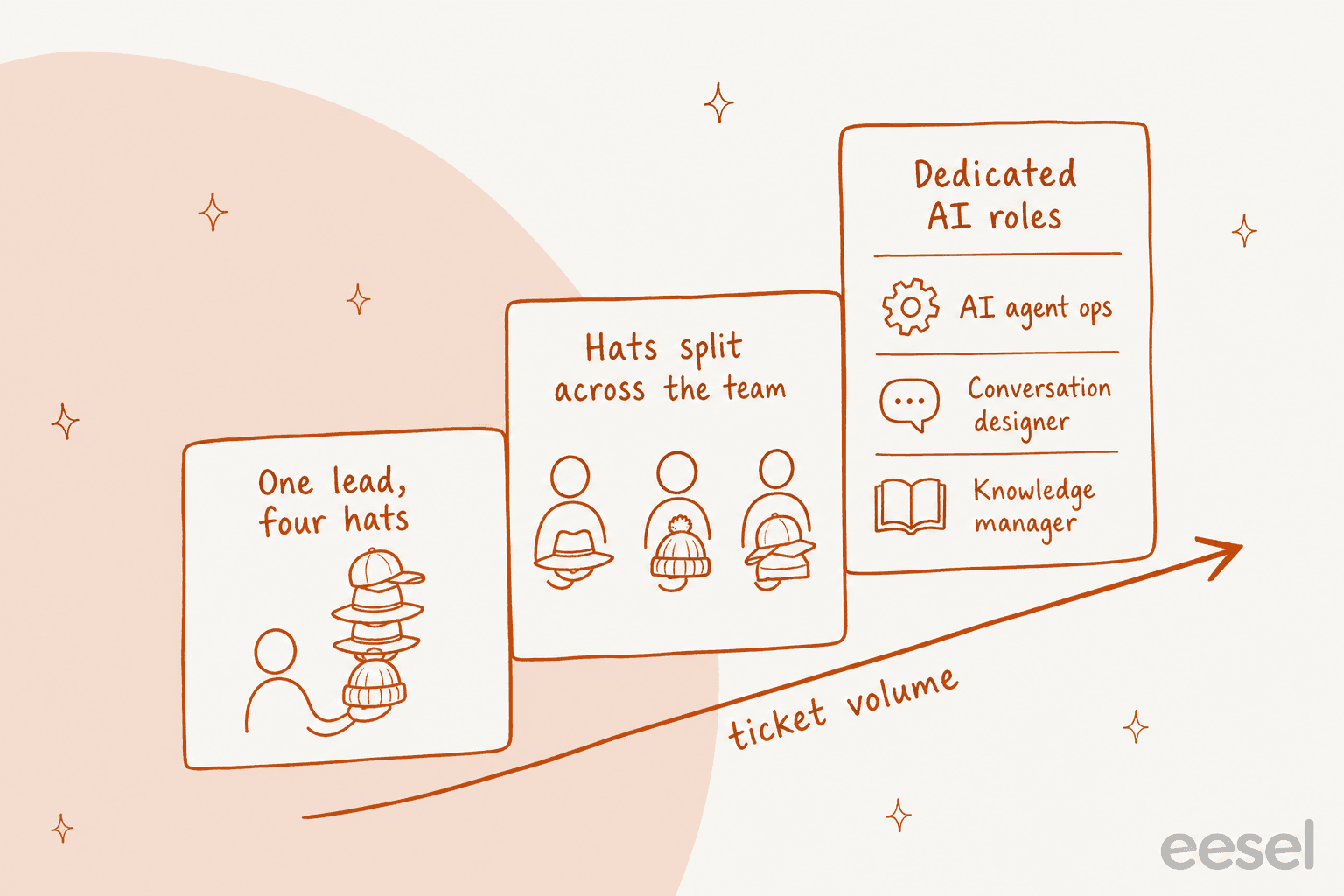
The hats turn into hires in roughly three stages. On a small team, one lead wears all four. As volume grows, the hats split across senior agents. Dedicated roles appear when one hat alone fills a week, which in the postings above means companies the size of Okta, Coinbase or Airbnb.
Pick your team size and how far the AI goes today to see who should wear which hat.
A quick budgeting note: if you are paying per seat for the AI, adding reviewers and approvers costs money every month. eesel's pricing is per ticket instead, with unlimited seats on the Free and Teammate plans, so putting the whole team in as reviewers costs nothing extra.
What happens to tier 1 agents?
Most frontline agents reading a post like this are not asking about new titles. They are asking whether their job survives. The honest answer from the people living it is mixed, and I would rather show that than paper over it.
"Mine too. I'll be in a meeting tomorrow about AI and "role impacts"."
The quieter pattern is not layoffs but a hiring freeze. A support lead running a B2B tech support team at a later-stage startup described leadership deciding to use AI "to keep our team size low as our customer base grows". That matches what the job postings say, too: Harvey and Coinbase both write "without adding headcount" into the job description. The team you have today is the team that absorbs the growth.
"If your role is at risk of being replaced by AI, you need to upskill in technical domain knowledge. TSMs have far more job security and value to the business and clients. I have yet to see an AI that can replace all I do for my customers."
So where do tier 1 agents go? Three directions show up in the postings and threads above, and each one lines up with a hat:
| Strength | Where they move | Hat they grow into |
|---|---|---|
| Calm with upset customers, good judgment | Escalations, refunds, retention, high-value accounts | Escalation owner |
| Know the product and policies cold | Writing and fixing the docs the AI answers from | Knowledge owner |
| Pick up patterns, like spreadsheets | Reviewing AI drafts, QA, reading the misses | Reviewer, later agent owner |
The tier 2 support path is the most common, because the work AI hands over is mostly tier 2 work. The two less obvious paths, knowledge and AI review, are where the new titles in the postings come from. Vanta's AI specialist role asks for 3+ years of technical support, which is a profile a tier 1 agent can grow into by saying yes to the reviewer hat early.
One warning from the other side of the rollout: how you introduce the AI matters as much as what it does. One Reddit commenter put it well: reps "can see these tools as help or as another way management watches them." If agents hear about the AI in a "role impacts" meeting, they will read every draft as a threat. If they start as the reviewers who decide what goes out, they read it as a tool they are in charge of.
How does the team lead's job change?
The team lead goes from managing people who answer tickets to managing a mixed queue: some tickets answered by people, some by the AI, some drafted by one and sent by the other. That changes the questions they get, the numbers they watch and the training they run.
The questions change first. One permissioned eesel case study, from vfm Group, put it this way:
"We can onboard new employees much faster with eesel AI's Copilot, and help train them or answer questions with accurate responses straight from the source. Managers are now asked the important questions, and sourcing documents or learning processes has become much easier."
vfm Group, eesel customer
The numbers change next. Deflection rate alone is a trap, because an AI that stops customers reaching a person without solving their problem looks great on that metric. A lead now watches the AI's resolution rate, how often it escalates, how often drafts go out unedited, and how long approvals sit waiting. The guide to AI customer service metrics lays out the full set.
And training changes too. New hires used to spend their first weeks on easy tickets. If the AI takes those, new agents start on harder work with less ramp, so agent onboarding needs more shadowing on escalations and more time reading how the AI handles the easy ones.
A practical way to keep the numbers honest is to stop reporting one "AI handled X%" figure. One Reddit commenter in r/CustomerSuccess suggested a split I'd steal:
"The percentage is useful, but I would split it into four buckets or the number gets misleading fast: Fully resolved with no human touch. AI drafted the answer, human reviewed/sent. AI triaged/routed/tagged the issue. AI summarized context for the CSM/support rep. [...] The guardrail I like is: if the wrong answer can create churn, compliance risk, billing confusion, or account damage, AI should prepare the work, not close the ticket."
The last change is the hardest: old targets stop fitting. If the AI takes the quick tickets, an agent's tickets-per-hour drops even when they are doing better work, because what is left takes longer. Retire per-agent volume targets before they punish the people handling the hard cases, and measure resolution quality on escalations instead.
"We've evolved the CSM role to be less technical and more focused on value and product adoption, so folks are flexing new muscles and it's taking time. [...] We also have KPIs that are incongruous to this evolution and we're working on changing those for better long-term alignment."
How do you roll out the new roles without breaking the team?
The order matters more than the titles. This is how I'd sequence it:
- Name the four hat owners before go-live. Write the names down, in the same doc as your AI rollout plan.
- Start in draft mode. Every agent becomes a reviewer for a few weeks. They learn what the AI gets right, and the agent owner learns what it gets wrong. eesel's simulation runs the agent on 20 tickets your team already resolved before any customer sees a reply.
- Move one ticket type at a time to autopilot. Pick the type with the fewest edits. Leave refunds, cancellations and anything that costs money behind a human approval.
- Shift people as the queue shifts. As routine tickets leave, move agents toward escalations, knowledge and QA, based on who is good at what, not seniority alone.
- Hire only when a hat fills a week. If your agent owner spends most of their week on the AI, that is the moment to make it a role.
For the full timeline, see the AI support implementation timeline and the guide on building an AI-first support team.
Try eesel as your AI helpdesk teammate
If you are working out who on your team will own an AI agent, eesel's AI helpdesk teammate is built for the hats in this post. It joins your existing helpdesk (Zendesk, Freshdesk, Gorgias and more), learns from your past tickets and help center, and starts in draft mode so every agent reviews before anything reaches a customer. The agent owner corrects it in plain language and the fix becomes a saved rule, the reviewer approves actions from the helpdesk or Slack, and the escalation owner gets every handoff with a note explaining why.
That is how smava runs 27,000 loan tickets a month, with the Head of Customer Success owning the rules. In the story's words, "changing what eesel may say is a text edit, not a project."
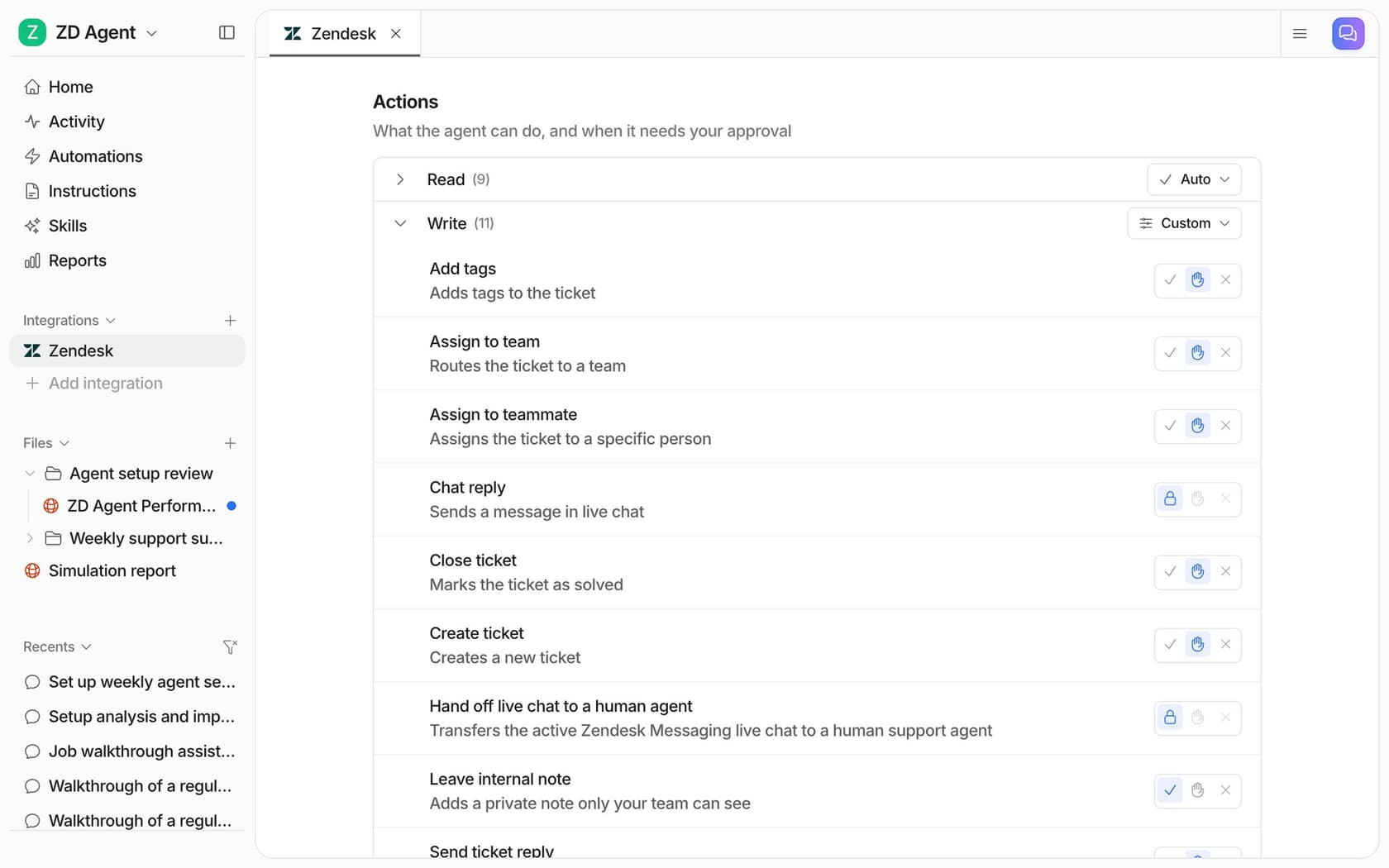
Plans start free with 100 tickets, and the Teammate plan is $299 a month for 500 tickets, with unlimited seats for every reviewer you add. Try eesel on your own queue, or browse more customer stories first.
Frequently Asked Questions
What new job roles does an AI support agent create?
Will AI replace customer support agents?
What does an AI agent owner do in customer support?
How much do AI support job roles pay in 2026?
$73K at Robinhood to $245K at Airbnb, AI agent owner roles from $110K-$129K at Vanta to $148K-$185K at Lyft, and OpenAI's AI Support Engineer $180K-$260K. Pay tracks how technical the role is.Should I hire an AI trainer or train my own support agents?
What happens to tier 1 support agents when AI takes over?
How do support team roles change with an AI helpdesk agent like eesel?
27,000 tickets a month this way, with unlimited seats for reviewers.