Knowledge management
Knowledge management is the practice of capturing, organizing, sharing, and maintaining an organization's information so the right people can find and use it.
What knowledge management means
Knowledge management is the practice of capturing, organizing, sharing, and maintaining an organization's information so the right people can find and use it when they need it. It covers the full lifecycle of knowledge: how it is created, where it is stored, how it is kept accurate, and how it flows to the people and systems that depend on it. The goal is to stop important information from living only in one person's head or buried in a thread nobody can find.
In customer support, knowledge management is the discipline that keeps the knowledge base trustworthy. It is the difference between a library of articles that quietly rots and one that stays current enough for an agent, a customer, or an AI to rely on it. Where the knowledge base is the content, knowledge management is everything that keeps that content correct.
Why knowledge management matters
Good knowledge management is what separates a support team that scales smoothly from one that re-solves the same problem forever:
- It prevents knowledge loss when people leave, by capturing how things are actually done instead of relying on tribal memory.
- It keeps answers consistent, so the same question gets the same correct response no matter who or what handles it.
- It powers self-service and AI, because both can only be as good as the documentation behind them. Strong management is what makes self-service actually deflect tickets.
- It surfaces gaps, by tracking which questions have no good answer yet and feeding that back into what gets written next.
- It assigns ownership, so articles have someone responsible for reviewing and retiring them rather than drifting unowned.
Part of what makes this hard is that the knowledge rarely lives in one place to begin with:
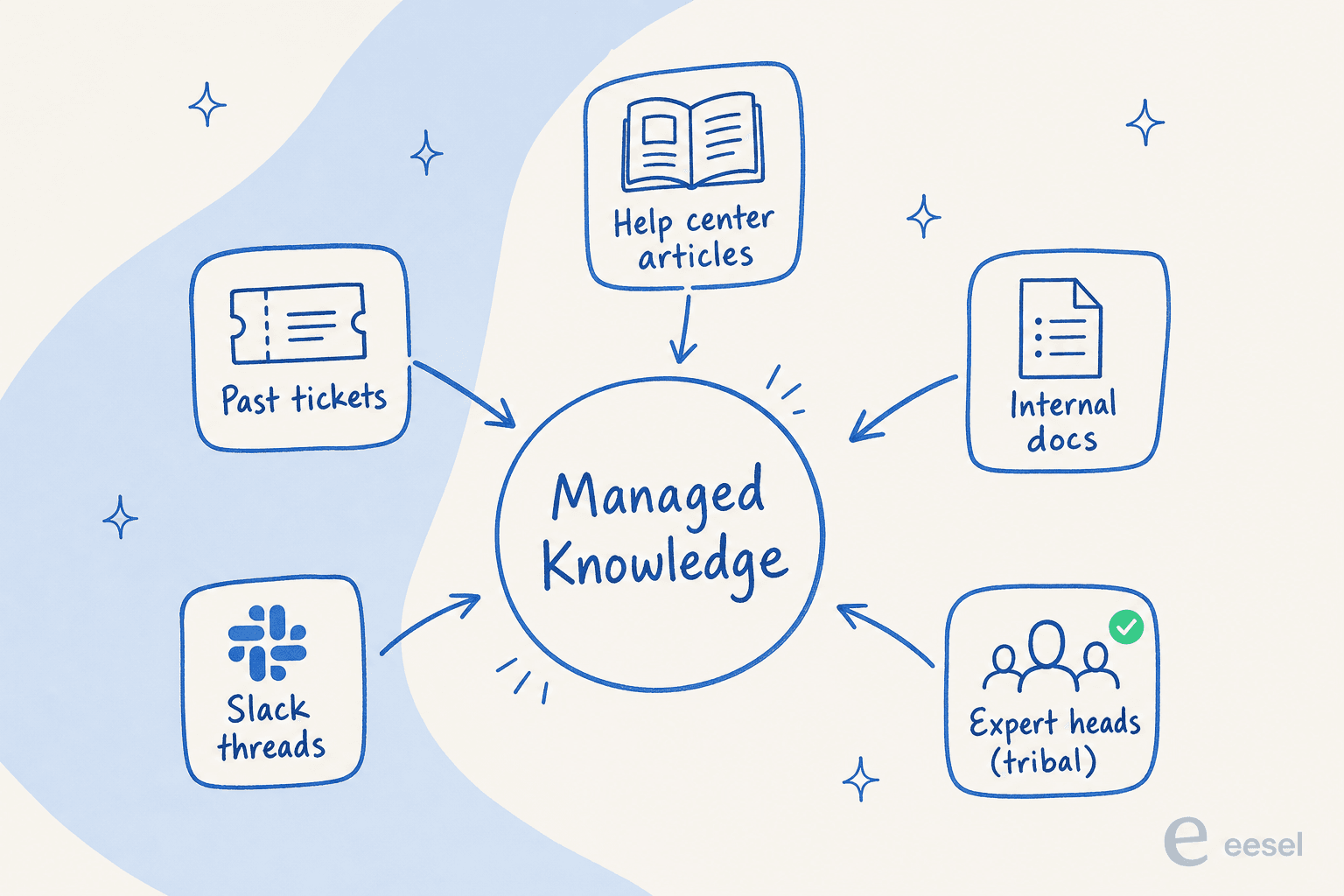
Support answers are scattered across the help center, closed tickets, Slack threads, internal wikis, and the heads of a few experts. The job of knowledge management is to pull those sources into one place a system can trust, which is the same set of sources eesel AI grounds its replies on.
How knowledge management works
In a support context, knowledge management usually runs as a continuous loop:
- Capture. Agents and experts turn resolved tickets and recurring questions into documented answers, often as they close the case.
- Organize. Content is structured, tagged, and stored so it is findable by both humans and search.
- Distribute. The knowledge reaches every surface that needs it: the help center, agent tooling, and AI.
- Maintain. Articles are reviewed on a schedule, updated when policies or prices change, and retired when they go stale.
- Ground the AI. A support agent like eesel AI connects to that managed knowledge and uses RAG to answer from it, so the quality of your knowledge management shows up directly in the quality of its replies.
Knowledge management in practice
The hard part of knowledge management is not creating content, it is maintaining it. Most teams are good at writing articles when a product launches and bad at pruning them afterward, which is how a knowledge base ends up full of contradictory answers. The practical fix is to make maintenance part of the daily workflow rather than a quarterly cleanup: capture answers at the moment a ticket is solved, give every article an owner, and use the questions AI cannot answer well as a live to-do list of what to fix next. Knowledge management done this way pays off twice, once for the humans and once for every automated answer built on top of it.
We go deeper on this in AI knowledge management.
Knowledge management that actually resolves tickets
eesel AI keeps answers grounded in your live docs and past tickets, so good knowledge management turns straight into resolved conversations.