How AI handles order cancellations in 2026

Stevia Putri

Katelin Teen
Last edited May 18, 2026
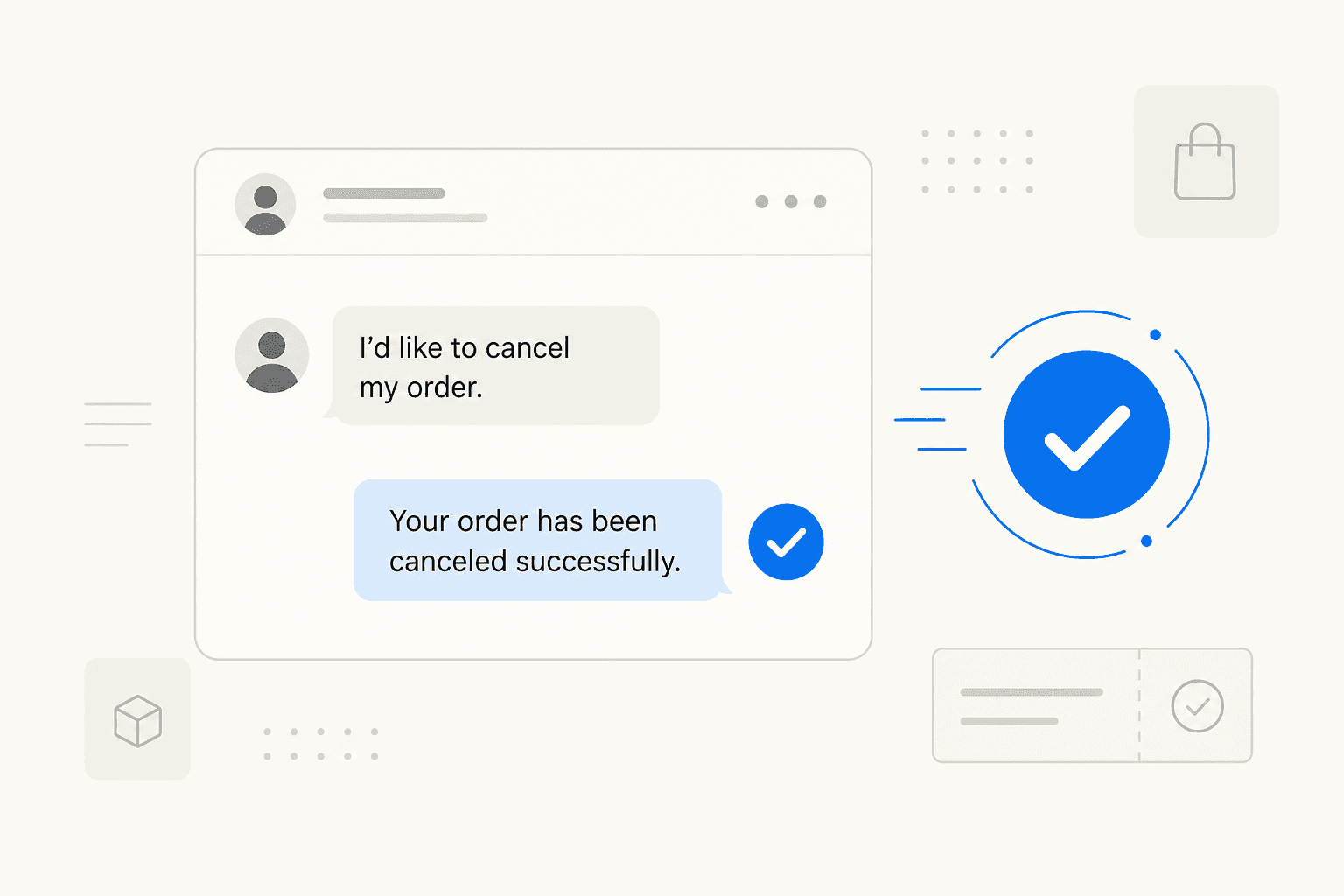
Order cancellations sit in an awkward spot for most ecommerce support teams. They are among the most common ticket types (roughly 10-15% of total support queue volume), entirely rule-based, and time-sensitive in a way most other tickets are not. A customer who needs to cancel within the first hour after ordering has a narrow window -- miss it and you have a different, messier problem on your hands.
That combination makes cancellations a near-perfect candidate for AI. The decision logic is simple: is the order unfulfilled? Cancel it and confirm. Has it shipped? Route to returns. There is no judgment call, no grey area, no product expertise needed. Yet most teams still route every cancellation to a human agent, where it sits in a queue and gets resolved five to ten minutes later -- if the customer hasn't already given up and filed a chargeback.
This post covers how AI for order cancellations actually works, what makes most implementations get it wrong, and what the numbers look like when it is done right.
Why order cancellations are expensive to handle manually
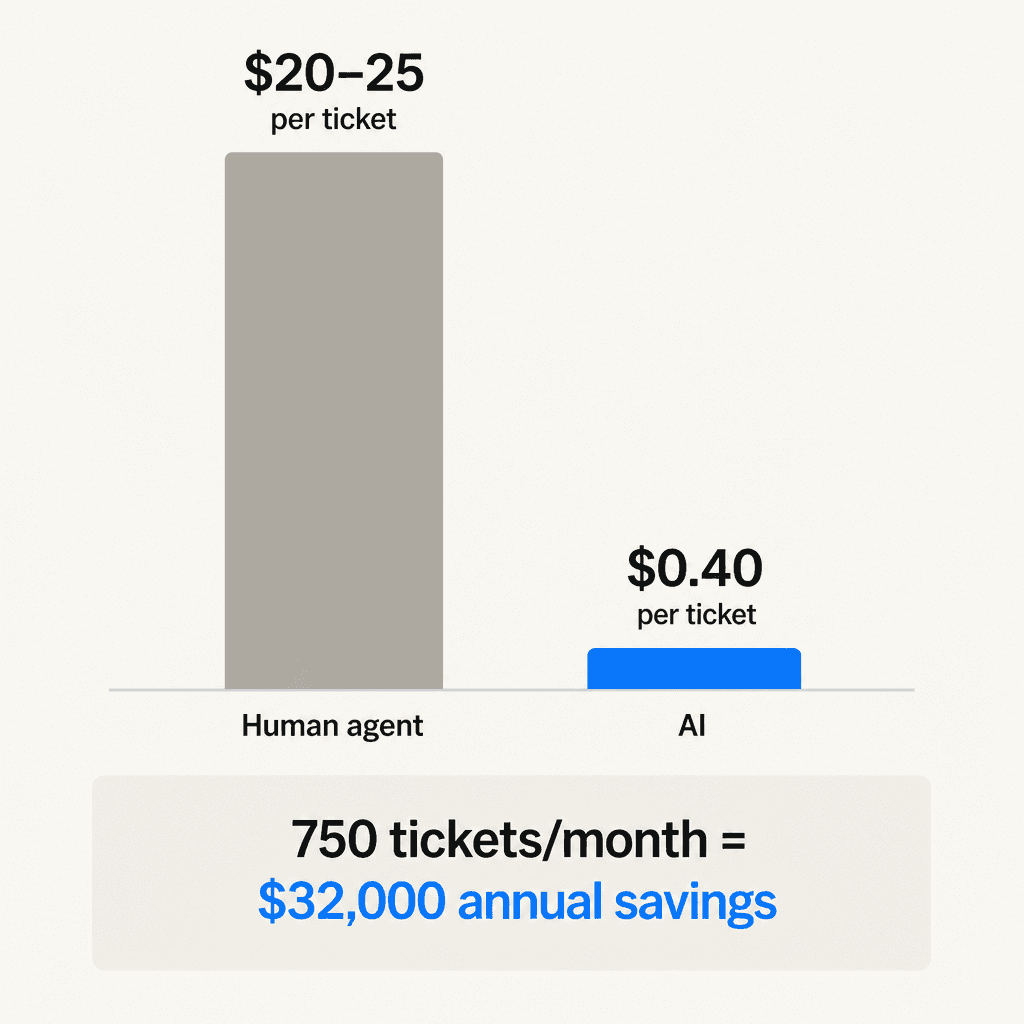
The cost of a human-handled cancellation ticket ranges from $20 to $25, accounting for agent time, overhead, and tooling. AI resolves the same request for $0.35 to $1.00. The gap sounds large in isolation, but consider what it looks like at volume.
A mid-size ecommerce brand handling 750 order status and cancellation tickets per month pays around $3,000 per month with human agents, assuming a $4 average cost per ticket. AI at $0.40 per resolution brings that to $300. The annual difference from one ticket category alone is over $32,000.
The volume is the other half of the argument. 16.9% of completed ecommerce orders were returned in 2024, nearly double the 8.1% rate from 2019. Returns and cancellations together represented $890 billion in products globally last year. The top reasons customers cancel post-purchase: 45% changed their mind, 40% encountered shipping costs they hadn't expected, and 35% were put off by delivery timelines. Every one of those requests lands in your support queue as a ticket an agent has to touch.
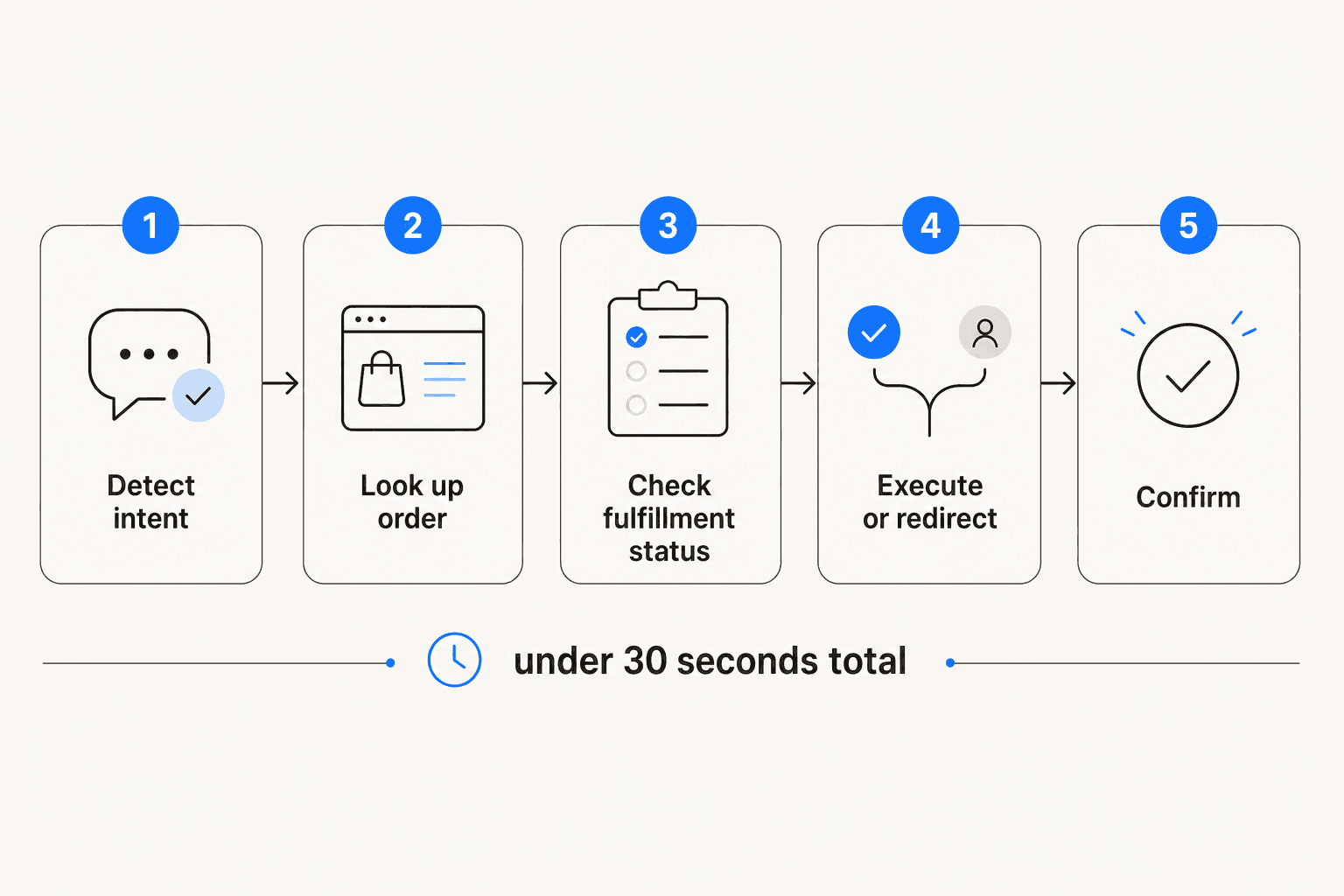
The manual loop -- open ticket, look up order, check status, run action, confirm with customer -- takes five to ten minutes when done by a person. AI runs the same loop in under 30 seconds.
How AI processes a cancellation request
The cleanest implementations follow a five-step pipeline. Alhena AI has documented this in detail for Shopify-based stores, and it applies broadly across platforms:
-
Detect intent. The AI parses the message semantically, not by keyword. "I changed my mind about that order" and "please cancel #1234" both resolve to the same intent. This matters because customers rarely phrase requests the way form fields expect them to.
-
Look up the order. A live API call to the ecommerce platform -- Shopify, WooCommerce, BigCommerce -- retrieves real-time order status. No cached data, no stale state.
-
Check fulfillment status. This is the gate. If the order is unfulfilled, cancellation proceeds. If it is partially or fully fulfilled, the AI routes to returns instead. This step is where most DIY implementations break: bots that skip the gate either cancel orders that have already shipped or refuse to cancel orders that are still eligible.
-
Execute or redirect. For eligible orders: the AI calls the platform's cancellation API, triggers a refund, restocks the inventory, and notifies the customer. For ineligible orders: it explains why cancellation is not possible and initiates a return flow with full context passed along.
-
Confirm. The customer receives a clear success message in the chat. The platform sends its standard cancellation email. The ticket is closed without a human ever touching it.
Guardrails that make this safe: live API calls for every action (never cached data), email verification before address changes, non-revealing error messages that don't confirm order existence to bad actors, and server-side credential handling that the customer chat never touches.
For merchants using third-party logistics providers, there is one additional timing constraint worth noting. Gorgias recommends setting an order date condition -- for example, cancellations only processed within the first two hours -- to prevent the AI from attempting to cancel an order that has already entered the fulfillment partner's pipeline even though Shopify still shows it as unfulfilled.
The gatekeeper problem
Here is where most AI implementations go wrong: they use AI as a wall between the customer and a resolution, not as the mechanism that delivers one.
The typical failure looks like this: customer asks to cancel, bot explains the cancellation policy, customer asks again, bot offers to connect them with an agent, agent eventually processes the request -- fifteen minutes after the customer first asked. The AI added zero value to the outcome; it just added friction.
On Reddit, this failure mode is well-documented:
"Trying to get ahold of anyone to cancel my order and no human response, AI responses are all I get."
Users across r/FuckZepto and r/Swiggy have posted versions of the same complaint: quick-commerce apps where the chatbot actively prevents customers from cancelling orders placed one minute earlier. One Swiggy user: "I made a cancellation request the very next minute after I ordered. Chat bot is not listening to me even after multiple requests."
The irony is that this design pattern is deliberate. Some businesses configure their AI to resist cancellations in the hope of reducing revenue loss -- which has the opposite effect. Customers who can't cancel simply dispute the charge. A separate r/UnethicalLifeProTips thread reached 10+ comments recommending that users tell any AI chatbot they want to cancel in order to get a human faster -- which reveals how many companies have trained their customers to associate "I want to cancel" with "this bot is useless."
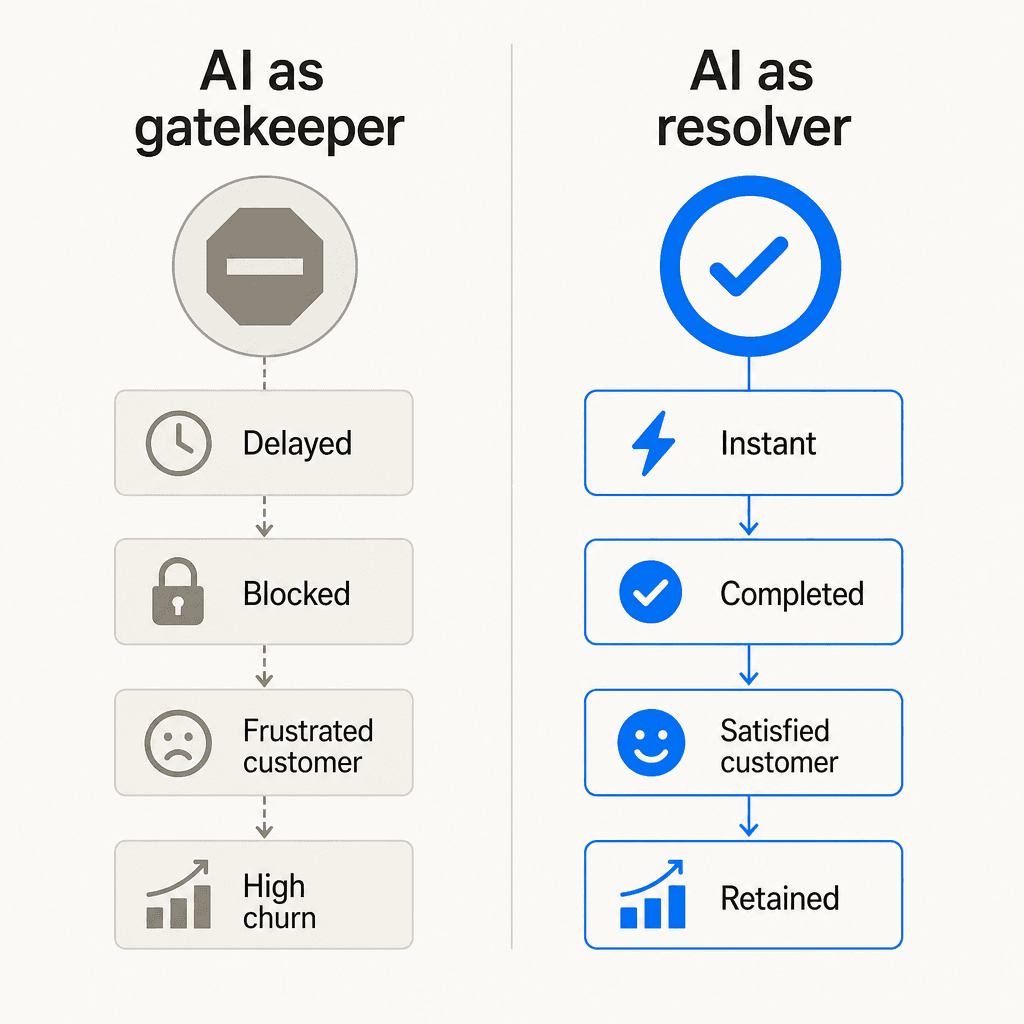
The distinction is not subtle. AI that processes the cancellation instantly creates a satisfied customer who may order again. AI that blocks the request creates a frustrated customer who files a chargeback and leaves a one-star review. The only difference between the two is whether the AI is connected to the platform's API and configured to use it.
Setting up AI order cancellation correctly
The chatbot for order cancellations implementation checklist has five components:
Live API connection. The AI needs read and write access to your ecommerce platform -- not a webhook that receives events, but an active API integration that can query status and execute mutations in real time. This is the non-negotiable prerequisite. Without it, the AI can only describe your policy.
Fulfillment status gate. Before any cancellation action, the AI checks whether the order is unfulfilled, partially fulfilled, or fulfilled. Unfulfilled proceeds to cancellation. Everything else routes to returns. This single check prevents the most common AI errors in this workflow.
Order timing window. For merchants with 3PLs or fast-moving fulfillment operations, add a time-based condition. An order placed three hours ago might still show as unfulfilled in Shopify but have already been submitted to a warehouse. Two hours is a common cutoff; adjust based on your fulfillment SLA.
Identity verification. Require the customer to confirm their email address against the order record before any changes are made. This is standard practice for shipping address changes and should apply to cancellations as well.
Escalation path. AI should handle the clear cases -- unfulfilled, within window, matching identity. Any request outside those parameters should route to a human with full context: order number, customer message, status at time of request. The AI's job is to eliminate the easy tickets, not replace judgment on the hard ones.
The eesel AI ecommerce agent handles all of this and also manages the adjacent workflows: WISMO queries, returns and refunds, product questions, and shipping address changes. Worth noting: it runs in a supervised mode where low-confidence responses surface as drafts for human review rather than going out live, which makes it easier to expand the AI's scope incrementally as you build trust in its outputs.
The retention opportunity inside cancellation requests
Processing a cancellation correctly is the minimum bar. What most teams leave on the table is the chance to prevent the cancellation entirely.
When a customer initiates a cancellation, they have not yet left. They are still in the conversation, waiting for a response. A fast AI that detects cancellation intent and asks one question before processing -- "Can I ask what's making you want to cancel?" -- opens a structured moment to offer an alternative. A delay waiver if the concern is shipping time. An exchange if the concern is product fit. Store credit if the concern is price. The Fluent Commerce research on cancellation reasons shows that 45% of post-purchase cancellations happen because customers changed their mind -- a category where an offer has a real chance of converting a loss into a retained sale.
The data on this is compelling. McKinsey found that a US airline using AI to personalize service recovery for at-risk customers saw an 800% increase in customer satisfaction and a 59% reduction in churn intention among high-value accounts. Freshworks research cited by Crisp found that customers are 2.4x more likely to stay loyal when problems are resolved quickly.
Speed is the prerequisite for all of this. The save opportunity only exists if the AI resolves fast enough that the customer is still engaged. A bot that takes four message exchanges to reach the question "would you like to exchange instead?" loses the window. Under 30 seconds gets there in time.
What the numbers look like at scale
Three case studies that show the ROI across different business types:
A leading US airline (JIFFY.ai, COVID-19). The pandemic triggered a volume spike in flight cancellations and refund requests that human teams couldn't absorb. JIFFY.ai deployed hyperautomation across the cancellation and refund queue. In under six weeks, the system processed nearly 100,000 transactions, automated 96% of refund queue items with no manual intervention, and saved more than 2,000 person hours. A 10x to 100x volume spike, handled without additional headcount.
A global IT solutions provider (Intellias). Dozens of order cancellation tickets were coming in every minute, each requiring manual work in two separate systems. Intellias built an automated cancellation bot combining web app, mainframe, and database integrations. Result: processing time dropped from 10 minutes to 1 minute per cancellation, five or more employees were freed for sales and customer relations, and the client saw six-figure USD savings from eliminated rework and inventory complications.
Caraway Home (Flip CX, voice channel). For phone-based cancellations, Caraway Home achieved a 98% total automation rate over six months using Flip CX's voice AI, which cancels directly via Shopify API within the one-hour eligibility window.
Gartner's March 2025 prediction: agentic AI will autonomously resolve 80% of common customer service issues by 2029, reducing operational costs by 30%. Order cancellations, being entirely rule-based and high-volume, are among the first categories to hit that threshold.
Which AI tools actually execute cancellations
There is a meaningful distinction between AI that talks about cancellations and AI that processes them. This comparison from AskYura's 2026 research makes it concrete:
| Tool | Cancels orders? | Processes refunds? | Updates shipping address? | Starting price |
|---|---|---|---|---|
| eesel AI | Yes | Yes | Yes | $0.40/resolved chat |
| Gorgias AI Agent | Yes | Yes | Yes | $360/mo (real cost often $960+) |
| Flyweight AI | Yes (API or Flow) | Yes | Yes | Free tier; paid from $30/mo |
| AskYura | Yes | Yes | Yes | Free tier; $175/mo Pro |
| Zendesk Auto Assist | Human-in-loop | Human-in-loop | Human-in-loop | Add-on to Zendesk plans |
| Tidio Lyro | No | No | No | $68-150+/mo |
| Zipchat AI | No | No | No | Sales-focused, not support actions |
Zendesk's Auto Assist sits in a middle tier: it checks Shopify status and surfaces suggested actions, but an agent approves each step before execution. That model cuts handle time significantly while keeping oversight, and it suits teams that want AI assistance before full autonomy.
For a deeper look at setting up Zendesk cancellation and refund workflows or configuring Gorgias AI agent actions for order management, eesel's documentation covers both in step-by-step detail.
Try eesel
eesel AI's ecommerce agent handles the full post-purchase support stack: order tracking, cancellations, returns, refunds, and product questions -- connected to Shopify, WooCommerce, BigCommerce, and Magento, with helpdesk integrations for Gorgias, Zendesk, and Freshdesk.
It resolves customer queries in under 30 seconds with live Shopify API access, and routes anything it can't handle with full context passed to the agent. For stores that want to start cautiously, the supervised mode means responses surface as drafts until you've built confidence in the outputs. Pricing is $0.40 per resolved chat with no platform fee and a free trial to start.
One customer, Tulipy (a gardening retailer on Shopify and Zendesk), described the result plainly: nearly all WISMO questions resolved automatically. That's the category where most cancellations originate -- customers checking in on a delayed order and deciding to cancel when the answer is unsatisfying.
Start a free trial with eesel AI or explore the ecommerce agent to see how it connects to your existing stack.

Frequently Asked Questions
Share this article

Article by
Stevia Putri
Stevia Putri is a marketing generalist at eesel AI, where she helps turn powerful AI tools into stories that resonate. She’s driven by curiosity, clarity, and the human side of technology.