

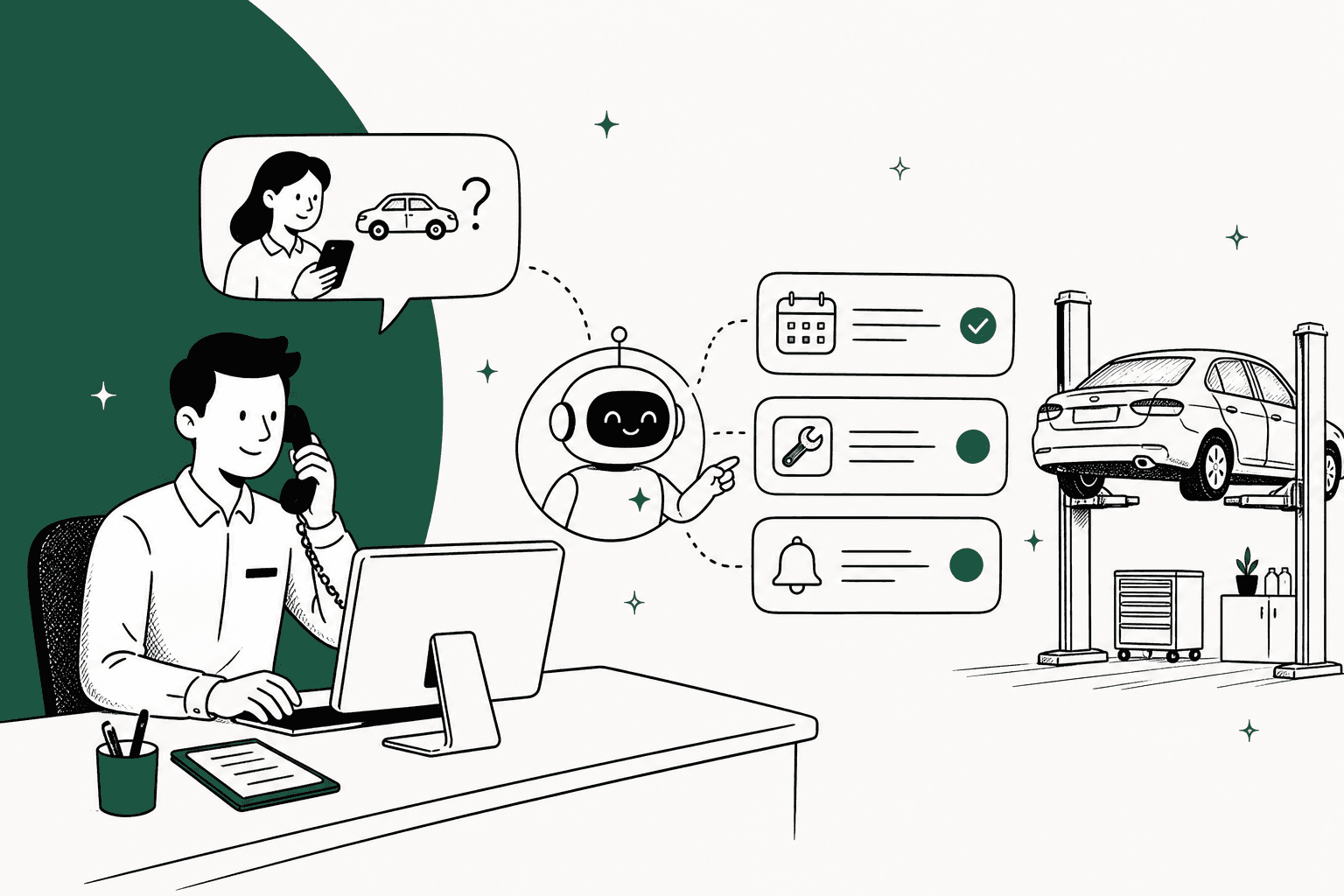
AI for automotive customer service works when you let AI book and answer from your own pages, let it report only the repair status the record confirms, and keep every money and safety call with a person. Booking or moving a service, hours, loaner rules, parts stock and "which recalls cover my model" are safe for AI. "Is my car ready?", "why did my quote change?" and finance paperwork need the repair order or the deal file, so AI drafts and the advisor sends. Credit decisions, cost disputes, safety worries, warranty disputes and goodwill stay human.
Two facts most dealer AI pitches skip. NHTSA's public recall API works by make, model and year, so it can't tell you whether this particular car still needs the fix. And every dealer-specific AI tool I checked (Impel, Numa, CarAi, ShortLoop, Podium) is phone-first and quote-only.
The written side of the queue is where a helpdesk AI fits. eesel's AI helpdesk teammate runs this pattern inside Zendesk and Freshdesk: Swiftreg, a UK number plate seller, answers about 2,100 tickets a month from live order lookups and never reports a step a lookup hasn't confirmed. Plans start at $299 a month.
Why is a dealership service desk buried in "is my car ready?"
Because the answer lives in a system the customer can't see and the advisor is too busy to open. A service advisor juggles the drive, the techs, the parts counter and the phone at the same time, so every "any update?" message is an interruption with a lookup behind it. The dealer AI vendors put numbers on the phone side of it: Impel's Voice AI page says dealerships miss up to 40% of service calls at peak hours, citing a Car Wars study, and CDK's AIVA page puts unanswered service calls at 20%.
I work a support queue every day, so before writing this I asked ChatGPT the question a dealership customer service manager would ask: we're buried in calls and messages about appointments, repair status, recalls, financing and parts, what can AI handle and what stays with a person? It read about a dozen dealer AI vendor case studies and the NIST AI framework, and came back with a sensible split. What it didn't do was tell that manager what the AI is allowed to say when it can't see the repair order, or what the recall lookup it recommended can and can't tell you. That's what this guide covers.
Advisors say it plainly. One service advisor on Reddit explained why they push customers to written updates instead of calls:
"I'll answer their email within 5 minutes, but if they call me, it might distract me from whatever im working on, and then I'll be serving 2 customers badly."

That's the case for putting AI on the written queue first: the email and text threads are where customers already accept a short wait, and where a draft from the record saves the advisor a phone call.
The pattern I see most is that the questions are simple and the answers are scattered. Hours and loaner rules sit on the website. Appointment slots sit in the scheduler. Repair status sits in the repair order inside the dealer management system (the DMS, the software that runs the dealership). Recall status sits with NHTSA and the manufacturer. Finance sits in the deal file. An AI can only be as good as the one it's connected to, which is why the split below is about where the answer lives, not how hard the question sounds.
What can AI answer, what should it draft, and what stays with a person?
Sort every message by one question: can AI read the exact answer somewhere you trust, and does it involve money, safety or a dispute? If the answer is on a page you wrote, AI answers. If it's in a record that changes by the hour, AI drafts from that record and the advisor sends. If it's a decision about money or a car that might not be safe, a person owns it.
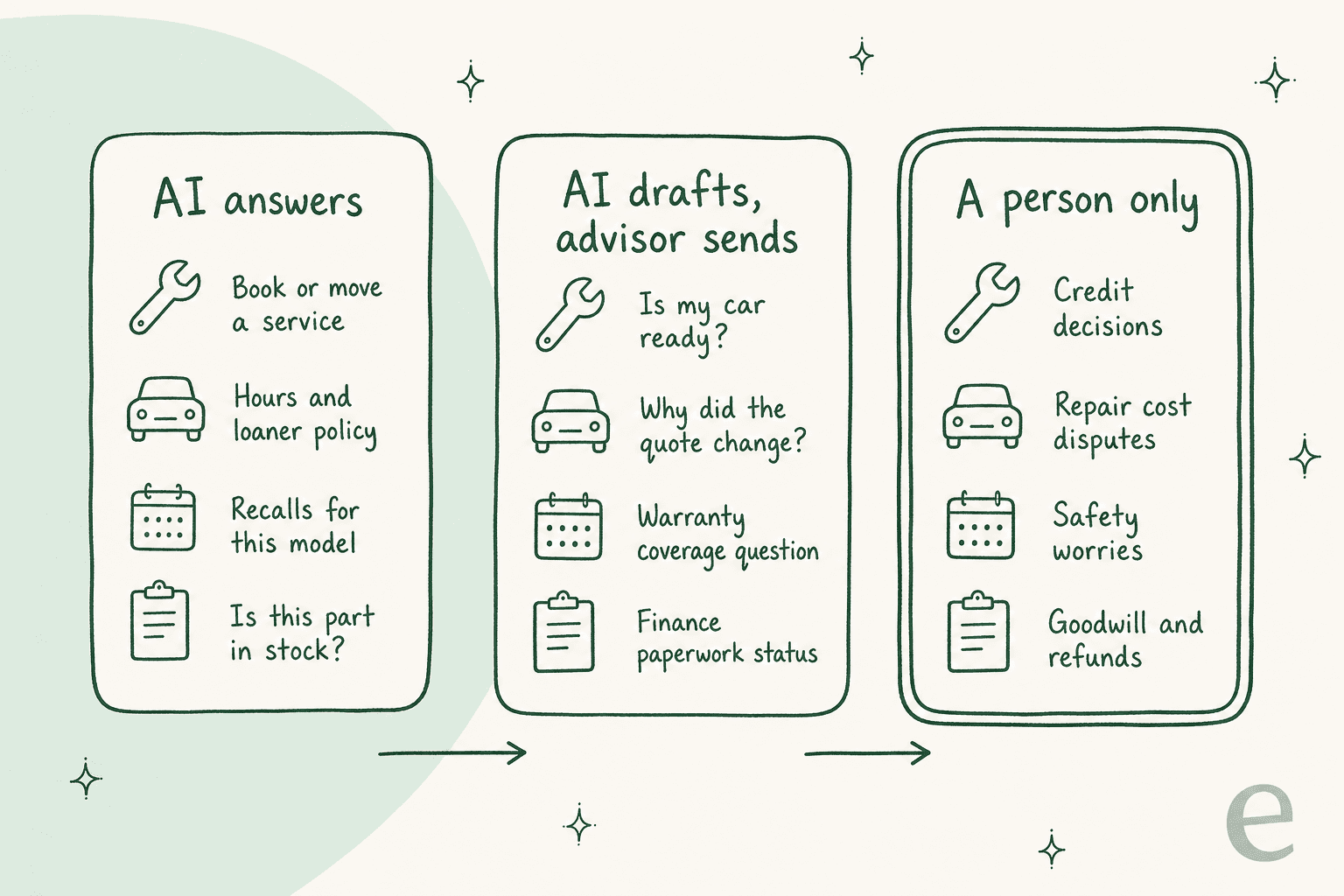
Here's how that plays out across the five topics ChatGPT and every dealership I've read about agree fill the queue:
| Topic | AI answers on its own | AI drafts, advisor sends | A person only |
|---|---|---|---|
| Service appointments | Book, move or cancel a slot, what a service includes, hours, shuttle and loaner rules | Requests that need a tech's judgement ("strange noise, how long will it take?") | Anything the customer says feels unsafe to drive |
| Repair status | Only what the repair order shows right now, if AI can read it | "Is it ready?" and "why the delay?" when AI can't read the record | Delays that need an apology, a loaner or a discount |
| Recalls | Which recalls exist for a make, model and year, how to check a VIN, how to book the fix | "Does my car still need this?" with the dealer's own record pulled in | Safety worries, "park it" recalls, cars already on the road with a problem |
| Financing | The process, documents to bring, where to apply | Paperwork status and missing documents, from the deal file | Approvals, denials, rates, payoff disputes |
| Parts | Stock and price from the parts system, order status | Fitment questions on unusual models | Substitutions, special orders, warranty parts disputes |
The right-hand column isn't there because AI writes badly. It's there because those messages are where a wrong answer costs someone money or puts them in a car that shouldn't be driven. Every dealer AI vendor I checked draws the same line in practice: according to the vendor research I pulled, their AI books and reschedules, answers routine questions and runs outreach, and CarAi explicitly doesn't negotiate prices or discuss financing. My piece on AI escalation management has more examples of phrases that should route a message to a person.
Two lanes hide inside friendly-looking messages. "Quick question about my bill" can be a cost dispute, which a person should own from the first reply. And "is it safe to drive until Tuesday?" sounds like a scheduling question but is a safety call. Route on the words, not the topic, and send angry messages to a person too, as my guide to AI for complaints explains.
Try it on a few real-sounding messages:
Pick a message from a dealership inbox
Lane: AI answers
AI reads: your scheduler's open slots and the service menu.
AI does: offers Saturday times at the right rooftop, moves the booking, confirms by the customer's channel.
Person: not needed.
Lane: AI answers
AI reads: NHTSA's recalls by make, model and year, plus your recall page.
AI does: lists the recalls for that model, explains that the fix is free, links the VIN lookup and offers to book the inspection.
Person: if the customer describes a symptom or the recall says not to drive.
Lane: AI answers
AI reads: the parts catalogue and stock count.
AI does: confirms fit for that model year, gives the price and pickup options.
Person: only for an unusual trim or an aftermarket question.
Lane: AI drafts, advisor sends (or answers, if connected)
AI reads: the repair order, if your DMS allows a lookup.
AI does: reports the stage the record shows, nothing further along. Without a lookup, it drafts an internal note asking the advisor.
Person: owns any new pickup time and any delay apology.
Lane: AI drafts, finance sends
AI reads: the document checklist, and the deal file if connected.
AI does: drafts which documents arrived and which are missing.
Person: checks and sends. Says nothing about the decision.
Lane: A person only (cost dispute)
AI reads: nothing it should act on.
AI does: tags it, routes it to the service manager with the repair order number, tells the customer a person will reply today.
Person: explains the extra work, and decides on any goodwill.
Lane: A person only (credit decision)
AI reads: nothing it should act on.
AI does: routes it to the finance office. Never says approved, denied or why.
Person: the creditor sends the decision and any required reasons.
Why can't AI just tell customers their car is ready?
It can, but only if it reads the repair order, and only the stage the repair order shows. A repair isn't one status. It's checked in, diagnosed, waiting on the customer's approval, parts ordered, parts arrived, in repair, and ready. The classic AI mistake is reading "parts ordered" and saying "should be ready tomorrow", which is the next step along, not a fact.
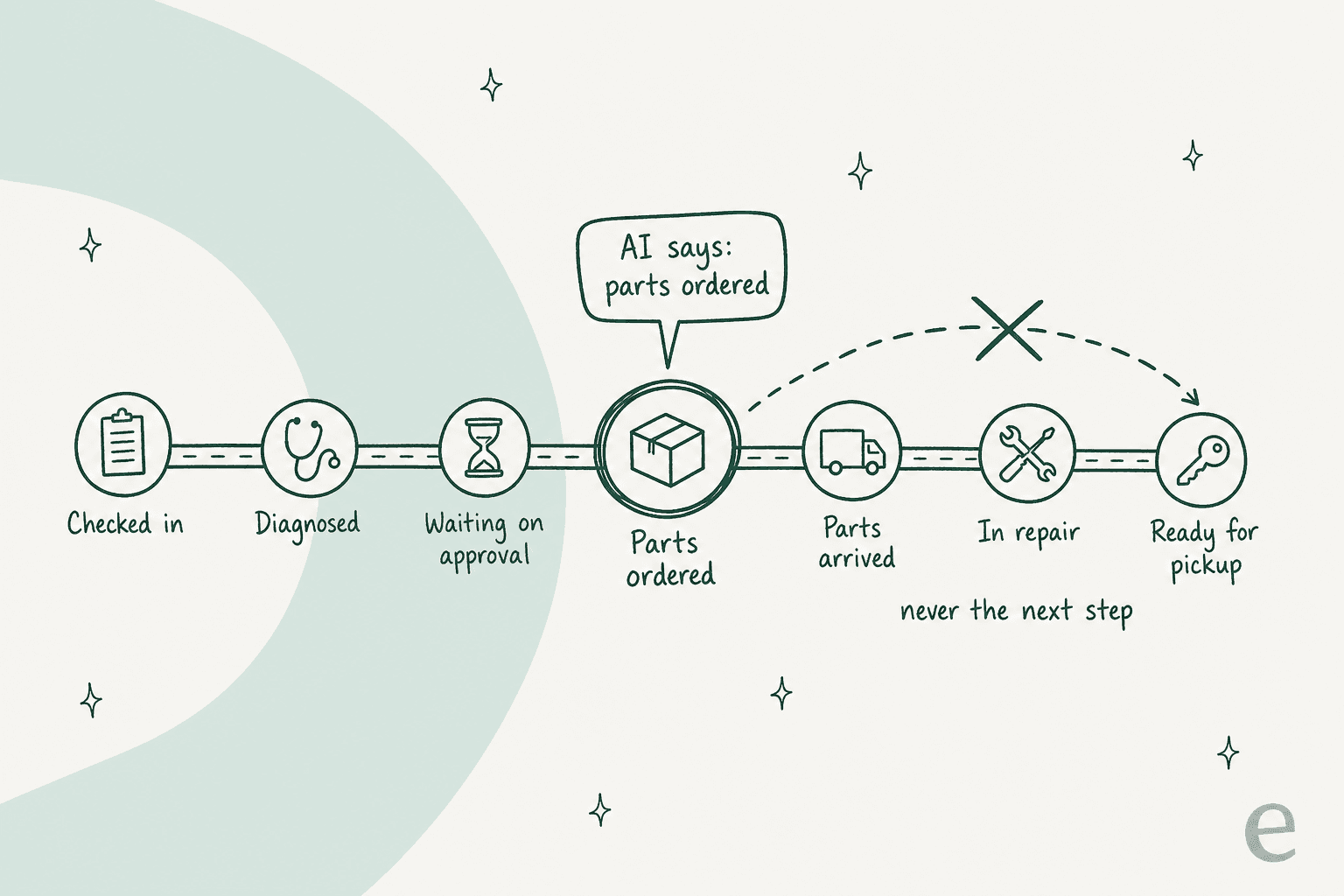
The best example I know of this rule in production isn't a dealership, it's a car-adjacent business. Swiftreg sells private number plates in the UK, where every sale runs through the DVLA transfer, the certificates, the V5C log book and the posted plates. Its team wrote the rule into eesel's instructions: a reply carries the status a lookup actually confirmed, never the next step along. In their words, requested is not processing, and offered is not issued. Order details only go to the verified account holder, and every public reply ends with a footer saying AI wrote it. Between 8 August and 8 September 2026, eesel handled about 2,100 Zendesk tickets for them, sent 1,494 public replies and left 1,055 internal notes where a step belonged to staff.
That's the shape a dealership needs. If the AI can read the repair order, it answers with the stage and nothing more. If it can't, it leaves an internal note for the advisor with the customer's question and the RO number, so the advisor answers without hunting for the record. Among the dealer vendors I checked, only Tekion and Numa mention giving customers repair status at all, which tells you how hard the DMS connection is in practice.
The other trap is the confident "yes". On one eesel sales call, a vehicle-telematics support team on Zendesk told the eesel team their bot had said "yes, we support your car model" for brands that weren't in their database, because the knowledge base said they supported all models. The fix was to give the AI the actual list. Dealership parts and accessories questions have the same risk: "does this fit my car?" should come from the parts catalogue, not from a marketing page that says "fits most vehicles". I wrote more about this in AI for order tracking, which has the same lookup-first logic.
Advisors who stay on top of this already do the AI's job by hand. One preloads status texts so nobody has to call:
"99% of people hate the idea of getting a phone call so I just preload texts to send at 8am and 4pm."
An AI connected to the repair order can send those same updates from the actual stage, at the same times, for every car on the lot.
Can AI check vehicle recalls for a customer?
Yes for the model, not for the specific car. NHTSA runs a public recalls API that takes a make, model and year and returns every safety recall for it. I tested it on a 2018 Honda Accord today and it returned six recalls, each with the campaign number, the component, a summary, the consequence and the remedy, plus flags for "park it" and over-the-air fixes. That's enough for AI to answer "is there a recall on my 2018 Accord?" well.
What it can't answer is "does my car still need it?". The API has no VIN parameter. NHTSA's own VIN lookup is the tool for that, and it's built for people, with a reCAPTCHA on the form. Even it has gaps by design: it doesn't show recalls already repaired, recalls more than 15 years old, recalls from some small and ultra-luxury makers, recent recalls where not every VIN is loaded yet, or non-safety service campaigns.
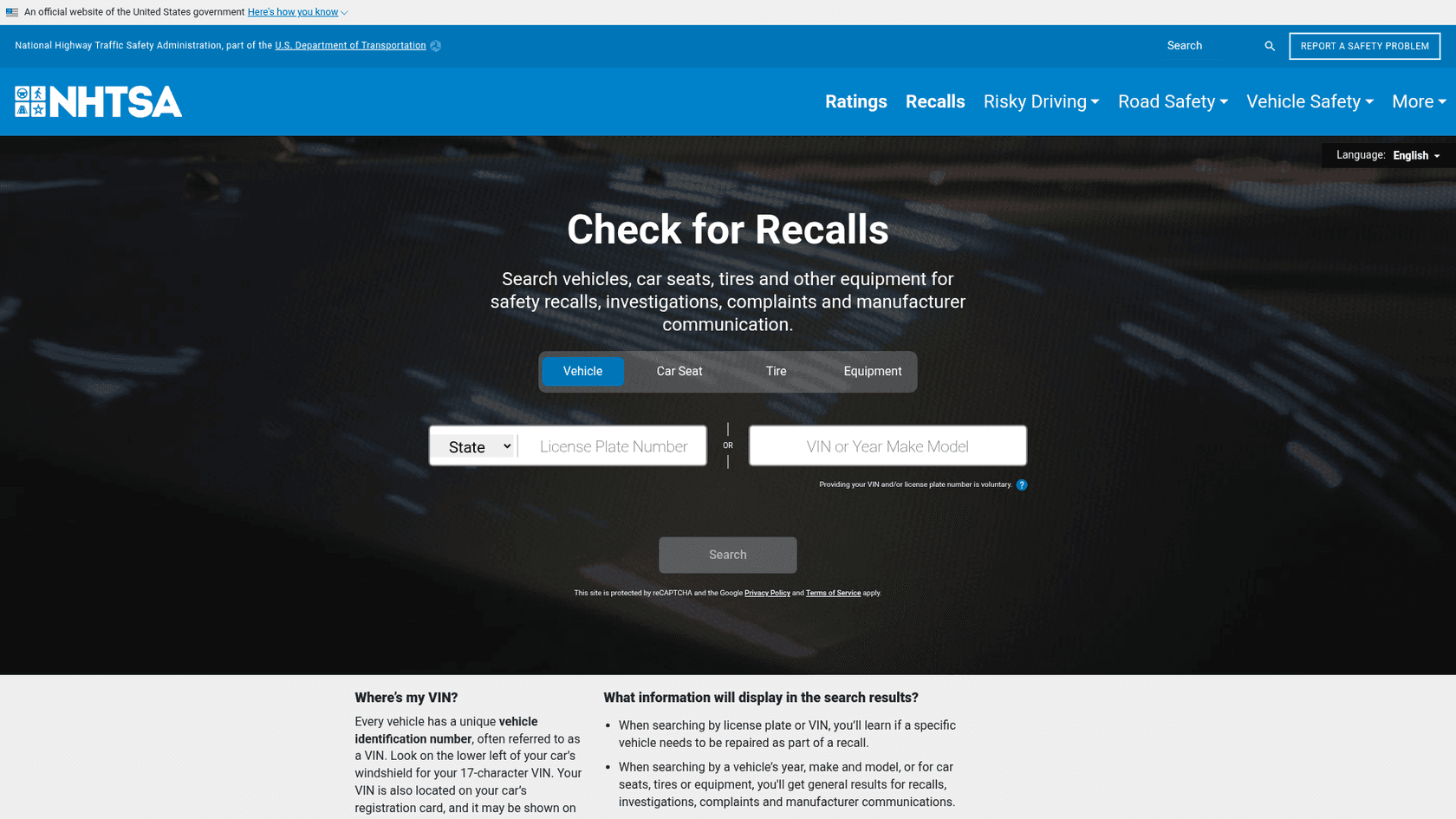
So the honest AI reply sounds like this: here are the recalls for your model year, the fix is free at a dealer, check your VIN here to see if your car still needs it, and I can book the inspection now. If the customer describes a symptom that matches a recall, or the recall carries a "park it" flag, that message goes to a person, today. My guide to AI for product recalls covers the wider pattern, including how to handle the spike when a big campaign lands.
What are dealer AI tools actually doing today?
Mostly answering the phone and booking service, the job an AI appointment setter does in any industry. I went through the product pages and published case studies of seven dealer-focused vendors. Every one leads with missed service calls, every one books appointments, and none publishes a price.
| Tool | Channels | DMS and scheduler connections | Price | Published customer result (vendor-reported) |
|---|---|---|---|---|
| Impel | Phone, SMS, email, chat | CDK, Reynolds, Dealertrack, PBS, Xtime, Tekion and others | Quote only | Murfreesboro Nissan: $110K in repair orders in 2 months |
| Numa | Phone, text, chat | CDK, Reynolds, PBS, Dealertrack, Tekion, Xtime | Quote only | Juneks CDJR: 70% AI booking rate vs 63% for staff |
| CarAi | Phone, text | PBS, Xtime, CDK | Quote only | Aurora Toyota: 331 calls, 72 bookings, 53% while closed |
| ShortLoop | Phone, text, email | Tekion, CDK, Reynolds, Xtime | Quote only | Corley Ford: 240+ AI bookings, 20% of service volume |
| Podium | Phone, text, chat, email | Xtime, Tekion, CDK, Dealertrack | Quote only | Billingsley Hyundai: 100% of calls answered |
| CDK AIVA | Phone, web chat, text | CDK's own scheduler | In the Fixed Ops Suite | None published |
| Tekion | Built into the DMS | Tekion's own DMS | Quote only | None tied to a rooftop |
A few things stand out. The results are real but vendor-reported, and the best ones measure bookings and revenue, not resolved questions. Impel's widely quoted stat, that customers who got AI messages were 27% more likely to complete a service appointment within 90 days, comes from its own study of 50 dealerships and compares AI outreach with no outreach at all, not AI with people. That's still useful. It just answers a different question from "will AI cut my advisors' message load?".
The second is that these tools are built for the phone and the booking. The written queue, meaning the email inbox, the web chat, the Facebook and SMS threads and the "contact us" form, usually lands in a helpdesk or a shared inbox that none of these tools read. Texts are their own channel too, covered in my SMS support guide. That's where a helpdesk AI layer earns its place: it works on the tickets you already have, in the tool your BDC or customer care team already uses. If phone is your bigger problem, a voice tool from the table above is the right first buy, and my voice agent guide covers what to check.
Phone AI also has a harder audience. Callers who wanted a person tend to say so loudly, and one advisor described their group dropping a phone tool for exactly that reason:
"My group dropped it after 90 days because all customers wanted to do was yell and cuss at it. Poor AI bot. He’d make a good advisor."
Other advisors on the same subreddit like AI for recall reminders, so the lesson isn't "AI fails on the phone". It's that inbound callers who already chose the phone are the hardest place to start.
Which rules apply to AI in automotive customer service?
Five rules shape what a dealership AI can say, and one big rule that dealers were bracing for is gone. None of them ban AI. They decide what it may say, who must consent, and who answers for the data.
Customer data: the FTC Safeguards Rule
US car dealers are covered by the FTC's Safeguards Rule, which names "motor vehicle dealers" alongside mortgage brokers and payday lenders. A breach involving the information of 500 or more consumers must be reported to the FTC within 30 days of discovery, a requirement that took effect in May 2024, per the FTC's amendment. The FTC's guide also asks for encryption in transit and multi-factor login for anyone accessing customer information, and says that when you bring in a service provider, "the buck still stops with you". Any AI vendor that reads repair orders or deal files is a service provider under that rule, so run it through your security review like any other.
Disclosure and consent: California's bot law and the FCC
California's bot disclosure law makes it unlawful to use a bot to mislead someone about its artificial identity to drive a sale. A clear, conspicuous disclosure that it's a bot is the safe harbor. A sales chat on a dealership website is the textbook case, so say "I'm an AI assistant" up front.
For calls, the FCC ruled in February 2024 that AI-generated voices count as "artificial" under the federal robocall law (the TCPA). Outbound AI calls need prior express consent, and written consent if they carry telemarketing. The FCC treats texts as calls for these rules. The stricter "one-to-one consent" rule from 2023 was vacated by the Eleventh Circuit in January 2025, so the older consent rules still apply.
Credit and warranty: what the AI must not say
Regulation B requires a creditor that denies credit to give specific reasons, and says "internal standards or policies" isn't enough, per 12 CFR 1002.9. That's a legal notice with required content, not a chat reply. Your AI should never tell a customer they were approved, denied or why.
Warranty is the other easy mistake, and I cover the claims side in AI for warranty claims. The Magnuson-Moss rule at 16 CFR 700.10 says a warranty can't depend on using only authorized service or parts for routine maintenance, and calls a "void if serviced elsewhere" clause deceptive. An AI trained on old marketing copy could say exactly that. Check your knowledge base for it before launch.
The rule that's gone, and the UK
The FTC's CARS Rule, aimed at dealer pricing and add-on practices, was vacated by the Fifth Circuit on January 27, 2025 because the FTC skipped a required advance notice step. The FTC's general ban on deceptive practices still applies to anything your chat says about prices. In the UK, the FCA's car finance compensation scheme covers agreements from 2007 to 2024, around 12.1 million of them, and is partly suspended pending a legal challenge due to be heard in February 2027, per the FCA. If you run UK rooftops, "am I owed money on my car finance?" is a question your AI should answer only with the FCA's own page and a handoff.
How do you set up AI on a dealership support inbox?
Start with the written queue, one rooftop, and a short list of things the AI must never do. Here's the setup I'd run, in order.

- Pull your top 20 questions. Export a month of tickets and messages and count them. My guide to AI for FAQ deflection shows how to sort them. In most service desks, booking changes, status chasers and recall questions fill the top five.
- Give each rooftop its own knowledge. Hours, loaner rules, service menus and contact names differ by store. Nordbutiker, a Swedish light electric vehicle retailer, runs one eesel bot per brand and country, each trained on its own store's pages and solved Zendesk tickets, with spare parts and warranty cases going to a person. A dealer group with five rooftops needs the same split, and a multilingual agent helps if your stores serve Spanish-speaking customers.
- Verify before you share a record. Repair status and finance paperwork go only to the customer on file. Match the phone number or email on the repair order before the AI says anything about a car.
- Write the never list. Never approve, deny or explain credit. Never promise a pickup time the record doesn't show. Never say a car is safe to drive. Never offer goodwill or a discount. smava, a German loan comparison site, runs eesel on about 27,000 Zendesk tickets a month this way: it drafts around 15,300 replies a month for a person to approve, and never sends a reply itself.
- Start with drafts, then let the safe lane answer. Run AI as a copilot for two weeks so advisors see every reply before it goes. Then let it answer bookings and recall questions on its own, and keep repair status and finance in draft mode. The implementation timeline guide has realistic dates.
- Test on past tickets before going live. Replay a few hundred real messages through the AI and compare its answers with what your team sent. My guide to simulation testing covers how many tickets per topic you need for a fair read.
Measure what changes for the advisors as well as what the AI handles: the share of messages answered without an advisor, time to first reply after hours, and how many "any update?" follow-ups you get per repair order. The pilot scorecard I use has the full list.
What does AI for automotive customer service cost?
You can't compare the dealer tools on price, because none of them publish one. Impel, Numa, CarAi, ShortLoop and Podium are all "get a quote", and CDK bundles AIVA into its Fixed Operations Suite. Expect a sales call and a per-rooftop quote, and use a vendor checklist to compare them.
Helpdesk AI is easier to price. eesel publishes its rates on its pricing page: a free plan with 100 credits, then fixed monthly plans where one ticket or chat is one credit however many replies it takes.
| Monthly tickets and chats | eesel plan | Price per month |
|---|---|---|
| Up to 100 (trial) | Free | $0 |
| 500 | 500 credits | $299 |
| 1,000 | 1,000 credits | $499 |
| 2,000 | 2,000 credits | $849 |
| 3,000 | 3,000 credits | $1,149 |
| 5,000 | 5,000 credits | $1,749 |
A worked example: a three-rooftop group getting 2,000 written messages a month pays $849, or about 42 cents a message, whether the AI answers it or drafts it for an advisor. Overage is off by default, and if you turn it on, extra credits are $0.80 each with a cap you set. If your phones are the bigger leak, budget for a voice tool too. My breakdown of AI vs human agent cost has the maths for comparing against another BDC hire.
Try eesel for your dealership inbox
eesel is an AI helpdesk teammate that joins the queue you already run in Zendesk, Freshdesk, HubSpot or Gorgias, plus SMS and Facebook Messenger. For a dealership, that means it answers booking, hours and recall questions from your own pages, drafts "is my car ready?" replies for advisors from the record, and routes finance, safety and cost disputes to a person with the context attached. It's the same pattern Swiftreg runs on 2,100 tickets a month: live facts win, nothing gets promised that a lookup didn't confirm, and every reply says AI wrote it.
You can try it free with 100 credits and see real drafts on your own tickets before you pay anything. Try eesel.