

Why SMS support is its own beast
Most "best AI support tool" roundups treat SMS as just another channel toggle. It isn't. Three things make text different from a website chat bubble or email:
- The reply window is tiny. People expect a text back in seconds, not the "we'll get back to you within 24 hours" grace email buys you.
- There's no UI to hide behind. No buttons, no carousels, no knowledge-base sidebar. Just words. The AI has to actually understand the question and answer it in plain language.
- Every message costs money to send. SMS runs over a carrier network (usually through a provider like Twilio), so each outbound text has a real per-message fee that a chat reply doesn't.
The good news is that texts are also the most automatable channel, because the questions are so repetitive. A huge share of SMS volume for ecommerce is WISMO, "where is my order", plus address changes, cancellations, and refunds. Those are exactly the tickets a well-trained AI agent can close end to end, as long as it can read your order data and knows when to back off.
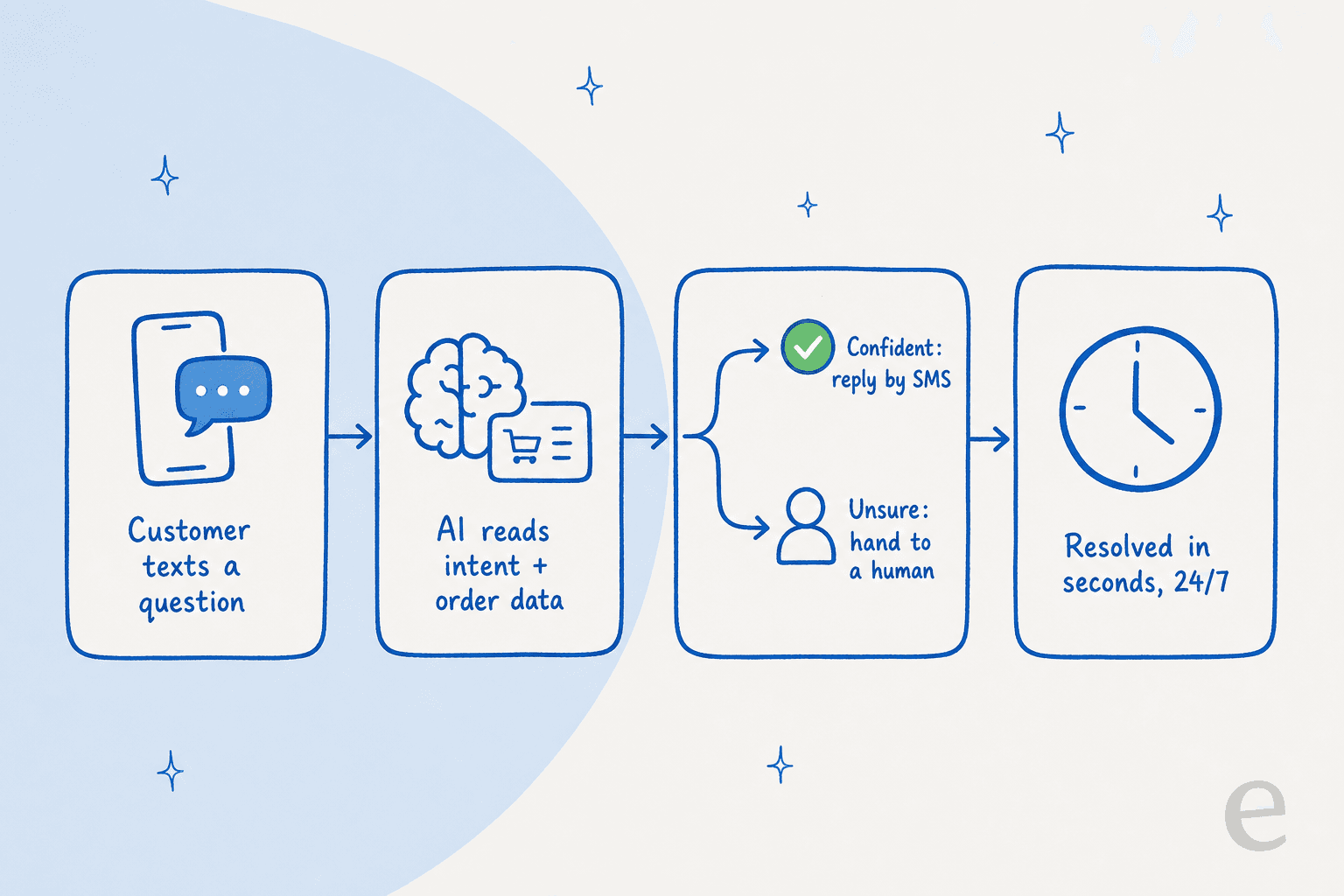
The flow above is the whole game: read the text, check intent against your order data and help docs, reply by SMS when confident, and quietly hand the messy ones to a human. The tools below differ mostly in how well they do that middle step, and what it costs you.
What I looked for
I judged each tool on the things that actually matter once a text comes in:
- Native SMS channel (or a clean path to one) vs. a bolted-on integration.
- AI quality on real questions, especially whether it has confidence-based routing so it doesn't guess.
- Order and account context, since most SMS tickets need it to be resolved.
- The real cost, both the AI billing model and the carrier fee underneath it.
- Setup effort, because a tool you can't roll out safely isn't worth much.
One quick note on method: this is grounded in each vendor's own docs, pricing pages, and product UI, plus public reviews, not a claim that I've personally run all eight in production for a year. Where a number comes from a vendor's marketing, I've said so.
The tools at a glance
| Tool | Best for | SMS channel | AI pricing model | Starting price | Standout |
|---|---|---|---|---|---|
| eesel | Adding AI to your existing helpdesk's SMS | Via your helpdesk + SMS integration | Usage-based, per ticket | $0.40 / ticket, no seats | Learns from past tickets; simulate before go-live |
| Gorgias | Shopify ecommerce brands | Native (SMS add-on) | Per resolved conversation | $10/mo + $0.90/resolution | Deep Shopify order actions |
| Zendesk | Mid-market & enterprise on Zendesk | Native (text/messaging) | Per automated resolution | $19/agent (AI from $55) | Mature platform, huge app marketplace |
| Salesforce | Enterprises on Salesforce | Native (Digital Engagement) | $2 / conversation | $25/user (Service Cloud) | Agentforce on full CRM data |
| Respond.io | Messaging-first B2C sales+support | Native (omnichannel) | Included (fair use), Growth+ | $79/mo (1k contacts) | Conversation-led, billed by contact |
| Trengo | EU teams wanting one messaging inbox | Native (usage-billed) | €0.25–0.30 / AI conversation | €299/mo (10 users) | WhatsApp + SMS in one inbox |
| Front | Collaborative teams, complex ops | Via Twilio/Dialpad | $0.05 / conversation (Autopilot) | $25/seat/mo | Best-in-class team collaboration |
| Kustomer | High-volume B2C / DTC at scale | Native (PAYG) | ~$0.60 / engaged conversation | Quote-only (~$89/seat) | Customer-timeline data model |
Now the detail, starting with the option most teams overlook because it doesn't ask them to switch helpdesks.
1. eesel
Best for: teams that want AI on their SMS support without leaving the helpdesk they already use.
Full disclosure: I help build eesel, so take my enthusiasm with the appropriate grain of salt, the facts below are all on eesel's pricing and product pages. The reason eesel belongs at the top of an SMS list isn't that it's another inbox. It's that it isn't one. eesel is an AI layer that plugs into the helpdesk already running your texts, Zendesk, Gorgias, Front, Freshdesk, and others, so you add AI to SMS without a migration.
The thing that makes me actually trust it on a channel as exposed as text is what I learned the hard way: I've watched confident-sounding bots quietly give wrong answers, which is why every eesel rollout is simulated against your historical tickets first. You see the AI's projected resolution rate by topic before a single live text goes out, then turn on autonomy gradually, starting with the questions it nails.
Features
- Learns from your past tickets, help docs, and macros on day one, so "years of history becomes knowledge," not a blank bot you have to script.
- Confidence-based routing: the AI only auto-replies to texts it's sure about and silently leaves the rest for a human, which is the single most-requested thing I hear from buyers.
- Simulation mode runs the AI over thousands of past tickets so you can see coverage and fill gaps before go-live.
- Connects to Shopify, order systems, and 100+ tools so it can answer WISMO and account questions with real data.
- 80+ languages out of the box, handled in the customer's language.
Pros
- No rip-and-replace, it works with the SMS channel you already run.
- The simulation step makes going live on text genuinely low-risk.
- Usage-based pricing with no per-seat fees.
Cons
- It's an AI layer, not a helpdesk, you need an underlying tool (or channel) to run the texts through.
- If you don't have past tickets yet, you lean more on help docs to start.
Pricing
eesel is usage-based: $0.40 per ticket or helpdesk conversation, no platform fee, no seats, no minimum. A regular ticket or chat session is $0.40; lighter lookups are free. There's a free trial with $50 of usage and no credit card. Because there are no seat fees, the cost scales with volume, not headcount, which suits a channel where one AI handles a lot of repetitive texts.
My take: if you already have a helpdesk and just want AI handling your texts safely, this is the lowest-friction path on the list. It's the only option here that doesn't ask you to migrate, and the simulation-first approach is built exactly for a channel where a wrong answer is costly. If you don't have a helpdesk yet, pick one of the all-in-one tools below and layer eesel on later.
2. Gorgias
Best for: Shopify and ecommerce brands where most texts are order-related.
Gorgias is the ecommerce-native helpdesk, and its whole pitch is that orders, customers, and store data live inside the ticket. For SMS that's a real advantage, because the texts you get are mostly WISMO, refunds, and order edits, and the Gorgias AI Agent can do those actions inside the conversation. It claims to power conversations for 40% of Shopify brands and serve 15,000+ stores, per its pricing page.
The community sentiment lines up with that positioning. As one operator put it in a Reddit thread on helpdesk choice:
"If a meaningful chunk is WISMO, address changes, cancels, refunds, exchanges, Gorgias usually feels worth it because the agent can do the work inside the ticket with Shopify context right there."

SMS and voice are sold as add-on channels rather than being in the base plan, so factor that in. If Gorgias isn't the right shape for you, I keep a roundup of Gorgias alternatives.
Features
- AI Agent pre-trained on 1B+ ecommerce conversations; handles returns, refunds, order edits, and product questions.
- Native Shopify, BigCommerce, Magento, and WooCommerce actions inside the ticket.
- Omnichannel inbox: email, chat, social, plus SMS and voice as add-ons.
Pros
- Best-in-class Shopify order context for resolving texts.
- AI can take real actions (refund, cancel, edit) inside the conversation.
- Ticket-based pricing instead of per-seat.
Cons
- Pricing climbs fast at volume; one Reddit reviewer notes it "adds up quick once your volume grows."
- SMS is an add-on, not included in the core plan.
Pricing
Ticket-based plans: Starter from $10/mo (50 tickets), Basic $50/mo (300), Pro $300/mo (2,000), Advanced $750/mo (5,000). The AI Agent is a usage add-on at $0.90 per resolved conversation on annual plans ($1.00 monthly), and each AI interaction also counts as a billable ticket. See the Gorgias AI breakdown for the full picture.
My take: if you're a Shopify brand and a real chunk of your texts are order actions, Gorgias is the most natural fit on this list. Skip it if your support is mostly conversational or you're not on a supported ecommerce platform, you'd be paying an ecommerce premium for features you won't use.
3. Zendesk
Best for: mid-market and enterprise teams already standardized on Zendesk.
Zendesk runs SMS natively as part of its messaging stack, and it has leaned hard into AI with what it now calls the "Resolution Platform," including the Forethought-powered self-improving AI agents. It's a mature, deeply integrated platform with an 1,800+ app marketplace, and it claims up to 80% automation with its AI agents. If you're already on Zendesk, adding AI to your text channel is a configuration job, not a migration.
The thing to watch is the pricing model, which is layered and easy to under-estimate. For a deeper look at what the AI actually does, I wrote a guide to Zendesk AI agents and a review of its real impact.
Features
- Native SMS/text and omnichannel messaging in one platform, see the Zendesk SMS channel guide.
- AI agents and Copilot across channels, plus QA scoring on AI and human replies.
- Enterprise governance: intelligent triage, approval workflows, sandbox.
Pros
- Battle-tested at scale with a huge ecosystem.
- Native SMS plus genuinely capable AI agents.
- Strong analytics and QA tooling.
Cons
- Billing stacks up: seat price, plus per-resolution AI, plus $50/agent add-ons.
- The entry $19 plan includes no AI at all.
Pricing
Seat-based, billed annually: Support Team $19/agent, Suite Team $55/agent (where AI agents first appear), Suite Professional $115/agent. AI agents are billed separately per Automated Resolution on top, and key add-ons like Copilot run $50/agent/mo. Worth modeling carefully, the Zendesk licensing explainer helps.
My take: if Zendesk is already your system of record, its native SMS plus AI agents are a solid, low-disruption choice. Just budget for the full stack, not the $19 headline. Teams who find the native AI underwhelming or overpriced often layer eesel on top of Zendesk instead of paying for every add-on.
4. Salesforce Service Cloud
Best for: enterprises running support on the Salesforce platform.
Salesforce handles SMS through its Digital Engagement / messaging layer, and its AI story is now Agentforce, autonomous agents built on the Atlas Reasoning Engine that act on full CRM data. For an enterprise that already runs everything on Salesforce, an AI agent that can see the entire customer record while answering a text is genuinely powerful. Salesforce cites a Valoir report claiming 16x faster agent delivery and a 75% accuracy increase with Agentforce versus a DIY build.
The flip side is cost and complexity, which is why I wrote is Agentforce worth the cost and a full Agentforce pricing breakdown.
Features
- Agentforce AI agents grounded in Customer 360 / Data 360 data.
- Native messaging including SMS via Digital Engagement.
- Trust Layer for data masking and zero-retention; MCP support.
Pros
- Unmatched depth of CRM context for resolving complex texts.
- Agentic AI built into the platform you already run.
- Enterprise-grade governance and security.
Cons
- Expensive and complex to stand up; not a quick rollout.
- Pay-per-conversation AI billing adds up at SMS volume.
Pricing
Service Cloud editions run Starter $25, Pro $100, Enterprise $175, Unlimited $350 per user/month. Agentforce is consumption-based: $2 per conversation, or Flex Credits at $500 per 100k, with Salesforce Foundations as a $0 entry point. If the price tag stings, the Agentforce alternatives post covers lighter options.
My take: the right pick if you're a large Salesforce shop and the CRM context is the point. For everyone else, the setup cost and per-conversation AI billing make it heavy for what is, on SMS, mostly repetitive WISMO traffic.
5. Respond.io
Best for: messaging-first B2C teams blending sales and support across channels.
Respond.io is a WhatsApp-first omnichannel inbox that also handles SMS, Instagram, Messenger, and more in one thread, with AI Agents layered on to qualify leads, recommend products, and route conversations. It bills by Monthly Active Contacts rather than per seat, which fits high-volume B2C, and its live counter shows over 2.2 million conversations handled by its AI Agents. It's rated 4.8 on G2 across 400+ reviews, per its pricing page.
It leans more toward conversational commerce than deep ticketing, so it's strongest where support and sales blur together over messaging.
Features
- Omnichannel inbox: SMS, WhatsApp, Instagram, Messenger, email, voice.
- Multimodal AI Agents with guardrails, RAG from your knowledge, and human takeover.
- Billed by active contacts, with AI included under fair use on Growth+.
Pros
- One thread per customer across every messaging channel.
- AI usage included rather than metered per resolution.
- Contact-based billing suits high-volume B2C.
Cons
- More sales/CLG-focused than a traditional support helpdesk.
- WhatsApp-first; SMS is one channel among many, not the headline.
Pricing
By Monthly Active Contacts: at 1,000 contacts, Starter $79/mo, Growth $159/mo, Advanced $279/mo. AI Agents require Growth or above, included at no extra cost under fair use; SMS/carrier fees bill separately. A 7-day free trial covers Growth features.
My take: a great fit if your customers already message you and support blends into sales. If you run structured, high-volume ticket support with SLAs, a dedicated helpdesk (or an AI layer on one) will serve you better.
6. Trengo
Best for: European teams that want WhatsApp and SMS in one AI-assisted inbox.
Trengo is an AI-first omnichannel inbox, strongest in ecommerce, travel, and hospitality, that unifies WhatsApp, email, chat, voice, and SMS. Its AI Agents claim to resolve up to 80% of repetitive conversations in 70+ languages, and it's an official WhatsApp and Meta Business Partner, trusted by 9,000 businesses per its pricing page. It holds a 4.3/5 on G2 across 246 reviews.
The recurring knock is pricing stability. One Capterra reviewer flagged a steep jump:
"[A] 300% increase" in pricing, with the structure described as "extremely unstable."

A Reddit user also paired a pricing gripe with the mobile app "glitching," so it's worth a close read of the contract before committing.
Features
- Omnichannel inbox: WhatsApp, SMS, email, chat, voice, social.
- AI Agents plus no-code AI Journeys for multi-step automation.
- Official WhatsApp/Meta Business Partner.
Pros
- WhatsApp and SMS genuinely well unified in one inbox.
- AI bundled into all plans (metered by surcharge).
- Strong fit for EU ecommerce and travel.
Cons
- Reviewers report frequent, steep pricing changes.
- AI surcharge per conversation adds an extra cost layer on SMS.
Pricing
Quoted in EUR: Boost €299/mo (10 users, 6,000 conversations/year), Pro €499/mo (20 users, 18,000/year), Enterprise custom. AI is included but metered by a €0.25–0.30 surcharge per AI-handled conversation, and SMS/voice are usage-billed on top.
My take: worth a look if you're EU-based and WhatsApp plus SMS in one inbox is the priority. Go in clear-eyed on the pricing volatility, and model the AI surcharge plus carrier fees together, not just the plan price.
7. Front
Best for: collaborative teams handling complex, multi-department support.
Front is a collaborative shared inbox built for complex customer operations that span teams, not simple FAQ deflection. It runs SMS through Twilio or Dialpad, and its AI command center, Autopilot plus Copilot, is designed to handle more than the low-hanging fruit, with a claim it can resolve up to 70% of requests. Front reports a 428% average ROI and 97% CSAT on its pricing page, and it's trusted by 9,300+ companies.
Where Front shines is collaboration, internal comments, shared drafts, and handoffs that don't get lost. If your texts often need a second person's input, that matters. If Front isn't a fit, I cover Front alternatives.
Features
- Collaborative shared inbox with comments, shared drafts, and assignments.
- SMS via Twilio/Dialpad; omnichannel on Professional and above.
- Front AI: Autopilot agent, Copilot, Smart QA, Smart CSAT.
Pros
- Best-in-class team collaboration on conversations.
- Flexible AI add-ons you can scope to your needs.
- Clean omnichannel once you're on Professional+.
Cons
- SMS depends on a third-party connection (Twilio/Dialpad).
- AI is mostly add-on pricing on lower tiers.
Pricing
Seat-based, billed annually: Starter $25/seat (single channel type), Professional $65/seat, Enterprise $105/seat. AI is largely add-on: Autopilot from $0.05/conversation, Copilot $20/seat/mo, with everything bundled into Enterprise.
My take: Front is the pick when support is a team sport and conversations need collaboration, not just deflection. Just remember SMS rides on Twilio/Dialpad here, so it's a couple of connections to wire up rather than a native channel.
8. Kustomer
Best for: high-volume B2C and DTC brands that want AI on a full customer timeline.
Kustomer is an AI-native CX platform built around a customer-centric data model: every text is tied to a complete customer record, order history, loyalty tier, past conversations, rather than an isolated ticket. Its AI suite, led by Concierge, handles end-to-end self-service across chat, email, SMS, WhatsApp, and voice. Kustomer cites results like 70% of chat conversations fully automated at Vuori. For more, see the Kustomer AI review.
The honest caveats: pricing is quote-only and steep, and reviewers flag a complex UI. Note the rating gap too, Kustomer advertises a 5.0 from 500+ G2 reviews on its homepage, but the actual G2 aggregate is 4.4/5 from 555 reviews.
Features
- Concierge AI for end-to-end resolution across SMS, chat, email, WhatsApp, voice.
- Unified customer timeline so the AI answers with full context.
- Architect (no-code AI builder) with native MCP support.
Pros
- The timeline data model gives the AI rich context on every text.
- Strong fit for high-volume DTC and marketplaces.
- Native SMS plus a genuinely capable AI agent.
Cons
- Quote-only pricing with a high seat floor and 8-seat minimum.
- Reviewers cite a complex UI and a buggy voice channel.
Pricing
Quote-only, every path routes to sales. Competitor-teardown research (flag as directional) puts it around $89–$139/seat/mo annual with an 8-seat minimum, plus AI billed separately at roughly $0.60 per engaged conversation and $40/user/mo for agent-assist. SMS and voice are pay-as-you-go on top. The Kustomer pricing guide digs in, and I list Kustomer alternatives too.
My take: compelling for large B2C brands where the unified customer record is worth the price and the setup. For smaller teams, the seat floor and quote-only model make it hard to justify over a usage-based option.
How to actually choose
Strip away the logos and the decision comes down to your starting point. This is the map I'd hand a friend:
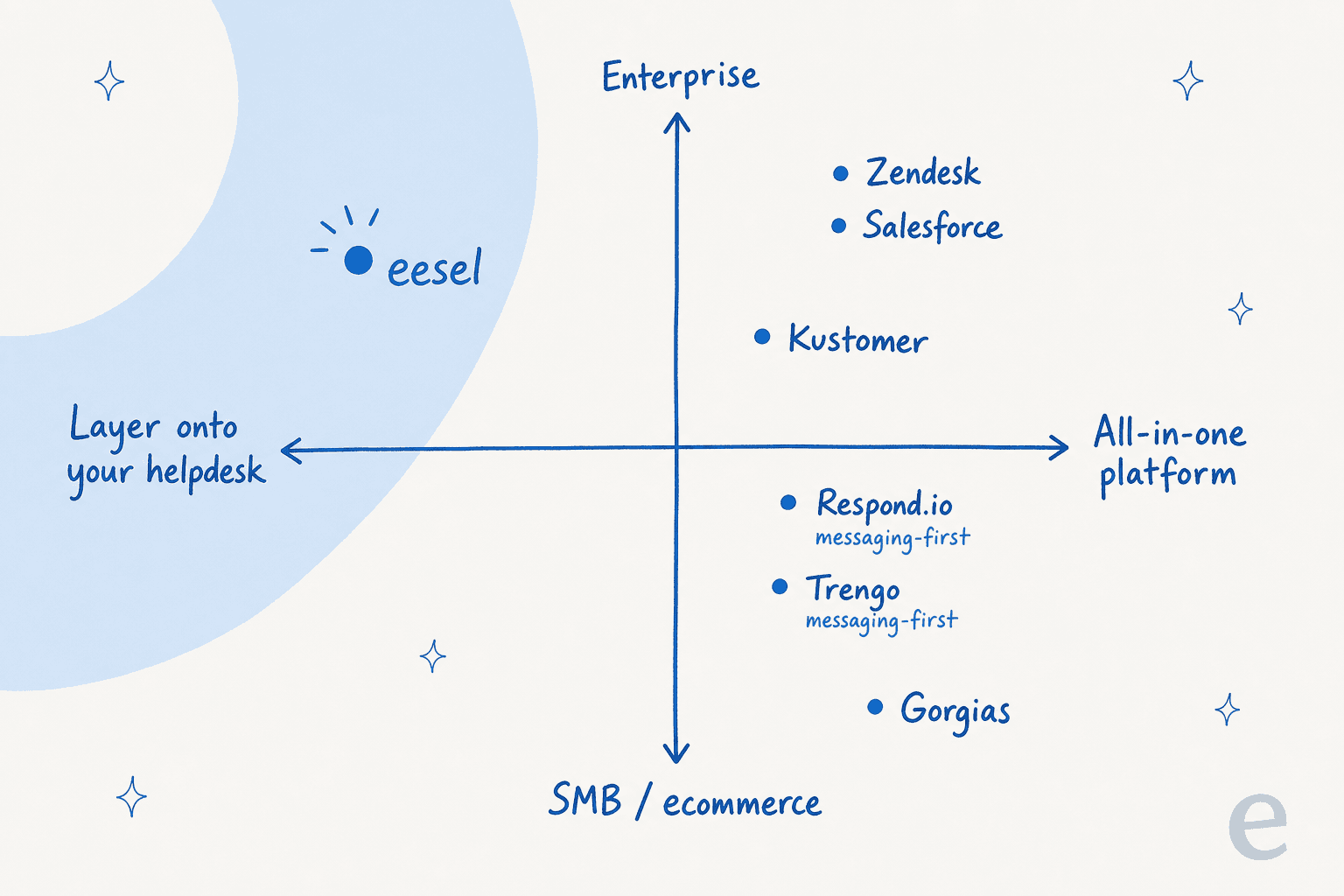
- Already on a helpdesk you like? Layer AI on top instead of switching. That's the eesel lane, and it sidesteps a migration entirely.
- Shopify ecommerce? Gorgias, for the order context.
- Enterprise on Zendesk or Salesforce? Use their native AI agents; you've already paid for the platform.
- Messaging-first B2C? Respond.io or Trengo, where SMS sits alongside WhatsApp.
- Collaboration-heavy support? Front.
Don't forget the carrier cost
Here's the line item that ambushes teams: SMS isn't free to send. Every tool above adds an AI cost on top of a carrier fee, and the carrier fee is the part chat-only tools don't have.
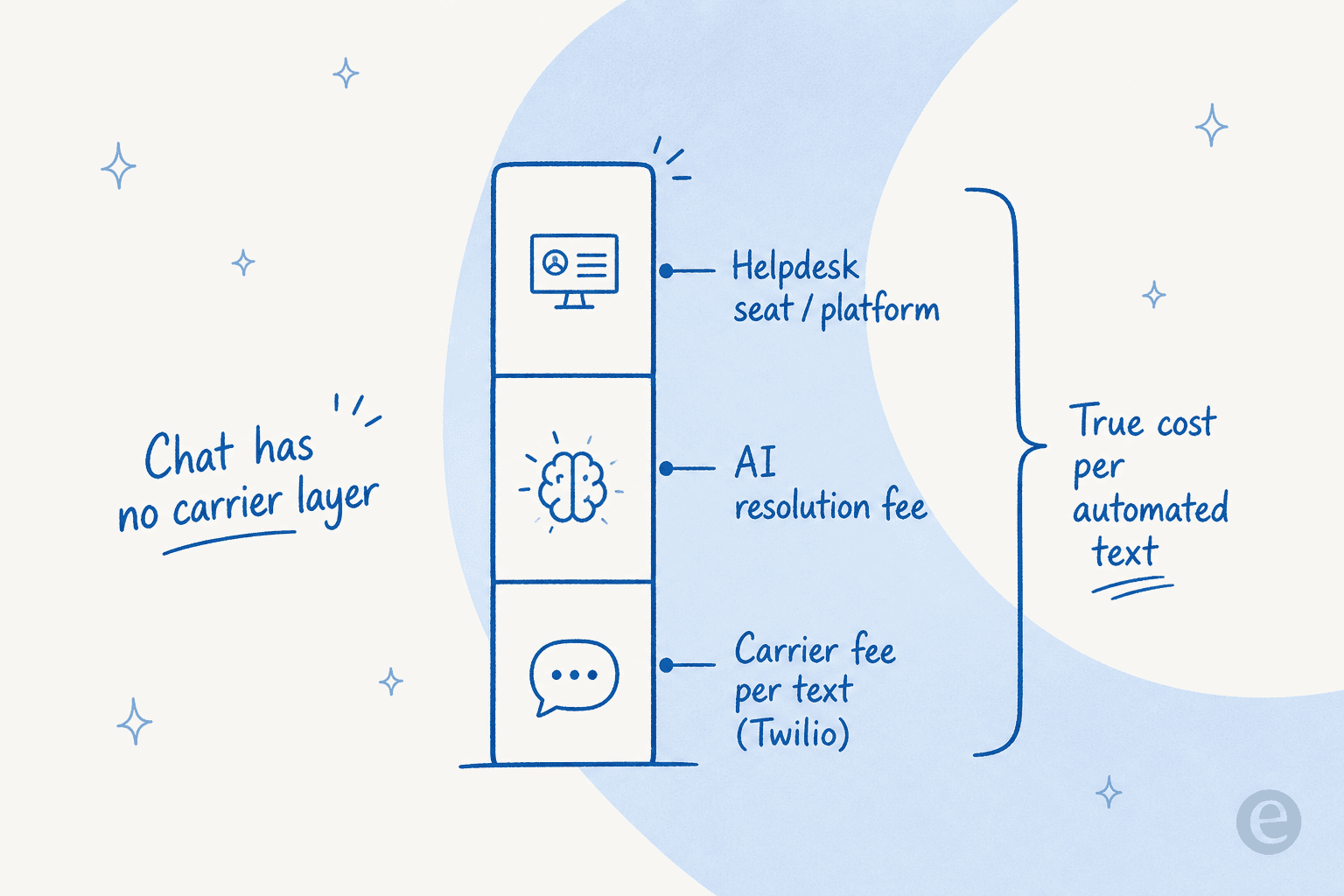
So when you compare a $0.90-per-resolution model against a $2-per-conversation model against eesel's $0.40 per ticket, remember the carrier fee sits under all of them. The cheapest AI model wins more decisively once you stack the per-text cost on top, because that fee multiplies across every automated reply. It's worth running the real math, the cost-savings guide and AI vs human cost comparison both help.
Try eesel for AI on your SMS support
If the takeaway you're landing on is "I don't want to migrate just to put AI on my texts," that's exactly the problem eesel was built for. It connects to the helpdesk already running your SMS, learns from your past tickets, and only auto-replies to the texts it's confident about, so you get automation on the most exposed channel you have without betting your CSAT on a bot's first guess.
The part I'd point you to first is simulation mode: run the AI over thousands of your real past texts and see its projected resolution rate by topic before it sends anything. In the first month, eesel resolved 73% of tier-1 requests for Gridwise, with results landing during a 7-day trial. You can connect your stack and run that same simulation free, with $50 of usage and no credit card. Try eesel.
Frequently Asked Questions
What is the best AI for SMS support in 2026?
How much does AI for SMS support cost?
Can AI answer text messages from customers automatically?
Do I need a separate tool to add AI to SMS support?
Is AI safe for SMS, where customers expect fast, accurate replies?


Article by
Rama Adi Nugraha
Rama is a software engineer at eesel AI with two years of experience writing about B2B SaaS, AI tools, and customer support technology. Based in Bali, Indonesia, he brings a developer's perspective to product comparisons — cutting through marketing copy to what the integrations and APIs actually do.