


AI for airline customer service works best when you sort the storm-day inbox into lanes and let AI own only the lanes where the answer already exists in writing: delay and status questions, rebooking options, refund rules, and the steps to report a bag. Anything that moves money, judges a claim, or involves a medical need or a frightened passenger stays with a person.
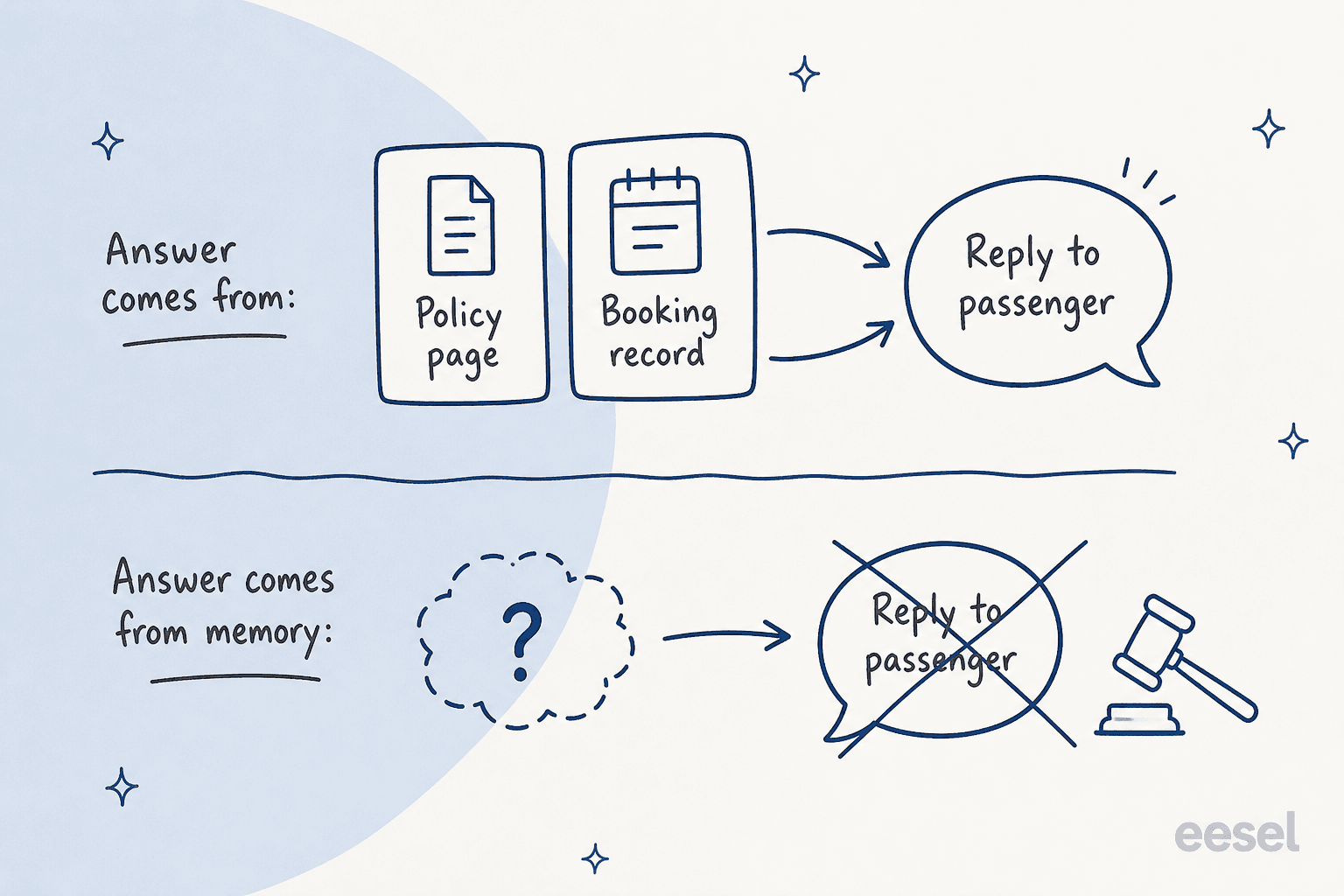
The law makes the line sharper than most teams expect. US airlines owe an automatic refund when they cancel or significantly delay a flight and the passenger declines the alternative, within 7 business days for a card purchase. A tribunal also ruled that Air Canada was responsible for what its chatbot told a grieving passenger. So the rule I'd give any regional carrier, charter operator or travel seller is: AI answers from your policy text and the booking record, never from memory.
I work eesel's support queue every day, and the AI helpdesk teammate I help support runs on live helpdesks, including a ferry line that scales it up for peak season. It drafts replies from your help center, leaves the send to your team on anything risky, and starts at $299 a month for 500 credits.
Why does one storm bury an airline inbox?
Because a cancelled flight does not produce one question, it produces five, and every passenger asks all five at once. "Is my flight still going?" turns into "Can I get on tomorrow's?", then "Can I get my money back?", then "Where is my bag?", and finally "What do you owe me?". Each question is a different lane with a different risk.
Big carriers answer this with agents wired into their reservation systems. Ryanair-sized budgets are not the situation I'm writing for. I'm writing for the regional carrier with a shared inbox, the charter operator whose flights get cancelled two days before a holiday, and the travel seller who sold the ticket but doesn't fly the plane. All of them take the same flood through a normal helpdesk, and all of them have the same week where the queue triples.
I should be upfront about where I'm standing. I have never run an airline's queue. I work the queue at eesel, where I see what a spike does to a team and which replies a person has to own, and I've read the primary sources for the rules below rather than a vendor summary. The shape of the problem is the same one I covered in my guide to AI for seasonal support spikes, with one big difference: in an airline inbox, a wrong answer can cost real money by law.
Which lanes can AI answer, and which stay with a person?
Seven lanes cover almost every storm-day message. Three belong to AI, two are drafted by AI and approved by a person, and the rest never leave human hands.
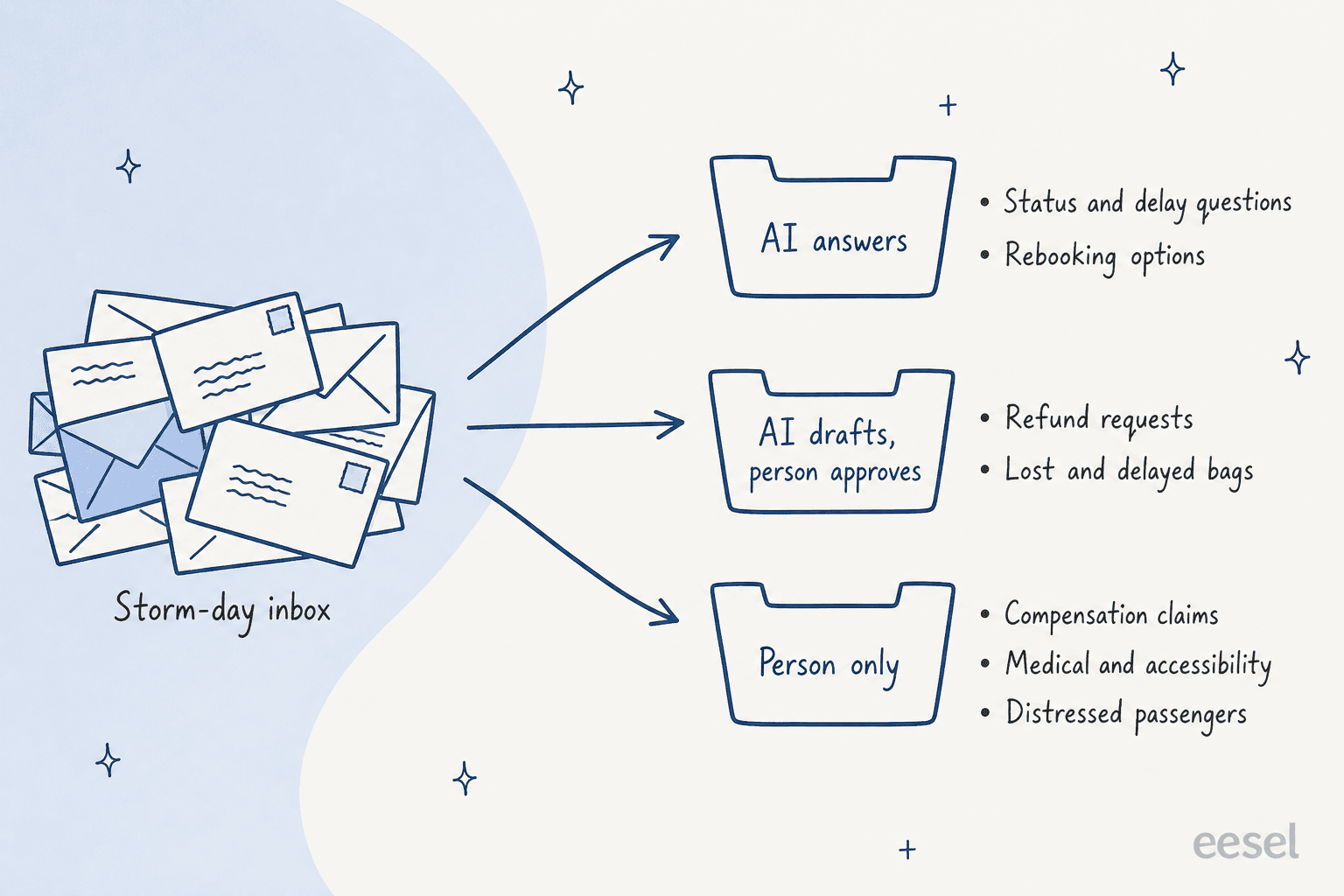
| Lane | What AI does | What it must read | Person takes over when |
|---|---|---|---|
| Status and delay questions | Repeats the latest approved notice and the next update time | One verified disruption notice | The question is about a specific booking you can't see |
| Rebooking options | Explains your rebooking and stand-by policy in plain words | Your policy page | The passenger needs a seat actually moved |
| Refund requests | States the rule and the deadline, drafts the reply | Policy plus the booking record | Any refund amount is confirmed or issued |
| Lost and delayed bags | Collects bag tag, flight and address, explains how to file the report | Baggage policy | The claim is decided or a bag is declared lost |
| Compensation claims | Acknowledges, logs, tags | Regulation summary on your site | Always, because the answer is a legal judgment |
| Medical and accessibility | Nothing, except an instant handoff | Nothing | Immediately |
| Distressed passengers | Nothing, except an instant handoff | Nothing | Immediately |
That last row matters more than it looks. Sentiment detection can flag the frightened or furious message, but the right reply to someone stranded with a child at midnight is a person, not a better-worded template. My guide on angry customers has the human side of that lane.
How should AI answer status and rebooking questions?
From one verified notice, written by your operations team, and nothing else. This is the same principle I laid out in my guide to AI for major incident communication: one record, every channel answers from it. For an airline that record has four fields: which flights are affected, what you know for sure, what passengers can do now, and when the next update comes.
The AI then rewrites that notice for each question. "Is the 14:20 to Bergen going?" gets the status from the notice. "Can I go tomorrow instead?" gets your rebooking policy, explained, followed by "a colleague will confirm your seat." It never picks the seat. It never says "should be fine".
The DOT is clear that rebooking is not the airline's legal duty in the US: it says that, although not required by DOT, airlines often offer to rebook, and when they do they must say the passenger is entitled to a refund if they don't accept. That last sentence is the one an AI reply must never drop. A rebooking message that leaves out the refund option is the quiet way a helpful-sounding reply becomes a compliance problem.
For a ferry line, the same split plays out every summer. Norden-Frisia runs an eesel agent called CaptAIn across Zendesk, its website chat and a public chat link, answering from 346 knowledge items (FAQs, macros and past tickets), and it's planned for up to 10,000 interactions a month in high season, scaling down from October to March. When a chat can't be closed, the agent creates a Zendesk ticket for the team. It isn't an airline, but a seasonal, timetable-driven passenger business with weather is close enough to learn from.
What do refund rules say, and what can AI safely state?
AI can state the rule. It should not decide whether the rule applies to this passenger. The rules differ by region, so I read them from the primary sources instead of a summary.
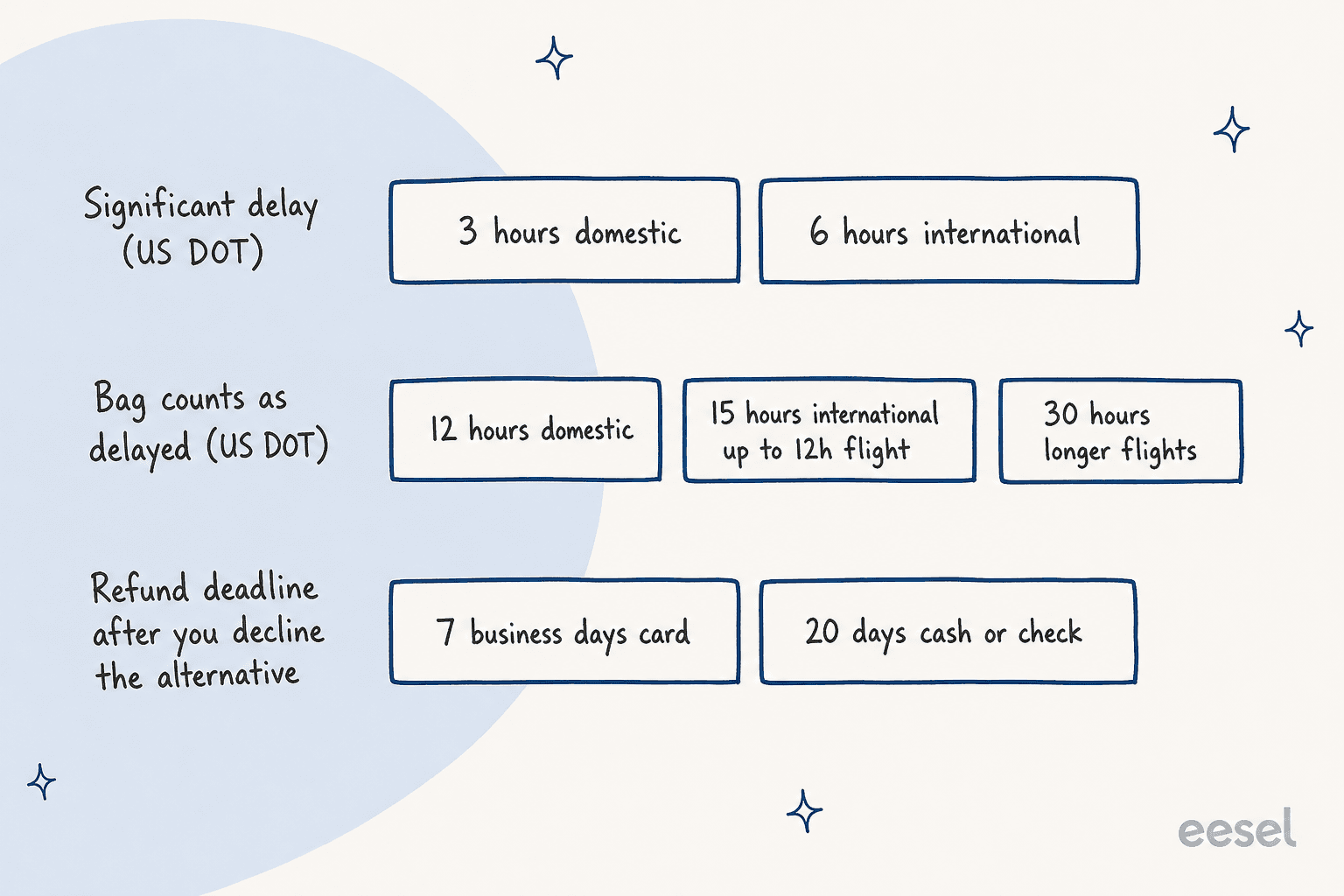
In the US, the DOT's refund page says a passenger is owed a refund of the ticket price if the airline cancels a flight for any reason, or significantly delays or changes it, and the passenger chooses not to travel or accept credits or vouchers. A significant delay means arriving 3 hours or more later domestically, or 6 hours or more later internationally. It is an automatic refund: the passenger shouldn't have to ask, and it is due within 7 business days for a credit card payment and 20 calendar days for other payment forms. The underlying 14 CFR Part 260 defines an automatic refund as one issued without waiting for an explicit request.
In the EU, Regulation 261/2004 gives a cancelled-flight passenger a choice between reimbursement within seven days or re-routing, plus free meals, refreshments and, where needed, a hotel (Articles 8 and 9). Cash compensation is EUR 250, 400 or 600 depending on distance (Article 7), but the airline doesn't owe it if it proves the cancellation was caused by extraordinary circumstances, and the recitals name weather conditions that make the flight impossible as an example.
Here is how I'd split the work:
- AI states: "If we cancelled your flight and you don't want the rebooked one, you're entitled to a refund to your original form of payment. For card purchases it is due within 7 business days." That sentence is on the DOT's own page.
- A person confirms: whether this booking qualifies, the amount, and anything involving vouchers or credits. The DOT says credits and vouchers offered instead of a refund must be valid for at least five years.
- Never automated by the AI: a weather call. "Is this extraordinary circumstances?" is a decision with money behind it, and the regulation puts the burden of proof on the carrier. A support agent, a duty manager or a legal team makes that call.
If you sell tickets rather than fly them, there is a wrinkle worth printing out. The DOT says ticket agents that are the merchant of record must make proper airfare refunds, but for bag fees and other optional services the passenger must ask the airline. An AI agent at a travel seller that tells every passenger "we'll refund everything" is making a promise the rule doesn't make.
The refund rules also rule out one popular design: the chatbot that says "please submit a refund request form". Where a refund is automatic, asking the passenger to ask is the wrong flow, which is a good reason to read how AI handles refund requests before you wire one up.
What happens when the AI gets a rule wrong?
You own the answer. In Moffatt v. Air Canada, a passenger booked flights after the airline's chatbot said he could apply for a bereavement fare retroactively within 90 days. The airline's own web page said the opposite. The tribunal sided with the passenger and rejected the idea that the bot was somebody else's responsibility:
"It should be obvious to Air Canada that it is responsible for all the information on its website. It makes no difference whether the information comes from a static page or a chatbot."
Air Canada was ordered to pay $812.02 in total: $650.88 in damages, $36.14 in interest and $125 in tribunal fees. The sum is small. The precedent isn't, because the tribunal also said it was not reasonable to expect a passenger to double-check a chatbot against another part of the same website.
Two habits fall out of that case:
- Keep one source of truth. If the bot and the policy page can disagree, one day they will. Train the AI on the same pages you publish, and when a policy changes, change it in one place. My guide to AI hallucination prevention covers how to keep an AI hallucination out of a reply.
- Make "I don't know" a normal outcome. An agent that hands over a ticket it can't answer from your text with a clear note is working correctly, not failing. That's what a good escalation looks like, and I've written about it in AI agent handoff best practices.
How should AI handle lost and delayed bags?
By doing the intake and leaving the decision. The DOT says a checked bag counts as significantly delayed if it isn't delivered within 12 hours of arrival on a domestic flight, within 15 hours on an international flight of 12 hours or less, and within 30 hours on a longer one. A passenger gets the bag fee back only if they file a mishandled baggage report with the airline, per the 14 CFR Part 260.5 rule that sets out the requirement.
That makes the first reply easy to automate and easy to get wrong. The AI should do these four things:
- Tell the passenger a mishandled baggage report is the step that protects their refund.
- Collect the bag tag number, flight, description and delivery address into the ticket.
- Say the fee refund and any expense reimbursement are decided by your baggage team.
- Tag the ticket so the team can route it to the right desk.
A small luggage retailer shows how that looks in a real queue. Koffer.ch sells suitcases and runs eesel on Freshdesk, and in its setup every reply is a draft. Damage and warranty claims get a draft asking for photos and order details, and the team decides. In one month it drafted replies for 60 tickets across 4 languages. That's a tiny number next to an airline's storm day, but the pattern, intake by AI and a decision by a person, is exactly the bag lane.
The handoff note matters as much as the reply. Timengo, a Danish software company on Freshdesk, has eesel leave an internal note for the engineer on every ticket with what it found, besides the draft reply. A baggage agent opening a ticket with the tag number, the flight and what the passenger was told is a much faster start than a blank thread.
What does the AI have to read to be useful?
Two things, and they are different problems. The first is your policy text: rebooking rules, refund rules, baggage thresholds, what you do and don't owe in a weather event. That's a knowledge base job, and an AI trained on a real help center and your past tickets does it well.
The second is the booking record, and I want to be straight about it. The answer to "is my refund approved?" sits in a reservation or payments system, not in a help center. eesel connects to your helpdesk, your knowledge sources and the tools you point it at, but I wouldn't tell an airline that an eesel agent can rebook a seat in a reservation system on its own. For a regional carrier today the practical setup is: AI handles everything the policy text can answer, and a person does the lookup and action for anything that needs the booking. That is a smaller promise than the big airline case studies make, and it's one you can keep.
If your passengers write on WhatsApp, by email and through a chat bubble, the same rule holds on every channel. Passengers expect an omnichannel answer that matches, and one policy source is how you get it. If you need replies in the passenger's language, my guide to a multilingual support agent covers it.
How do you try this before a storm hits?
Test on last year's worst day, not this year's. Take the tickets from your last big disruption and run them through the agent before it touches a live passenger. eesel's simulation skill replays past tickets and scores the agent's answers against what your team actually sent. It doesn't forecast a resolution rate or a cost, so treat the output as a list of gaps to fix, not a promise.
Then go in three steps:
- Draft mode on the answer lanes (week 1). The agent writes replies for status, rebooking policy and refund rules, and a person sends every one. Read the drafts and fix the policy page where the agent gets it wrong, because the fix belongs in the source, not in a patch.
- Auto-send on the narrowest lane (week 2). Let it send only delay-status replies that quote the approved notice, with an approval workflow in place for anything else.
- Write the handoff rules down (before storm season). Medical, accessibility, distress, compensation, and any message that mentions a lawyer or a regulator, go to a person at once, with a note.
Measure what matters to the passenger, not just deflection. My piece on deflection versus resolution rate explains why a bot that closes a chat isn't the same as a bot that solved the problem, and your first response time on a storm day will tell you quickly whether it's working.
What does it cost on a storm day?
Less than a temp hire, and it's predictable. eesel sells fixed monthly credit plans: 500 credits for $299, 1,000 for $499, up to 5,000 for $1,749, and a free plan with 100 credits. One ticket or chat is one credit, whether or not the AI resolved it. Optional overage is $0.80 a credit and is off by default.
| Messages in the month | Credits used | Plan that covers it | Plan price divided by messages |
|---|---|---|---|
| 300 | 300 | 500 credits, $299 | about $1.00 |
| 800 | 800 | 1,000 credits, $499 | about $0.62 |
| 4,000 | 4,000 | 4,000 credits, $1,449 | about $0.36 |
The maths is the plan price divided by the messages you send through it, so a busy month is cheaper per ticket than a quiet one, and a plan is a monthly batch with no rollover. Compare it with the cost of the alternative: my guide to cost per resolution walks through the same maths against a seasonal hire, and AI versus human support covers where people still win.
Try eesel for airline and travel support
If your passengers write to a normal helpdesk, eesel gives your team an AI helpdesk teammate that answers delay and policy questions from your own help center, drafts refund and baggage replies for a person to send, and hands medical, accessibility and distressed messages to your team with a note. It works with Zendesk, Freshdesk and the other helpdesks it integrates with, and you can start free with 100 credits before you commit to a plan.
I'd start with one question: which five messages did your team answer most often during your last disruption? If four of them are in the answer lanes above, that's your first week.