8 best Claude Opus 5 alternatives in 2026

Rama Adi Nugraha

Katelin Teen
Last edited August 5, 2026

Why anyone looks past Claude Opus 5
Opus 5 shipped on 24 July 2026 and it is a strong model. It is number one on the index, it holds a 1M context window with no long-context surcharge, and Anthropic left the price at $5 and $25 per million tokens, unchanged since Opus 4.5. There is no scandal here. The Claude Opus 5 explainer covers what actually landed, and the Opus 5 review covers where the headline number gets less flattering.
What pushes people to look elsewhere is narrower than "it is bad", and it comes down to three things.
The bill per task went up even though the price card did not. AA measures cost per index task at $2.34 for Opus 5 at max effort. Its own predecessor, Opus 4.8, measures $2.03 on the identical price card. Same dollars per token, more tokens spent. That is the single most common complaint I see, and it is a real one. The Opus 5 pricing breakdown models what that does to a monthly bill.
It is slow. AA clocks median output at 55.7 tokens per second. Gemini 3.6 Flash runs at 213.5 on the same measurement, which is 3.8x quicker. For anything a human is sitting and watching, that gap is the product.
There are no weights. Anthropic has never published an Opus checkpoint and shows no sign of starting. If your requirement is running the model on your own hardware, in your own region, under your own retention rules, no Claude model answers it at any price. This is the only reason on the list that Anthropic cannot fix with a discount, and it is why two MIT-licensed models made this roundup.
People are already making that move, and the trade they describe is an honest one rather than a free win:
"I'd assume open weight models hosted on openrouter aren't being run at a loss. As such, I've been experimenting with them lately and results are pretty promising. Requires slightly more patience and handholding than just cranking Opus 5 in Claude Code, but for the cost saving it's definitely worth it."

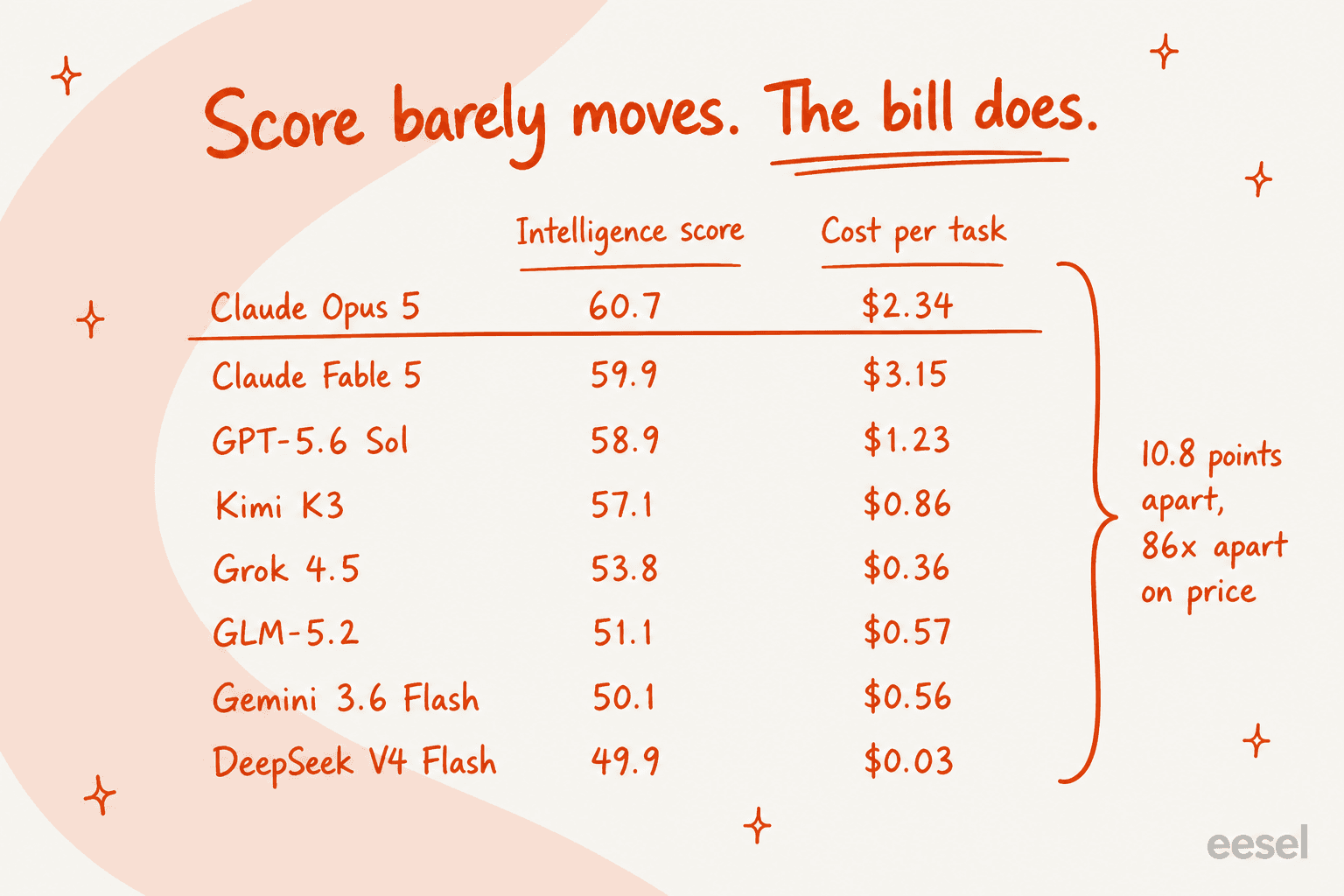
Notice what is not on that list: capability. Nobody I talk to is leaving Opus 5 because it cannot do the work.
How I picked these eight
The trap in a roundup like this is ranking by whichever benchmark flatters the narrative, so I fixed the measurement first and let the order fall out.
Every model here is scored by Artificial Analysis on the same harness, so the scores are comparable rather than vendor-reported. I pulled every figure in this post on 5 August 2026. Alongside the intelligence score I took AA's cost per completed task, which prices the reasoning tokens a model actually burns rather than the rate it charges for them. Those two numbers disagree constantly, and the disagreement is the interesting part.
Each model also had to be callable today, with a published price and no waitlist. I read the licences, because two of these have open weights and one of those has a revenue threshold attached. Where a vendor and AA disagreed on a figure, I have said so rather than picking the flattering one. One model I left out for that reason is Qwen3.8-Max, which is strong on human-preference leaderboards but is not on the AA board at all, so it cannot be compared on the same axis as everything else here.
What I have not done is run six months of production traffic through all eight. I read the docs, the price cards and the independent measurements, and I have kept the claims inside what those support.
The best Claude Opus 5 alternatives at a glance
Prices are per million tokens in USD. Scores, speed and cost per task are Artificial Analysis measurements taken on 5 August 2026.
| Model | Best for | Index | Cost / task | Speed (t/s) | Knowledge | Input | Output | Context | Weights |
|---|---|---|---|---|---|---|---|---|---|
| Claude Opus 5 (baseline) | The default at the top | 60.7 | $2.34 | 55.7 | 31.3 | $5.00 | $25.00 | 1M | Closed |
| GPT-5.6 Sol | Nearly the same score, half the bill | 58.9 | $1.23 | 70.6 | 21.7 | $5.00 | $30.00 | 1M | Closed |
| Kimi K3 | Long-horizon agent runs | 57.1 | $0.86 | 37.1 | 18.4 | $3.00 | $15.00 | 1,048,576 | Open, custom licence |
| Claude Fable 5 | The only model that knows more | 59.9 | $3.15 | 73.8 | 40.2 | $10.00 | $50.00 | 1M | Closed |
| Claude Sonnet 5 | Staying on Anthropic for less | 53.4 | $1.72 | 83.0 | 15.3 | $2.00 | $10.00 | 1M | Closed |
| Gemini 3.6 Flash | Anything a human waits for | 50.1 | $0.56 | 213.5 | 23.5 | $1.50 | $7.50 | 1M | Closed |
| Grok 4.5 | Cheap without losing recall | 53.8 | $0.36 | 61.3 | 26.4 | $2.00 | $6.00 | 500K | Closed |
| GLM-5.2 | Fast open weights under MIT | 51.1 | $0.57 | 182.7 | 4.0 | $1.35 | $4.29 | 1M | MIT |
| DeepSeek V4 Flash | The price floor | 49.9 | $0.03 | 122.7 | Not scored | $0.14 | $0.28 | 1M | MIT |
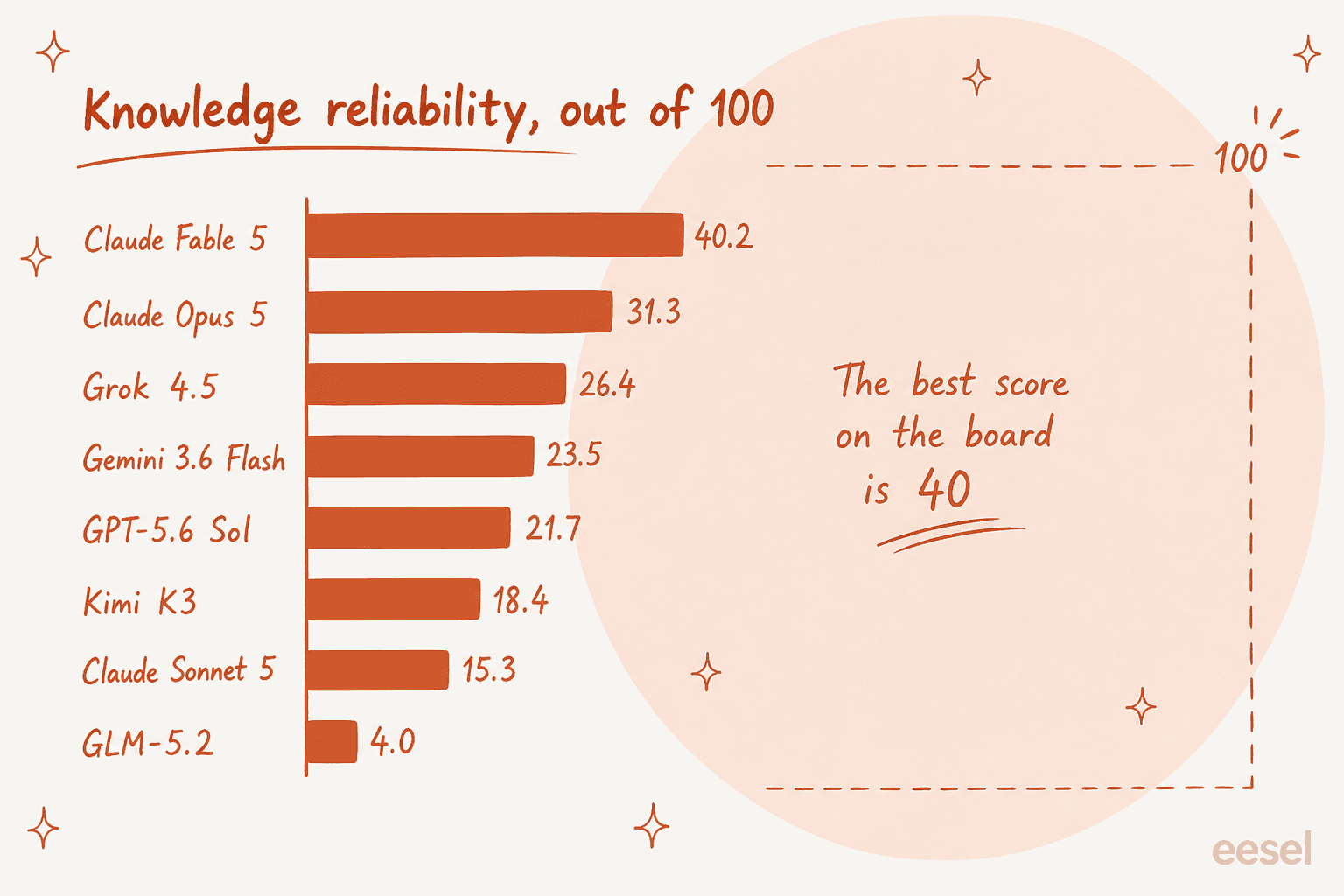
"Knowledge" is the AA-Omniscience Index, which runs from -100 to 100 and measures whether a model knows things versus confidently inventing them. Read the column twice. The best number on it is 40.2.
1. GPT-5.6 Sol
Best for: getting within two points of Opus 5 for about half the measured cost.
OpenAI's flagship went GA on 9 July 2026 and holds the price its predecessor had, $5 in and $30 out per million. On paper it is the more expensive of the two. In practice AA measures it at $1.23 per index task against Opus 5's $2.34, because it finishes the same work on fewer reasoning tokens. My GPT-5.6 explainer has the full family breakdown, and the pricing page covers the Terra and Luna tiers underneath it.
Where it beats Opus 5. Cost per task, by 47%. Output speed, 70.6 tokens per second against 55.7. Time to first token at medium effort is 6.1 seconds, which is quick for a reasoning model.
Where it does not. Index score, 58.9 against 60.7. Knowledge reliability is the wider gap: 21.7 against 31.3 on AA-Omniscience. On AA-Briefcase, which measures long-horizon agentic work, Sol at max effort scores 1502 Elo while Opus 5 at max scores 1719. If your workload is a long agent run rather than a single answer, that gap is the one to weigh.
Pricing. $5.00 input, $30.00 output, $0.50 cache hit, per million tokens. 1M context.
Verdict. The best straight swap on this page. Two points of index for half the bill is a trade most teams should take, provided you check the knowledge gap against your own evals rather than mine.
2. Kimi K3
Best for: long-horizon agent work at a third of the cost.
Moonshot AI's flagship launched on 16 July 2026: 2.8 trillion parameters with 104 billion active, a 1,048,576-token window, and weights published on schedule two weeks later. AA scores it at 57.1 and, more usefully, at $0.86 per task. My Kimi K3 overview goes deeper, and there is a dedicated alternatives roundup if it is your starting point rather than your destination.
Where it beats Opus 5. Price per task, 2.7x lower. Published weights, which no Claude model offers. On AA-Briefcase it scores 1541 Elo, above GPT-5.6 Sol's 1502, so it holds up on exactly the long agent runs you would expect a cheaper model to fall down on.
Where it does not. Output speed is the weak spot at 37.1 tokens per second, the slowest in this roundup. Knowledge reliability is 18.4. Reasoning cannot be switched off at any effort level, and the entry spend tier allows 3 requests per minute, which catches people out.
Pricing. $3.00 input, $0.30 cache hit, $15.00 output, per million tokens. No batch tier.
Verdict. The best score-per-dollar in the top four, and the pick when your agent runs for minutes rather than seconds. Just do not put it anywhere a person is watching the cursor.
3. Claude Fable 5
Best for: the one thing Opus 5 is not best at.
Anthropic's top tier is the only model in this roundup that scores higher than Opus 5 on knowledge reliability: 40.2 against 31.3, the best figure on the board. It also costs the most per task at $3.15, and its index score of 59.9 is fractionally below Opus 5's 60.7. So it is not simply the bigger model. My Opus 5 versus Fable 5 comparison covers where each one wins.
Practitioner reports run in both directions on this pair, which is what a 0.8-point gap looks like from the inside:
"I also have preferred Opus 5 to Fable 5 for most things. Fable is way better than Opus 4.8 for me - it just produces much more complete work in one shot reliably. But when Opus 5 came out, I found that I was getting the same results as Fable, just faster and cheaper."
Where it beats Opus 5. Knowledge, by 8.9 points. Speed, 73.8 tokens per second against 55.7. Same 1M context, same tooling, same SDK, so switching is a model-string change.
Where it does not. Cost, at 1.35x per task and 2x on the price card. Index score, by 0.8 points, which is inside the noise but worth knowing before you pay double for it. AA-Briefcase puts Fable 5 at 1574 Elo against Opus 5's 1719 at max effort.
Pricing. $10.00 input, $50.00 output, $1.00 cache hit, per million tokens.
Verdict. Not a cost play, and not a general upgrade. Reach for it when a confidently wrong answer costs real money and you have already exhausted retrieval as a fix.
4. Claude Sonnet 5
Best for: staying on Anthropic while spending less, with a caveat.
Sonnet 5 is the obvious in-family step down: $2 in and $10 out per million, 1M context, the same API. It is also the clearest example of why the price card lies. Output tokens are 60% cheaper than Opus 5. Cost per finished task is only 27% cheaper, at $1.72 against $2.34, because Sonnet 5 takes far more turns to get there. My Opus 5 versus Sonnet 5 piece has the turn counts.
Where it beats Opus 5. Output speed, 83.0 tokens per second, the fastest Claude here. Cheaper on both the price card and the measured task.
Where it does not. Index score of 53.4 against 60.7 is the widest gap of any model in the top half. Knowledge reliability is 15.3, less than half Opus 5's. On AA-Briefcase it scores 1385 Elo against 1719.
Pricing. $2.00 input, $10.00 output, $0.20 cache hit, per million tokens, through 31 August 2026. From 1 September it becomes $3.00 and $15.00. Any cost model built on today's rate expires in under four weeks.
Verdict. A modest saving for a real capability drop, and the saving shrinks again in September. Worth it for high-volume, low-stakes work. Model it on the September rate, not the current one.
5. Gemini 3.6 Flash
Best for: anything with a person waiting on the other end.
Google's workhorse Flash model launched 21 July 2026 and is the fastest thing in this roundup at 213.5 tokens per second, which is 3.8x Opus 5. It costs $0.56 per task. Full detail in the Gemini 3.6 Flash writeup, plus a separate alternatives list if you are shopping inside Google's range.
Where it beats Opus 5. Speed, by a lot. Cost per task, 4.2x lower. One flat input rate across text, image, video, audio and PDF, which is unusual and useful when your inputs are messy. Knowledge reliability of 23.5 is respectable for the price band, and better than GPT-5.6 Sol's 21.7.
Where it does not. Index score of 50.1 is 10.6 points down. AA-Briefcase puts it at 962 Elo, so long agent runs are not what it is for. Output caps at 65,536 tokens despite the 1M input window.
Pricing. $1.50 input, $7.50 output, $0.15 cache hit, per million tokens. Batch is half that.
Verdict. The right answer whenever latency is the product. Live chat, autocomplete, anything streaming to a user. Not the right answer for an unsupervised agent doing multi-step work.
6. Grok 4.5
Best for: cutting spend without giving up recall.
xAI's model is the quiet value pick here. It scores 53.8 on the index at $0.36 per task, which is 6.4x below Opus 5, and its knowledge reliability of 26.4 is the third-best number on this page, ahead of Gemini 3.6 Flash, GPT-5.6 Sol and every open-weights model in the roundup. My Grok 4.5 overview covers the wider picture.
Where it beats Opus 5. Cost per task, 6.4x. Output speed, 61.3 tokens per second against 55.7. Input at $2 and output at $6 make it one of the cheaper price cards among closed models.
Where it does not. Index score of 53.8 is 6.9 points down. Context tops out at 500K, half of everything else here, which matters if you are feeding it whole repositories or long ticket histories. AA-Briefcase scores it at 1314 Elo.
Pricing. $2.00 input, $6.00 output, $0.30 cache hit, per million tokens.
Verdict. Underrated on the axis that matters most for support work. If you are dropping down a tier and worried about the model inventing things, this is the one to test first.
7. GLM-5.2
Best for: fast open weights with a licence your lawyer will not query.
Z.ai's flagship is MIT-licensed, scores 51.1 on the index, and runs at 182.7 tokens per second, second only to Gemini 3.6 Flash. At $0.57 per task it is 4.1x cheaper than Opus 5. There is more on deployment in my GLM-5.2 for business writeup.
Where it beats Opus 5. Open weights under MIT, which is the cleanest commercial licence available and the one requirement no Claude model can meet. Speed, 3.3x. Cost, 4.1x. Full 1M context.
Where it does not. Knowledge reliability is 4.0, the lowest scored number in this roundup and a long way under Opus 5's 31.3. Index score is 9.6 points down. Output caps at 128K.
Pricing. $1.35 input, $4.29 output, $0.23 cache hit, per million tokens, on the hosted API. Self-hosting is free of licence cost and expensive in hardware, and my roundup of open-source AI agents covers what that actually takes.
Verdict. The best open-weights option if you want speed and a permissive licence. Treat that knowledge score as a hard constraint: this is a model to give documents to, not a model to ask questions of.
8. DeepSeek V4 Flash
Best for: the floor.
The 0731 build went into public beta on 31 July 2026 and it is the cheapest serious model on the board by an order of magnitude. AA scores it at 49.9, ten points under Opus 5, at $0.03 per index task. Weights are MIT, roughly 167GB, with 57 community quantizations available. My DeepSeek V4 Flash writeup and the pricing breakdown go into the modes.
Where it beats Opus 5. Price, by 86x per task. MIT weights. 1M context with a 384K output ceiling, the largest here. Output speed of 122.7 tokens per second, more than double Opus 5. Cache hits at $0.0028 per million.
Where it does not. Index score is 10.8 points down, and the gap widens if you get the configuration wrong: DeepSeek's own table shows Flash at HLE 8.1 without thinking and 34.8 at max effort. Same weights, different runs. AA has not scored the 0731 build on Omniscience, so treat its knowledge reliability as unmeasured rather than good. A 2x peak-hours surcharge is announced with no start date.
Pricing. $0.14 input, $0.0028 cache hit, $0.28 output, per million tokens.
Verdict. Unbeatable on cost, and the reason to be careful is not quality. DeepSeek's paid-API terms are silent on training use rather than protective, there is no published DPA or zero-retention option, and the data sits under PRC law. That is a procurement question before it is an engineering one.
The gap between what these charts measure and what your users ask
Anthropic published its own cost-versus-score charts at launch, and they tell a consistent story across every benchmark: the frontier is a shallow slope, and you pay steeply to climb the last part of it.
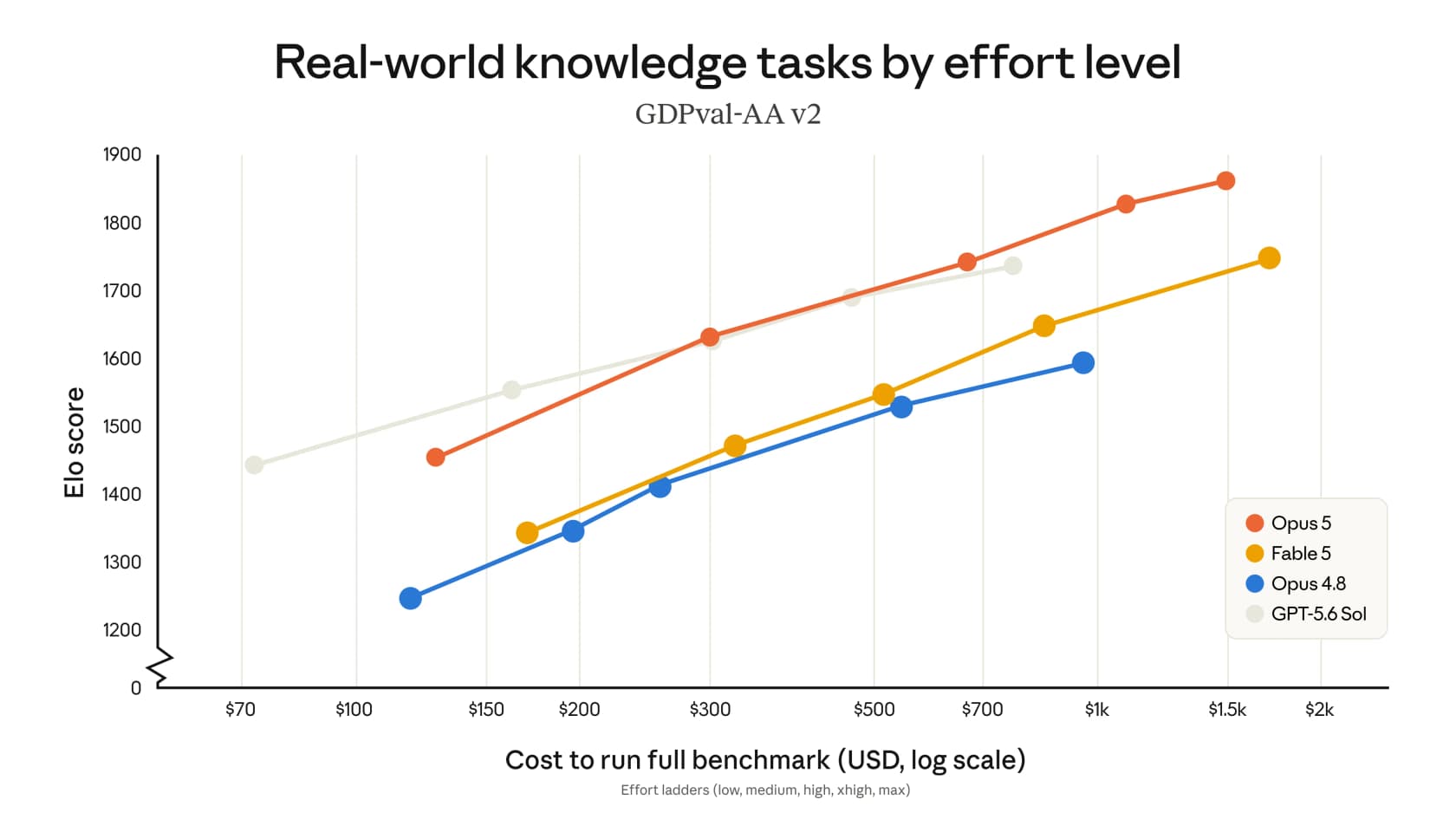
Here is the thing none of it measures. Every eval on this page tests general capability. Not one of them tests whether the model knows that your enterprise plan includes SSO, or that you stopped shipping to Norway in March.
Which is why the "just use a smarter model" reflex keeps disappointing people who try it:
"At work I am sitting on a small pile of incomplete/wrong/missing-the-point bug reports right now, all generated by Opus 5 on High effort. Even under good conditions, LLMs are still wrong quite a lot, and confidently so."
I have watched this play out enough times to recognise the shape. An operator writes into the agent's instructions, mid-shift, something like:
"stop promising customers things we cant do. we cannot guarantee this customer's order to them by friday"
That is a real correction, from an eComm support manager watching an AI over-promise delivery dates to customers. And here is what makes it worth quoting in a post about model selection: no model swap on this page fixes that. The model was not confused. It was fluent, confident and unaware of a fact that lived in their operations, not in its weights.
Another team I sat with, a Danish vehicle-telematics support desk on Zendesk running about 200 tickets a month, hit the same wall from the other side. Their bot cheerfully confirmed support for car brands that were not in their database, because the help centre article said they supported "all models". The model read the document correctly. The document was wrong. Upgrading from a 50 to a 60 on an intelligence index does nothing about that, which is the argument for treating your knowledge base as the thing under test rather than the model.
This is why the AA-Omniscience column matters more than the index column for support work, and why even the best number in it, Fable 5's 40.2, is not a solution. The fix is architectural: ground answers in your own documents, cite the source, and hold back when confidence is low. That is what AI escalation management is actually about, and it sits a layer above whichever model you land on. The mechanics of the handover itself are covered in agent handoff best practices.
If you are picking a model for a support queue specifically, the things that decide the outcome are retrieval quality, the confidence gate, and how you test before going live. AI support quality assurance covers the testing side.
For the grounding side, start with hallucination prevention. That layer is also what separates a real agent from a rule-based chatbot, regardless of how good the model underneath is.
Try eesel
Picking between Opus 5 and these eight is a real decision and I hope the table above makes it a shorter one. It is also not the decision that determines whether your AI support actually works.
eesel sits above the model. It learns from the tickets your team has already resolved, grounds every answer in your help centre and internal docs, and stays quiet on anything it is not confident about instead of guessing. You can run it against your last few thousand historical tickets before a single customer sees it, which is the only test that tells you what your resolution rate will really be. It plugs into Zendesk, Freshdesk, Gorgias, HubSpot and the rest in a few minutes, and pricing is per resolved ticket rather than per seat, so the bill tracks the work. Most teams point it at tier-1 deflection first, which is where customer service automation pays back fastest.
If you are already comparing models on cost per task, the same maths applied one layer up is cost per resolution, and that is the number your finance team will ask for. There is a fuller breakdown in AI customer service cost, and if you would rather start with drafting than autonomy, AI copilot for support is the lower-risk entry point.

Try eesel free, or book a demo and I will run it against your own ticket history first.
My take
If I had to compress this into three lines.
Default to GPT-5.6 Sol if the reason you are here is the invoice. It is 1.8 index points behind and 47% cheaper per task, which is the best trade on the page, and its higher output rate makes it look like the wrong answer until you check the measurement.
Default to Gemini 3.6 Flash if the reason is latency, and DeepSeek V4 Flash if the reason is that you want the bill to disappear. Read DeepSeek's data terms first, since the silence in them is the actual cost.
And stay on Opus 5 if the reason you were looking is that it got something wrong. Swapping models moves you a few points along a 100-point scale where the best score is 40. Grounding the answers in your own documents moves considerably more than that, and it works whichever model you end up calling. My roundup of Claude alternatives covers the wider family if you want to keep looking, and AI for customer service covers the layer that actually does the work.
Frequently Asked Questions
What are the best Claude Opus 5 alternatives?
Is there a cheaper alternative to Claude Opus 5?
How much does Claude Opus 5 cost compared to its alternatives?
Which Claude Opus 5 alternative is best for customer support?
Is there an open-weights Claude Opus 5 alternative?
Is Claude Opus 5 still the best model in 2026?
Can I switch away from Claude Opus 5 without rewriting my app?
How do I test a Claude Opus 5 alternative before committing?


Article by
Rama Adi Nugraha
Rama is a software engineer at eesel AI with two years of experience writing about B2B SaaS, AI tools, and customer support technology. Based in Bali, Indonesia, he brings a developer's perspective to product comparisons — cutting through marketing copy to what the integrations and APIs actually do.