

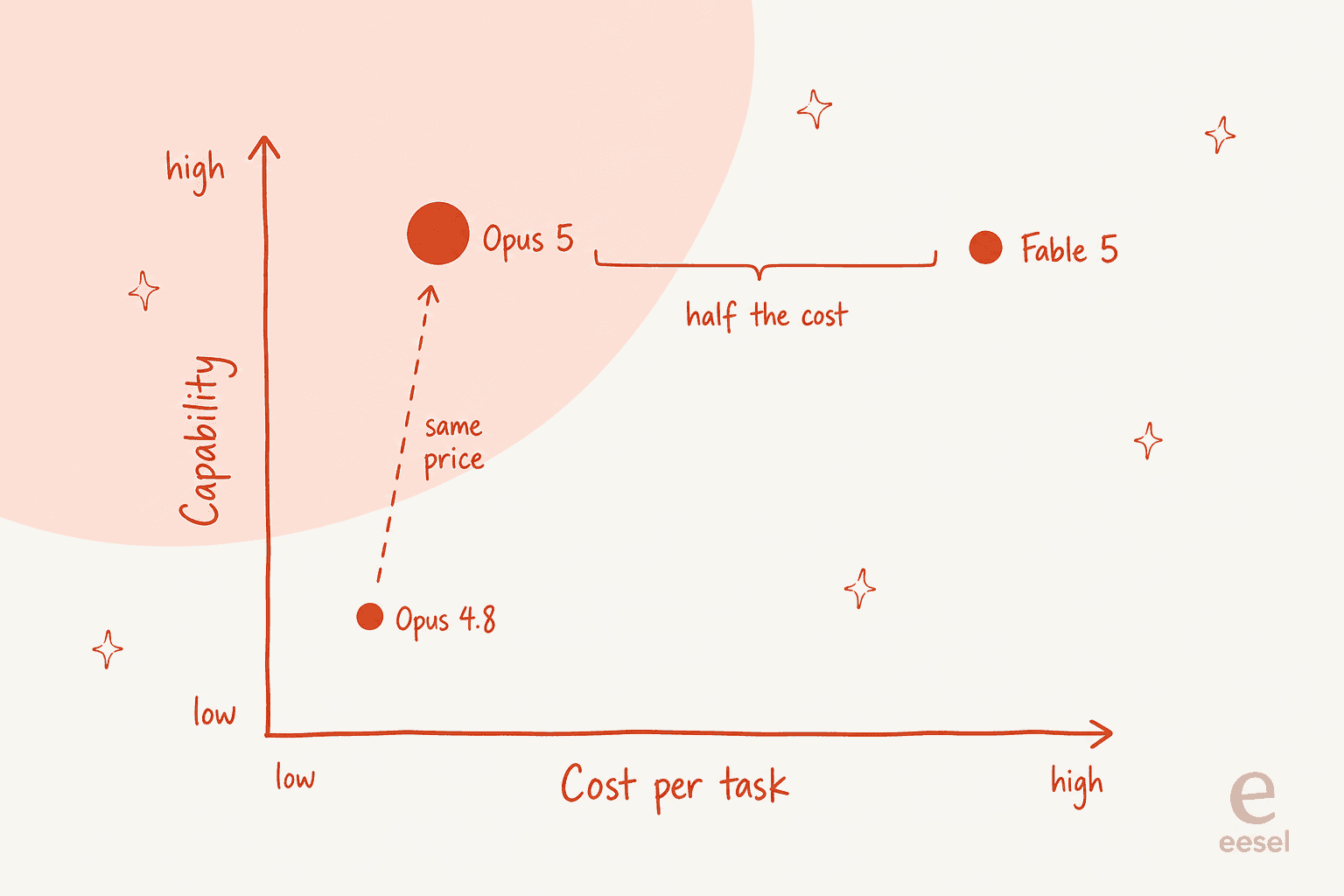
Claude Opus 5 shipped on July 24, 2026. Price stayed at $5 per million input tokens and $25 per million output, exactly what Opus 4.8 cost. Yet it more than double Opus 4.8's Frontier-Bench score, at a lower cost per task too. It is the clear leader on agentic knowledge work, and on CursorBench it lands within 0.5% of Fable 5's peak score, for half the price per task. If you write code, or run long agent loops, this one is worth the upgrade.
Two numbers keep it honest. Hallucination rate on AA-Omniscience rose 14 points to 50%, so some of that accuracy gain came from more confident guessing. Time to first token: 68 seconds at max effort, versus a class median of 2.81 seconds. This is a background worker at heart. Point it at a live chat window and the wait alone kills it.
That gap matters most if a support queue was the plan. The model is only the engine, that part is done already. What a live helpdesk still needs: ticket sync, testing against past tickets, confidence routing, then a clean human handoff. eesel does exactly that part, the part no API key ships with.
What Claude Opus 5 actually is
Opus 5 is Anthropic's new workhorse. The flagship is still Fable 5. Opus 5 is the model Anthropic tells you to reach for first though: the docs say to start with Claude Opus 5 for complex agentic coding and enterprise work, then move up only once you actually need the ceiling. On Claude Max it is already the new default. On Claude Pro, per Anthropic, it is the strongest model available.
The launch post frames it this way: it "comes close to the frontier intelligence of Claude Fable 5 at half the price." That reads as a positioning claim first. What is unusual is that the independent data mostly backs it up, for once.
The pace here is worth registering, especially if you last looked at this family a couple of releases back. My Opus 4.5 review is barely a few months old, and it already reads like a different tier of model. Opus 4.6 landed somewhere in between.
Specs, briefly. Model id is claude-opus-5. Context window: 1M tokens, with 128k max output, per the models overview. Knowledge cutoff sits at May 2026, which is later than both Fable 5 and Sonnet 5. Batch requests can push output to 300k tokens with a beta header. There is no long-context premium either: a 900k-token request bills at the same per-token rate as a 9k one, per the pricing docs.
Three years now, I have been building AI agents that run on other people's real support queues at eesel. So I read model launches with one question in mind: does this change what I can safely put in front of a customer? This review looks first at the coding wins. Then at the two numbers that decide whether a model belongs anywhere near a live conversation.
The benchmark picture: real wins, thinner than the headline
Start with the number Anthropic leads on. Frontier-Bench v0.1 is the successor to Terminal-Bench, built by the same team, and Opus 5 hit 44.4% mean reward at xhigh effort. Opus 4.8 managed 18.7%, per the system card. Fable 5 sat at 33.7%, GPT-5.6 Sol at 37.5%. Not an incremental bump, this one.
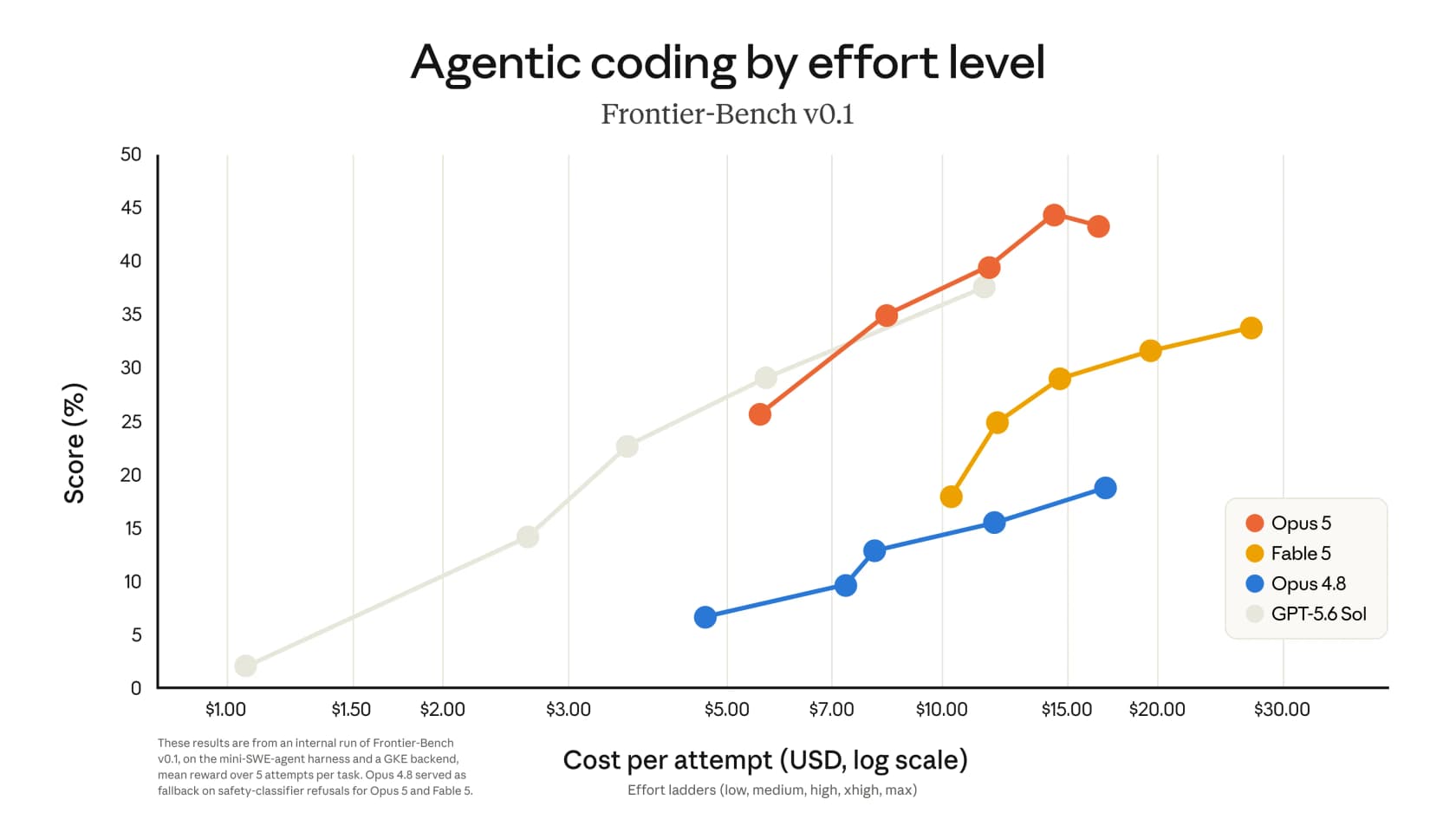
The shape of the chart is what matters here, more than the peak. Opus 5's line sits above and to the left of everything else. That is the position you want, more score for less money. Fable 5's whole curve lives to the right of it, paying two to three times as much per attempt for a lower ceiling.
The headline table below comes straight from the system card, reproduced exactly.
| Evaluation | Claude Opus 5 | Claude Opus 4.8 | Claude Fable 5 | GPT-5.6 Sol |
|---|---|---|---|---|
| SWE-bench Pro | 79.2 | 69.2 | 80 | 64.6 |
| SWE-bench Multilingual | 89.5 | 84.4 | 86.6 | – |
| SWE-bench Multimodal | 59.4 | 38.4 | 54.1 | – |
| DeepSWE v1.1 | 68.8 | 59.0 | 69.7 | 72.7 |
| FrontierCode 1.1 (Main) | 53.4 | 46.5 | 53.5 | 47.5 |
| FrontierBench v0.1 | 43.3 | 21.1 | 33.8 | 34.4 |
| BrowseComp | 90.8 | 84.3 | 87.4 | 90.4 |
| Humanity's Last Exam (no tools) | 56.3 | 49.8 | 56.5 | – |
| OSWorld 2.0 | 70.6 | 55.7 | 66.1 | 62.6 |
| GDPval-AA v2 (Elo) | 1861 | 1593 | 1747 | 1736 |
| AA-Briefcase (Elo) | 1720 | 1346 | 1574 | 1505 |
| AutomationBench | 26.0 | 17.0 | 17.4 | 18.1 |
| ARC-AGI-2 | 90.4 | 72.1 | – | 92.5 |
| ARC-AGI-3 | 30.2 | 1.5 | – | 7.8 |
Read the rows here, the average hides too much. Opus 5 loses SWE-bench Pro to Fable 5 and DeepSWE to GPT-5.6 Sol, and it loses ARC-AGI-2 too, by two points. Where it does win though, it wins big: SWE-bench Multimodal jumps 21 points over Opus 4.8. ARC-AGI-3 goes from 1.5 to 30.2, which the system card calls roughly four times the best previously reported score.
There is a genuine perfect score buried in here too. Held July 15-16, the 2026 International Mathematical Olympiad saw Opus 5 score a perfect 42 out of 42, with no agent harness and no tools. Gold-medal cutoff was 29, per the system card.
If you track the head-to-heads, this one reshuffles them. My Gemini 3 Pro comparison needs a new baseline now, and so does the Codex versus Opus 4.6 piece.
What the independent numbers say
Artificial Analysis puts Opus 5 at 61 on its Intelligence Index. Rank one of 190 models, against a class median of 32. Rank one is real, sure, but it is also a one-point lead: Fable 5 sits at 60, GPT-5.6 Sol at 59, per AA's writeup, with Opus 4.8 trailing at 56. AA's own word for it is "narrowly" the most intelligent model.
The wide leads live somewhere more specific than "intelligence." Take GDPval-AA v2, a set of 220 real occupational tasks: Opus 5 takes the top two spots, at 1861 and 1827 Elo, per the system card, 114 clear of Fable 5. On AA-Briefcase, long-horizon knowledge work across multi-week projects, it takes the top three positions outright. These are the results that actually justify the launch. They are about sustaining a long, messy piece of work, which is a different skill than answering one hard question.
One caveat most coverage skips entirely: Anthropic ran its own Frontier-Bench numbers with Opus 4.8 as a fallback for safety-classifier refusals, per the system card, and that fallback caught 5% of API calls. Artificial Analysis ran its Index the exact same way. So a small slice of every "Opus 5" score was actually produced by Opus 4.8.
It is an agent model before it is a coding model
The thing that surprised me the most is not on any coding leaderboard at all. It is Zapier's AutomationBench, which drop an agent into a simulated company with dozens of REST endpoints across 47 apps, then grades whether it finishes a real business workflow. Opus 5 scored 26.0%, against 17.0 for Opus 4.8, 17.4 for Fable 5, and also 18.1 for GPT-5.6 Sol, per the system card.
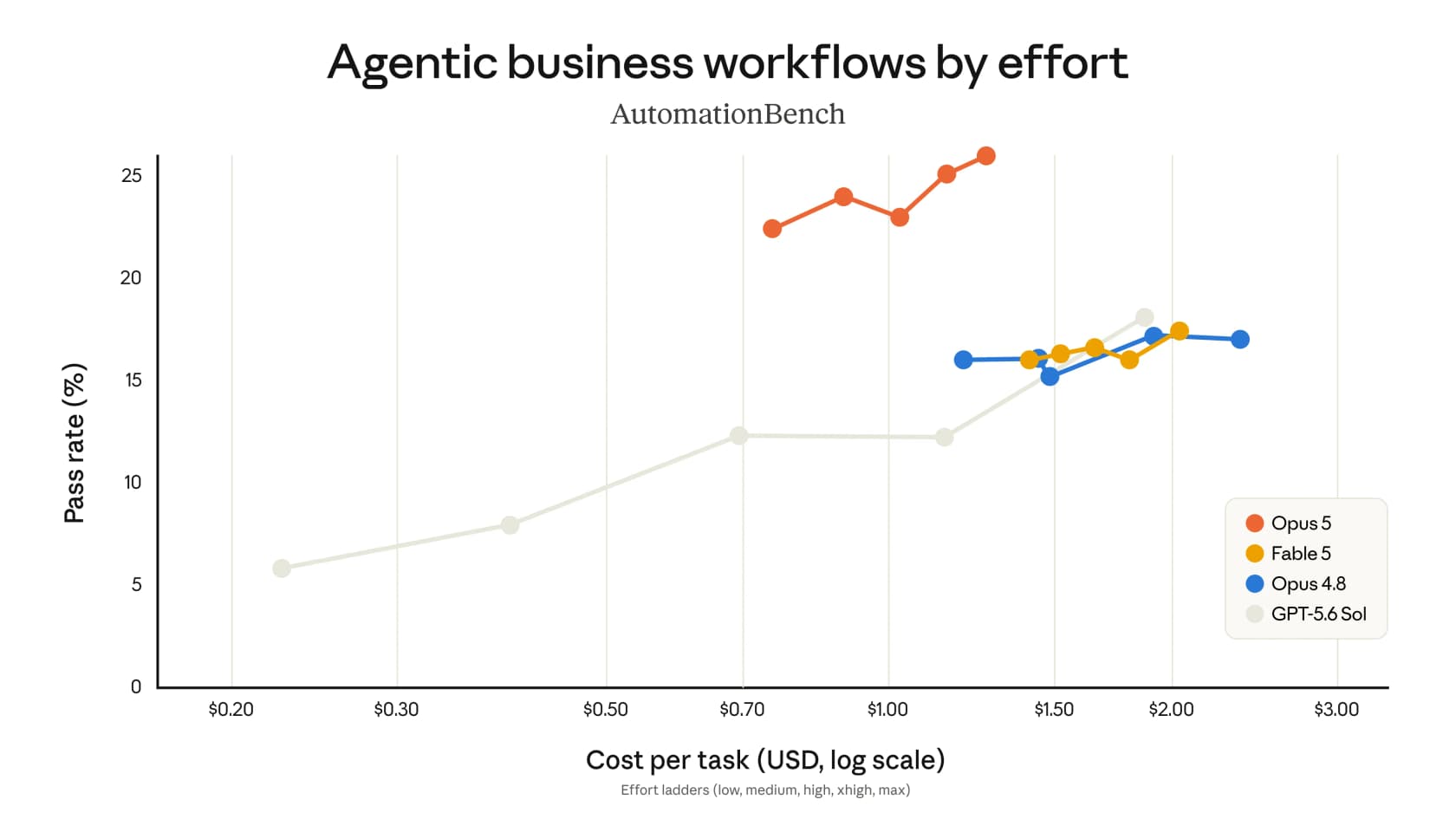
Look at where the orange line starts: Opus 5's cheapest setting already beats every other model's best setting, at roughly $0.75 per task. Anthropic report 24% at medium effort for $0.89 per task, and say it outperforms both Opus 4.8 and Fable 5 at less than half the cost. That is the real story of this release: not a smarter chatbot, a cheaper agent.
The behaviour behind it shows up in the anecdotes. On one Frontier-Bench task, Opus 5 was handed a drawing of a machine part and asked to rebuild it in FreeCAD, and on top of that deliberately given no way to view the drawing at all, per the launch post. It wrote its own computer vision pipeline to read the geometry out of the raw pixels, and no competing model solved it in five attempts. JetBrains framed the change as judgment: the model catches its own logical faults during planning, rather than after the fact.
Early-access numbers back up the pattern too. Box measured an 8% overall improvement over Opus 4.8, rising to 17% on due diligence workflows. Lovable put it up 22% over Opus 4.7 on their hardest agentic coding tasks, with far less run-to-run variance. A trading firm reported reaching the same result with roughly a seventh of the reasoning tokens, per the launch post.
Efficiency deltas like that matters more than raw scores, once a model is doing real work unattended. It is the same shift I described in my agentic coding CLI writeup, and in the wider AI agents roundup too: the interesting question stopped being "can it answer" and became "can it finish."
The two numbers that should give you pause
This is the section I would want to read first, so I will not bury it.
It hallucinates more than the model it replaces
On AA-Omniscience, a closed-book factual benchmark, Opus 5 improved accuracy by 7 points over Opus 4.8, and its hallucination rate rose 14 points too, to 50%, per Artificial Analysis. Anthropic's own system card records the same trade in its own words: accuracy sits 11% higher than Opus 4.8, but the hallucination rate is also 6% higher.
That is not really a contradiction. The model just answers more often when it is uncertain. On a coding task with tests, guessing comes cheap: the test fails, the loop continues. On a customer's refund question, a confident guess is the whole failure mode, and it is the objection that comes up in almost every evaluation call I sit in on.
"The AI will never be able to answer 100% of the questions. I need an AI who is only handling the tickets that it's confident to handle and all the other ones, leave them alone."
That is a CX lead at a DTC supplements brand, and the line sums up the thesis of the whole category. Better raw intelligence alone does not solve it, confidence gating does, which is why preventing hallucinations in support is a product problem rather than a model one.
It is slow, and it is slow in the worst place
Artificial Analysis measured Opus 5 at 52.6 output tokens per second, rank 117 of 190, against a class median of 76. Fine, for background work. What actually disqualifies it from real-time use is time to first token: 68.04 seconds at max effort, versus a class median of 2.81. That is roughly 24 times slower before a single character even appears.
Dropping the effort level barely helps: 52.8 tokens per second at xhigh, 56.8 at high, per Artificial Analysis. Fast mode buys about 2.5x the speed, for twice the base price. AA's own summary is blunter than anything I would write myself: Opus 5 is "notably slow and very verbose."
There is a third number worth knowing before you set effort: "max" and just forget about it. On AA-Briefcase, max effort averaged 36.2 minutes and 103 turns per task, per Artificial Analysis, against 24.1 minutes and 55 turns for Opus 4.8. On cost per Index task, Opus 5 at max runs $2.03, against Opus 4.8's $1.80, and also Sonnet 5's $1.53, per AA's writeup. It comes out 26% cheaper than Fable 5, and more expensive than its own predecessor.
The fix here is simple: do not default to max. Best value point in the whole dataset is Opus 5 at high effort, which beats Fable 5 by 32 Elo at $10.41 per task, per Artificial Analysis, under half of Fable 5's $22.30. Anthropic even reversed its own guidance to match, now recommending you start at high rather than xhigh, per the release notes.
What the people who shipped with it are saying
Launch week on X split in a way I had not seen before. The argument was not whether Opus 5 is good, most people think it is the best model available. The argument was that it is the best model available and unpleasant to work with.
The sharpest version came from someone who ranked it first:
"BIG NEWS: Opus 5 is here...and I hate working with it. And yet in a blind taste test, I ranked it above every other model (even Fable and my beloved GPT-5.6)"
The blind part is what makes it useful. Ranking models without knowing which is which strips out brand loyalty, so "I hate it" is purely about ergonomics, not about capability. Dan Shipper at Every spent a week on pre-release testing, across coding and writing, and also their internal agent, and landed in the same place: "it's a hard model to love." It "argued with instructions, stopped before the work was finished," and it did not play well with their existing skills and plugins.
The most operationally useful complaint comes with a fix attached:
"Opus 5 is out now! And it broke Compound Engineering, but I also like it. Love it and hate it. I have been coding with it without many skills and it's nice at a medium effort level. Just remember to let go of you skills and big mega prompts."
He describes one specific failure: in an autonomous flow, the model kept handing control back to the human. Anthropic's own prompting guide says roughly the same thing, from the other direction: it tells developers to strip out "include a final verification step" instructions, because Opus 5 now over-verifies on its own. Scaffolding built for Opus 4.8 now works against you.
There is a clean mechanical explanation, and it comes from the benchmark side:
"Claude Opus 5 averages 103, 91, and 76 turns per task across its top three effort levels, compared to 55 for Opus 4.8 (max)"
Roughly double the agent loop. That single number explains "neurotic," "argued with instructions," and also "kept returning control" all at once. It is the same behaviour, just seen from the outside.
The one hard third-party measurement in all the launch-week noise came from CodeRabbit, who ran Opus 5 through their production code-review benchmark. Precision went up, from 35.2% to 39.3%. Recall went down, from 61.1% to 55.2%, and also four times the nitpicks. Their verdict was "a precision specialist, which pairs well with a recall model," and they do sell code review, so read the ensemble recommendation with that in mind. The tradeoff itself matches everything else here: more careful and more thorough, and also more talkative.
Recall dropping while precision rises is the finding worth sitting with longest, if a model is your reviewer. It changes what an AI code review pass is actually for, and it is worth re-running your own numbers before you assume a straight upgrade.
The same caution holds inside editors like Cursor. It holds for Windsurf too, and inside Claude Cowork as well.
The effort setting is the whole argument
The Hacker News launch thread ran to 1,315 comments, and it holds what looks like a flat contradiction. Half the thread says Opus 5 is remarkably cheap to run, the other half says it is torching their five-hour limit. Both are true. The variable is the effort setting.
"It overthinks quite a bit above medium effort, try using that."

"The chart shows max effort, used mostly by price-insensitive enterprise users. At medium effort it drops to almost half K3's cost, and is probably sufficient for 95% of coding tasks."
Then the thread found something better than complaints. Reading the system card, several people spotted that Opus 5's coding score actually falls above medium effort, which reads like a bug, or worse:
"Page 151 of the linked system card - did Opus 5 get nerfed to prevent it being better than Fable? The graph makes no sense. Huge decline in coding performance at effort levels higher than medium."
The system card answers it plainly, and the real answer is more interesting than nerfing. Both FrontierCode bests land at medium effort, and Anthropic explains that at higher effort Opus 5 "make[s] more changes than the task requires", which the grader then penalises as out-of-scope. Adding a short stay-in-scope instruction "recovered performance on most of these tasks." So the model is not getting dumber at max effort at all. It is getting more ambitious, and ambition is a bug when the task was small.
That is probably the single most actionable thing in this whole review: raising effort is not a free upgrade, and on scoped work it can cost you both money and score.
Worth noticing too that the same behaviour reads as a feature to a different audience. Rolling Opus 5 out across Copilot, GitHub's announcement praised it for "validating its work, and reducing unnecessary execution overhead on complex tasks." Same self-checking loop, different read on it: one team calls it thorough, the other calls it neurotic. Which one you get depends entirely on whether a human is sitting there waiting on the output.
Pricing, in full
Nothing changed at the token level, which is honestly the most interesting thing about it. The Opus line has held at $5 and $25 since Opus 4.5, per the pricing docs, a 3x cut from Opus 4.1's $15 and $75.
| Rate (per million tokens) | Claude Opus 5 | Claude Fable 5 | Claude Sonnet 5 | Claude Haiku 4.5 |
|---|---|---|---|---|
| Base input | $5 | $10 | $2 (to Aug 31) | $1 |
| Output | $25 | $50 | $10 (to Aug 31) | $5 |
| 5-minute cache write | $6.25 | $12.50 | $2.50 | $1.25 |
| 1-hour cache write | $10 | $20 | $4 | $2 |
| Cache read | $0.50 | $1 | $0.20 | $0.10 |
| Batch input / output | $2.50 / $12.50 | $5 / $25 | $1 / $5 | $0.50 / $2.50 |
| Fast mode input / output | $10 / $50 | – | – | – |
| Context window | 1M | 1M | 1M | 200k |
Four things quietly change your bill:
- Sonnet 5's $2 and $10 is only introductory and reverts to $3 and $15 on September 1, 2026, per the pricing docs. Budgeting Sonnet against Opus today means comparing against a rate that expires in about five weeks.
- The tokenizer changed. Models from 4.7 onward can use up to 35% more tokens for the same text, per the migration guide. A flat per-token comparison against a 4.6-era model will understate the real cost.
- The cache floor dropped to 512 tokens, the lowest in the lineup, eight times lower than Opus 4.5. Short system prompts that could never be cached before, can be now. Prompts under the floor still get processed, just with no error and no caching.
- US-only inference costs 1.1x on every token category, which works out to $5.50 and $27.50 for Opus 5.
On the consumer side, Pro is $20 a month (or $17 billed annually). Max runs $100 or $200, and Team seats also come in at $25 or $125. Usage limits are session-based, on a rolling five-hour window rather than a message count, and web, desktop, mobile and Claude Code all draw from the one pool.
Full numbers live in my Claude Code pricing breakdown, and if you are deciding which model to point at which job, the model selection guide and the context window notes are the practical companions to this section.
What breaks when you migrate
Anthropic calls Opus 5 a drop-in for Opus 4.8, and mostly, it is. Two things really do break:
- Adaptive thinking is on by default. Revisit your
max_tokens, because thinking tokens now come out of it, on requests that previously had none. - Disabling thinking is capped.
thinking: {"type": "disabled"}returns a 400 atxhighormaxeffort, per the release notes, enforced per request. Opus 4.8 used to accept the combination.
Two features also went missing entirely, rather than just changing: web fetch is not available on Opus 5, per the migration guide, and neither is Priority Tier, which Opus 4.8 still keeps. If you hold a capacity commitment, plan around that before flipping traffic.
Coming from Opus 4.6 or earlier, there is a longer list. Sampling parameters like temperature and top_p return a 400 at any non-default value, per the migration guide, and the SDK types still accept them, so your code type-checks fine and the API rejects it anyway. Assistant prefill is gone too. Thinking content is omitted by default, which for anything streaming reasoning to a user looks like a long silence before any output starts.
On the additions side, two betas shipped alongside the model: mid-conversation tool changes, which swap the available tools without invalidating the prompt cache, and automatic server-side fallbacks. If you build multi-step agents, that first one is quietly a big deal.
It also changes how agents get composed. Swapping tools mid-run without a cache miss makes the subagent pattern cheaper. It sits alongside Claude Skills too, and MCP tools as well, rather than replacing either.
My skills versus subagents breakdown covers when each is the right container. If you run on a cloud provider instead of the first-party API, note that fast mode is first-party only, which my Bedrock and Claude Code notes get into.
Safety, and the fallback nobody mentions
Anthropic's pre-deployment audit calls Opus 5 its most aligned model to date, scoring 2.3 on overall misaligned behaviour, the lowest score of its recent models. It ships under ASL-3 protections, same level as Opus 4.8.
The result I care about the most is prompt injection resistance, because that is what breaks agents connected to real customer data. Attacker success on the indirect prompt injection eval dropped from 5.5% to 2.0%, best of any model tested and well clear of GPT-5.6 Sol's 20.0%. Browser-use attack success fell from 31.5% to 3.70%, then all the way to 0% across 129 scenarios with auto mode on. For anyone giving an agent tool access, that matters more than any coding score.
The part that gets skipped: Opus 5 does not always answer your request.
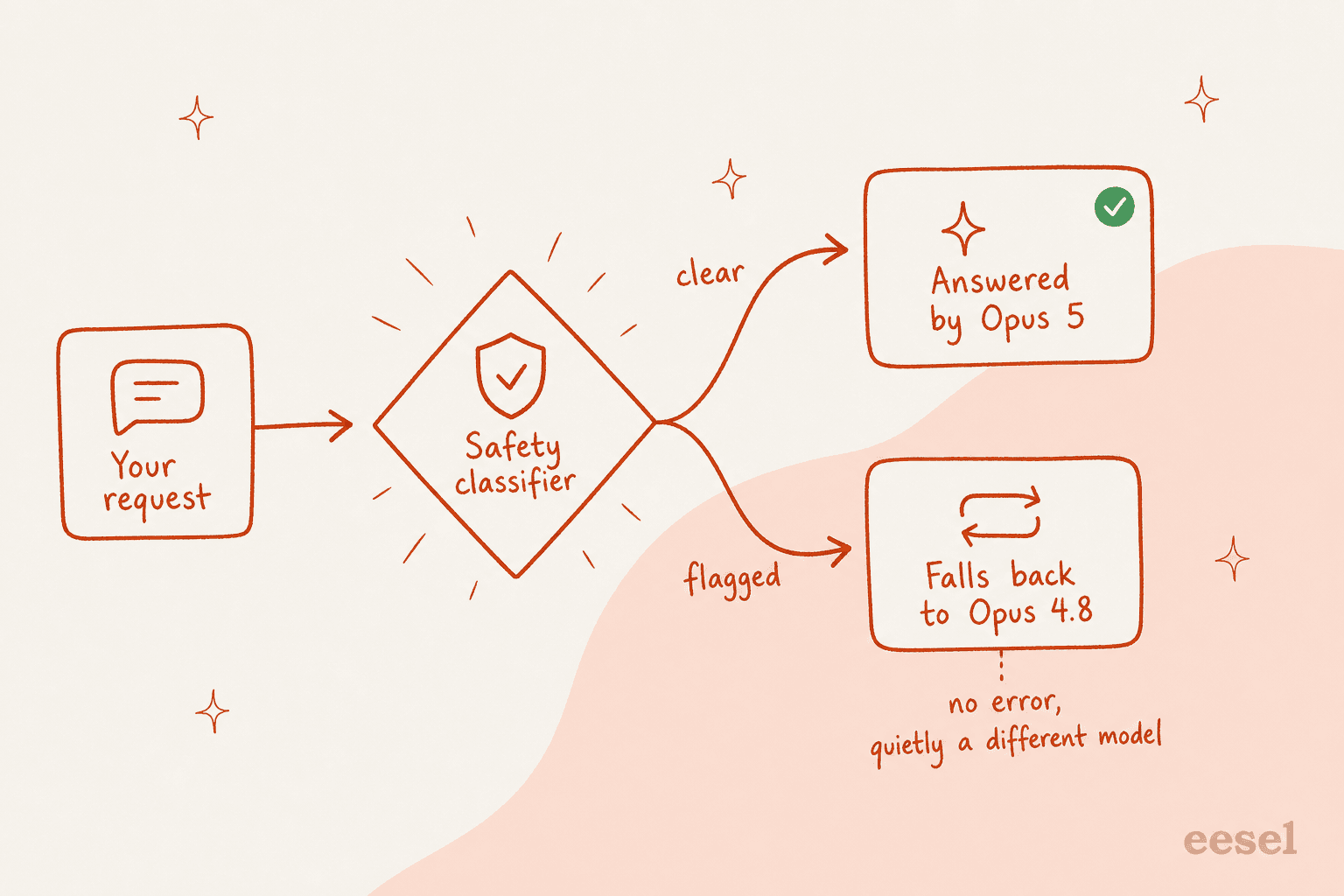
In Claude.ai and Claude Code, and also in Claude Cowork, requests flagged by the cyber classifiers fall back to Opus 4.8 by default, per the launch post, and the same behaviour is available on the API too. No error, no obvious signal, just a different model quietly answering. Anthropic expects those classifiers to intervene around 85% less often than they do for Fable 5, per Anthropic, which is a real improvement, but if you are benchmarking or debugging, know that some fraction of your traffic may not be the model you think it is.
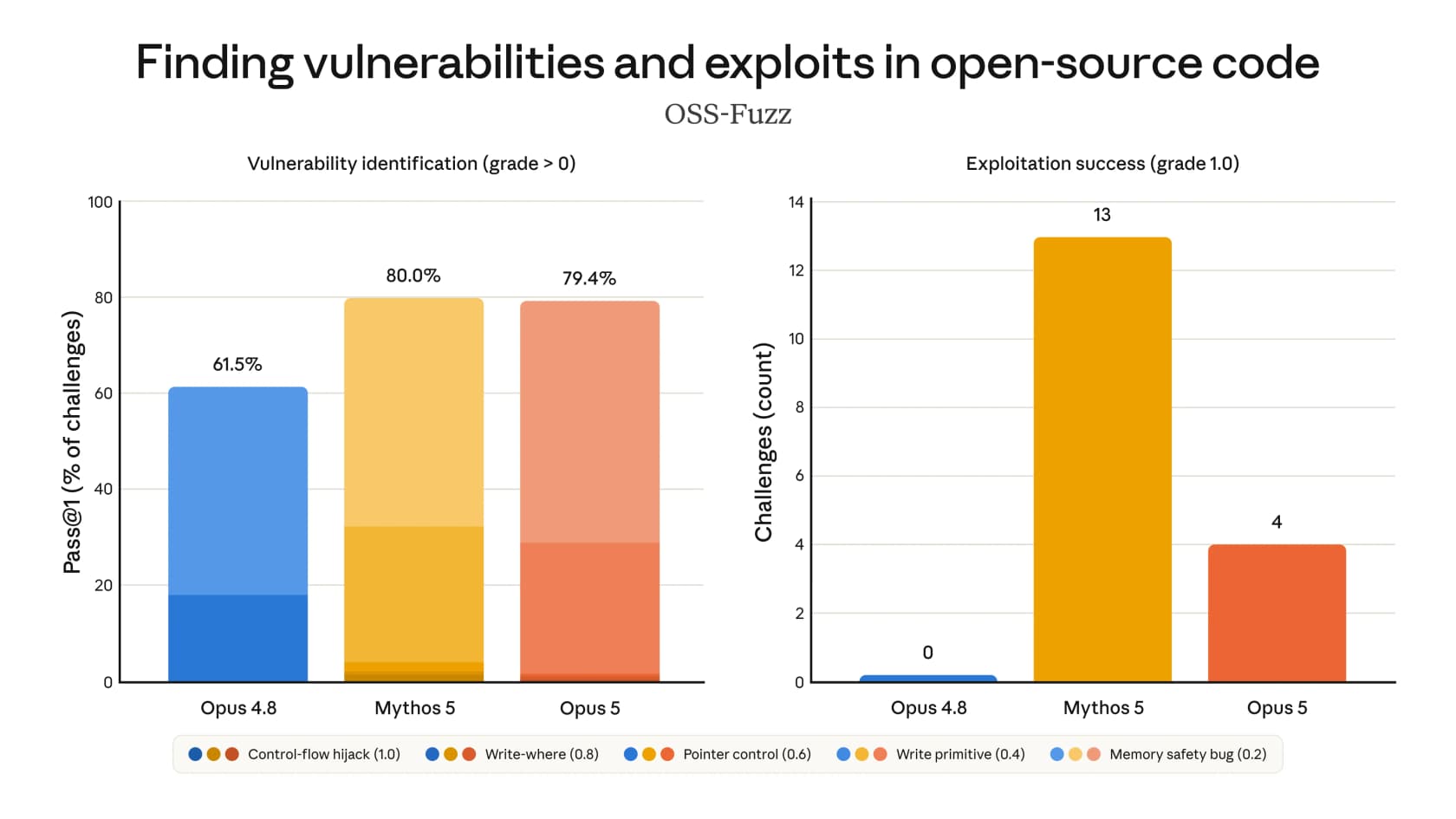
Where Opus 5 is deliberately held back: it stays behind Mythos 5 on both cybersecurity and biology research, per the launch post. On OSS-Fuzz it finds vulnerabilities about as well as Mythos 5 does, but it is far behind on turning them into exploits.
Who should upgrade, and who should not
Upgrade if you run agents: long multi-step tasks, coding loops, research pipelines, computer use, anything where the model works for twenty minutes unattended. The AutomationBench and AA-Briefcase results are not close, and the price did not move either. If you are choosing between assistants, my AI coding tools roundup and the GPT-5.3 Codex review cover the alternatives, with more context in my Opus 4.6 alternatives list.
Stay put if your workload is short, latency-sensitive chat. A 68-second first token is not something you can configure your way out of. Sonnet 5 is the right call there, so is Haiku, and at max effort Opus 5 costs more per finished task than either one.
Look elsewhere if you need current factual recall with no retrieval layer. Opus 5 has lower factual knowledge than Fable 5, per Artificial Analysis, and the hallucination number says the rest of it.
Compare against Gemini 3. Also look at Kimi K3. Or consider Mistral before committing.
One honest gap: there is still no human-preference data at all. Opus 5 does not appear on the LMArena text leaderboard, whose current snapshot predates the launch. Worth noting, Opus 4.8 sits at rank 13 there despite being a top-five model on the Index, so benchmark intelligence and what people actually prefer are clearly not the same thing.
What this means if you are building support AI
Every frontier launch triggers the same conversation, on my team's calls. Someone technical looks at a $5-per-million-token model that scores 26% on business workflow automation, and asks the reasonable question: why are we paying for a support product when we could wire this up ourselves?
I take that seriously, because I have watched it actually happen. A couple of technical accounts, including a DTC beauty brand, left eesel to go build directly on the Claude API. It is the most common competitive alternative I run into, and it is not a silly plan either.
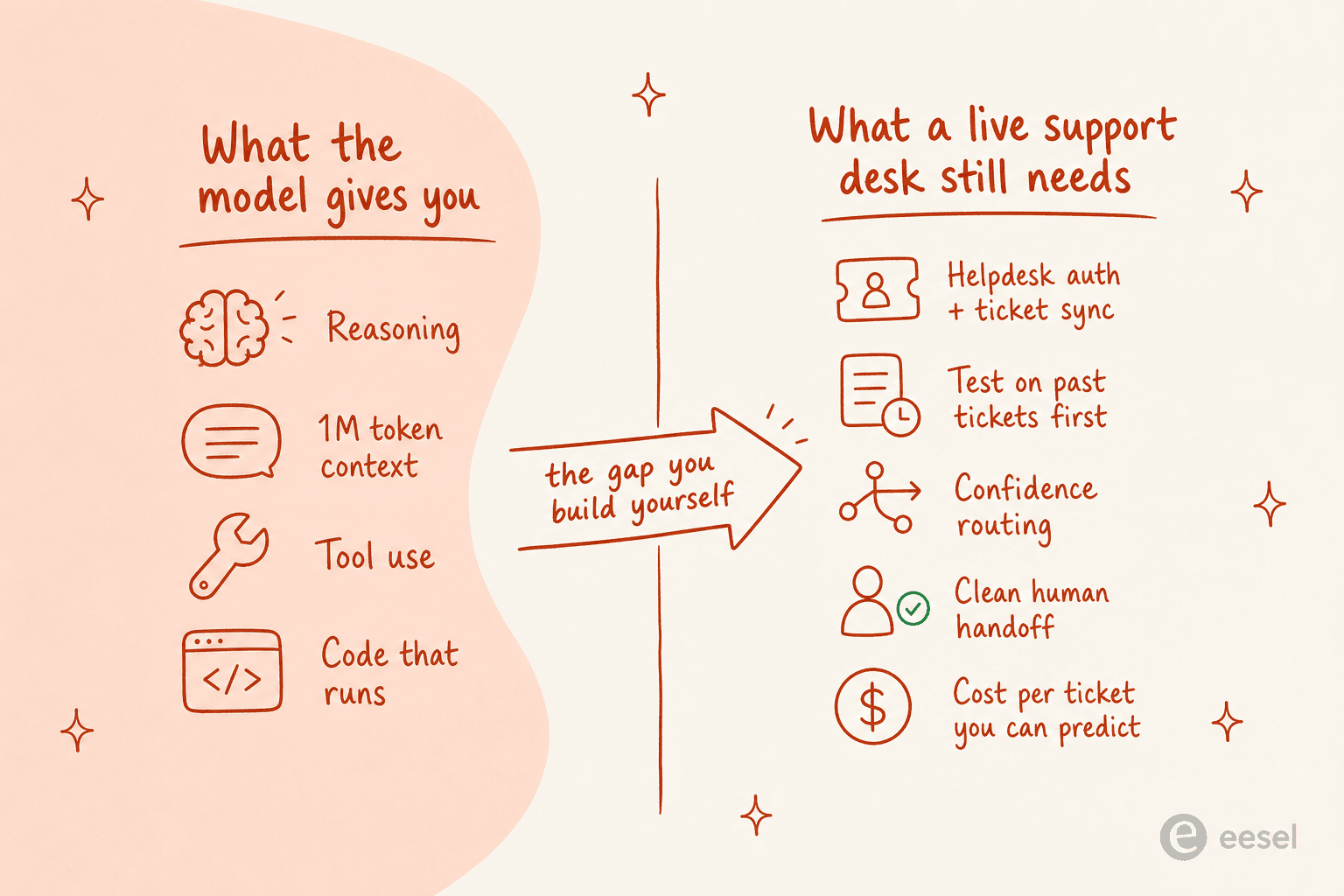
What tends to happen is, the model was never the hard part. The hard part is everything to the right of that arrow: authenticating into the helpdesk and keeping tickets in sync, training on your knowledge base, running the thing against past tickets before it ever touches a live one, routing by confidence so it stays quiet when unsure, handing off to a human without losing context, and knowing your cost per ticket in advance instead of reconciling a token bill after the fact.
Add the two numbers from this review together and the guardrails stop being nice-to-have. A 50% hallucination rate is the exact thing every AI customer service chatbot gets judged on, and a 68-second first token is longer than most people will sit in a chat window waiting. There is a reason resolution rate is measured on outcomes rather than benchmark scores, and why the helpdesk tools that work are the ones that let you see what the AI would have said, before it actually says it.
One customer put the build-versus-buy call better than I can:
"We could try to write our own LLM application but we didn't want to invest our time into that. We wanted something that we would not have to maintain."
Karel, GENERAL BYTES, from their case study
That is the trade, really. Opus 5 makes the engine dramatically better and cheaper, and it does nothing about the twelve months of maintenance sitting around it. If you enjoy that kind of work, build. If you just want the outcome, do not.
Where eesel fits
If what you actually want is Opus-class reasoning answering your tickets tomorrow, not next quarter, eesel is that. Plug it into the helpdesk you already run, it trains on your existing macros and docs, and also your past tickets, and it starts drafting or resolving from day one. No token accounting, no prompt-injection hardening, no fallback logic to write.
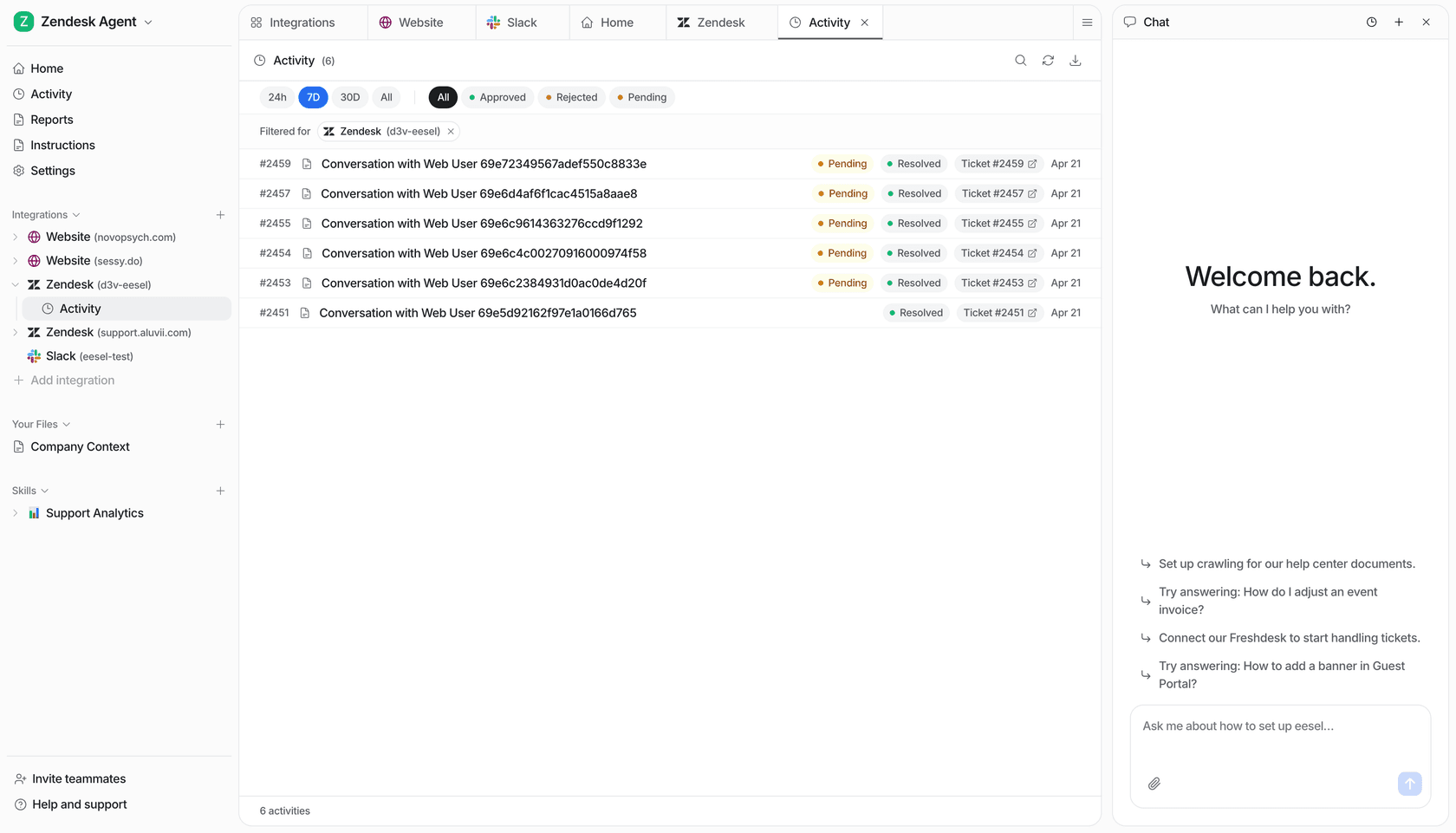
The piece I would point a skeptical engineer at first is the simulation. Before eesel answers a single live ticket, you can run it over your historical ones and see exactly what it would have said, which is the only honest way to find out whether a model's confidence is earned on your own data, rather than on a benchmark. After that, confidence-based routing decides what it answers and what it leaves alone, and pricing is a fixed monthly credit plan (1 credit per ticket or chat, from $299 a month for 500 credits) rather than per token, so a chatty model never surprises you at the end of the month.
It is not for everyone, to be clear. If your use case is code, use Claude Code directly. But if it is a support queue, and a quarter of rebuilding ticket deflection, plus escalation, on top of a fresh API key was the plan, try eesel first. It is free to start.
Frequently Asked Questions
Is Claude Opus 5 worth it compared to Opus 4.8?
How much does Claude Opus 5 cost?
Is Claude Opus 5 better than Claude Fable 5?
Can I use Claude Opus 5 for customer support?
What breaks when migrating to Claude Opus 5?
max_tokens, and disabling thinking returns a 400 error at xhigh or max effort. Web fetch and Priority Tier are also missing on Opus 5. The new tokenizer counts up to 35% more tokens for the same text, so re-baseline your costs rather than reusing old estimates. Anyone wiring it into agents should also read our model selection guide.