The AI world saw two major releases on February 5, 2026. In a single day, we saw the release of both OpenAI’s GPT-5.3 Codex and Anthropic’s Claude Opus 4.6. This isn't just another small update. It feels like the start of a new chapter in AI-powered coding.
Both companies are advancing beyond simple code completion. We're now talking about AI agents that can tackle complex, multi-step projects with a new level of independence. They are evolving from assistants into collaborators and, in some cases, independent workers.
So, what’s the real difference between them? Let's break down what you actually need to know. We’ll look at what each model is built for, how they stack up on key performance tests, what makes their new "agentic" features unique, and what this all means for the future of AI in your business.
What is OpenAI’s GPT-5.3 Codex?
OpenAI has been a major player in AI coding models for a while, and GPT-5.3 Codex is their latest creation. They’re positioning it not just as a tool that helps you write code, but as a specialist agent designed to handle the entire lifecycle of professional work you do on a computer. Think of it less as a coding assistant and more as an autonomous software developer.
The announcement came with some significant claims. First off, Codex is designed to be a full-fledged agent that can operate your computer to debug code, deploy applications, and even write product documentation. It's a significant leap from just suggesting lines of code in an IDE.
One of the notable details is that Codex was the "first model that was instrumental in creating itself." The OpenAI team actually used it to debug its own training processes and manage its deployment. It's literally AI building AI, which is a significant milestone.
When it comes to performance, the numbers are noteworthy. It's achieving high scores on tough coding benchmarks like SWE-Bench Pro (56.8%) and Terminal-Bench 2.0 (77.3%), which test its ability to solve real-world software engineering problems and use a command line. To bring all this power to your desktop, OpenAI also launched the new Codex app for macOS, which acts as a command center for managing multiple AI agents working on different tasks at once.
What is Anthropic’s Claude Opus 4.6?
Anthropic has always built its reputation on creating reliable, safe, and controllable AI systems. Claude Opus 4.6 is the next step in that mission. It's their top model, designed for complex knowledge work, deep reasoning across huge amounts of information, and collaborative, agent-like workflows for businesses.
The headline feature is its massive 1M token context window (currently in beta). This is significant because it helps solve the "context rot" problem, where models forget the beginning of a long conversation by the time they reach the end. With a million tokens, you can feed it an entire codebase or a massive novel, and it can reason across the whole thing without losing its train of thought.
Opus 4.6 also introduces a feature called "Agent Teams" in Claude Code. This lets you spin up multiple AI agents that can coordinate on a single project together, much like a human software team would. One agent could handle the frontend, another the API, and a third could manage the database migration, all working together.
On the performance side, Opus 4.6 is showing leading results on benchmarks that test complex reasoning and knowledge work, like GDPval-AA and BrowseComp. It's also making moves with new productivity integrations, including a research preview for using Claude directly within PowerPoint and an enhanced ability to work with tools like Excel.
Key differences between GPT 5.3 Codex and Claude Opus 4.6
They're both powerful, but they're not the same. They’re built with different philosophies in mind and shine in different areas. Let's break down how they really stack up.
Performance and benchmarks
When you look at the raw numbers from the official announcements, a clear picture starts to form.
Codex's strengths are in pure software engineering. It scores highly on benchmarks that test raw coding ability and command-line execution. For example, its 77.3% score on Terminal-Bench 2.0 is notably higher than Opus's 65.4%. This makes it a suitable choice if your main goal is to automate software development tasks.
Opus's strengths, on the other hand, are in areas that require deep reasoning and long-context analysis. It's the industry leader on benchmarks like GDPval-AA and BrowseComp. Interestingly, while its standard SWE-Bench score isn't specified against Codex's "Pro" version, a modified approach using specific prompting gave it an 81.42% score on SWE-Bench Verified, showing its nuanced power when guided correctly.
Here’s a quick look at the scores side-by-side:
| Benchmark | GPT-5.3 Codex | Claude Opus 4.6 | Winner |
|---|---|---|---|
| Terminal-Bench 2.0 | 77.3% | 65.4% | GPT-5.3 Codex |
| SWE-Bench Pro | 56.8% | Not specified | GPT-5.3 Codex |
| SWE-Bench Verified | 80.0% | 81.42% (with modification) | Claude Opus 4.6 |
| OSWorld-Verified | 64.7% | 72.7% | Claude Opus 4.6 |
| GDPval-AA | Lower than Opus | Industry Leader | Claude Opus 4.6 |
| BrowseComp | Not specified | Industry Leader | Claude Opus 4.6 |
codex imo is far better. Opus is only good when you give it a big issue to sole. Codex with a single problem is far better imo.

Agentic capabilities
Numbers are one thing, but the real difference is in their big-picture vision for AI agents.
Codex's vision is an evolution from a simple code writer to a "computer operator." The new macOS app is the centerpiece of this vision. It acts as a command center where a single user can direct and manage a fleet of powerful agents in real-time. You're the conductor, and the agents are your orchestra.
Opus's vision is more about collaborative, multi-agent systems. The "Agent Teams" feature allows agents to autonomously divide complex projects and coordinate with each other, mimicking how a human software team operates. It’s less about a single user directing everything and more about setting a goal and letting the AI team figure out how to get there.
Security, safety, and enterprise readiness
With all this power comes a big question: can you trust it? Especially if you're running a business.
Codex is classified by OpenAI as having "High capability" for cybersecurity tasks, both offensive and defensive. To manage this, they've launched a Trusted Access for Cyber framework, which provides tiered access to cyber defenders and is backed by a $10M fund to promote AI-powered cyber defense.
Opus comes from Anthropic's foundational focus on AI safety, which is baked into its design via Claude's Constitution. For businesses, they back this up with enterprise-grade compliance, including certifications like SOC 2, ISO 27001, and HIPAA readiness, all detailed on their Trust Center.
Why does this matter? Because adopting powerful AI in a business isn't just about what it can do; it's about trust. Knowing that these models are built with solid safety measures and verifiable compliance is critical for any team looking to integrate them into their workflows.
Pricing and accessibility
So, how can you get your hands on these new models, and what will they cost?
GPT-5.3 Codex is available right away for anyone with a paid ChatGPT plan. You can access it through the new Codex app, a CLI tool, and IDE extensions. However, API access is still rolling out, and the pricing for it hasn't been announced yet.
Claude Opus 4.6 is also available immediately via the Claude API. Anthropic is keeping the same pricing as its predecessor: $5 per million input tokens and $25 per million output tokens. There's a catch, though: if your prompt exceeds 200,000 tokens, a premium price of $10/$37.50 applies.
My point being, they should not be comparable. There is a 80$ a month pricing gap here. It is one MacBook Air of difference a year. I feel like Anthropic should wake up a bit here, they can ride OpenAI crazy finance approach to a certain extent, but if they start losing 'pro' customers because their pricing is 4x for no significant better performance, they might get in big troubles later down the line.
For a more in-depth visual breakdown and live reactions to these new models, the following video provides a full analysis of the day-one features and capabilities of both GPT-5.3 Codex and Claude Opus 4.6.
Which model should you choose?
You should choose GPT-5.3 Codex if your main goal is to automate highly specific, complex software development and engineering tasks. It’s a powerful, fast, and increasingly autonomous agent that’s designed to operate your computer and generate code.
You should choose Claude Opus 4.6 if you need a reliable AI for deep reasoning across huge amounts of information, complex knowledge work, and collaborative business projects that can be divided among a team of agents. It’s more of a strategist than a pure-play engineer.
But for most businesses, the real question isn't which low-level engine to use. It's how to apply AI to solve immediate problems without needing a team of developers to do it.
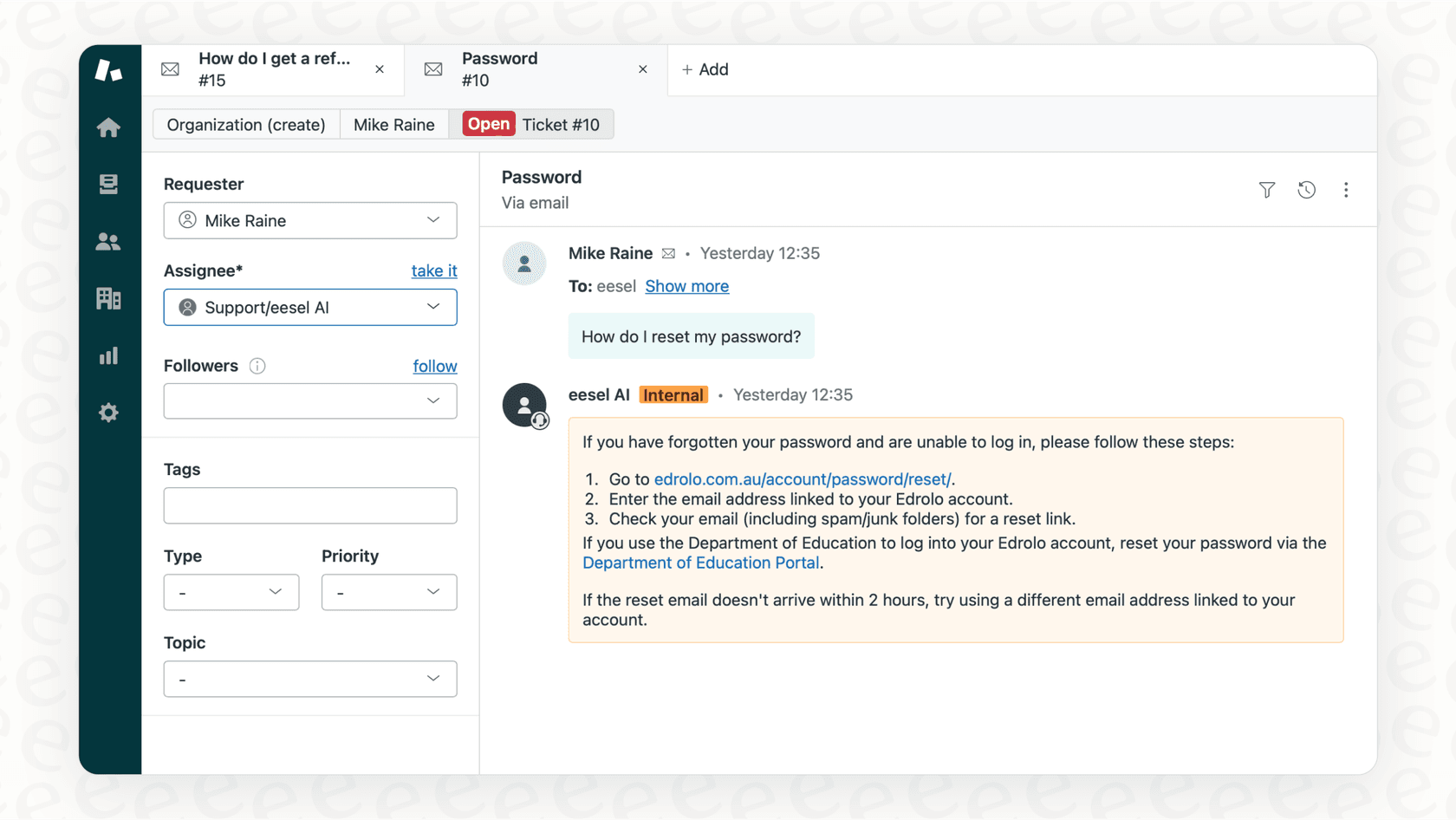
Frontier models like Codex and Opus are pushing the boundaries of what's possible, but they require significant technical expertise to implement effectively. If you're looking to hire an AI teammate that's ready to handle customer support from day one, see how eesel AI can join your team. It learns from your existing help desk data in minutes and can start resolving tickets autonomously, no coding required.