On February 5, 2026, Anthropic announced Claude Opus 4.6, a significant update in the AI field. This model represents a substantial advancement, particularly for tasks like agentic coding, deep reasoning, and managing complex business workflows.
You can think of it as a new engine for AI applications. In this post, we'll provide a straightforward rundown of what Claude Opus 4.6 is and why it matters. It's helpful to think of these powerful models as foundational building blocks, similar to an engine rather than a complete car. This distinction is important because it highlights the difference between a general-purpose model and a specialized, ready-to-use solution.
What is Claude Opus 4.6?
Claude Opus 4.6 is the latest "frontier model" from Anthropic. They're an AI research company that's also a public benefit corporation, which means their goal is to build AI that's safe and genuinely useful.
A "foundational model," in plain English, is a powerful, all-purpose AI that can be trained for many different jobs. Think of it like a brilliant new hire who can learn anything but doesn't have a specific role yet. You have to show them the ropes.
Compared to the last version, Opus 4.6 is a significant upgrade. It is better at planning its work, can stay on track with long, complicated tasks, and is more dependable when dealing with massive codebases.
The feedback from early partners is already positive. The AI Lead at Notion mentioned, "For Notion users, it feels less like a tool and more like a capable collaborator." This highlights the model's capacity for complex tasks beyond basic question-answering.
As a legal professional, I just tested Opus 4.6 on some of my own legal drafts for corrections and stylistic improvements. I have to say, I'm beyond impressed. It didn't just suggest the most appropriate amendments in seconds, but it also offered to generate the final document with all the accepted changes integrated. I was able to download the polished file instantly. A task that would normally take me over two hours of meticulous work was finished in about 15 minutes. For legal tech workflows, this is a massive step up.

Key capabilities and performance benchmarks
Claude Opus 4.6 is raising the bar in a few important areas. Let's look at what it does best.
State-of-the-art agentic performance
You've probably heard the term "agentic" AI popping up more and more. It simply means an AI that does more than just answer a question. It can plan, execute a series of actions, and use various tools on its own to get a job done.
Opus 4.6 performs well on tests that measure this ability. It is hitting top scores on benchmarks like Terminal-Bench 2.0 (which focuses on agentic coding) and Humanity’s Last Exam (which tests high-level reasoning).
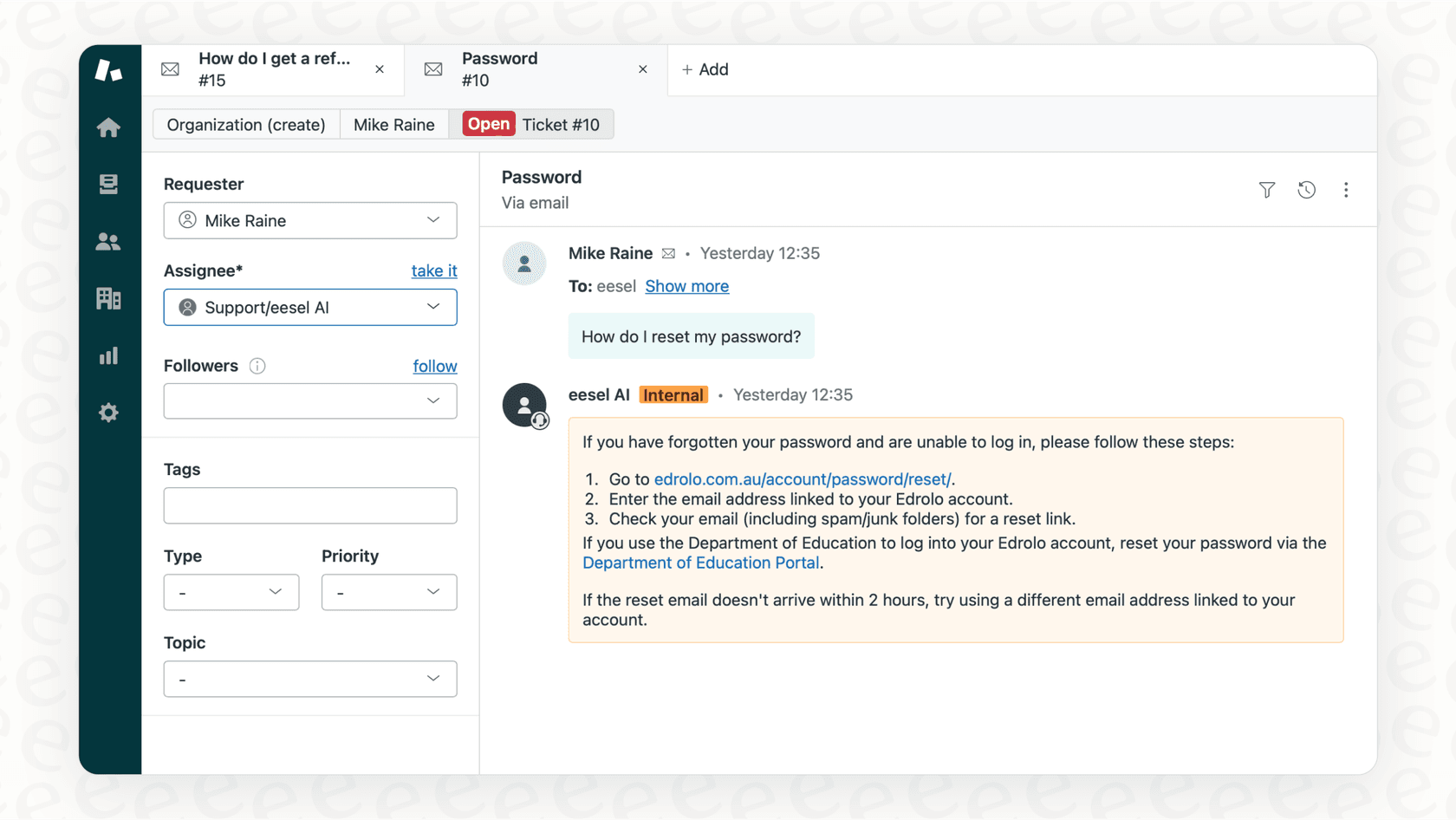
Partners are clearly impressed. Replit described it as "a huge leap for agentic planning," and Asana noted its capabilities are "exceptional at powering our AI Teammates." This type of agentic power is leveraged by specialized business solutions like eesel's AI Agent. Such systems apply these principles to tasks like handling customer support tickets autonomously, with reported resolution rates of up to 81%. This represents a shift from an AI suggesting a reply to an AI that can resolve an issue.
Enhanced long-context reasoning
Have you ever been in a long conversation and had to repeat something because the other person forgot what you said ten minutes ago? AI models can do that too, and it's called "context rot." They lose track of information in long documents or chat histories.
Opus 4.6 has made a huge improvement here. It scored 76% on the 1M token needle-in-a-haystack test. This means it’s good at finding one tiny piece of information buried in a massive document, like something the size of a 1,500-page book. Anthropic calls this a "qualitative shift," and they're right. For businesses, this means the AI can reliably go through long reports, legal documents, or project histories without missing key details.
Benchmark scores
Here’s a quick look at how it performs in different professional fields.
| Benchmark | Domain | Claude Opus 4.6 Result | Key Insight |
|---|---|---|---|
| GDPval-AA | Knowledge Work | Outperforms GPT-5.2 by ~144 Elo points | State-of-the-art on real-world finance, legal, and other professional tasks, per independent analysis. |
| Terminal-Bench 2.0 | Agentic Coding | Highest industry score | Best-in-class at complex, real-world coding and system administration tasks. |
| Humanity's Last Exam | Multidisciplinary Reasoning | Leads all other frontier models | A significant leap in expert-level reasoning across complex academic domains. |
| BrowseComp | Agentic Search | Better than any other model | Excels at finding hard-to-find information online through multi-step search. |
| Context Compaction | Long-Context Reasoning | 76% on 1M token needle-in-a-haystack | A qualitative shift in the ability to recall information from massive documents. |
| CyberGym | Cybersecurity | Outperforms other models | Better at finding real vulnerabilities in codebases. |
New API features for developers
For developers building custom applications, the Claude API provides several new features.
Adaptive thinking and the effort parameter
A notable new feature is "Adaptive Thinking." The model can now figure out on its own when it needs to "think harder" to solve a tough problem. Developers can control this with a new "effort" parameter, which has four settings: "low", "medium", "high" (the default), and "max".
This gives you a way to balance intelligence, speed, and cost. If you need a quick, cheap answer, you can set the effort to "low". If you're dealing with a really complex problem, you can crank it up to "max". It's a flexible way to manage how the model works.
Context compaction and larger outputs
To help with those really long conversations, "Context Compaction" automatically summarizes the chat history so the agent doesn't run out of memory. It's a smart way to have almost endless conversations without bumping into technical limits.
The model also now has a 1M token context window (which is currently in beta) and can produce much longer answers, with a maximum output of 128k tokens.
While these are powerful tools for engineers, an alternative is to use a pre-built platform. Solutions like eesel AI offer a different approach where users can guide an AI agent with simple instructions in plain English, such as, "If a customer asks for a refund, check their order date first." This allows teams to leverage the technology without direct API management.
Plain English AI Configuration vs. Claude Opus 4.6 API
A GIF of the eesel AI platform being configured with simple, plain English commands, an alternative to using the Claude Opus 4.6 API directly.
How to access the model
So, how can you start using this new model? Since it's a foundational model, you'll usually get to it through another platform or service.
- Directly via Claude.ai: Individual users can get to it through the web interface on the Pro, Max, Team, and Enterprise plans.
- Through the Claude API: Developers can start building with it by using the "claude-opus-4-6" model ID in their API calls.
- On Cloud Platforms: It’s available on major cloud services like Amazon Bedrock, Google Cloud's Vertex AI, and Microsoft Foundry.
- Inside Developer Tools: It's now available for users of tools like GitHub Copilot.
Pricing
Anthropic has kept the pricing simple. Here’s what it looks like for API use:
- Standard API Pricing: $5 per million input tokens / $25 per million output tokens.
- Premium Long-Context Pricing: For prompts over 200,000 tokens long, the price goes up to $10 per million input tokens and $37.50 per million output tokens.
- Data Residency: If you need your data to be stored in the US, you can do that for a 1.1x multiplier on the standard price.
- Cost-Saving Features: Developers can cut costs by up to 50% by using batch processing for tasks that aren't time-sensitive.
A powerful engine vs. a ready-to-go teammate
Claude Opus 4.6 is a highly capable foundational model. It’s stretching the limits of what AI can achieve, especially with agentic coding, deep reasoning, and sifting through huge amounts of data.
It is useful to remember the distinction between a powerful engine and a complete car. A foundational model, like an engine, typically needs to be integrated into a practical application to deliver business value.
To see the model's capabilities in action, this video provides a full breakdown with real-world examples that demonstrate how its new features perform on various tasks.
Developers can create custom solutions with the Opus 4.6 API. For companies seeking a ready-to-use option, platforms like eesel AI provide an alternative. These platforms integrate with existing help desks and knowledge bases to provide a functional AI agent quickly.
For businesses looking to implement agentic AI without building a solution from the ground up, pre-built AI teammates offer a viable path.
To learn more about how agentic AI can be applied, you can see how eesel automates support.