


Per token, Claude Opus 5 costs 1.67x what Claude Sonnet 5 costs. On long-running agentic work it still finishes the job cheaper. Take Artificial Analysis's AA-Briefcase benchmark. Opus 5 at high effort: 1606 Elo, $10.41 per task. Sonnet 5 at max landed on 1386 Elo, and the bill there was $14.43. More quality for less money, out of the model carrying the bigger sticker price.
A blanket win it is not. Short benchmark tasks reverse the order, and there Sonnet 5 at max comes in as the cheapest of the two. What decides it is the effort setting, plus how long the job runs. The model name matters less than either. Most developers landed on one rule in the first week. Run Sonnet 5 at low or medium. When that is not enough, switch models instead of turning Sonnet's dial up.
Before you build any budget on this, one dated item. Sonnet 5's $2 / $10 introductory pricing ends August 31, 2026, and then it becomes $3 / $15. So a cost model you make today is compared against a rate with about five weeks left on it.
And maybe you are reading this because a model has to answer real customer tickets. Then the model tier is the least of it. I build integrations at eesel. What actually decides whether an agent survives contact with a live queue: testing it against past tickets, then gating replies on confidence. Handing off cleanly counts too. The pricing there is one credit per ticket, from $299 a month for 500 credits. Not per token.
Why I am not answering this with a spec sheet
Never trust the price list. That is the one habit three years of shipping AI agents onto other people's support queues has taught me. I have watched a trial user run twelve clean test conversations and love every answer. Then they opened the billing page, and filed a cancellation request right away. Between those two moments nothing about the product had changed. What changed was only this: the abstract per-unit number turned into a real bill.
The same trap sits inside the Claude Opus 5 vs Sonnet 5 question. Per million tokens, Opus 5 lists at $5 in and $25 out. For Sonnet 5 the list is $3 and $15. Stop the reading there and you pick Sonnet, and a good share of the people who do that will spend more.
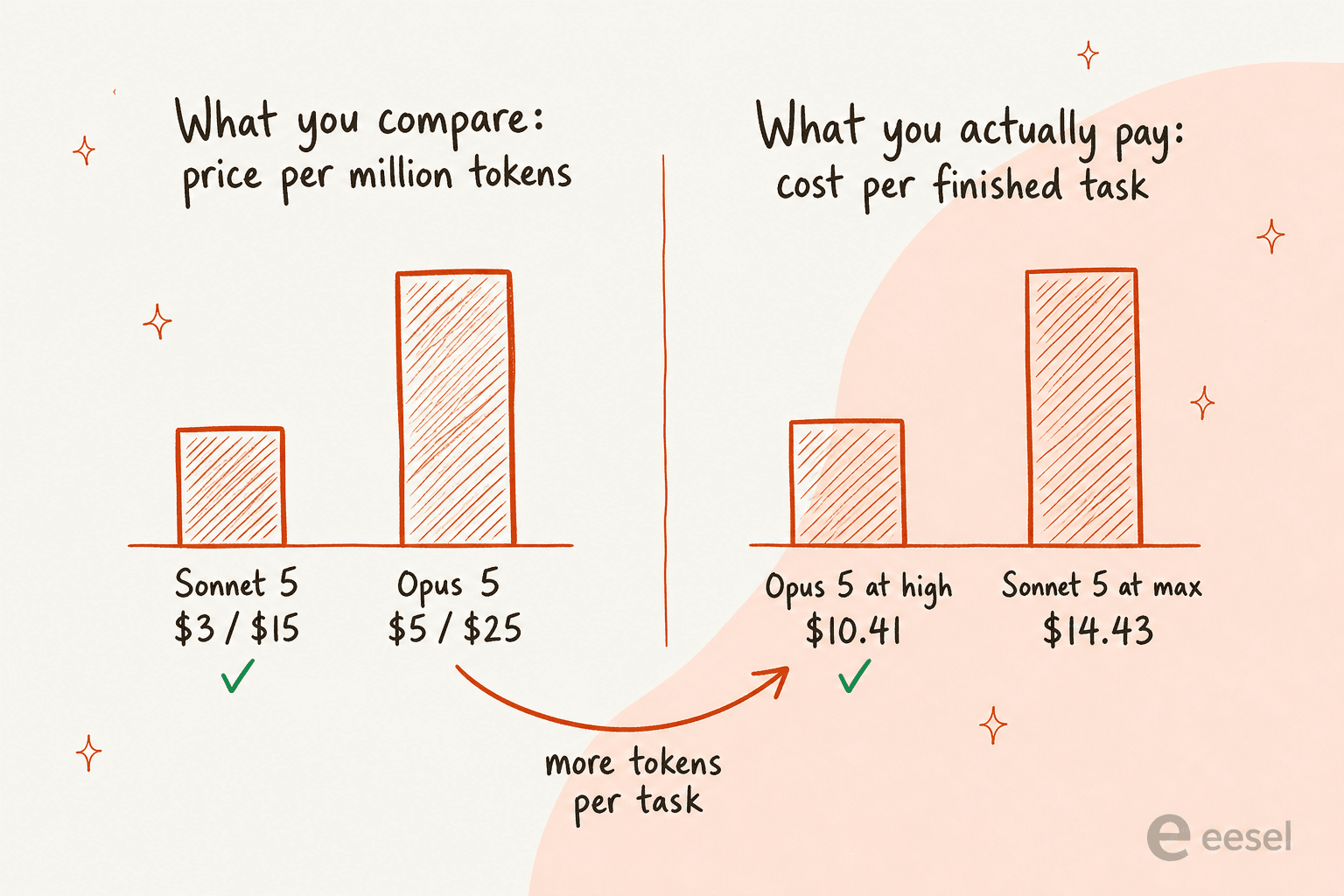
So the order of this piece goes: the specs first, benchmarks after that, then what the bill actually looks like. It ends on a routing rule which you can apply this afternoon.
What Claude Opus 5 is
Claude Opus 5 launched on July 24, 2026, and Anthropic describes it as coming close to the frontier intelligence of Claude Fable 5 at half the price. The API id is claude-opus-5, it holds a 1M token context window together with 128k max output, and the reliable knowledge cutoff sits on May 2026.
The positioning here is unusually direct. Anthropic's docs tell you to start with Claude Opus 5 for the complex agentic coding and enterprise work, and to step up on Fable 5 only when the absolute ceiling is what you need. Worth to flag: Sonnet 5 does not appear inside that recommendation at all.
Price did not move from Opus 4.8, it is still $5 and $25. Behaviour is the thing that moved. Thinking is now on by default, which means a request that previously ran thinking-free will spend tokens on reasoning now, unless you say otherwise. I dug through the full upgrade path in my Opus 5 review, and the Fable 5 head-to-head covers the tier above.
What Claude Sonnet 5 is
Claude Sonnet 5 shipped June 30, 2026, pitched as "the most agentic Sonnet model yet" and, in Anthropic's own words, close to Opus 4.8 in performance but at lower prices. The 1M context is the same, and so is the 128k output ceiling. Five effort levels on both as well. It is also the default model on Claude's Free and Pro plans, which makes it the Claude that most people are using without ever choosing it.
There is two things about it that are easy to miss.
First, the comparison anchor for it is Opus 4.8, not Opus 5. Sonnet 5 launched three and a half weeks before Opus 5 existed, so Anthropic has never published a Sonnet 5 versus Opus 5 comparison. Every head-to-head that you read, this one also, gets assembled out of two separate launches.
Second, the headline benchmark scores for Sonnet 5 are published as an image on the product page, not as text. On July 27 I re-checked the launch post, the product page and also the docs, and the numbers still stay locked inside a PNG. So wherever I quote a Sonnet 5 figure below, it comes from Anthropic's Opus 5 system card or from an independent evaluation, never from a number I could not verify. The deeper look on the model itself lives in my Sonnet 5 review, while the alternatives roundup covers what else fits that slot.
The spec comparison
Everything here comes out of Anthropic's models comparison table and the pricing docs, plus the migration guide.
| Claude Opus 5 | Claude Sonnet 5 | |
|---|---|---|
| API id | claude-opus-5 | claude-sonnet-5 |
| Input / output per MTok | $5 / $25 | $3 / $15 (intro $2 / $10 to Aug 31, 2026) |
| Batch API rate | $2.50 / $12.50 | $1.50 / $7.50 (intro $1 / $5) |
| Context window | 1M tokens | 1M tokens |
| Max output | 128k (300k on Batch) | 128k (300k on Batch) |
| Effort levels | low to max, five settings | low to max, five settings |
| Adaptive thinking | Yes, on by default | Yes, on by default |
| Comparative latency | Moderate | Fast |
| Reliable knowledge cutoff | May 2026 | Jan 2026 |
| Minimum cacheable prefix | 512 tokens | 1,024 tokens |
| Fast mode | Yes, $10 / $50 | No |
role: "system" inside messages | Yes | No |
| Long-context surcharge | None | None |
Four of the rows there change on how you build, not only what you pay.
The knowledge cutoff gap is four months wide, and it runs in the direction you maybe do not expect: the expensive model is the fresher one here. Opus 5 knows May 2026, while Sonnet 5 stops on January.
The 512-token cache floor on Opus 5 is a half of Sonnet 5's. Short system prompts which were silently uncacheable on Sonnet become cacheable on the Opus, and a cache hit costs 10% of base input. On a high-frequency, short-prompt workload this quietly narrows the price gap.
Fast mode is Opus-only. At $10 / $50 for roughly 2.5x the output speed, fast mode stays a research preview on the first-party API only, so it is off the table for Bedrock and the partner clouds.
And role: "system" inside the messages array works on Opus 5, while it is not supported on Sonnet 5. If you have been rebuilding the whole message histories just to update instructions mid-run, Opus 5 lets you stop that, and without losing prompt cache hits on the earlier turns. It is a real code-path simplification, and it is also the kind of detail which never shows up on a benchmark chart. For picking an API across vendors rather than within one, my three-way API comparison covers the wider field.
On capability, this is not close
Anthropic's Opus 5 system card is the one place where both models get measured on the same harness, and the gaps there are wide ones.
| Evaluation | Claude Opus 5 | Claude Sonnet 5 |
|---|---|---|
| Frontier-Bench v0.1 (terminal tasks) | 44.4% at xhigh | 17% |
| BBQ disambiguated accuracy | 81.6% | 72.4% |
| Protein design | 42.5% | 21.2% |
| Organic chemistry V2 | 61.6% | 40.6% |
| Prompt injection, browser use with auto mode | 0% attacks succeeded | 0% attacks succeeded |
Frontier-Bench is the row to sit with. It is the successor to Terminal-Bench 2.1, 74 harder tasks running in containerised terminal environments, and Opus 5 scores more than two and a half times what Sonnet 5 does. A tier difference does not describe that. For that kind of work it is a different class of tool.
Two honest caveats on this. Anthropic states in the system card that the safety classifiers of Opus 5 flagged and refused 5% of API calls inside that eval, falling back on Opus 4.8. And on the security row both models hold: neither one produced a working exploit on the Firefox 147 evaluation, and with auto mode enabled no prompt injection attack succeeded against either of them across 129 browser-use environments.
Now the part that decides it
Capability was never really the question here. With an unlimited budget you would just run Fable 5 for everything. The real question is what a finished piece of work costs, and this is the place where the two models stop behaving like their price tags.
Artificial Analysis ran both of them on AA-Briefcase, which is a long-horizon knowledge work benchmark built around multi-week projects with thousands of source files. Anthropic then reproduces the results inside the Opus 5 system card.
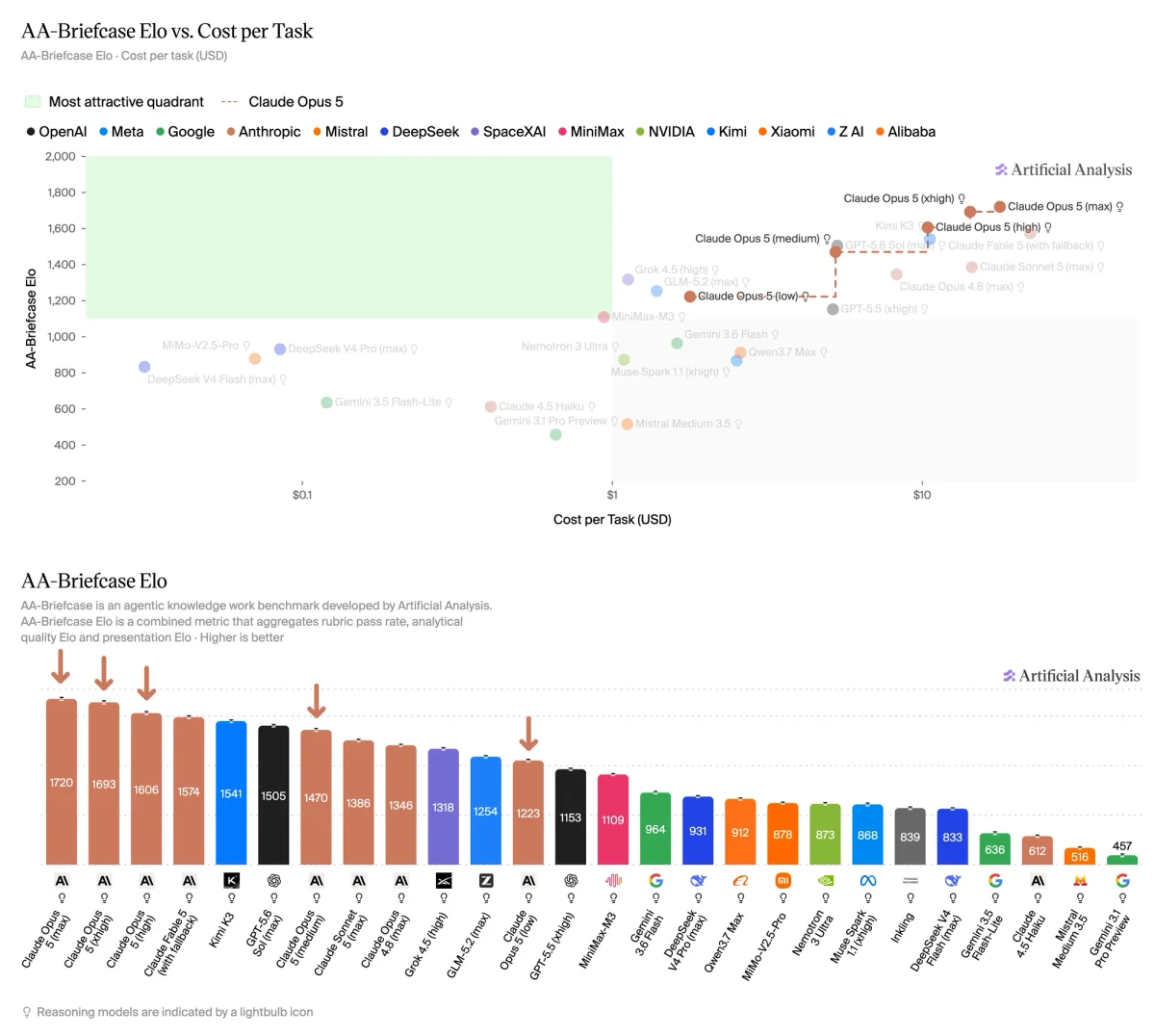
Opus 5 takes the top three slots, 1720, 1693 and 1606 Elo, for max, xhigh and high in that order. Sonnet 5 at max sits on 1386, which is below Opus 5 at medium (1470). Then comes the cost chart:
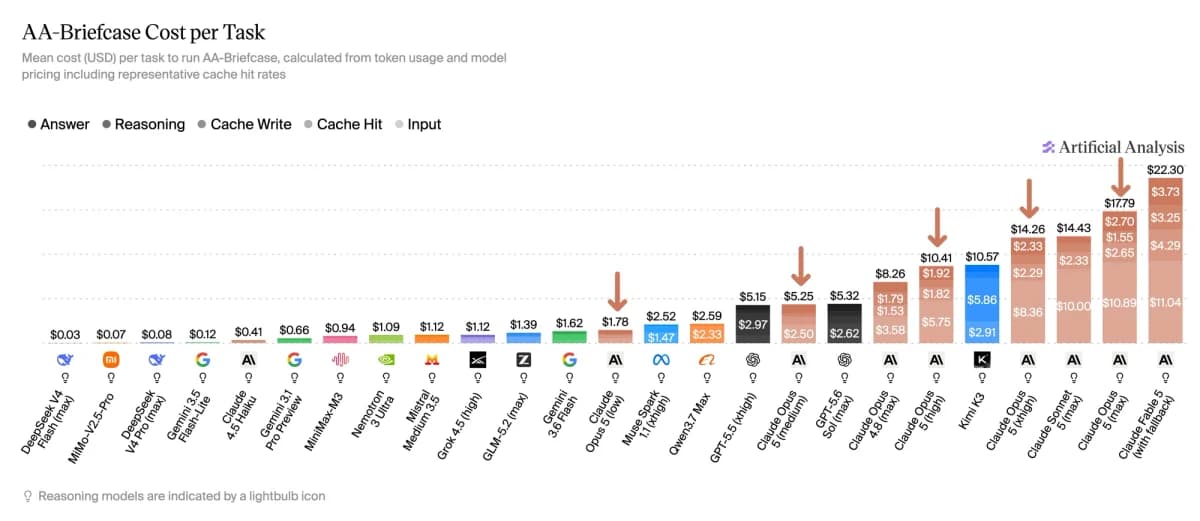
Line the two of them up and the result gets uncomfortable for the cheap model:
| Setting | AA-Briefcase Elo | Cost per task |
|---|---|---|
Opus 5 at max | 1720 | $17.79 |
Opus 5 at xhigh | 1693 | $14.26 |
Opus 5 at high | 1606 | $10.41 |
Opus 5 at medium | 1470 | $5.25 |
Sonnet 5 at max | 1386 | $14.43 |
Opus 5 at low | 1223 | $1.78 |
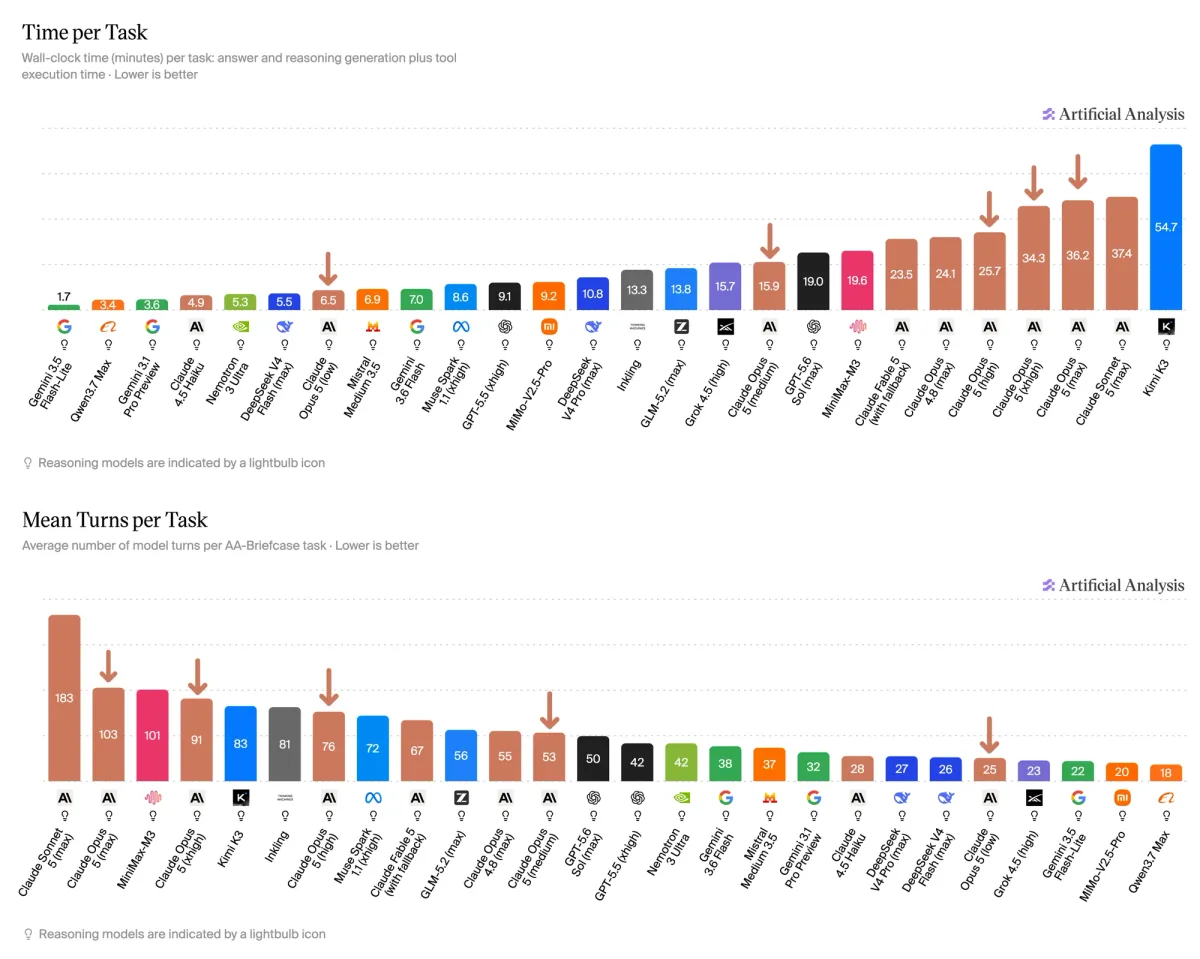
Opus 5 at high beats Sonnet 5 at max on quality, and it costs $4 less per task while doing that. Opus 5 at medium still beats it too, on roughly a third of the price. The turn counts is what explains why: Sonnet 5 at max averaged 183 turns per task, the highest of any model on the chart, against the 103 for Opus 5 at max.
Where the reverse is true
I would rather to flag this than let you find it later on. On the short tasks, the ordering flips. Artificial Analysis's Intelligence Index run puts it plainly:
"Frontier intelligence with reduced cost: Claude Opus 5 (max) costs $2.03 on average per Intelligence Index task, below Claude Fable 5 (with fallback) at $2.75, but still above Claude Opus 4.8 (max) at $1.80 and Claude Sonnet 5 (max) at $1.53. However, at high and xhigh reasoning efforts Opus 5 can outperform both Opus 4.8 and Claude Sonnet 5 at a lower cost per task"
So on index-scale tasks Sonnet 5 at max is the cheaper model, $1.53 against $2.03. On multi-hour agentic work the same model becomes nearly the most expensive thing on the board. Task length is the hinge. Short and shallow favours Sonnet, long and deep favours Opus, and there is no single "which is cheaper" answer that survives both of those.
Run your own numbers
Sticker rates are the easy part. The multiplier is the piece people skip, so this calculator makes you set it yourself. Drag it until it reflects how many more output tokens the cheaper model needs for finishing the same work, then watch where the two lines are crossing.
Two things to keep honest about it. The multiplier applies on output only, so it understates the gap a bit, because more turns also mean re-reading of more input. And this is arithmetic on list prices, not a benchmark: prompt caching, the Batch API discount and also your own prompt shape will all move the real number.
The mechanism which it encodes is not a theoretical one. One developer measured it directly:
"Sonnet is supposed to be the cheaper model, but on the harder task it:
Cheaper per token does not always mean cheaper per completed task."
took longerwrote more codeused more than twice the output tokensneeded more fixesstill cost more than Fableshricodev, Reddit

The effort dial is the real decision
Here is the reframe that I would want handed to me: you are not choosing between two models, you are choosing a point on a five-step effort dial, and the model name sits downstream from that choice.
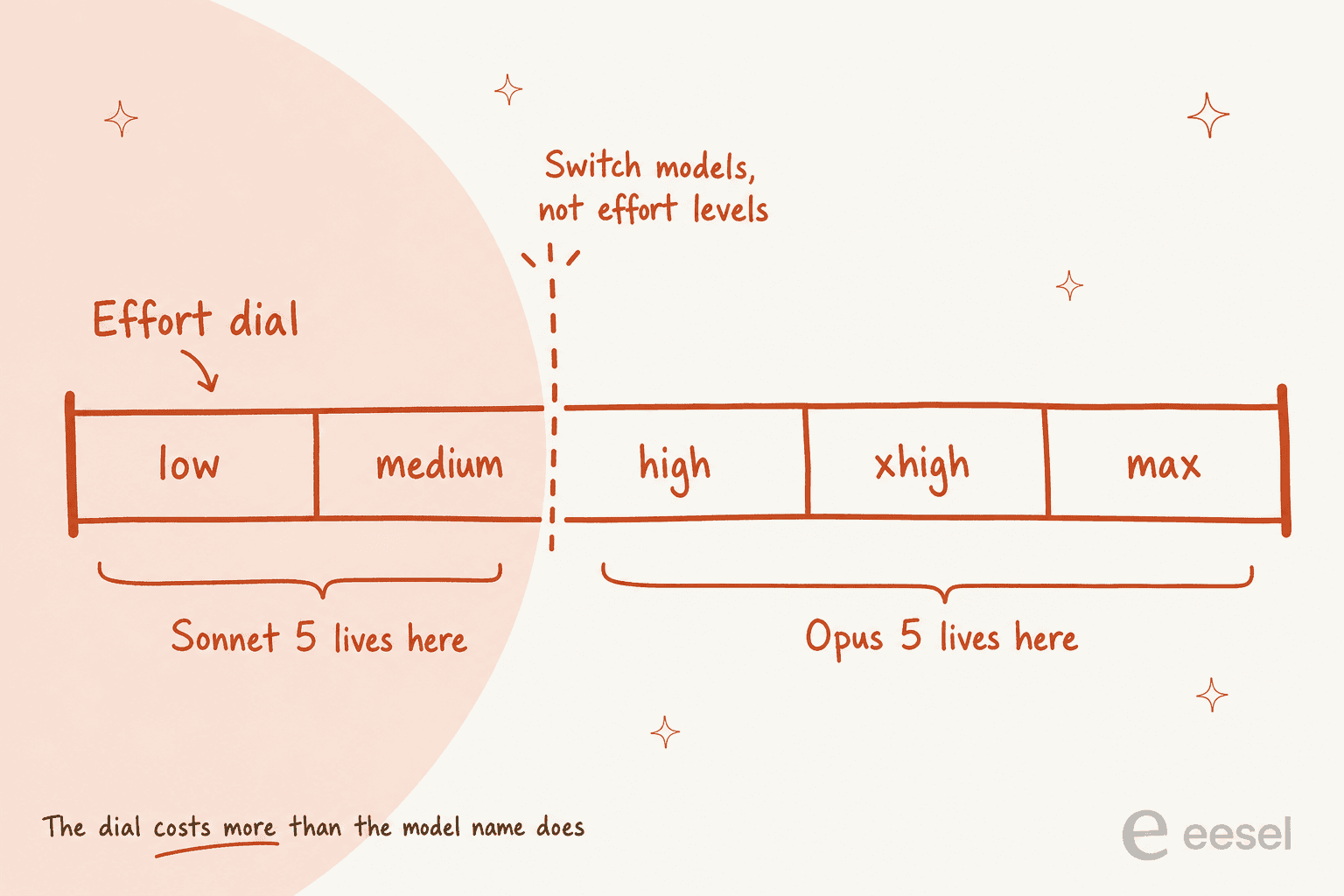
Both models take low, medium, high, xhigh and max, and both of them default to high on the API. The spread which that setting produces is enormous. On Anthropic's own AA-Briefcase run, Opus 5 spans from 1223 Elo at low up to 1720 at max, and the cost spans $1.78 to $17.79. Inside one model id that is a 10x cost range. The mistake is to call it "Claude Opus 5" as though it has one single performance profile.
Which is why the sharpest rule out of the first week is about the dial, and not about the tier:
"The cost per task chart is telling me that I should never use Sonnet 5 above medium effort level - Opus always performs better for a given cost. So I guess the takeaway is that if Sonnet 5 medium isn't good enough for you, switch models, not effort levels."

Other developers arrived on the same policy independently:
"If I'm using medium or low reasoning, I use Sonnet 5. If high or above, I use Opus 4.8. (Before 5, I was never using Sonnet. This is a Sonnet 5 vs Opus 4.8 comparison.)"
Applied on today's lineup, that means: Sonnet 5 at low or medium, Opus 5 at high and above, and nothing at Sonnet 5 max ever. If your instinct says to raise Sonnet's effort, this is the signal for changing models instead. The effort docs back it up from the other direction: Anthropic's guidance for Opus 5 flipped away from the 4.x era's "start at xhigh", to start at high and reach for low and medium as the primary cost control.
Practical companions, if you are wiring this into a workflow: my model selection guide and the context window notes. Also the wider Claude Code overview.
What people actually do: Opus plans, Sonnet implements
Ask developers which one of them they picked and most will refuse the question. The dominant pattern of the first week is a two-model pipeline.
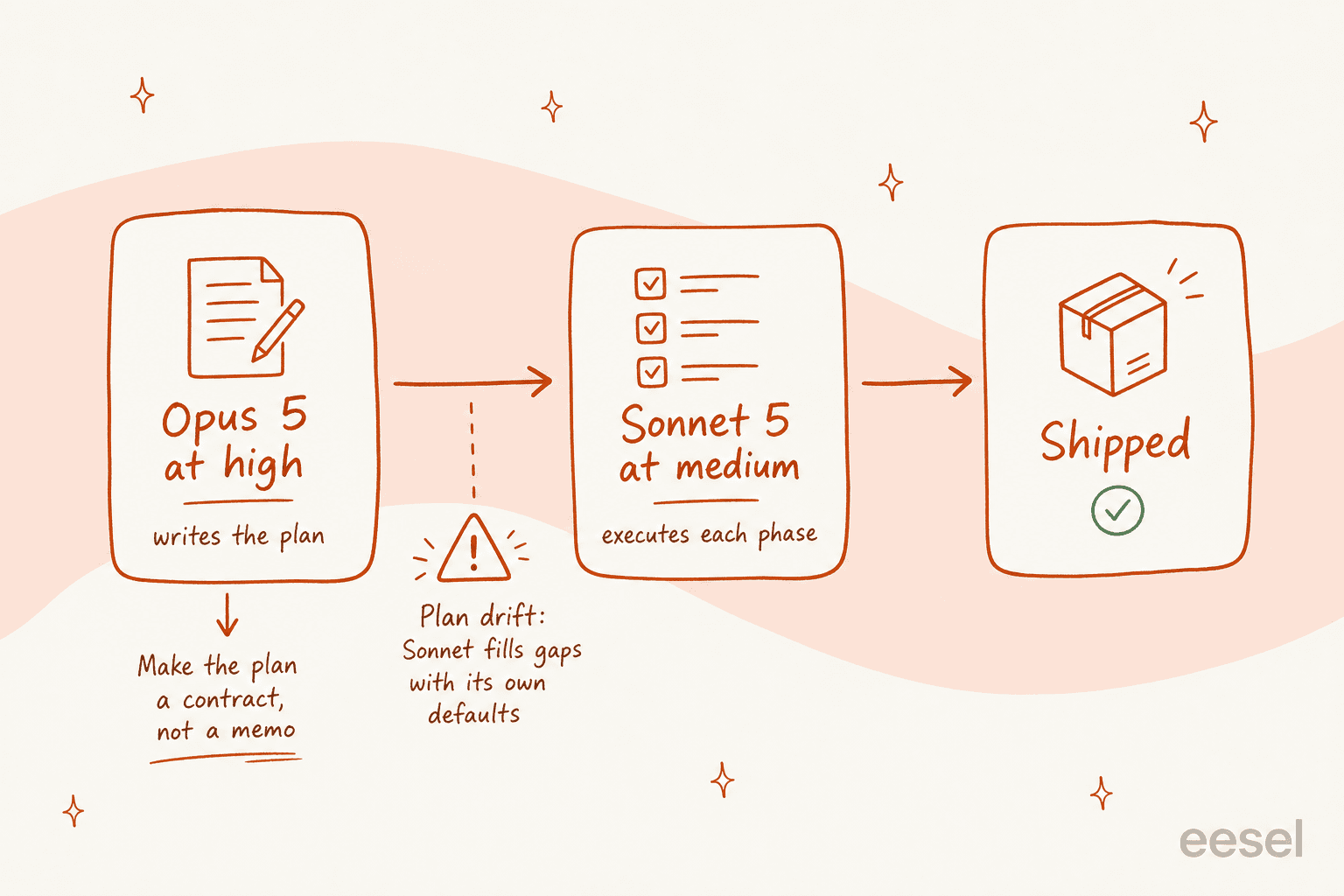
It doubles also as the fix for the most common Opus 5 complaint, the plan-limit burn:
"Control which subagents get spawned on your workflows. Opus 5 is spawning Opus 5 (most probably) and eating up your usage. Get a grip of the promo and use Opus 5 to orchestrate and Sonnet 5 to implement and that's it."
That burn is real, and it gets reported repeatedly. One user on the $20 plan put a number on the swap in the other direction: "Can confirm, I asked it to do one thing that I was getting Sonnet 5 to do and it used like 15% of my Pro usage limit." Other people say the opposite and cannot dent their Max quota with it at all, so treat the plan-limit reports as workload-dependent rather than as settled.
The pattern has one honest failure mode, and this one has a name:
"Sonnet 5 is great at following concrete specs but will fill in gaps with reasonable-sounding defaults that quietly diverge from what Opus intended."
The fix here is a tighter spec, not a better model. As one reply inside that thread put it, a plan detailed enough that the implementation becomes mechanical will not drift, no matter which model is running it. If you build this pipeline properly, Claude Skills and subagents are the containers, and my skills versus subagents breakdown covers which one does what.
One live gotcha which is worth knowing before you build on it. Developers on r/ClaudeCode report a hardcoded instruction inside recent Claude Code binaries that discourages Opus 5 specifically from delegating to subagents, and that would silently undercut an Opus-plans-Sonnet-implements setup. Worth to verify against your own version before assuming the routing is happening. My notes on MCP tools and on Claude Code best practices cover the surrounding plumbing.
The case for Sonnet 5, made fairly
Most of this post I have spent on explaining why the expensive model is often the cheap one, so let me give the other side it's due, because the support for it is real.
"I daily drive Sonnet 5/medium because it gets most things right most of the time at first try, while costing a lot less than Fable.
Opus can give better results on architectural/concept tasks and I use it sparingly, but it still costs more than Sonnet 5. Opus 5 seems to achieve results very close to Fable 5 while costing less (keeps Opus 4.8 pricing IIUC), but still more than Sonnet 5 then."
Sonnet 5 wins outright in four places. By Anthropic's own latency rating it is the faster model, which matters enormously for anything that is user-facing. On Claude's Free and Pro tiers it comes free and default. It is really cheaper on short, shallow, high-volume work, and that describes most production traffic. And at low or medium on a well-specified task, the quality difference frequently does not show itself in the output.
There is also a real constituency which argues the mid tier should not exist at all, and the Opus 5 launch sharpened that argument:
"Seeing Opus 5 vs Sonnet 5 or even Sol vs Terra, I really think it doesn't make sense having mid tier models, just train top tier and low tier, AI labs saves money and users have 1 less model to choose/try/discard, no?"
I do not agree with that one, and my reason is the routing pattern above: production systems are multi-agent, so orthogonal strengths beat a single intelligence ladder. It stays a live argument though, and not a fringe one. If you want to widen the field beyond Anthropic, my roundups of GPT-5.6 Sol alternatives and Kimi K3 alternatives cover the nearest competitors, and so does the Gemini 3.6 Flash review.
So which one should you use
The picking goes by the job here, not by preference:
| Your situation | Pick | Effort |
|---|---|---|
| High-volume, shallow, well-specified tasks | Sonnet 5 | low or medium |
| Anything user-facing where latency matters | Sonnet 5 | low or medium |
| You are on the Free or $20 Pro plan | Sonnet 5 | medium |
| Multi-step agentic work running unattended | Opus 5 | high |
| Planning, architecture, ambiguous problems | Opus 5 | high or xhigh |
| Long-horizon research across many files | Opus 5 | xhigh |
A task Sonnet 5 at medium failed | Opus 5 | high |
| Absolute ceiling, cost no object | Fable 5 | max |
Two anti-recommendations, stated plainly. Do not run Sonnet 5 at max. Every dataset which I found points on the same way: at that setting you pay Opus-scale money for the Sonnet-scale results. And do not default Opus 5 to max either. On every chart here it was the most expensive setting, while high or xhigh beat most of the field for a fraction of it.
If neither of them fits, Claude alternatives and my best AI agents roundup cover the wider market.
For the tooling around the model, best AI coding assistants covers the editors which these models sit inside of, and agentic coding CLIs is the companion piece for the terminal side.
Costs across the consumer tiers are living in my Claude Code pricing and Cowork pricing breakdowns. Below Sonnet there is one more cheaper tier again, and I covered that one in Haiku in Claude Code.
If the model is going to answer real customers
Everything above assumes that you are the one who holds the effort dial. When the plan is a support queue, that assumption breaks and the whole framing shifts.
A customer does not care that you routed their refund question on medium. What they care about is whether the answer was right. And the two numbers deciding that sit on none of the leaderboards above: what fraction of tickets the agent closes without a human, then how often it says something confidently wrong. Anthropic's own system card notes that Opus 5 hallucinates slightly more than Opus 4.8 despite being more accurate overall, and this is exactly the shape of problem which makes preventing hallucinations in support a product concern rather than a model one.
The unglamorous work stays the same, regardless of which Claude you picked. It starts with training on your knowledge base. After that comes gating the replies on confidence, and tracking resolution rate honestly instead of counting the auto-closed spam.
Then it is about keeping a human in the loop, plus designing when the AI hands off so that the customer never feels the seam. None of this ships together with an API key.
Practical guides on the rest: my ticket deflection walkthrough and the handoff best practices piece. There is the agent versus human cost breakdown too.
More on that vertical sits in my notes on AI for tech support.
Try eesel
If you got here because a support queue is the destination, then the honest answer to Claude Opus 5 vs Sonnet 5 is that the decision should not be yours to make at all. eesel picks and swaps the underlying model for you. It also simulates every rollout against your historical tickets before it touches a live conversation, and the billing is one credit per ticket (plans start at $299 a month for 500 credits) rather than per token. So the failure mode which this whole post is about, where the cheap model quietly runs up the bigger bill, never lands on you.
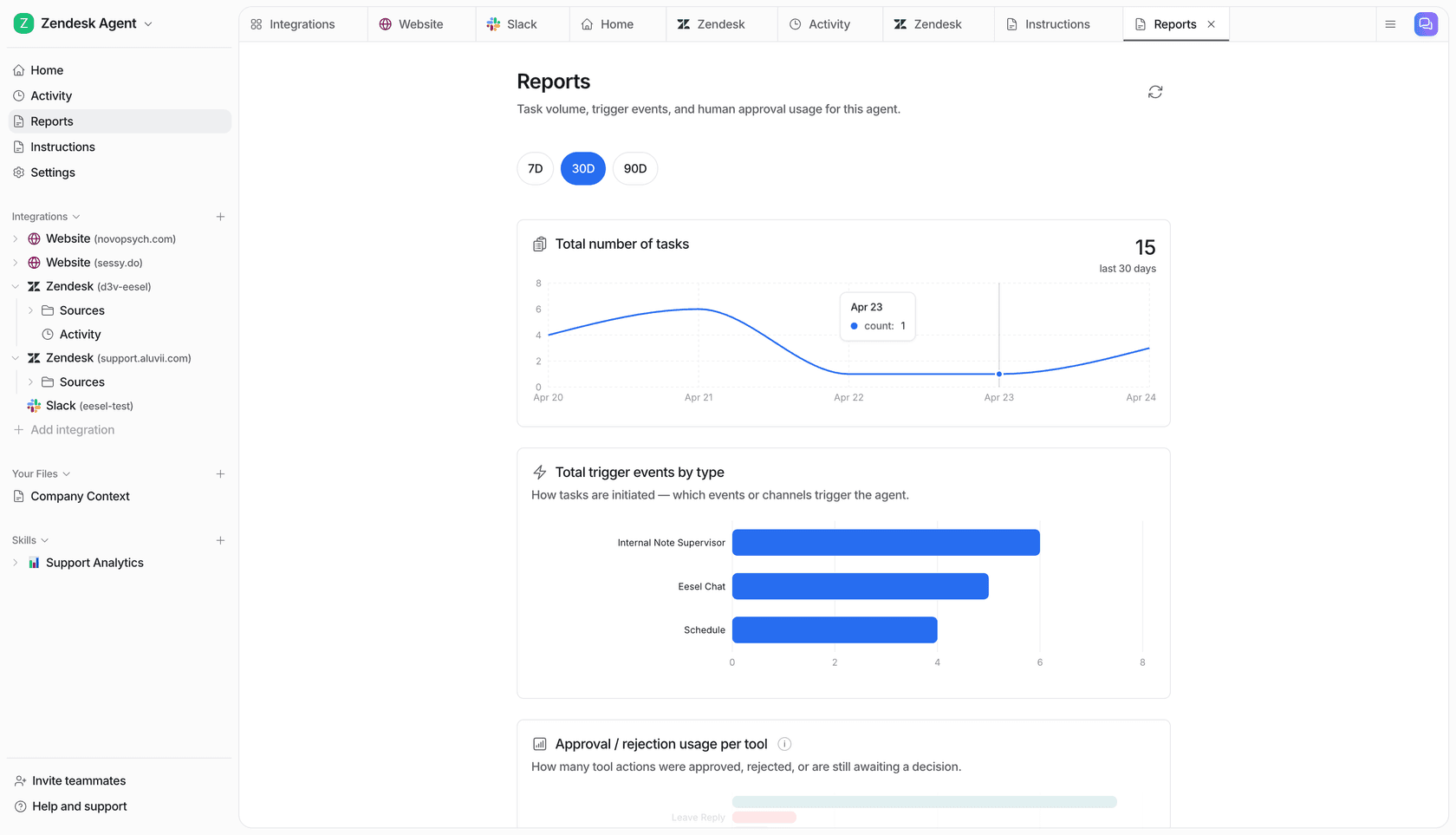
It plugs into the helpdesk which you already run and learns from the tickets you have already answered. And you can see what it would have said on real past conversations, before anyone external sees a word of it. Free to try.