

Can you actually get Claude Mythos 5.1?
Start here, because for most readers this is the whole question.
Claude Mythos 5.1 access check
Pick the description closest to your team. Every answer is drawn from Anthropic's own access pages as of September 2026.
Who are you?
Maybe, and not yet today
The Cyber Verification Program is the route. It already grants reduced cyber safeguards on Opus and Sonnet-class models, and Anthropic says Mythos-class access joins it in the near future. Applications go through the CVP portal.
Run today: Fable 5.1. It now identifies software vulnerabilities in source code, and Claude Code users see roughly 60% fewer cyber-safeguard interventions per session than on Fable 5.
Only by invitation
The Life Sciences Verification Program is an invite-only beta, built with the US government, that relaxes biology safeguards for professional R&D. First participants are enrolled; broader enrolment is promised but unscheduled.
Run today: Fable 5.1, whose biology safeguards now fire 85% less often on benign elementary biology and medical questions. Research-grade life sciences queries still route to Opus.
Ask your account team
Claude Mythos 5.1 is listed on the Claude API, Amazon Bedrock, Google Cloud and Microsoft Foundry, and the docs say to request access through your Anthropic, AWS, or Google Cloud account team. Availability is still restricted to a set of US organizations.
Run today: Fable 5.1 on the same platform, with Enterprise Frontier Safeguards arriving in phases this fall and zero data retention available to eligible customers in the meantime.
No, and that is unlikely to change soon
There is no self-serve path to Mythos 5.1. Both programs are organizational, vetted, and US-scoped. Nothing about a credit card or a usage tier moves you into them.
Run today: Fable 5.1 for the ceiling, or Opus 5 at $5 in and $25 out, which is what Anthropic's own docs tell most workloads to start on.
No, and you do not want it
Mythos 5.1's extra headroom is in cybersecurity and biology. Neither shows up in a refund request or a WISMO ticket. It is also the slowest and most expensive model in the family, on a queue where latency is what the customer feels.
Run today: Sonnet 5 or Opus 5 behind a layer that actually knows your product. The gap on a support queue is grounding and testing, not raw model tier.
What Claude Mythos 5.1 actually is
Claude Mythos 5.1 is Anthropic's Mythos-class frontier model, released on September 1, 2026 with the model ID claude-mythos-5-1. Its status in the docs reads "Active (invite only)", and retirement is committed no sooner than September 1, 2027.
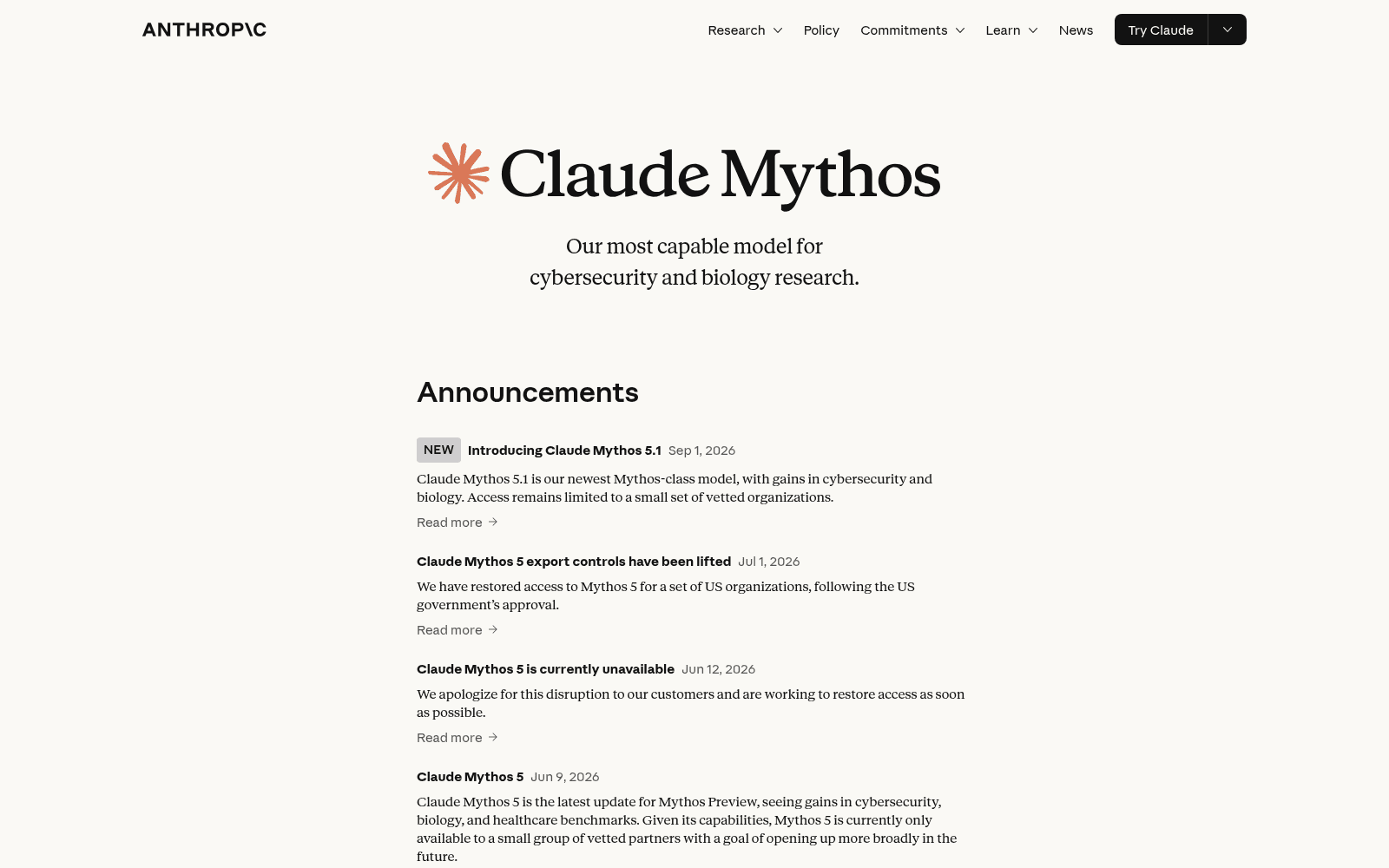
The Mythos line started as Claude Mythos Preview, the unreleased model that Anthropic used to launch Project Glasswing in April 2026. Mythos 5 followed on June 9, went unavailable on June 12, and had its export controls lifted on July 1 after US government approval. Mythos 5.1 is the third entry in that line, and the first that arrives alongside a generally available twin.
Here is the spec sheet, taken from the model page rather than the marketing copy.
| Spec | Claude Mythos 5.1 |
|---|---|
| Model ID | claude-mythos-5-1 |
| Released | September 1, 2026 |
| Status | Active, invite only |
| Context window | 1M tokens |
| Max output | 128K tokens |
| Thinking | Adaptive, always on |
| Default effort | high |
| Knowledge cutoff | June 2026 |
| Comparative latency | Slower |
| Input / output | Text and images, to text |
| Input price | $10 / MTok |
| Output price | $50 / MTok |
| Cache read | $0.25 / MTok |
| Platforms | Claude API, Bedrock, Google Cloud, Microsoft Foundry |
| Retirement | Not sooner than September 1, 2027 |
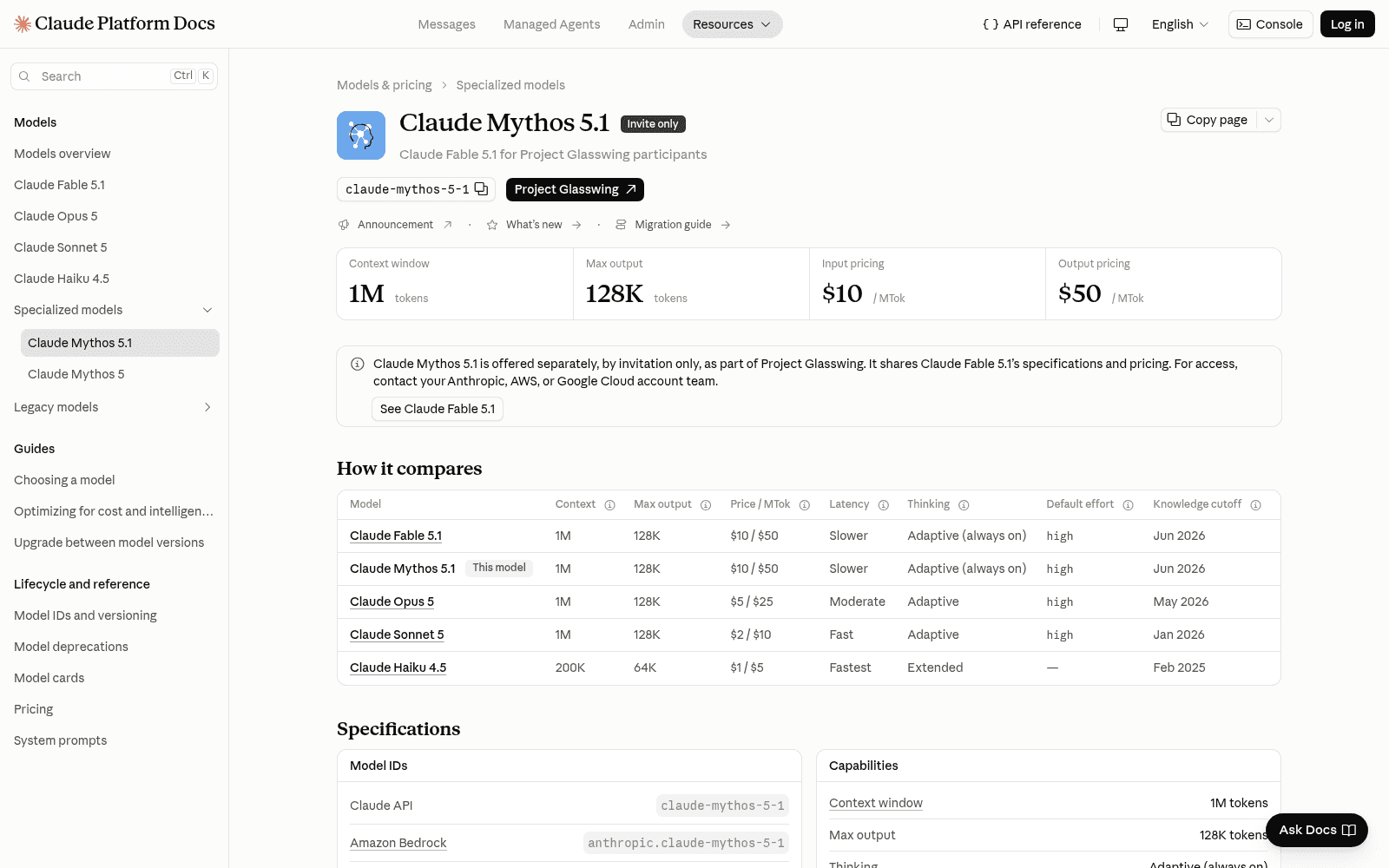
One more line worth reading twice: using Mythos 5.1 requires accepting a 30-day data retention policy for safety monitoring by default. That is a real procurement fact, and it is the mirror image of the zero-retention story Anthropic is telling on the Fable side.
Mythos 5.1 and Fable 5.1 are one model with two locks
This is the piece that confuses almost everyone, including the Hacker News thread on launch day:
"Claude Mythos 5.1 is identical to Fable 5.1, but it offers more permissive safeguards for vetted individuals and organizations"
Then why does it have separate datapoints for Terminal Bench, and score higher? Something doesn't add up here??

It does add up, and the answer is mechanical rather than mysterious. Anthropic evaluates Fable 5.1 with production safeguards enabled. When those safeguards fire on a benchmark task, the task does not simply fail; it gets handed to a different model. Cybersecurity tasks were completed by Opus 4.8, biology tasks by Opus 5, and on OSWorld 2.0 the intervened tasks scored a flat zero. So the published Fable 5.1 number is the number for the whole safeguarded system, not for the weights.
Mythos 5.1 is those same weights with the cyber and biology classifiers loosened. That is the entire delta.
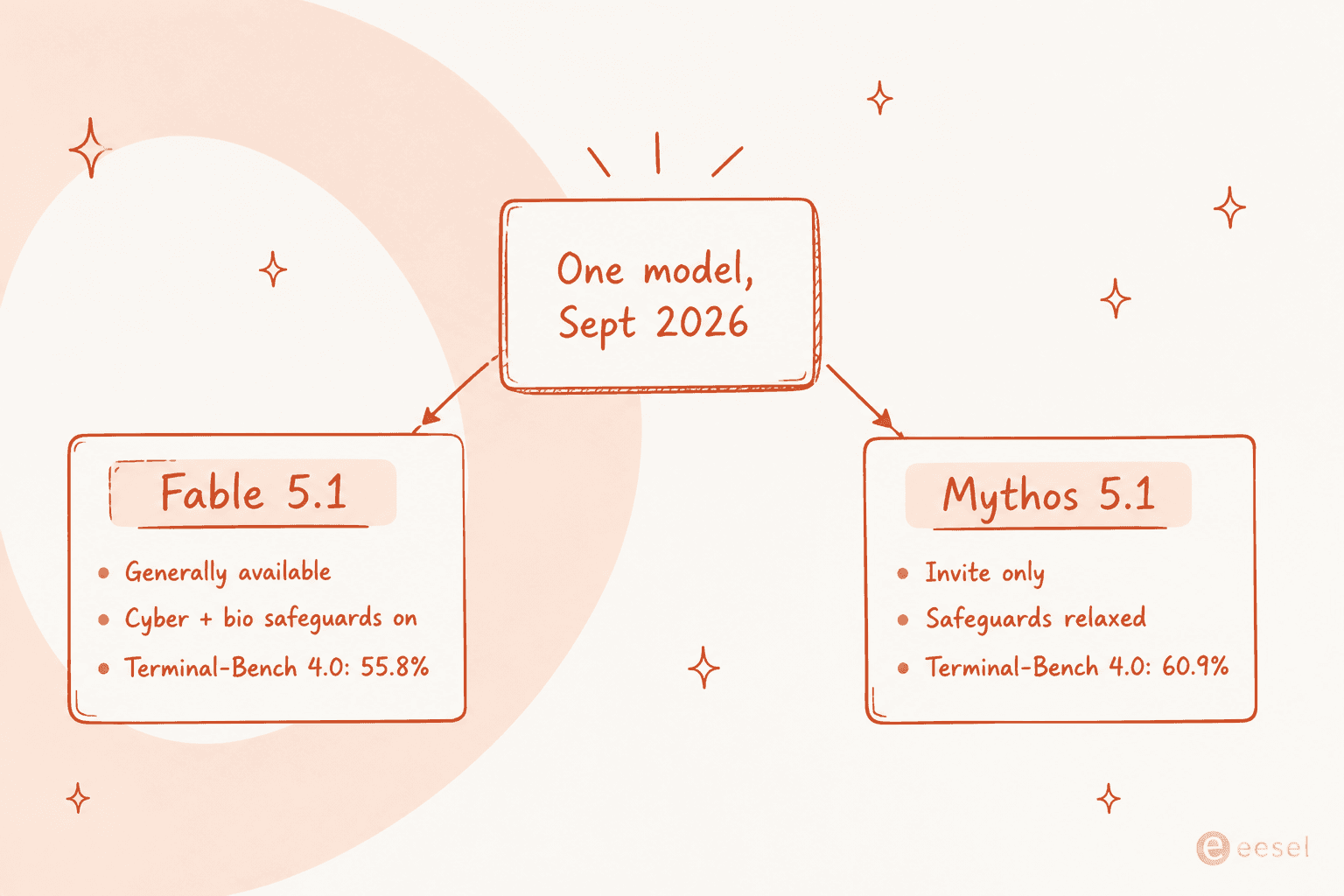
Anthropic is explicit that it expects the gap to shrink. The launch post notes that the Terminal-Bench difference reflects the earlier, less precise cyber safeguards, and that with the Fable 5.1 improvements shipping the same day, the difference between the two models should be much smaller.
What actually changed on the Fable side is worth knowing even if you never touch Mythos:
- Fable 5.1 can now be used to identify software vulnerabilities in source code, which the previous safeguards blocked.
- Claude Code users should see around 60% fewer cyber-safeguard interventions per session.
- Biology safeguards fire 85% less often on benign elementary biology and medical questions than the ones that launched with Fable 5.
- Dual-use work is still redirected to Opus models: penetration testing, exploit generation, and binary-based vulnerability scanning.
That last bullet is the honest boundary. Fable 5.1 will read your source and tell you where the bug is. It will not write you the exploit.
The benchmarks, and the one that matters
Anthropic published Fable 5.1 and Mythos 5.1 numbers side by side with Fable 5, Opus 5, and GPT-5.6 Sol. Scores below are Fable 5.1 unless the row says otherwise.
| Benchmark | Fable 5.1 | Fable 5 | Opus 5 | GPT-5.6 Sol |
|---|---|---|---|---|
| Terminal-Bench-Science 0.1 | 52.6% | 24.7% | 29.0% | 22.4% |
| Terminal-Bench 4.0 | 55.8% (60.9% Mythos 5.1) | 42.0% | 52.3% | 37.3% |
| GDPval-AA v2 | 1853 | 1723 | 1824 | 1711 |
| OSWorld 2.0 (strict) | 41.7% | 36.1% | 39.6% | not published |
| Humanity's Last Exam (tools) | 65.0% | 63.8% | 63.6% | not published |
| AutomationBench | 31.4% | 17.1% | 26.9% | 19.6% |
| CursorBench 3.2.0 | 73.4% | 70.5% | 70.0% | 67.2% |
The standout is Terminal-Bench-Science, which more than doubled against Fable 5. Everything else is a narrower step, and the launch thread noticed:
The price reduction comes from the cache read pricing falling from $1/M to $0.25/M, which means that Fable 5.1 now costs half of Opus's cache read costs ($0.5/M).
That reading is fair on the coding rows and less fair on the science row, where a 27.9-point jump is not a rounding artefact. Anthropic footnotes a standard error of 3.5 to 4.5 points per model on that benchmark, which still leaves the gap comfortably outside noise.
The science demos behind it are the part I would actually screenshot. Mythos 5.1 designed protein binders that beat the best entries in Adaptyv Bio's competitions by 10x on binding affinity for three targets, with a hit rate near 50% across 12 targets where 10 to 15% is typical. It also wrote GPU kernels that sped up seven open-source genomics and protein models by up to 2.5x with identical outputs, cutting estimated GPU cost on genome-wide analyses by 30 to 60%. Separately, Fable 5.1 built a new high-resolution elevation map for a third of Venus from 30-year-old Magellan radar data.
None of that is a support use case. All of it is why the model is behind a door.
Pricing: the cache read cut is the actual news
Mythos 5.1 and Fable 5.1 carry the same rate card. Input is $10 per million tokens, output is $50 per million. That is unchanged from Fable 5.
What changed is the cache read line, and it changed a lot.
| Meter | Fable 5 / Mythos 5 | Fable 5.1 / Mythos 5.1 |
|---|---|---|
| Base input | $10 / MTok | $10 / MTok |
| Output | $50 / MTok | $50 / MTok |
| 5-minute cache write | $12.50 / MTok | $12.50 / MTok |
| 1-hour cache write | $20 / MTok | $20 / MTok |
| Cache read | $1.00 / MTok | $0.25 / MTok |
| Batch input / output | $5 / $25 | $5 / $25 |
Every other Claude model prices a cache hit at 0.1x base input. Fable 5.1 and Mythos 5.1 price it at 0.025x, and Anthropic's docs call that out in a footnote as the only exception in the family. It is also, as the thread above noted, half of what an Opus 5 cache read costs, on a model that is twice the base price.
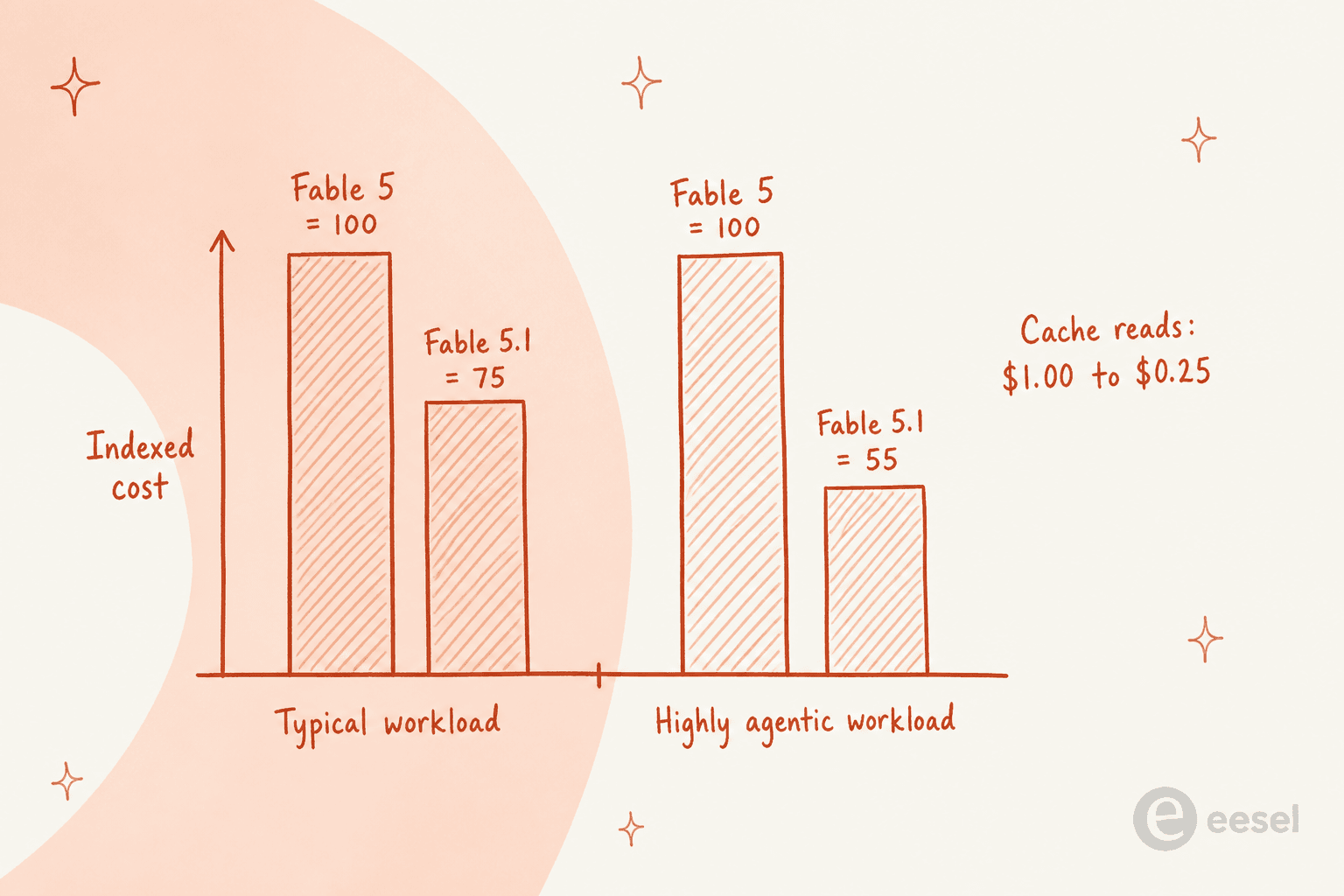
Anthropic measured this over four weeks of real August 2026 usage at default effort. Typical workloads across Claude Enterprise, Claude Code, and the API land around 25% cheaper. Context-heavy, tool-heavy agentic work, where cache reads are most of the bill, lands around 45% cheaper.
The practical consequence is a planning change, not just a smaller invoice:
"Cache reads now cost 75% less, or $0.25 per million tokens." For me, at a typical 95% cache hit rate, I think my optimal context window size before autocompaction goes from ~200K to ~400K tokens. Great for longer horizon tasks.
That is the whole point of the change. On a long agentic run, the transcript gets re-read on every turn, so the cache read meter is the one that compounds. If you have been aggressively compacting context to keep a bill down, the math for that just moved. The wider family rate card lives in my Anthropic API pricing breakdown, and the subscription side is in Claude pricing.
One thing the price cut does not change: long context is still billed flat. Claude 4.6 and later models include the full 1M window at standard rates, so a 900k-token request bills at the same per-token rate as a 9k-token one.
How access actually works
Two programs, both vetted, both US-scoped today.
Cyber Verification Program. The CVP currently provides reduced cyber safeguards on certain Opus and Sonnet-class models for defensive security work. Anthropic says Mythos-class access joins it in the near future, which is a promise rather than a date. Applications go through the Anthropic programs portal.
Life Sciences Verification Program. The LSVP is an invite-only beta, developed with the US government, that relaxes biology safeguards for professional research and development while leaving every other safeguard in place. First participants are enrolled, and Anthropic says it plans to expand to the broader life science community.
Existing enterprise customers have a third door: the docs tell you to contact your Anthropic, AWS, or Google Cloud account team. And Claude Security, Anthropic's codebase scanning product, now runs on Mythos 5.1, which is the one way to consume the model without being invited to it directly.
The reason for all of this sits in the Glasswing announcement from April 2026. Mythos Preview found thousands of zero-day vulnerabilities across every major operating system and browser, including a 27-year-old remote crash in OpenBSD and a 16-year-old flaw in FFmpeg that automated testing had hit five million times without catching. Anthropic committed $100M in usage credits and $4M in donations, and brought in twelve launch partners plus 40 more infrastructure organizations, expanding to roughly 150 organizations in over fifteen countries by June.
On the safety side, Anthropic's own assessment is that Mythos 5.1 has the strongest cyber capabilities of any model it has released, still sits in the lower risk category of its Frontier Compliance Framework, and falls short of the next risk tier in the Responsible Scaling Policy. It is deployed with the same biology safeguards as Mythos 5.
Three changes that will break someone's integration
Worth flagging even if Mythos itself is out of reach, because these land on Fable 5.1 too.
- Forced tool use returns an error. If your code sets
tool_choicetoanyor a named tool, that call now fails. This is the one most likely to page someone. - Thinking blocks are tied to the model that produced them. Earlier models cannot read Fable 5.1 or Mythos 5.1 thinking blocks, and editing an earlier turn invalidates them.
- Anti-distillation changes multi-turn editing. New API accounts created from launch day onward can no longer manually edit Claude's prior context while preserving the transcript of its prior thinking. Existing accounts are unaffected for now, but the change applies to everyone on future model releases.
There is also a compliance change with a long tail. To meet the EU AI Act's Code of Practice on Transparency of AI-Generated Content, models released after August 2, 2026 carry a text watermark, with a detection API in private preview for regulators, researchers, and obligated enterprises. Anthropic says it is invisible without the detection API and carries no information about the user or their conversations. It drew the most heat of anything in the launch thread, which is worth knowing if your content pipeline has an opinion about provenance. My notes on AI content and E-E-A-T cover the publishing side of that.
What to run instead, by job
Nearly everyone reading this is choosing between models they can actually call. Here is how I would split it.
- Frontier ceiling, available today. Fable 5.1. Same weights as Mythos 5.1, same price, no waiting list. Background in what Claude Fable 5 is and the Fable 5 relaunch.
- Default workhorse. Opus 5 at $5 in and $25 out. Anthropic's own docs still say to start most workloads here and move up only when your evals fall short. The Opus 5 review has my verdict, and Opus 5 pricing has the tables.
- Latency-sensitive work. Sonnet 5 at $2 in and $10 out, with the same 1M window. Sonnet 5 pricing and the Sonnet 5 review go deeper.
- Coding agents. Effort level moves your bill more than model tier does. Claude Code model selection and Claude Code pricing are the two to read.
- Long-running orchestration. Claude Managed Agents bills session runtime on top of tokens, which the cache read cut does not touch.
- Weighing the whole field. Claude alternatives and Opus 5 alternatives if you are not locked to Anthropic, plus GPT-5.6 versus Claude for the head-to-head.
If the job is customer conversations rather than code or research, the tier question is close to irrelevant. My roundup of the best model for support tickets walks the actual tradeoff, and custom AI models covers when training your own is worth it.
What a frontier model does not fix on a support queue
I want to be careful here, because the Mythos 5.1 results are real and the science is hard to argue with. But there is a failure pattern I have watched enough times to name it.
A team reads a launch post, upgrades the model behind their support bot, and expects resolution rate to move. It does not. What moves resolution rate is whether the model can see the right knowledge, whether it knows when to stop and hand off, and whether anyone tested it against real tickets before a customer saw it. None of those are model-tier problems.
The trust half of this is the one that costs money. As one CX lead at a DTC supplements brand put it on a sales call:
"The AI will never be able to answer 100% of the questions... I need an AI who is only handling the tickets that it's confident to handle and all the other ones, leave them alone."
That is a scoping and control problem, and a 60.9% Terminal-Bench score has nothing to say about it. Neither does the build-your-own route, which is where a lot of teams land after a launch like this one. Karel at GENERAL BYTES put the tradeoff plainly:
"We could try to write our own LLM application but we didn't want to invest our time into that. We wanted something that we would not have to maintain."
The API key is the cheap part. The retrieval, the permission boundaries, the escalation rules, the evaluation harness, and the maintenance of all four as your product changes are the expensive part. That work does not get cheaper because cache reads did.
Where eesel fits
eesel sells AI teammates, not a model. The AI helpdesk teammate joins the queue you already run, reads the help centre and past tickets you already have, and answers within scope you set. The AI blog writer does the same job for content. Both arrive with the integrations and company context for their role, which is exactly the layer a raw frontier model does not ship with.

The specific thing I would point at, given this post's subject: before an eesel teammate answers a single live customer, it runs against your own historical tickets so you can see what it would have said. That is the dry run nobody gets from a model launch, and it is the difference between shipping an upgrade and shipping a guess. It connects to Zendesk, Freshdesk, Gorgias, Front, Help Scout, and HubSpot in minutes, and it is free to try.
Chasing Mythos 5.1 for a support queue is optimising the one variable that was never the constraint. Connecting Claude to your helpdesk is a more useful afternoon, and using Claude for support is the honest version of what that gets you.
My verdict on Claude Mythos 5.1
It is the most capable model Anthropic has shipped, it is not available to you, and the version that is available to you is the same model. That is an unusual thing to be able to write, and it is the single most useful fact in this post.
If you are a cyberdefender or a life scientist, apply, because the science results justify the paperwork. If you are anyone else, the launch that matters is Fable 5.1's cache read price, which quietly made long-context agentic work about 45% cheaper. That will change more production systems this quarter than a locked model ever will.
Frequently Asked Questions
What is Claude Mythos 5.1?
claude-mythos-5-1. It is the same underlying model as Fable 5.1, shipped with looser cybersecurity and biology safeguards, and it is offered by invitation only through Project Glasswing. The earlier Claude Mythos explainer covers how the family started.How much does Claude Mythos 5.1 cost?
How do I get access to Claude Mythos 5.1?
What is the difference between Claude Mythos 5.1 and Claude Fable 5.1?
Is Claude Mythos 5.1 available on Bedrock or Google Cloud?
claude-mythos-5-1 ID on each. Being on the platform is not the same as being able to call it, since the invitation is still required.What should I use instead of Claude Mythos 5.1?
Does Claude Mythos 5.1 have a 1M context window?
high. Anthropic bills the whole window at standard rates, so a 900k-token request costs the same per token as a 9k-token one. Claude Code context sizing covers what that means day to day.