Claude for Freshdesk: every way to connect them in 2026

Rama Adi Nugraha

Katelin Teen
Last edited August 12, 2026

I have watched this go wrong, so let me start there
I build integrations at eesel, which means I have spent a lot of time on exactly this problem: a good model on one side, a helpdesk full of real customers on the other, and a surprising amount of nothing in between.
Here is the part I would want to know if I were you. Early on, our own agent shipped without a hard fallback when knowledge retrieval came back empty. So instead of saying nothing, it did what a language model does with an empty context: it made something up from training data. One paying customer's bot invented subscription terms for solar cells and sent them to real customers. Another answered a support question with "Oxygen," straight off the periodic table.
Nothing about that was a model failure. Sonnet and Opus are both excellent at reading a ticket and writing a reply. The failure was in the ten unglamorous decisions around the model, and those ten decisions are the entire job.
And this is not a rare shape of failure. It is the shape. Here is a stranger on Hacker News describing the same week I had, in a different product:
"LLM chatbots are a step forward for customer support. Well, ours started hallucinating a support phone number that while is a real number is not our number. Lots of people started calling which was a bad time for everyone. Especially the person's number it actually is. So maybe two steps forward and occasionally one back."

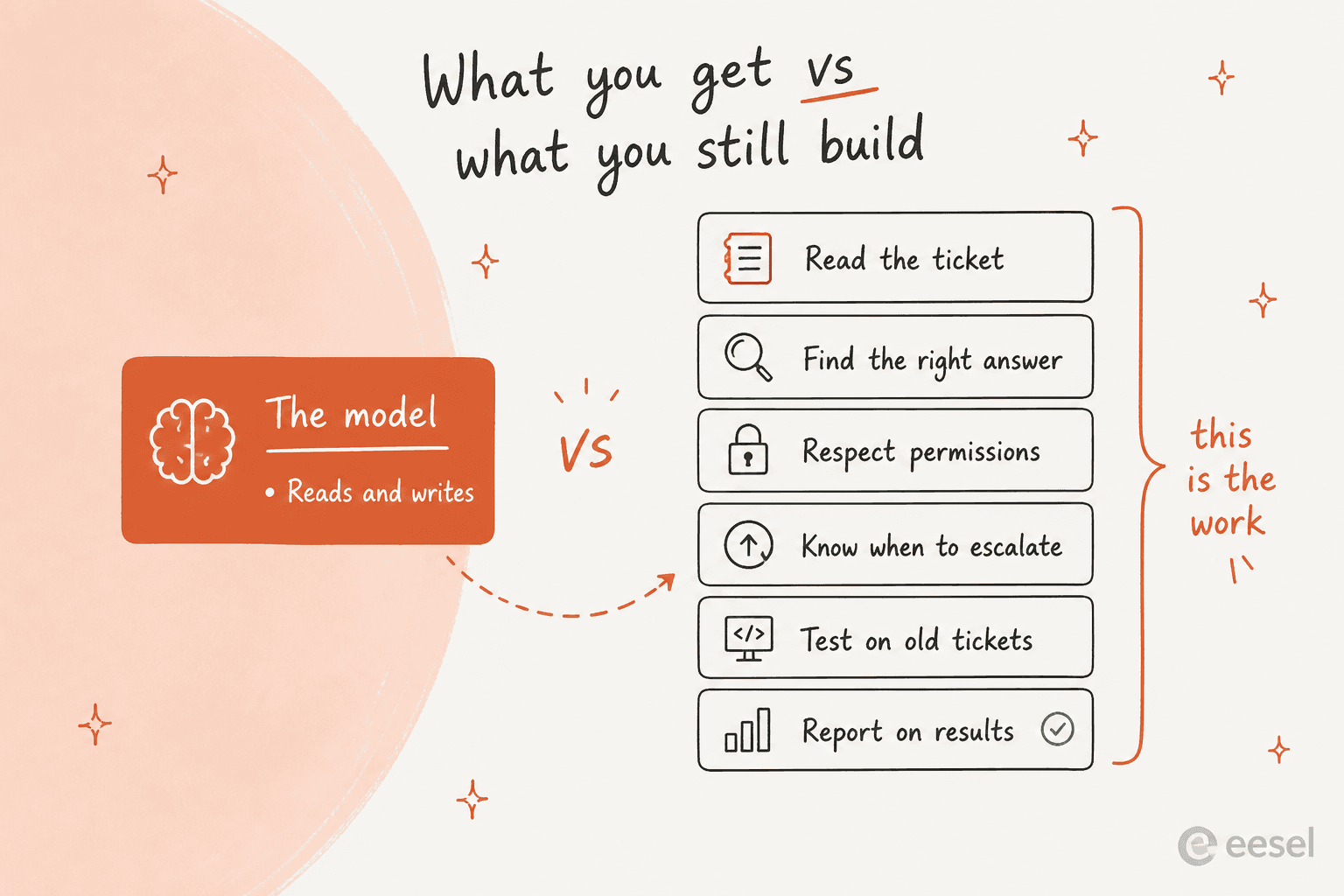
That is the frame I would hold while reading the rest of this. Every route below gives you the left-hand box. They differ in how much of the right-hand stack they hand you. If you want the wider category view before the specifics, our roundup of AI helpdesk software covers who has already built that stack.
One of our customers put the buy-versus-build version of this better than I can:
"We could try to write our own LLM application but we didn't want to invest our time into that. We wanted something that we would not have to maintain."
Karel, GENERAL BYTES
First, the thing most people get wrong
Search intent for "Claude for Freshdesk" usually assumes a setting exists. Open Freddy, pick your model, choose Claude, done.
It does not exist. Freshworks' own Freddy AI trust FAQ is explicit that generative capabilities are powered by enterprise-grade Azure OpenAI models. And AI Agent Studio, which is where you configure everything about a Freddy agent, gives you persona, tone, custom instructions, escalation behaviour, channels, and session accounting. It does not give you a model dropdown or an API key field. I went looking for one specifically, because a lot of platforms quietly added one in the last year. Freshdesk has not.
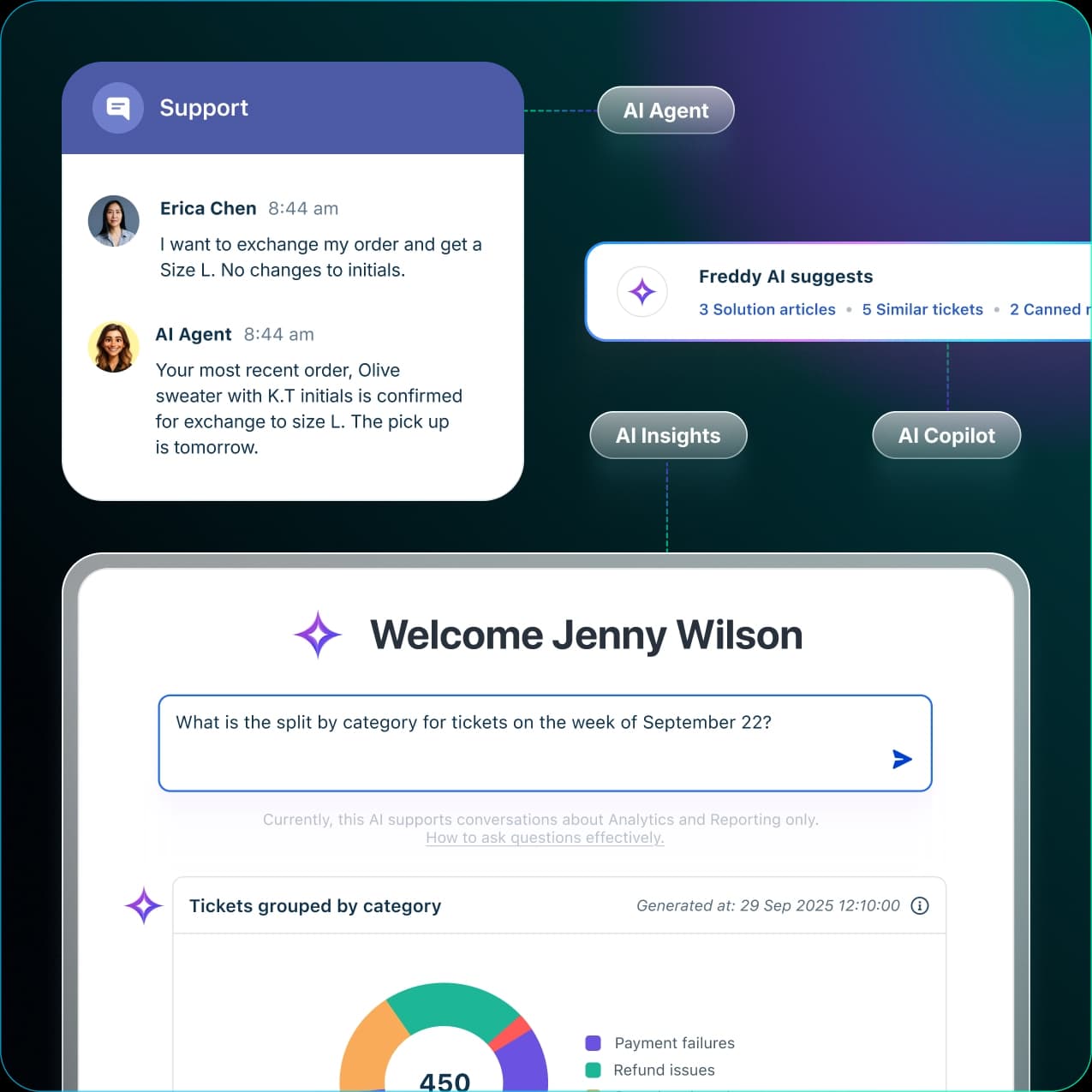
This is not a knock on Freddy. Choosing one model and tuning hard against it is a defensible product decision, and Freddy AI Copilot is useful in the agent workspace. It just means the question changes shape. You are not asking "how do I make Freddy use Claude." You are asking "how do I get Claude to see my Freshdesk data," which is a different problem with four different answers.
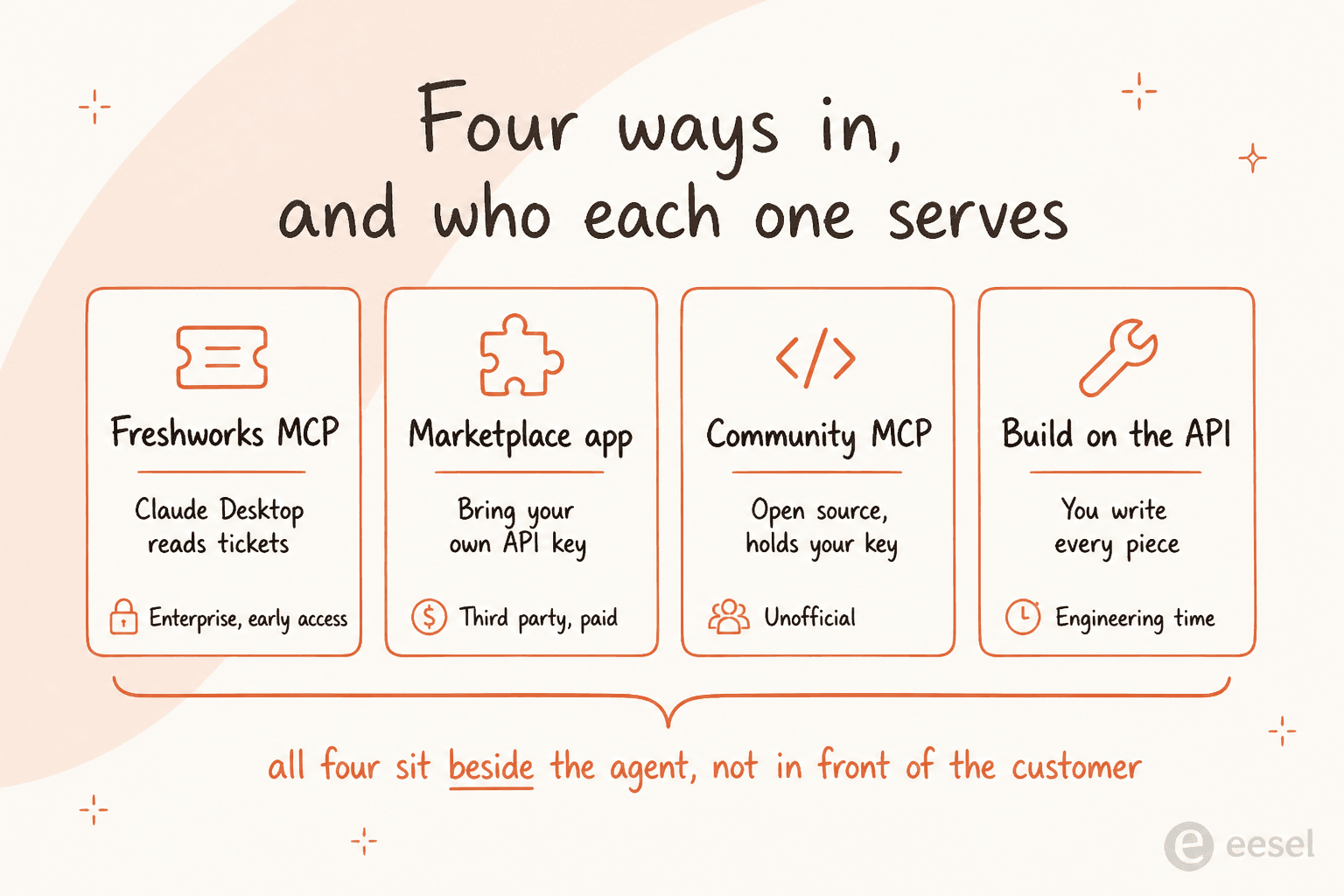
Route 1: Freshworks built the bridge itself
This is the genuinely interesting one, and it is barely six weeks old in public form.
Freshworks shipped its own MCP server. The support article, MCP integration in Freshdesk, was last modified on 10 August 2026 and opens by naming the supported clients: AI tools like Cursor and Claude. Further down, the documented client list is Claude Code, Claude Desktop, Cursor, Microsoft Copilot Studio, and Visual Studio Code.
For Claude Code, setup is one command:
claude mcp add my-remote-server --transport http https://<your-freshdesk-domain>/mcp --header "Authorization: <api-key>"
For Claude Desktop it is an mcp-remote entry in your config file pointing at the same endpoint. If you have wired up any MCP tools in Claude Code before, this will take you about four minutes.
Now the gates, all from the same article:
| Constraint | What it says |
|---|---|
| Availability | Beta, early access, selected customers on the Enterprise plan |
| How to get in | Request via your technical account manager or Freshdesk support |
| Authentication | API key only, no OAuth path documented for Freshdesk |
| EAP throughput | 100 tool calls per minute, 5,000 actions per month |
| Metering from 1 Sept 2026 | Growth 100 included actions/month, Pro 500, Enterprise 1,000 |
| Overage | $15 per 1,000-action pack, so 1.5 cents per action |
An action is defined as one successful tool invocation. That matters more than it sounds, because a single useful question ("what did this customer complain about last quarter?") is usually several tool calls, not one. Freshworks also markets MCP on the Freshdesk Omni page, so this is a real roadmap item and not a side experiment.
The catch is what surface it serves. This route puts your Freshdesk data inside Claude, on your desktop, for you. It is a fantastic way to ask questions about your queue, draft a tricky reply, or pull a pattern out of last month's escalations. It is not a customer-facing agent, and nothing in the documentation suggests it is meant to be.
My take: if you are on Enterprise, request access today. It is the cleanest Claude-plus-Freshdesk experience available and it is Freshworks-supported. Just budget it as a tool for your team, not as ticket deflection.
Route 2: a marketplace app that takes your Anthropic key
The Freshworks Marketplace has around ten AI apps for Freshdesk. Almost all of them are OpenAI-based and published by independent developers. Two touch Claude.
Support Assist AI, from PRAVAR PRO, is the closest thing to "use Claude inside Freshdesk" that you can install today. Its own listing describes it as a bring-your-own-key assistant that connects to OpenAI, Anthropic Claude, Google Gemini, or Azure OpenAI, where you pick the provider and model and pay cloud-provider rates directly. Setup needs a Freshdesk API key plus your own Anthropic key. It is listed as paid after a 21-day trial, at version 4.0, with 8 installs.
Knowledge Builder, from autosolve.ai, is the other one. Its privacy disclosure names the Anthropic API directly: ticket subject lines, descriptions, and relevant knowledge base content go to Claude models for ticket quality evaluation, search keyword generation, and article drafting.
Worth knowing before you install either: the marketplace's own search endpoint returns "App Not Found" for a Claude query, so you will not find these by searching. And neither app renders a numeric price server-side, which means the real cost only appears once you are in the install flow. If you would rather browse the tested field, we keep a list of AI automation apps for Freshdesk.
My take: the eight-install count on Support Assist AI is the number I would sit with. It is not a criticism of the developer, it is a statement about how much production hardening a tool has seen. For an internal experiment, fine. For a queue with paying customers on it, I would want more people to have hit the sharp edges first.
Route 3: the community MCP servers
If you want the MCP experience without the Enterprise plan, the open-source ecosystem already got there. Three servers are live enough to name, with star counts and last-push dates pulled from the GitHub API on 12 August 2026:
| Repo | Stars | Last push | License |
|---|---|---|---|
| effytech/freshdesk_mcp | 66 | 2026-07-30 | MIT |
| Enreign/freshdeck-mcp | 11 | 2026-08-08 | not stated |
| hashcott/freshdesk-mcp | 3 | 2026-06-08 | not stated |
The effytech server is the de facto default on stars, forks, and recency, and it does what it says: lets a model interact with Freshdesk modules and perform support operations. It is MIT-licensed and actively maintained.
The security posture is worth saying out loud, because it is identical to the official early-access server: you hand a Freshdesk API key to a locally running process. A Freshdesk API key carries the permissions of the agent it belongs to, so a key tied to an admin account can do admin things. If you go this way, mint a dedicated agent with the narrowest role and permission set that still lets it read what you need.
My take: this is the right route for a solo evaluation this afternoon. It is the wrong route for anything a customer sees, and I would not put a third-party server on a shared machine without reading its source first.
Route 4: build it on the Freshdesk API
This is the one most engineers reach for, and it is where I want to be most useful, because the API's real shape is not what the marketing pages imply. I went through the Freshdesk API v2 documentation properly for this.
Authentication is your API key as the HTTP Basic username with any dummy password, base64-encoded into an Authorization header. There is no documented OAuth flow, and custom CNAMEs are not supported, so you call your *.freshdesk.com host directly. Simple, which is good, and also a bearer-equivalent secret you now have to rotate, which is less good.
Rate limits are per minute and account-wide, which trips people up because the older docs published per-hour numbers:
| Plan | Requests per minute |
|---|---|
| Growth | 100 |
| Pro | 400 |
| Enterprise | 700 |
| Trial | 50 |
Purchasable add-on tiers reach 1,000 and 2,000. Note that "account-wide" means your AI shares that budget with every other integration you run, so a chatty agent on Growth can starve your Shopify sync. Our post on Freshdesk API rate limits goes deeper on the headers to watch.
Then three constraints that shape the whole design.
Your ticket history is harder to reach than you think
The list-tickets endpoint defaults to the past 30 days only and caps at 300 pages or 30,000 tickets. The search endpoint caps at a 512-character query, 30 results per page, and page 10, which is about 300 results total. So "just point Claude at our ticket history" is a data-engineering project with pagination and incremental sync in it, not a weekend script.
If your grounding plan was past tickets, budget for that properly, or start with solution articles and canned responses instead, which are far easier to pull and are what most knowledge base chatbots index first anyway.
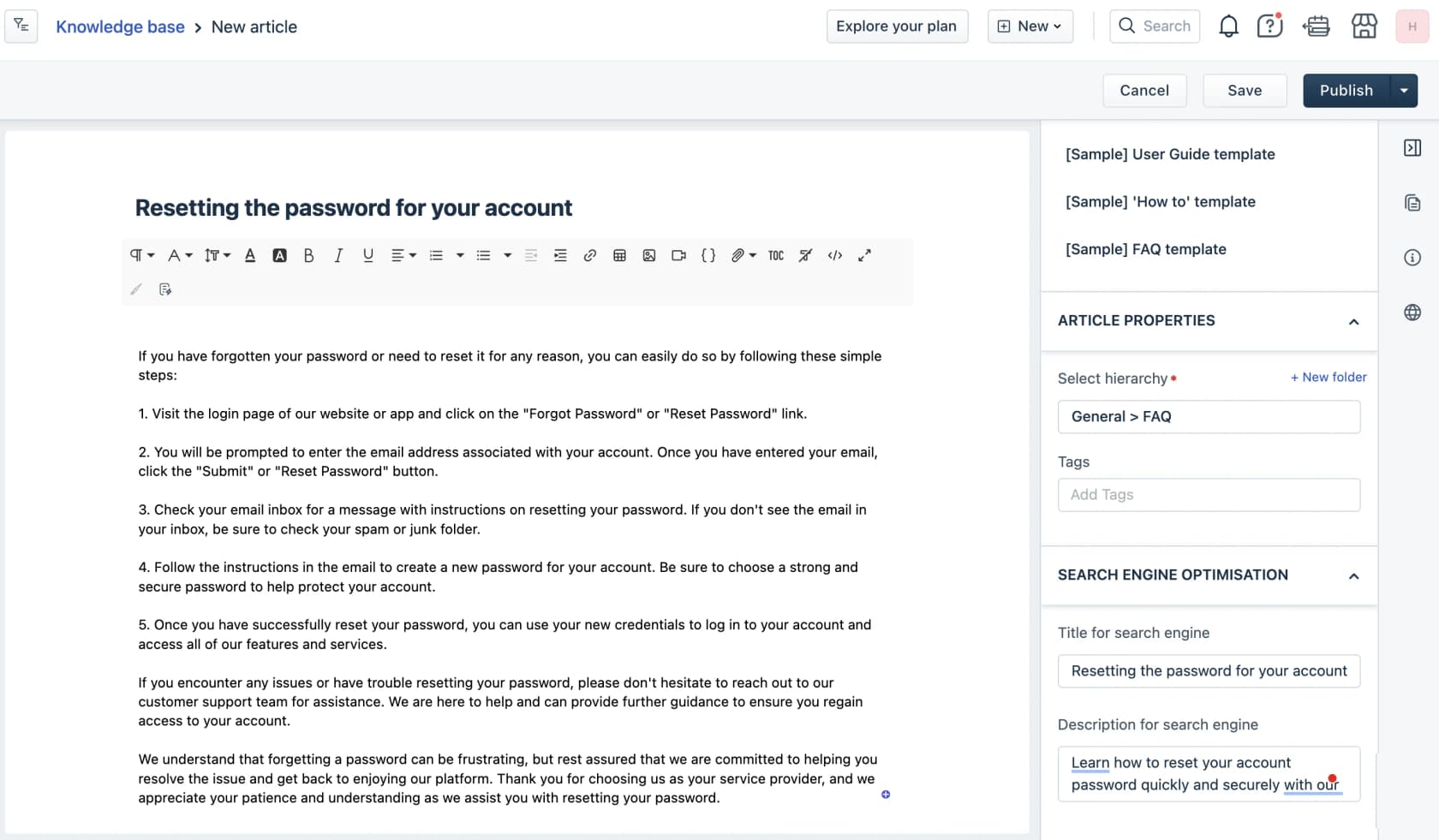
Notes and replies are different endpoints, and one of them is permanent
POST /api/v2/tickets/[id]/reply sends a public reply. POST /api/v2/tickets/[ticket_id]/notes adds a note, where private defaults to true. Only notes can be edited afterwards, via the conversations endpoint. A sent reply cannot be edited.
I would build your first version so it can only write private notes, and make sending a public reply a deliberate second step you unlock later. That is the same shape as any decent AI copilot, and it is the difference between a bad answer being an internal embarrassment and a bad answer being an email your customer has.
Webhooks go out, but events do not come in
You get full CRUD over automation rules, and the action schema carries a URL, request type, auth header, and custom headers with no documented domain allow-list, so outbound webhooks can hit your service on ticket creation, ticket update, or hourly. What does not exist is an inbound event-subscription API. You configure triggers inside Freshdesk, through the automation rules engine, not declaratively from your code.
One credibility note on all of the above: the public API changelog stops at June 2022, and the docs still ship two superseded rate-limit tables. Cross-check any single number against a live X-RateLimit-Total header before you design around it.
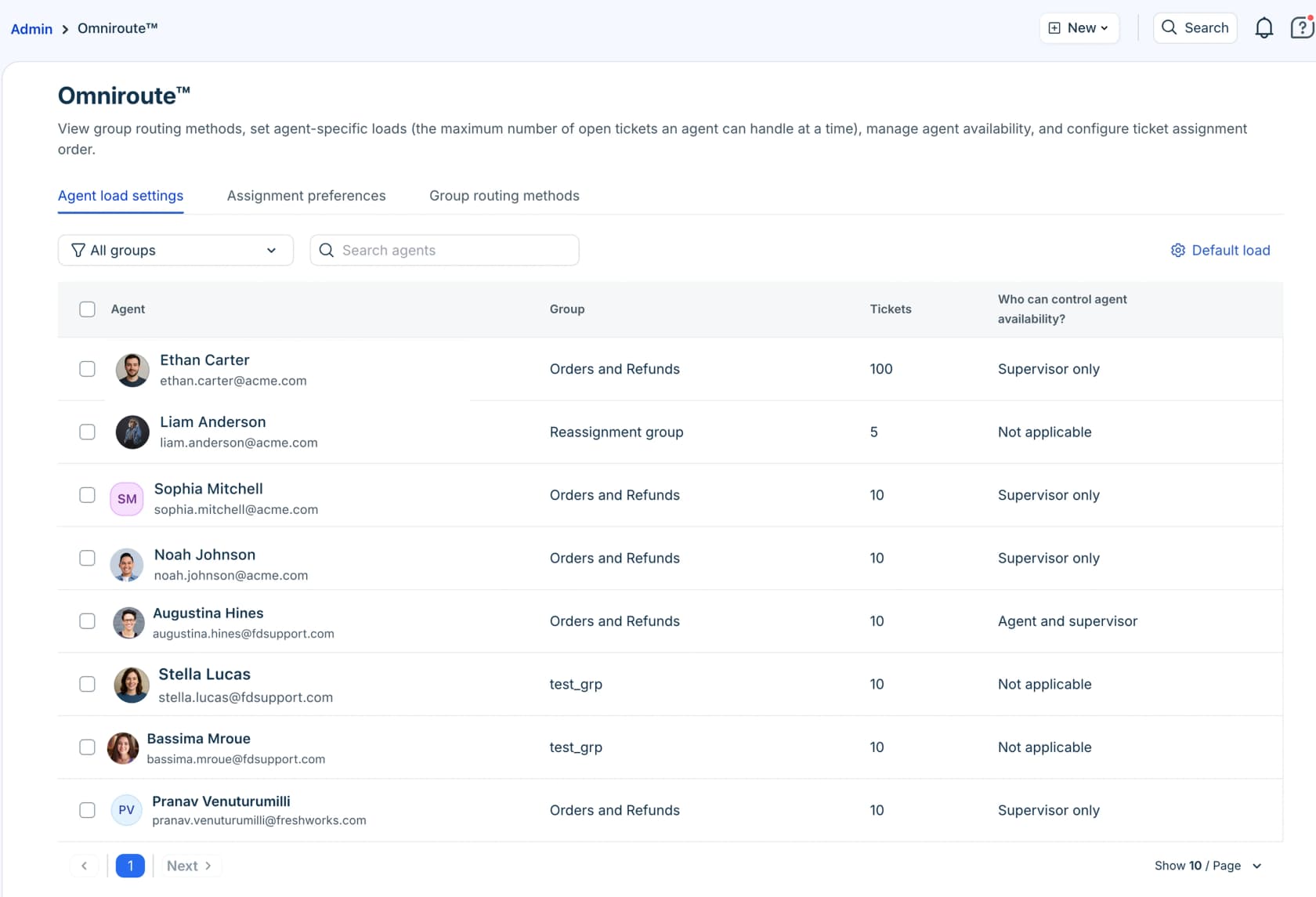
My take: the API is good. It is well documented, the endpoints are sensible, and the note-versus-reply split is exactly the safety boundary you want. Building on it is entirely doable. The question is not whether you can, it is whether the thing you build is the thing you want to own in eighteen months.
What one reply actually costs
Here is where the numbers stop agreeing with intuition.
Claude Sonnet 5 is $2 per million input tokens and $10 per million output. A grounded support reply is roughly 6,000 input tokens once you have the ticket thread, a system prompt, and three or four help-centre articles in context, plus about 250 tokens out. That is about $0.015. Claude Opus 5 at $5 and $25 puts the same reply near $0.036. Prompt caching, which reads cached input at a tenth of the normal rate, pushes both lower again.
A Freddy AI Agent session costs $0.49, because Freshdesk sells them in $49 packs of 100.
Those are list prices, so here is someone who actually ran the experiment on a live queue. A consultant on Hacker News described putting Opus behind a client's support queue and then re-engineering the bill:
"I was building a customer support AI for a client last year. We started with Claude Opus for everything because it worked great. The bill was $250/month for maybe 10K conversations. Then I looked at the actual queries. 70% were things like 'what are your hours?' and 'how do I return something?' [...] I started manually routing: simple patterns to a cheap model, everything else to Opus. The bill dropped to $40/month with no quality complaints from users."
He was posting to launch a model-router product, so read the framing accordingly, but the figures are his own build. $250 across 10,000 conversations is 2.5 cents each, which lands right between my Sonnet and Opus estimates and is the closest thing to an independent check either of us is going to get. Note also what he had to do to reach $40: build a triage layer. That work is not in either sticker price.
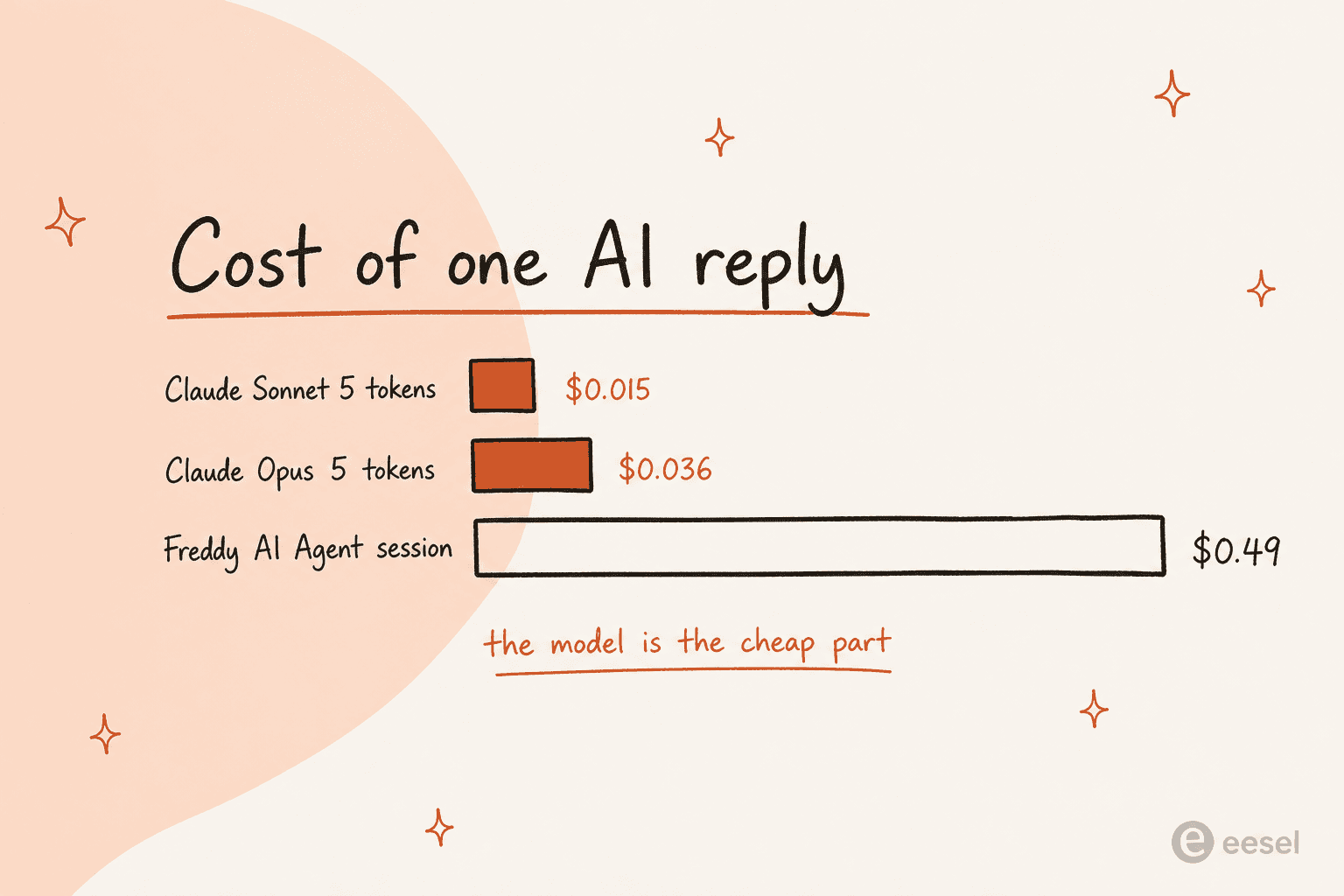
Roughly 33x, which looks like a slam dunk for building your own until you put your actual volume and your actual engineering time into it. So do that:
Two things the widget cannot price, and both are real.
The 500 free Freddy sessions are once per account, not a monthly refill, and session packs expire on your payment cycle. So the free tier is a trial, and unused packs are not a balance you carry. Worth reading the Freddy AI pricing detail before you model a year on it.
And the Claude API has no free tier and no signup trial credit. Neither the Anthropic pricing page nor the developer docs publish one. New organisations start on an evaluation tier with reduced limits. That is fine, it is just not the "spin it up for nothing" starting point people assume.
Where the money actually goes
Fifteen engineer days is my honest estimate for a first version that reads a ticket, retrieves from your help centre, drafts a reply as a private note, and logs what it did. I have built roughly this thing more than once. It is not the hard part.
The hard part is everything after week three, and it is all the stuff a buyer asks about the moment you demo it. One technical evaluator I sat with went straight to it: does it fall back to some general model if it does not know the answer, and can that be turned off? His colleague immediately followed with whether the knowledge stays closed to their organisation. Neither of them asked which model it was. They asked what happens when retrieval fails, which is the right question and the one my solar-cell story is the answer to.
The sharpest diagnosis of why DIY stacks fail that I have read came from a builder on Hacker News, and it is not about the model either:
"The first job of any support system—both in terms of importance and chronologically—is triage. This is not a research issue and it's not an interaction issue. It's at root a classification problem and should be trained and implemented as such. [...] What most AI systems (whether LLMs or scripts) do wrong is that they treat WTFs like they're grandmas."
That is the same conclusion the consultant above reached from the cost side, arrived at from the quality side. Triage is something you train and measure, not an instruction you add to a prompt, which is why triage tools are a category of their own.
Then there is the confidence problem, which a CX lead running 7,000 tickets a month framed better than any spec I have written:
"The AI will never be able to answer 100% of the questions, but if it tries and just answers 'sorry I don't know this,' I cannot go and check all my 7,000 tickets to see if the AI actually made a good answer, then the point is a little bit gone. I need an AI who is only handling the tickets that it's confident to handle and all the other ones, leave them alone."
Confidence routing is not a prompt. It is retrieval scoring, a threshold you tune against real outcomes, and a silent-abstain path that leaves the ticket looking untouched. That is week six, not week two. For what it is worth, we lost that deal on exactly this gap, which is a reasonable reason to trust me on how much work it is.
Community sentiment on the DIY route is consistent about where it breaks, and it is never the model:
"We tested an ai integration in freshdesk and had almost the exact same experience. it worked for very simple tickets but anything slightly complex got misclassified. agents ended up spending more time fixing errors than before, so we had to rethink our approach."

Misclassification is its own discipline, which is why ticket triage tools exist as a category rather than as a prompt someone wrote once.
I will give the honest counter-argument too, from a customer who left us:
"We switched to a system that is working well at half the cost. But long term we will just build our own, which is so possible now with AI. I think you have a decent system for now, but we are probably too large of a customer for this. That being said, we probably would have stayed if support was faster and better."
They are not wrong that it is possible now. Building this is more possible than it has ever been. The question the widget above is really asking is whether it is the best use of the next fifteen days of your engineering time, and for some teams the answer is genuinely yes.
How I would actually decide
| If you want | Take this route | The real gate |
|---|---|---|
| To query your own queue in Claude | Freshworks MCP, or a community server | Enterprise plan, or reading someone's source |
| To draft replies with your own key | Support Assist AI marketplace app | 8 installs, price hidden until install |
| Total control over the pipeline | Freshdesk API v2 plus the Claude API | 30-day ticket window, confidence routing, upkeep |
| Autonomous customer-facing resolution | None of the four | Every route above is agent-side |
That last row is the finding I did not expect when I started this. There is no route from Claude to a Freshdesk customer that does not pass through code someone has to own. The first-party option is a desktop tool. The marketplace option is a drafting assistant. The community option is a local process holding your API key. And the API option is you, building the six boxes in that first diagram.
If what you actually wanted was tier-1 tickets resolving themselves, the model was never the missing piece. That is the gap the AI agent category exists to fill, and it is worth comparing against a rule-based chatbot before you decide which problem you have.
eesel AI for Freshdesk
So here is the honest pitch, given everything above.
eesel installs from the Freshworks Marketplace and joins as a real AI Agent inside Freshdesk. No widget, no second inbox. It reads your past Freshdesk tickets, solution articles, and canned responses automatically, then does the things a human agent does: drafts and sends replies, adds private notes, routes tickets to groups, updates priority and status and tags, and respects your existing dispatch rules, SLA policies, and business hours. Setup is under 30 minutes and the page's own number is 85%+ average tier-1 resolution within a week.
Two things matter most given what this post is about.
First, on the model question: eesel does not ask you to pick one. Anthropic is one of its named model providers alongside OpenAI and Google, and Enterprise plans can bring their own. So if your instinct was "I want Claude-grade reasoning on my tickets," you can have the outcome without owning the integration.
Second, on the failure I opened with. Every agent runs against your own historical Freshdesk tickets before it goes live, which is how you find out that 23 tickets last week asked about pro-rated refunds while your docs only cover full cancellations. And you start in draft mode, with a human approving replies, then flip to autonomous on the easy tickets once you trust it. Co-pilot first, then full auto, is the pattern nearly every team we talk to actually wants.
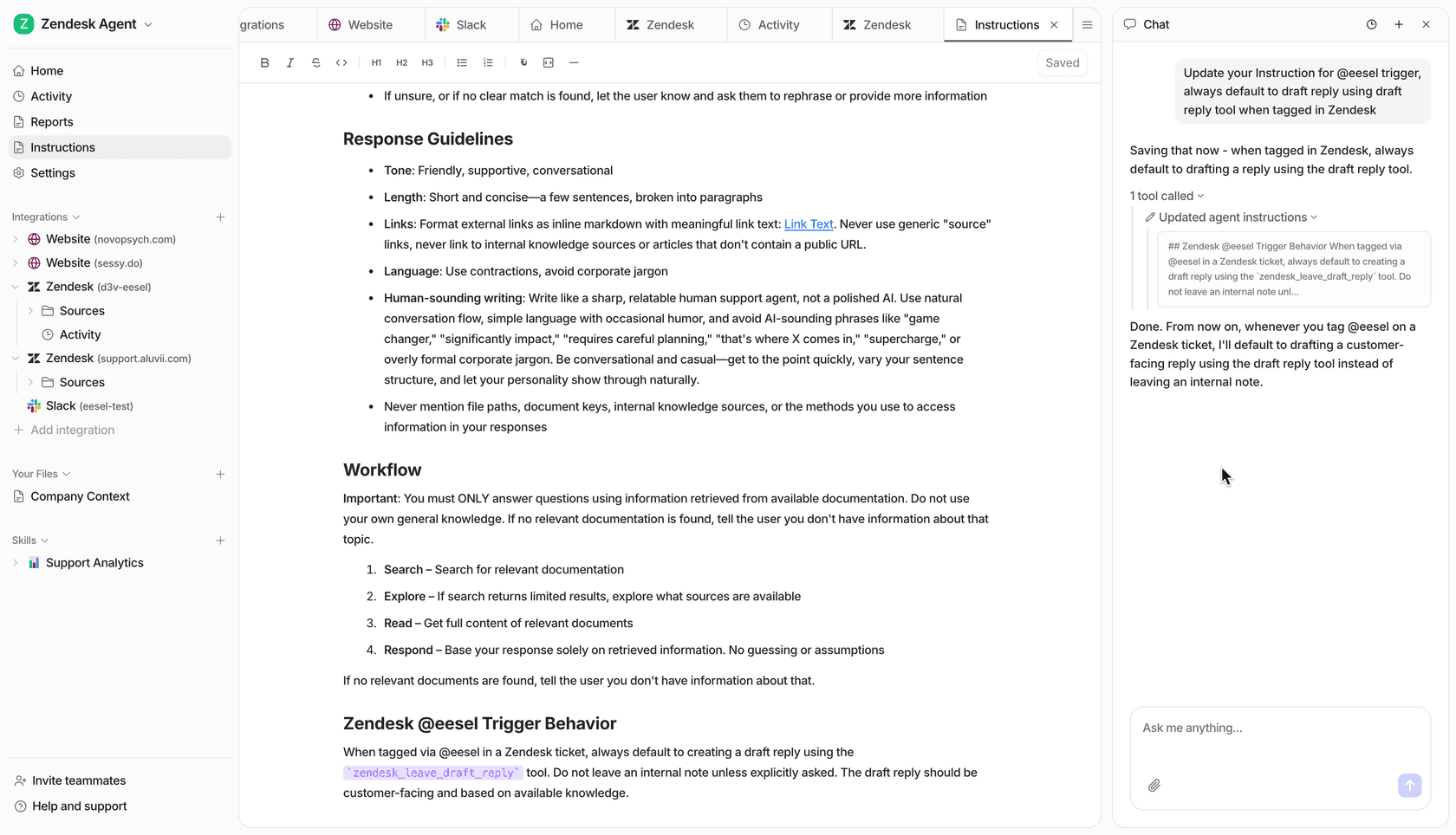
Pricing is $0.40 per Freshdesk ticket handled, where one ticket is one task including all replies and follow-ups. No platform fee, no per-seat pricing, no minimum, and you start with $50 of free usage. Route 200 of your 1,000 monthly tickets to it and you pay for 200. Being straight about it: you are billed per ticket handled regardless of outcome, because the compute runs either way, and there is a $250 default monthly cap that pauses the agents so a bad week cannot become a bad invoice.
Set against $0.49 per Freddy session or fifteen engineer days plus indefinite upkeep, that is the comparison I would want a buyer to make. If you would rather see the native option first, our Freddy AI review is fair about where Freshdesk's own AI wins, and eesel vs Freddy puts them side by side.
Try eesel free on your own Freshdesk tickets, or read best AI for Freshdesk if you want the wider field, including the free alternatives.
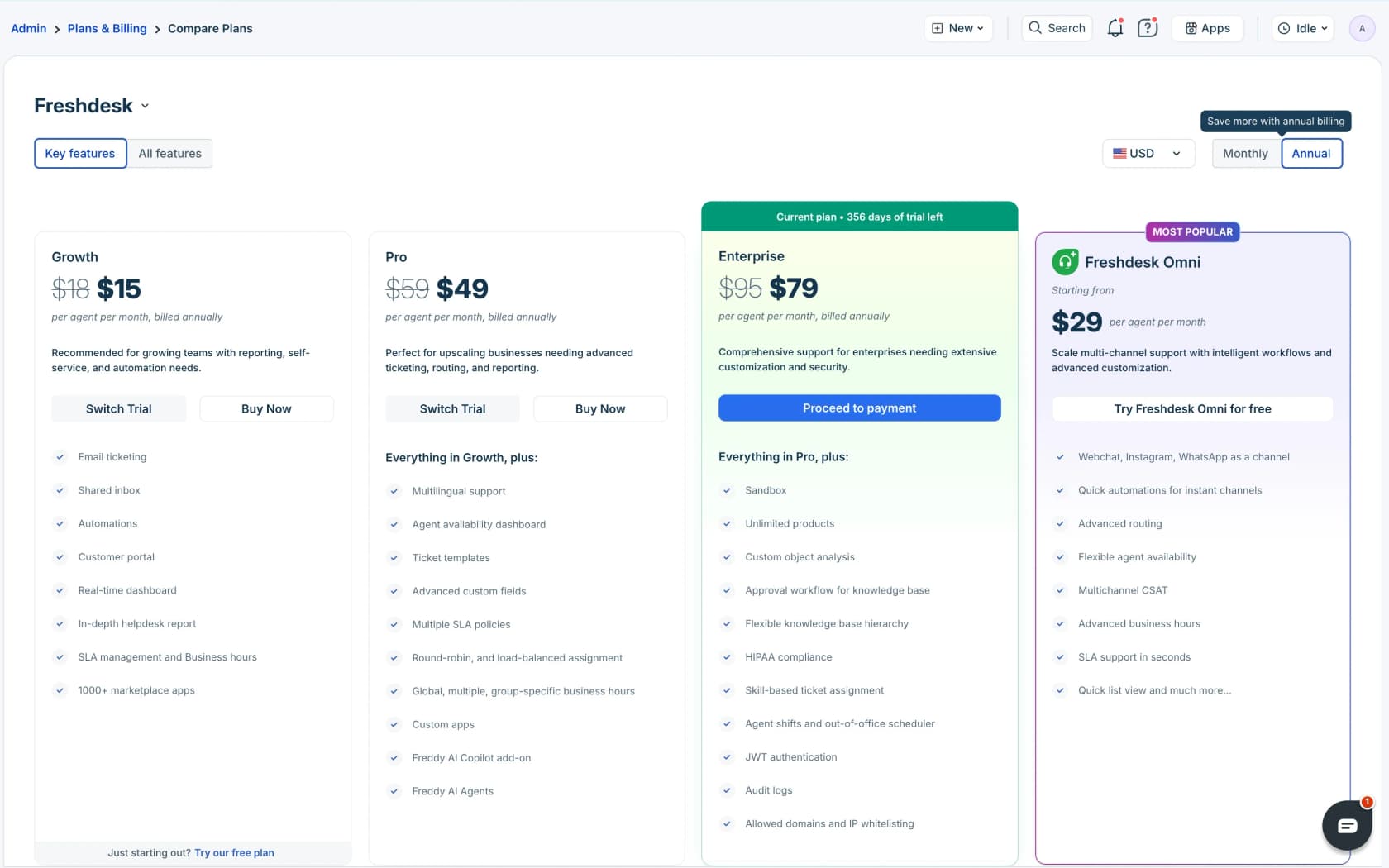
One last practical note, since it changes the arithmetic. Freddy AI Agent, including the Email AI Agent, is available from Growth at $19 per agent per month, so you do not need Pro to try the native path. Freshdesk Copilot is the thing gated to Pro and above, at $29 per agent per month on annual billing.
Full plan-by-plan numbers are in our Freshdesk pricing breakdown. If you are still deciding between the SKUs, Freshdesk vs Omni covers that split, and Freshdesk AI setup walks the native switches if you want to try Freddy before any of this.
Frequently Asked Questions
Is there an official Claude app for Freshdesk?
Can I use Claude as the model behind Freddy AI?
How much does Claude for Freshdesk cost compared to Freddy AI?
Can Claude reply to Freshdesk tickets automatically?
Can I train Claude on my Freshdesk ticket history?
What is the safest way to test Claude on real Freshdesk tickets?
Is Claude or ChatGPT better for Freshdesk support?



Article by
Rama Adi Nugraha
Rama is a software engineer at eesel AI with two years of experience writing about B2B SaaS, AI tools, and customer support technology. Based in Bali, Indonesia, he brings a developer's perspective to product comparisons — cutting through marketing copy to what the integrations and APIs actually do.